La France Insoumise Won’t Cede God to the Far Right
Religious identity has become an unusually prominent battleground in next year’s French election. During the pope’s visit to the country last week, left-wing France Insoumise resisted ultraconservative attempts to monopolize Catholic identity.
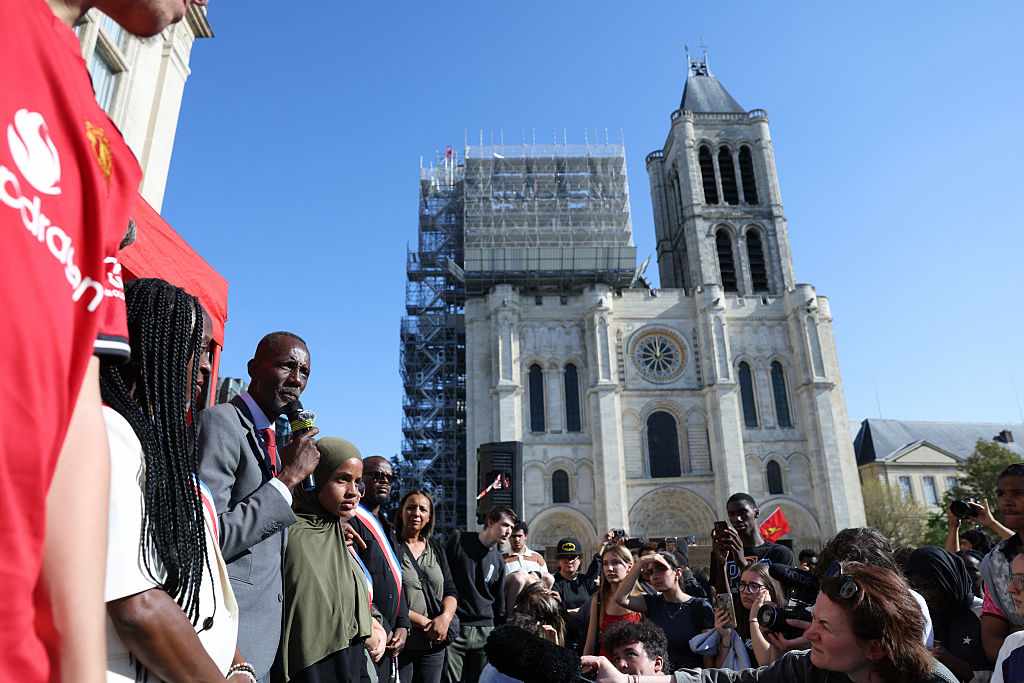
In March, Bally Bagayoko, a Muslim man of Malian descent, was elected mayor of Saint-Denis for left-wing party France Insoumise. Last Friday, he welcomed the pope to the city, rejecting the rise of religious sectarianism in French politics. (Kenzo Tribouillard / AFP via Getty Images)
In the video, a lanky, crisply-dressed Muslim man of Malian descent walks through a cathedral to the heady sounds of organ music. Several seconds later, he is pictured shaking hands with the most important figure in the Catholic Church: Pope Leo XIV. Off camera, the two exchange gifts and a few words.
Later, on French public television, Bally Bagayoko — the mayor of Saint-Denis and a member of Jean-Luc Mélenchon’s left-wing France Insoumise party — spoke of how, despite being of the Muslim faith, he shares many parts of his worldview with the pontiff. Last Friday evening, Leo had come to Saint-Denis, just north of Paris, for a prayer event for young people at the Stade de France football stadium. Bagayoko, who swept into office in this March’s municipal elections, used the opportunity to platform progressive issues, including the fight against Islamophobia, support for social mixing, and the recognition of the genocides in Palestine, Sudan, and the Democratic Republic of Congo.
For a brief moment, the eyes of France’s tens of millions of Catholics (and many others around the world) were on the poverty-afflicted Parisian suburb that Bagayoko represents. For once this was not because of the usual fearmongering about high crime rates, no-go zones and the rise of the Muslim Brotherhood but rather to celebrate the city’s diversity and central role in the Catholic faith.
“From a political standpoint, it’s a powerful symbol. Precisely at a time when a faction of the Catholic far right has a hold on the Catholic Church, we can see that there are elements in this visit that stand in opposition to that movement,” Théo Moy, founder of the progressive Catholic magazine Le Cri, told Jacobin.
Moy cautions about extrapolating too heavily from the youth prayer event, which was held in Saint-Denis primarily on account of the seating capacity of the Stade de France stadium. Still, he says that the symbolism of the pope’s brief “republican” encounter with Bagayoko and other left-wing figures like the Communist MP Stéphane Peu is not to be underestimated.
“Saint-Denis is not only the city where the cathedral housing the tombs of several kings of France is located, but it is also a very important site in the history of Catholicism in France,” he explains. “At the same time, it’s one of the cities that embodies a form of cosmopolitanism specific to the Paris region as well as the creolization of French society,” using a term which refers to France’s layers of cultural mixing.
A Mixed Bag
That cosmopolitanism was on display at the Stade de France, according to Ombline Damy, a PhD student in literature at Sciences Po who was in attendance on Friday night. “It was a mixed bag,” she tells Jacobin. “The event was for young people from the age of eighteen to thirty-five, and it really felt like they were trying to put together a ceremony that appealed to that entire group.”
From theatrical live-action-role-play-style performances and fireworks displays to speeches from non-Catholic youth of color, the event felt like an attempt to appeal to a wide variety of people without necessarily taking a party-political stand, she explains. Damy is part of a progressive Catholic group called CVX Jeunes, which had reserved several dozen seats at the event. Around another 1,500 seats at the event with the pope were reserved for young people from Saint-Denis regardless of their faith.
To Damy, some elements of the evening nonetheless “felt like the Puy du Fou” — a popular historical theme park founded and run by identitarian Catholic groups that has been accused of rewriting history. SOS Calvaires, a far-right organization bent on fighting what it sees as the rise of diversity over traditionalist Catholicism — and which has also received funding from billionaire Pierre-Édouard Stérin — installed a gigantic cross at the Stade de France for the ceremony.
Other moments, however, like a speech from the archbishop of Saint-Denis, Étienne Guillet, presented an opposing vision: of a France secure in its diversity and welcoming of difference. On his tour, the pope has highlighted interreligious dialogue, making it a key part of his discourse, Moy says. “We can see that there was a clear intent to make this a moment of interfaith unity,” he says.
Bagayoko, speaking to French television channel LCI, also centered Guillet’s speech and the message it sent about Saint-Denis: “It gave me chills,” he said. “He spoke so profoundly of the deep, visceral attachment that the people of Saint-Denis and Pierrefitte have for their city — and especially for its youth. While we might not necessarily share the same religious beliefs, we must still be sensitive to one another. Even if we have a different skin color, that doesn’t prevent us from loving one another.”
Spiritual Leadership
Bagayoko was not the only left-wing French politician to connect his message to that of the visiting pope. In advance of the papal tour, Mélenchon, who is currently polling above 40 percent with young people between eighteen and twenty-four years old, posted on Instagram: “The Pope is welcome in France. I would like to express my esteem for the spiritual leadership he embodies.” Mélenchon highlighted Leo XIV’s first encyclical — “Magnifica Humanitas: On Safeguarding the Human Person in a Time of Artificial Intelligence” — saying it has a “little taste of humanism.”
Like Pope Francis before him, Leo has made serving others, including the poor and working class, a key part of his message; in speeches, he has also highlighted tech overreach and crony capitalism while taking the fight to US President Donald Trump. On other key progressive issues, however, Leo has been seen as less progressive than his predecessor, including on abortion and euthanasia — which on Sunday he called “false compassion,” as French debate rages over a controversial assisted dying bill that came into effect in August.
Critiques of the pope from the Left have been largely muted, however, as young people are increasingly drawn to faith movements, Moy notes. “Today, there’s a major movement — a renewal among Catholic youth, and part of it is driven by the far right, which is gaining a lot of traction,” he says. This includes through the far right’s appropriation of media, including television channels and newspapers increasingly bought up by right-wing billionaires like Stérin and fellow Catholic Vincent Bolloré, and its effective grassroots organizing.
“But there’s also a resurgence of a new kind of young left-wing movement that’s coming together,” he adds. Though many of these new Catholics come from traditional conservative backgrounds, they have drifted left in search of answers to larger questions about ecology and other progressive issues. “It’s important to note that Catholics vote on many issues other than their faith,” he emphasizes.
Moy’s magazine, Le Cri, has been a fundamental part of the renewed left-wing interest in church issues. He notes that other progressive news outlets, including the Communist l’Humanité and the center-left daily Libération also dedicated surprisingly in-depth coverage to the pope’s visit.
On Friday, l’Humanité titled its cover story “Pope Leo’s Way of the Cross,” a term that means both “pilgrimage” and “burden to bear.” Despite some movement on the Left, the newspaper notes that in 2022, 45 percent of self-defined Catholics voted for far-right Marine Le Pen in the runoff against Emmanuel Macron — slightly above her overall score. “We are, in effect, experiencing within the church a form of polarization that’s similar to that of the political world,” Marielle Ménard, the president of the left-wing Jeunesse ouvrière chrétienne, told l’Humanité. “The voices of young Catholics are increasingly invisible in societal debates.”
But this time, despite the best efforts of the far right to once again capture the media spotlight, during this papal visit it was a black, left-wing Frenchman with immigrant parents who may have had the last word.