France’s Left Faces the 2027 Election Divided
The primary in France’s Parti Socialiste will not likely pick the winner of the 2027 presidential election. But it will decide whether the party seeks compromise on the Left, or else directs its fire against rival left-winger Jean-Luc Mélenchon.
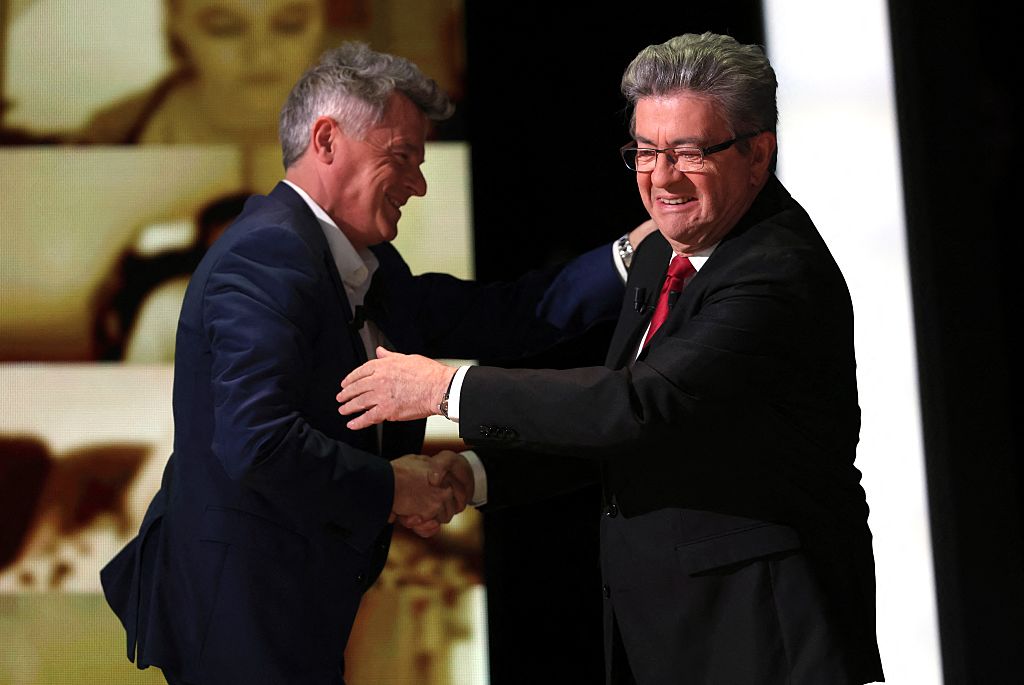
French Communist Party General Secretary Fabien Roussel and La France Insoumise presidential candidate Jean-Luc Mélenchon shake hands as they take part in the politics show Élysée 2022 on March 31, 2022. (Thomas Coex / AFP via Getty Images)
Over Christmastime 2018, Jean-Luc Mélenchon met for lunch with Raphaël Glucksmann in France’s National Assembly.
Mélenchon was an MP at the time, fresh off his strong 2017 presidential run for France Insoumise. Glucksmann was a liberal essayist with a murky background advising sometimes-dubious politicians in countries like Ukraine and Georgia, producing documentaries about human rights issues while looking to get into politics himself.
The conversation stayed light and nonconfrontational, and they were joined by the former Socialist Emmanuel Maurel (at that time supportive of France Insoumise), and Thomas Porcher, an economist who’d voted for Mélenchon the year before. Porcher would go on to cofound Glucksmann’s new electoral outfit, called Place Publique, later that year. This new formation, Porcher told Le Monde at the time, was not founded to be “anti–Jean-Luc Mélenchon.”
A decade on, though — and just eight months ahead of the 2027 presidential election — it’s hard to believe that’s true. Today hard-liners like Glucksmann and his wing of the Left have ruled out any potential alliance with Mélenchon, whether it’s in the presidential race or the parliamentary contest held directly afterward.
This position raises the stakes for the Parti Socialiste primary, which will be held in mid-October. Once the leading force on the Left, the Socialists were in power between 1981–95 and 2012–17. Today the party is substantially weaker, but it’s still an electoral factor, and the primary will determine exactly what role it plays. Some contenders, like Maurel, favor unity on the Left. Glucksmann’s camp, however, pushed hard in the other direction, unsuccessfully arguing in favor of a written ban on any alliance with France Insoumise, today France’s largest left-wing party.
Glucksmann’s Place Publique views Mélenchon as an antisemite, a “friend of Putin,” and a would-be autocrat.
The glory days of the broad left-wing electoral alliances of 2022 and 2024 are over, and not everybody thinks that’s a bad thing. Others, though, worry it could cost the Left the presidency and even bring the far right to power.
Broad Left
In 2027, one thing is sure: there will be more than one candidate running for president on the Left. The Parti Communiste Français (PCF) designated its general secretary, Fabien Roussel, as its candidate in early September; the Parti Socialiste primary in which Glucksmann is running will choose a contender in the middle of next month; and another major force on the Left, the Greens, are still debating whether it’s appropriate to run their own candidate at all.
“This is a unique presidential election,” the consensus-seeking president of the Greens’ parliamentary group Cyrielle Chatelain told me. “We could see the far right come to power, so we’re reflecting on what the best way is to present our ideas in this context.”
In 2022, an electoral alliance spanning the broad Left denied Emmanuel Macron a governing majority, leading to parliamentary instability throughout his second presidential term. Despite the electoral success, the pact soon broke up over friction between France Insoumise and the other left-wing parties. Another alliance was forged for the 2024 snap parliamentary elections. Every poll and pundit (including myself) predicted the election would sweep Marine Le Pen’s far-right Rassemblement National into power.
In 2024, that alliance, dubbed the Nouveau Front Populaire, as well as strategic stand-down deals with candidates from the center, delayed the far right’s march to power. But this alliance also quickly fell apart. Grievances over the political style and positions of Mélenchon and France Insoumise — in particular centered on unfounded allegations of antisemitism, in the context of Israel’s escalating genocide in Palestine — authored the demise of the left-wing front.
Even still, this spring’s municipal elections saw alliances between left-wing forces. Many included France Insoumise, as in Saint-Denis where its joint list with the PCF won the election in the first round, or in cities like Grenoble and Lyon, where alliances including France Insoumise kept the mayor’s office in the Left’s hands.
With Mélenchon now the Left’s front-runner in the presidential race, these parties are questioning what to do. Should these parties support Mélenchon and France Insoumise, despite their harsh criticisms of his party? Or should they run candidates who have little chance of making the runoff, and risk taking enough from Mélenchon’s score to ensure no left-winger makes the decisive second-round contest?
And if Le Pen wins, will the Left unite, even around France Insoumise, if it’s the only chance of stopping her governing with a crushing parliamentary majority?
Revolution
Fabien Roussel’s coronation as the PCF’s candidate earlier this month came as no surprise. The PCF congress voted 72 percent in favor of rerunning their 2022 candidate, despite a current within the party called Alternative Communiste arguing that running him last election did nothing to staunch the party’s decline.
“A communist candidate must allow us to rebuild our influence and to reestablish national visibility,” Alternative Communiste wrote ahead of the party congress vote. “[In 2022 our candidate Roussel] got 2.28 percent of the vote. Five years later, nothing allows us to think that a new candidature will fundamentally change the balance of power.”
For these internal critics, it was important to recognize how “recent events. . . . have demonstrated that the most reactionary forces are converging.. . . . in 2027, it’s communists’ responsibility to contribute to putting forward a joint candidate who is capable of winning.”
Some on the Left are not running to win. Small Trotskyist groupings like Lutte ouvrière or Révolution permanente have also named candidates, but they rarely get more than 1 percent of the vote.
François Ruffin, a former France Insoumise lawmaker who dramatically broke with the party after winning reelection in 2024, is also running, though he has danced around with allying with the Parti Socialiste. He’s even reportedly flirted with an alliance with Dominique de Villepin — a conservative former prime minister who’s spoken out strongly about Israel’s genocide in Palestine and is considering his own cross-party bid.
These candidates of the radical and revolutionary left once represented around 15 percent of the vote, before Mélenchon established electoral hegemony over similar voters. In 2012 and 2017, the PCF joined forces and supported Mélenchon’s runs, but the majority of the party’s voting membership no longer supports this.
Despite the PCF’s serious policy differences with France Insoumise — including its support for nuclear energy and rejection of Mélenchon’s narrative on racism — the party has often voted with France Insoumise and the Greens to censure Macron’s governments.
Reform
The two candidates who best represent the Parti Socialiste’s divisions are its first secretary Olivier Faure and Glucksmann, who Faure recruited to lead its list in the 2024 EU elections.
Glucksmann proposes reorienting the French left toward a more emphatic pro-EU line with paeans to democracy, human rights, and reindustrializing the EU. The aim: to head off both Russian imperialism and the Communist Party of China slyly taking over the world through trade.
Wherever Mélenchon and Glucksmann occasionally still intersect on policy, Glucksmann quickly backs off. In a recent polemic following Mélenchon’s proposition to cancel some of France’s debt held by the European Central Bank, the president of Glucksmann’s party claimed that now isn’t the time for such a move — despite previously supporting it.
A Glucksmann victory in the primary would amount to a referendum against any alliance with Mélenchon or France Insoumise. Always wary of France Insoumise’s hegemony over the Left, this week 292 leading figures and power brokers in the Parti Socialiste signed a letter calling for a Glucksmann vote.
His main rival is Faure, who took charge of the Parti Socialiste after its electoral collapse in 2017, when it won just 6 percent of the presidential vote. In 2022, its vote fell below 2 percent. However, for Arthur Delaporte, an MP for Calvados who’s close to Faure, the party’s first secretary is the natural candidate representing left-wing unity — and who’s running on his record as the “artisan” of recent broad-left alliances.
A Faure presidency, Delaporte told me, would look much different from the record of the last Socialist president, François Hollande, in 2012–17. On labor, Delaporte says, Faure would depart from the former president’s example of weakening worker power in the labor code. Delaporte cited rolling back the “inversion of the hierarchy of norms” — a reference to a provision in Hollande’s reform which allowed branches of companies to negotiate conditions worse than those already agreed at the company level.
The pro-business argument behind the “inversion” was that it could give companies more space to maneuver in a constrained business environment. Unions warned that companies would use it to “blackmail” union negotiations by threatening layoffs unless workers accepted a worse deal.
Delaporte also pointed to rolling back unemployment insurance changes under Hollande and Macron as a priority.
In this primary, Philippe Brun — an MP from Eure — tried to distinguish himself by calling for changing France’s retirement system to capitalization. It’s a measure supported by the center and the Right, all of whose candidates have called for such change to France’s redistributive system.
Brun repeated right-wing arguments that there are no longer enough active workers to fund pensions. But on September 16, Brun was excluded from the party and its primary after allegations arose of violence against a parliamentary assistant, which he denies.
On capitalization at least, Mélenchon and Faure are aligned.
“We will never pass to a system of retirement by capitalization,” thundered Mélenchon in one speech to supporters, arguing that individually paid-for retirement plans would require much higher contributions, and that market instability could delay or wipe out workers’ retirements.
Is Faure open to capitalization? I asked Delaporte. “No, that’s not one of the themes we’ve defended,” he replied.
Popular Greens
During the Paris municipal elections this spring, a small group of local politicians broke from the Greens’ official alliance with the Parti Socialiste and formed the Verts Populaires, which supported France Insoumise. Some were purged from the party, but their current is growing, with the Greens anchoring themselves more firmly on the Left over the past five years. However, other Greens are moving away from the radical left.
At a Glucksmann rally in June, the Greens’ 2022 presidential candidate Yannick Jadot told reporters that Mélenchon isn’t the candidate he wants leading the Left. Jadot quickly joined Glucksmann’s campaign after he entered the race last month.
But some Green politicians see Mélenchon as having a better chance of winning than any other left-wing candidate.
Sandrine Rousseau, runner-up in the Greens’ leadership election in 2023, has openly criticized the party leadership’s ambiguity on pursuing an alliance with France Insoumise and criticized talks to ally with other sections of the Left instead.
“I don’t know what the non-Mélenchonist left is, because we don’t really know what their proposals or main principles are,” Rousseau said in August.
Chatelain, the head of the Green parliamentary group, is reportedly in favor of an alliance with Mélenchon. She appeared alongside him as a guest at France Insoumise’s summer conference, with Le Canard enchaîné reporting that Jadot believes she’s made her choice and is just waiting for the right time to announce a decision.
Chatelain told me that for now there are no formal or informal discussions between the Greens and other parties about a presidential alliance; she was coy about what choice the party should make, deferring to the democratic desires of the membership.
She said that any presidential campaign the Greens joined would have to have a strong ecological program, ending fossil-fuel usage and transitioning to 100 percent renewable energy. Still she added that she doesn’t talk in terms of programmatic red lines, given that France’s left has campaigned jointly twice in recent elections and each time succeeded in reconciling its differences. “I don’t think there are any insurmountable issues on the Left,” she said.
Grand Coalition
While many on the Left are still weighing the best path to take, centrists see winning part of them over as a necessary step to avoid a Le Pen presidency.
Clément Beaune and Philippe Grangeon, two early-hour Macronists, argued earlier this month that a grand coalition should be organized even before next spring’s election.
“Excluded, of course, are the two extremes; those on the Right who make the rule of law a scapegoat, and those on the Left who have never excluded a compromise with France Insoumise,” Beaune and Grangeon wrote.
Of particular worry, they say, is the Rassemblement National’s plan to halve France’s contribution to the EU ahead of negotiations for the bloc’s 2028–34 budget, claiming that “Europe. . . . [is] the only space of effective sovereignty in the twenty-first century.”
Former President Hollande believes he could be a candidate of last resort for this camp, if no consensus is established by the winter.
Speaking on a radio show in early September, he argued that if a candidate wants to make it to the second round, they have to not only be capable of rallying the Left but also conscious of the need to reach beyond their own political family.
“Does that mean potentially governing with the center?” “Yes!” Hollande exclaimed. “It’s maybe the best manner, this broad coalition, to have the stability to transform, to act.”
Hollande has struggled to reach double digits in polling scenarios that count him as a candidate. While at the start of his presidency he headed a broad left-wing coalition with a huge majority, by the time he left office in 2017 his approval rating fluttered above the bottom of the Mariana Trench at 4 percent. The fact that he is today seeking allies on the Right and in the center is proof that France’s left has learned the error of his ways. The question that remains is whether it can build a principled alliance of its own.