France’s “Hot Autumn” Is Boosting the Left
High school students in France’s working-class suburbs sparked a revolt that now includes workers, unions, and a new generation of yellow vests. Stathis Kouvelakis explains why it could reshape France’s 2027 presidential election and the European left.
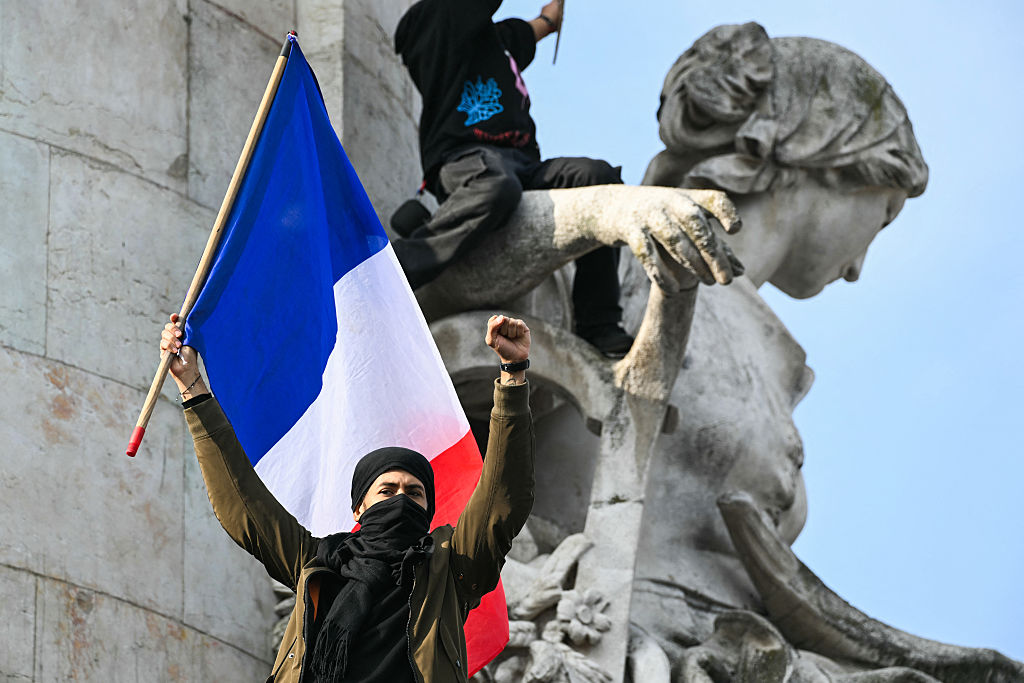
A mass movement has erupted in France only months before the presidential election, making a Jean-Luc Mélenchon victory a real possibility. (Sébastien Bozon / AFP via Getty Images)
- Interview by
- Jacobin
Since mid-September, a wave of protest has swept across France. High school students in working-class banlieues (suburbs) and the overseas territories started it by occupying their schools. University students, teachers, trade unionists, and a new generation of yellow vests (gilets jaunes) soon joined them. On November 5, about 1.6 million people took to the streets in two hundred cities.
Emmanuel Macron’s government has answered with the harshest crackdown in half a century. Police have arrested more than ten thousand people, most of them teenagers. A new “Rioters Pay” bill would punish protesters for acts they did not personally commit. Meanwhile, the far right is stoking a racist backlash, and, on October 23, a far-right gunman killed a young man in Trappes.
Stathis Kouvelakis has lived in France for more than four decades and has seen nearly every youth revolt there since the 1980s. In a wide-ranging interview with the editorial board of Jacobin Greece, he explains what makes this movement new, and why its young protesters are rallying around the idea of a “New France.” He also discusses the role of Jean-Luc Mélenchon’s La France Insoumise (LFI) and why the uprising could reshape next year’s presidential election and the European left.
Jacobin
How would you assess the state of the movement after October 17 and the government’s response?
Stathis Kouvelakis
Let me clarify, first of all, that the movement did not begin on October 17 but at least a month earlier, with the mobilization of school students. In the initial phase, it gradually spread to universities, parents, and teachers, and subsequently to the militant wing of the trade unions. What we saw on October 17 was a shift in the composition and a further expansion of the mobilization, with the rapid entry of virtually the entire trade union movement, of young workers, and of the new yellow vests.
October 17 marks a turning point, because on that day the mobilization took on the characteristics of a popular uprising. We saw attacks on public buildings, the looting of three thousand shops, and a section of demonstrators — a minority, but by no means negligible — determined to clash with the police.
The media, as usual, gave these acts of violence from below enormous and disproportionate coverage. But we must first and foremost see them as a response to the violence from above. On the one hand, they are a reaction to police repression unprecedented in over fifty years. On the other hand, they externalize the systemic violence that a section of society endures daily — marginalized young people in multiracial working-class suburbs endure it to a particularly acute degree.
To grasp the extent of the repression, let us look at some figures. In less than a month, and before October 17, the police arrested eight thousand people — more than in the first six months of the yellow vests’ protests (2018–19). Eighty-five percent of those arrested were under eighteen; 2,700 are facing prosecution, and the courts have handed down 2,300 “alternative sentences.”
On October 17, police arrested 2,700 more people, prosecutors brought around a thousand before the courts, and judges have already sentenced 217 to prison. These are staggering figures.
Added to this is the brutality with which the police dealt with the students’ actions from the very outset. The government’s line was that this was not a social movement with specific demands but “riots” (“violences urbaines”), mere instances of “disturbance of public order” to which the only appropriate response is repression. The result was those unbelievable scenes of police violence both outside and inside schools, and on the streets of cities across the country.
The situation is similar to that of the extremely violent crackdown on the yellow vests in 2018–19, except that now the main target is young people age fourteen to eighteen. So far, police grenades have torn off the hands of at least three people, and five have lost eyes to “rubber bullets” that police fired from defensive ball launchers (LBDs). Dozens, perhaps hundreds, of others have suffered irreversible physical injuries.
On October 3, Interior Minister Laurent Nuñez declared on television that he had given the police “no instructions to exercise restraint.” He emphasized that the security forces “will make use of the full range of weapons at their disposal,” meaning the lethal grenades and LBDs.
Jacobin
How did Emmanuel Macron and the government react to the unrest on October 17? Are they stepping up repression, backtracking, or remaining unyielding, believing that the movement will fizzle out?
Stathis Kouvelakis
The sheer scale of the mobilization and the violent clashes that followed came as a shock to the government. It had clearly underestimated the scale of the demonstrations (550,000 according to police figures, 800,000 according to the trade unions) and had consequently deployed relatively limited police forces. According to numerous accounts, while they made extensive use of force against the demonstrators, these forces remained passive or kept their distance from the areas where looting was taking place.
In any case, police brutality backfired on the government. The brutality of the crackdown helped radicalize and expand the mobilization, undermining the government’s narrative within families and more broadly across society.
On the other hand, however, the continuous escalation of repression that we have been witnessing for a decade now is accustoming a section of French society to the indiscriminate use of state violence. It fuels demands for restoring “law and order” by any means. The far right exploits these demands for political gain, particularly when the situation itself appears to be spiraling out of the state’s control.
This crackdown, however, failed to break the movement. The authorities banned demonstrations in forty towns and cities and imposed daily curfews in many central areas. Despite this, on October 24, the rallies and demonstrations matched the scale of the previous Saturday (420,000 according to official figures, 800,000 according to the trade unions). In many cities, and particularly in Paris, the marches were even larger than the previous week.
And this was during school and university holidays, with the army guarding public buildings and special anti-terrorist units patrolling the streets. For October 31, Macron stated that the authorities would only permit demonstrations in the “outskirts” of cities, far not only from their centers but also from the urban fabric itself. This provocative stance and repressive headlong rush are signs of weakness on the part of a faltering state authority that sees the ground slipping from under its feet.
Jacobin
We see school students at the forefront of the movement. This is a new phenomenon — how do you explain it?
Stathis Kouvelakis
It is not unusual in the French context for students to spark a wider mobilization. In a sense, the degree of convergence between the youth and the workers’ movement is the key to the major uprisings that periodically shake French society and to the radicalism that characterizes them.
What is new is that it is now high schools rather than universities that are at the forefront.
A second innovation of this movement is that it originates in deprived areas rather than, as is usually the case, in high schools in city centers. This means that at the forefront are students from working-class backgrounds and the multiracial banlieues, where a large proportion of the population originates from postcolonial immigration. It is no coincidence that the first school occupations took place in high schools in France’s overseas territories (Mayotte, the Antilles, French Guiana), where the situation remains strongly colonial.
We therefore have a dual dimension: class and race. Both directly affect a youth that experiences firsthand the consequences of the neoliberal steamroller and the structural racism that permeates state institutions, the labor market, and social relations more generally. We can say that this movement has, from the outset, been deeply anti-racist and has a clear perception of the interconnection between racism and class inequality.
This is also the key to understanding the third innovation of this student movement: its level of politicization and radicalism. Let me share a personal testimony here.
From the early 1980s, when I began my studies in France, I took part in or observed at close quarters almost all the youth protests. The scene I witnessed on October 6, during the first major march with widespread participation, was unprecedented.
What struck me most was the ability of the school students to link their material demands for better study conditions with the broader issues of the day. Alongside material demands concerning study conditions (shortage of teaching staff, deteriorating buildings, a competitive admissions process for higher education), this youth puts forward opposition to racism, war, genocide, police violence, and the logic of profit.
Everywhere there were Palestinian flags and scarves, slogans against the far right and police violence, and a rejection of the militarism encroaching on schools — all this in a combative atmosphere. I heard thousands of schoolboys and schoolgirls, who were clearly not members of any left-wing organization, chanting rhythmically “jeunesse déterminée et révolutionnaire” [“We’re a determined and revolutionary youth”]. Such a thing was unthinkable not only for my own generation, which grew up in the bleak 1980s (especially bleak in France) but also for those that followed.
The explanation lies in the overall nature of youth politicization internationally and in the particular significance that communities originating from postcolonial immigration hold for these generations.
This is why Palestine occupies such a central position. It is not simply a matter of solidarity with a distant cause, however important that may be. In the oppression the Palestinians suffer, this youth recognizes the racism that it confronts itself. And the unyielding resistance of the Palestinian people is a source of inspiration for their own resistance and way of life.
Jacobin
What other forces have joined the school student movement?
Stathis Kouvelakis
The qualitative leap took place on October 17. Two factors played a decisive role here. The first was the call from the new yellow vests, which began circulating on social media in early September, even before the school occupations broke out.
Unlike last year’s failed “Bloquons tout!” (“Let’s block everything!”) call, this one had strong organization and above all deep social roots. We know from related reports that the initiative came from young people, mainly non-white men from the working-class suburbs of major cities — a group very different from the “historic” yellow vests.
Nor, for that matter, was the choice of date a coincidence. It falls, of course, on a Saturday, just like the days of action during the 2018–19 yellow vests movement. But it also coincides with the anniversary of October 17, 1961, when, during the Algerian War, the police fired into a protest march by Algerians in central Paris, killing dozens and throwing the bodies into the Seine.
The parallel with the 2018–19 movement lies in the grassroots way the action spread and in its repertoire: rallies and marches scattered across the city that organizers did not declare to the authorities. It also lies in the demands, which focus on the cost of living. Gas prices are extremely high, which places an overwhelming burden on the working classes, who generally live some distance from their workplace. The cost of living is, of course, a broader issue, as real wages have stagnated, and the quality and accessibility of public services have plummeted.
In the run-up to October 17, the student movement and the brutal police repression it faced had created a confrontational atmosphere. In that climate, the call met with a remarkable response from young workers, particularly those in precarious employment and in multiethnic suburbs, but also among sections of the working class outside the scope of trade unions. Despite initial reservations, it ultimately mobilized a minority but significant section of the “original” yellow vests.
We can say that the experience of that movement is now part of the shared code of social movements in France. We even saw schoolboys and schoolgirls wearing these yellow vests at the roadblocks students set up during school occupations and, to a lesser extent, at the marches.
The second factor is the involvement of the trade union movement. The most militant sections had already joined the fray earlier in October, protecting and supporting the school occupations and marches. These were mainly local branches of the General Confederation of Labor (CGT) and Solidaires, and in some places Force Ouvrière.
In Toulouse and elsewhere, we also saw school and university students heading to workplaces and calling on workers to take to the streets. On October 17, trade union participation became widespread, drawing in even the extremely moderate French Democratic Confederation of Labor (CFDT).
We could say that there is now a powerful popular bloc on the streets opposing “Macron and his world” — that is, the neoliberal steamroller and the growing state authoritarianism. This is the moment when all the separate movements of the last decade finally crystallized and converged. Its driving force is the youth as the bearer of a qualitatively new political consciousness.
Jacobin
La France Insoumise (LFI) is supporting the protests and is once again in the firing line of the government, the far right, and the media who say it is instigating them. How do you assess the role of LFI at this stage?
Stathis Kouvelakis
Indeed, Prime Minister Sébastien Lecornu stated on October 1 that behind the student occupations lie “LFI and its proxies from the ultraleft (ultragauche).” Lecornu chose these words on purpose: “proxies” is the term the media and mainstream discourse use for Hamas and Hezbollah, which they regard as proxies of Iran. And the term ultragauche refers not so much to organizations of the extra-parliamentary left as to the constellation of anarchists and autonomist groups — that is, groups or individuals operating outside the institutional, and sometimes even outside the legal, framework.
This vocabulary reveals the mindset of those in power, who view a mobilized society in warlike terms.
For years, the ruling extreme center and the far right have targeted LFI, often with the complicity of sectors of the “soft left.” The reason is that LFI is the only significant political force that breaks the consensus on critical issues such as support for the genocidal Zionist state, police violence, Islamophobia and structural racism, and alignment with US and Western imperialism. It is essentially the only genuine opposition to the current order.
For LFI, supporting the mobilization is a matter of course. It means something very concrete and practical: mass participation in the marches and protection of the occupied schools and marches by LFI’s grassroots as well as by its deputies and mayors. The iconic figure is Bally Bagayoko, the charismatic newly elected mayor of Saint-Denis. He stands in solidarity with the occupied high schools in his city, and police have repeatedly beaten him when he tried to shield the students from their attacks.
Within the movement, at the marches and at the roadblocks set up by the students occupying schools, LFI is like a fish in water. The mainstream media are speechless every time they see young people and, more broadly, the crowds in the streets enthusiastically cheering the seventy-five-year-old Jean-Luc Mélenchon. It is not simply because of his position on this particular issue.
LFI is the only organization that has articulated the issues we now see stirring up those who take to the streets. To put it another way, what we are seeing is a dialectical relationship between the movements and LFI. To borrow a fine phrase from Houria Bouteldja, we should see LFI as our “war booty,” the fruit of our struggles of recent decades.
As for the other sectors of the Left, they are of little concern to society. The only exception, in a sense, is the candidate of the Socialist Party and its allies, Raphaël Glucksmann, who represents the most right-wing, warmongering, and pro-US element within this part of the political spectrum.
At every public appearance, people boo him, particularly young people, and he conspicuously stays away from any demonstrations. In his latest statements, he has endorsed the government’s so-called concessions. In essence, he is nothing more than a variant of Macron.
I should also point out that Macron does not even have a working majority in the National Assembly. The successive governments he appoints survive solely thanks to the Socialists, who refuse to support the motions of no confidence that LFI, the Greens, and the Communists have introduced.
Jacobin
What is this “New France” that LFI speaks of? Has a new, multiracial subject of struggle and demands come to the fore?
Stathis Kouvelakis
“New France” is both a statement and an interpellation, or a call to action if you prefer. At first sight, it refers to the profound changes that French society has undergone in recent decades.
The first is the end of the traditional countryside, and with it of the peasantry as a significant social group. The second is the internal migration that followed and continues to this day, albeit in a different form. Today one in two inhabitants of the country lives in a different area from that of their birthplace.
But of course, “New France” refers above all to people with migrant origins, the overwhelming majority of whom are now French nationals. If we go back three generations, one third of the population has at least one non-French ancestor. France is a country with a tradition of immigration dating back to the very beginnings of the Industrial Revolution and even more so since the late nineteenth century.
From the 1960s onward, however, the origin of this immigration shifted from Southern and Eastern Europe to the Global South, and in particular to the former French colonies of North and sub-Saharan Africa. Today, 20 percent of those under the age of eighteen are descendants of immigrants, and 84 percent of them are of non-European origin.
However, as we know, this section of the population, despite being French citizens, faces persistent racist discrimination, which has intensified in recent years and taken the form of escalating Islamophobia. Many laws create an atmosphere of permanent suspicion against Muslims and deprive them of any form of independent organization. Furthermore, until recently, the French left — with the partial exception of the trade unions — had stubbornly refused to recognize this group as an integral part of its social base. It did so even though it constitutes the “hard core” of the working class.
LFI recognizes racism not as an individual moral failing but as a mechanism of domination and exploitation that permeates all social relations. It speaks openly about the racist nature of police violence, of the labor market, and of an entire body of legislation that targets Muslims. In doing so, it turns a new page in the history of the French — and perhaps the European — left and its relationship with the working classes.
One immediate result is the overwhelming share of the vote it is securing in the multiethnic working-class districts of the major cities, in the region of 60 to 70 percent. According to estimates, 70 percent of Muslims voted for Mélenchon in the first round of the 2022 presidential elections, and this figure is likely to be even higher in the next elections.
Since the beginning of last year, New France has taken center stage in the discourse of Mélenchon and LFI. They now couple this observation with a call: those whom racism targets are not (merely) victims. They are, first and foremost, political subjects whom LFI calls on to take part in — and indeed to be at the forefront of — the struggle for social upheaval.
At the impressive rally on June 7 in Saint-Denis (26,000 people), which launched LFI’s election campaign, the colorful — and largely youthful — crowd spontaneously chanted “New France,” waving French flags. The rally ended, as usual, first with the Marseillaise and then, at the crowd’s initiative, with the Internationale.
However, New France’s “baptism by fire” in mass action was undoubtedly this current movement. On the streets, and particularly in the student blocs and in front of the occupied high schools, the French flag was emphatically present, often alongside the Palestinian flag or those of other countries where Gen Z is rising up. Strong references to the French Revolution and its symbols accompany the tricolor.
In the face of the far right’s racism and chauvinism, young people are putting forward a different France — one that reflects its people and their revolutionary traditions. It reflects the people as they are and as they constantly remake themselves through their struggles. The current situation marks the convergence of the political force of New France with a mass movement that is rallying an emerging popular bloc with majority support and a radical left-wing orientation. This is a historic moment, the moment when a new conception of the nation is emerging through the very action of the subordinate classes.
In my view, far from contradicting a class-based hegemonic politics, New France paves the way for its reconstruction. The reason is simple: it is the only proposal capable of shattering racial divisions within the French working and popular classes. Only it can open up the possibility of uniting them into a new “historical bloc” — a force capable of leading society and giving it a radically new direction. It is also clear that this is the antithesis of nationalism and nostalgia for colonialism.
As for LFI, its core position is that New France means a “de-Westernized” (“désoccidentalisée”) France. That France would have an independent foreign policy, breaking with the North Atlantic Treaty Organization and the imperialist framework and forging an alliance with the progressive forces of the Global South. It also means coming to terms with France’s colonial past and immediately recognizing the right to full self-determination of the people of Kanaky/New Caledonia. The New France project embodies the “internationalist patriotism” of Houria Bouteldja, a prominent figure in the de-colonial, anti-racist, and anti-imperialist movement in France.
Jacobin
How is the uprising affecting the wider political landscape?
Stathis Kouvelakis
It is still too early to have a clear picture, but a reasonable assessment is that such a development will intensify the existing social and political polarization. LFI is emerging as the natural political representative of the popular movement bloc, but on the other hand we are also seeing the formation of a “law and order” bloc, with Marine Le Pen’s National Rally as its main component.
Two Frances are heading toward a frontal clash. The far right and its supporters, whose influence objectively extends into sections of the extreme center, are railing against the “unrest.” They blame it on “Arabs,” “blacks,” and “Islamo-leftists” — that is, the supposed unholy alliance between Islamists and LFI.
The incidents that took place on October 17, and in particular the looting, provided ammunition for far-right rhetoric to denounce the actions of the “barbarians” — that is, the non-white youth of the working-class suburbs.
The tragic culmination of this line of reasoning was the deadly attack on October 23 in Trappes, a working-class suburb on the outskirts of Paris. A thirty-nine-year-old fascist, driving around in his car, began shooting at non-white passersby who had the misfortune to be in his path. He killed a young man and seriously injured seven others, including an eleven-year-old girl.
The perpetrator, who kept a copy of Adolf Hitler’s Mein Kampf at his home, stated that he had targeted “black people, Arabs, and Muslims” to “take revenge for the shopkeepers who lost their livelihoods on October 17.”
An initial response to the far-right escalation came in recent days, when mayors and local organizations initiated a series of rallies and marches in working-class suburbs. But the most effective response is a mass presence on the streets in the coming days and, on a political level, the hegemonic momentum that the call for a New France has generated.
Jacobin
What do you think is now at stake for LFI?
Stathis Kouvelakis
LFI has so far succeeded in forging an organic relationship with the movement in terms of its agenda, its central narrative, and the participation of its grassroots. The challenge now is to offer a perspective that goes beyond the immediate task of the day, namely the mass mobilization for Mélenchon’s victory in next year’s presidential election.
Here, however, lurks a difficulty. LFI is not a traditional party but a “movement.” In practice, this means there are no formal members; an online registration is sufficient to join a local “action group,” which enjoys a great deal of autonomy in practical matters.
The organizational structure remains very loose, although for the past three years LFI has put coordinating structures in place at a regional level. This porous structure facilitates communication with the movements and respects their autonomy. However, it does not allow for coordinated intervention within them.
Everything relies on the initiative of the grassroots, which naturally varies from place to place. It is, of course, entirely reasonable and correct to avoid the well-known pretension of “leading” movements by self-appointed “vanguards” and bureaucratic apparatuses. On the other hand, however, this does not help overcome the barrier that social movements have come up against throughout the recent historical period, and not only in France. That barrier is the challenge of forming a structure that gives them durability, cohesion, and the capacity for strategic autonomy.
The question that arises is: How can we combine the autonomy of movements with the necessary, distinct intervention of political actors?
The problem is by no means new. Nevertheless, it remains one of the most critical issues that not only LFI but also the radical left internationally must resolve — bearing in mind that every approach so far has failed.
Jacobin
What are the prospects for the uprising from here, and what are the next key dates?
Stathis Kouvelakis
November 5 was a milestone for the movement. About 1.6 million people took to the streets in two hundred cities across the country. The strike had a significant impact in some sectors, such as education, the civil service, the railways, and oil refineries. However, it did not grow into an all-out strike.
The demonstrations were particularly impressive and joyful, bringing together young people and workers from various sectors. There is now a sense that a more cohesive popular bloc is emerging, carrying a novel and creative protest culture with its own music, scenography, and slogans.
The government has responded with a simulacrum of negotiations on the one hand and a new escalation of repression on the other. It has offered some insignificant concessions, such as a €25 rise in the minimum wage and a minor modification of the admissions procedure for higher education.
The only success the government can claim on that front is that it has split the union movement. The more moderate confederations, such as the CFDT and Force Ouvrière, have refused to call for further action. But the CGT, the teachers’ union Unitary Union Federation (FSU), and other important unions such as Solidaires and the National Union of Autonomous Trade Unions (UNSA) have called for a new day of street protests and strikes on November 17.
The real purpose of those concessions is to cover up the hardening of police repression and of the legislation on street demonstrations. Since the schools reopened, police have intervened to prevent any form of occupation. The authorities are also asking principals to provide lists of students involved in the movement. University authorities have kept campuses affected by protests closed, some since late September, drastically reducing the possibilities for organizing mass action there.
The government has also introduced a “Rioters Pay” bill in parliament. It would hold individuals liable for acts they did not personally commit, provided they “knowingly” took part in a gathering where acts of violence or property damage took place. The penalties are heavy: up to three years in prison and a €45,000 fine. Furthermore, the bill would allow the state to seize benefits that families of children involved in these actions receive and to expel foreign nationals whom courts find guilty of those offenses.
The Senate has already approved the bill, and the National Assembly will now debate it. If parliament adopts it, the bill would “enshrine in law France’s shift toward authoritarianism,” as a petition launched by several well-known public figures puts it.
Jacobin
At a more strategic level, what is the movement’s political perspective?
Stathis Kouvelakis
What is really exceptional about this movement is that it is happening only months before next year’s presidential election, certainly the most decisive in half a century. The radical left, and LFI in particular, should see this as a gift from heaven. As historical experience suggests, only major social mobilizations can overturn the balance of political forces, both in society and at the ballot box. We should see the impressive momentum of Mélenchon’s campaign as the result of the movements of recent years, and the current movement will no doubt expand it even further.
There is now a sense that a Mélenchon victory next year is a real possibility, albeit far from a certainty. In the streets and in everyday conversations among ordinary people, within families and groups of friends, one can feel this novel optimism. If Mélenchon wins, it will be a political earthquake of continental, even global, magnitude. But he will immediately have to confront an extremely hostile environment, both at home and internationally.
The dominant classes have extremely powerful weapons at their disposal to strangle a government of the radical left. We have seen this happen many times in the past, in Europe and Latin America, and more recently in Greece in 2015. To survive this ordeal, the Left needs a confrontational line that mobilizes its own social base.
The current situation in France provides these elements: broad sectors of society with an experience of mass action and a political force with a radical program and a real chance of electoral success. LFI calls this strategy a “citizens’ revolution.” I would prefer the term “democratic road to socialism,” which the late Nicos Poulantzas theorized. But the substance, I think, is quite similar: the articulation of a struggle within the state with mass movements that develop autonomously and push a left-wing government in a more radical direction.
Once again, France appears as the laboratory for the European left. It is the only country where a force of the radical left can defeat the far right. It is also the only country, for the moment, that can initiate a process of social change capable of shifting the international balance of forces and opening up new possibilities for the Left worldwide.