In France, High Schoolers are Beaten, Choked, and Gassed
For over a week, high school students and teachers in France have been protesting the state’s abandonment of the education system. The government response: send in police to subdue them.
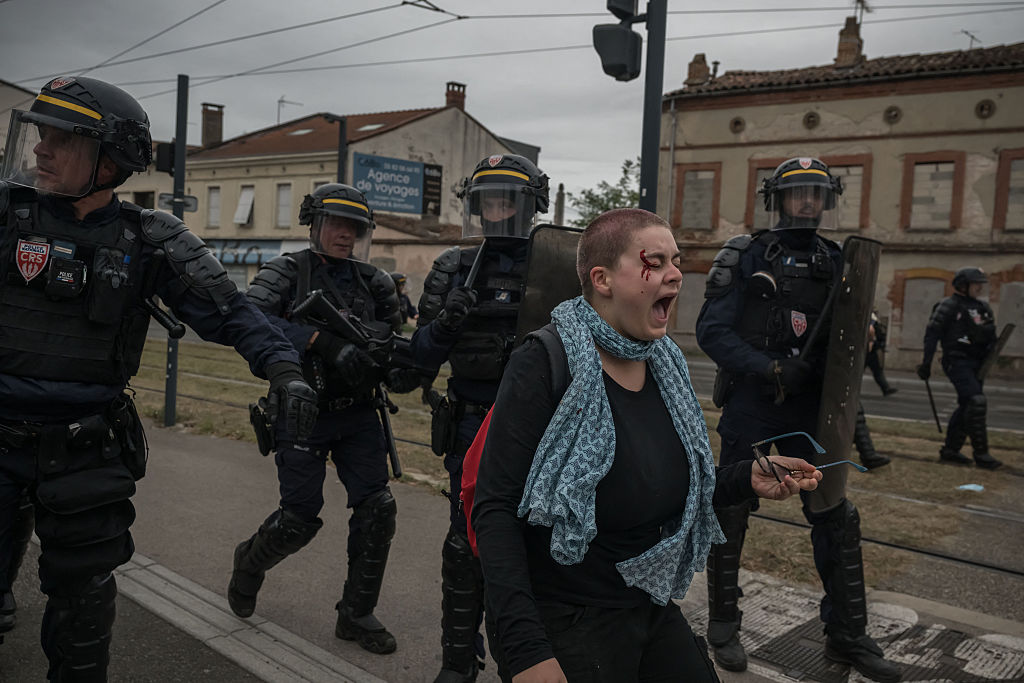
In recent years, French police have had ever more impunity in breaking up demonstrations. Now they see high schoolers as an enemy within and are trying to subdue their protests by force. (Ed Jones / AFP via Getty Images)
France’s government has launched an unprecedented campaign of repression against high schoolers after a surprise protest movement kicked off in September. Students across France blockaded their schoolhouses, demanding that dire learning and sanitary conditions — including poorly insulated and crumbling school buildings that freeze in the winter and swelter in the summer, as well as excessively long schooldays, large class sizes due to a lack of teachers, and the competitive system of higher education placement called Parcoursup — be addressed by the government.
As the movement mounted over the past week, with the high schoolers joined by university students and workers, the government accelerated its violent response. Videos of students being beaten, tackled to the ground, and shot in the face provoked outrage that fanned the flames of the high schoolers’ discontent and brought larger sections of society into the movement in support of them. Particularly shocking incidents, like a story about a fifteen-year-old who lost a hand and a video of a fourteen-year-old girl being strangled while arrested, increased the anger. At the beginning of the week, the government banned protests outside of schoolhouses in many regions (a move currently being challenged in the courts). On Tuesday, Prime Minister Sébastien Lecornu closed all high schools until the end of the week, announcing disingenuously that the move was a chance to “allow for some internal democracy.”
Laurent Nuñez, the interior minister, told MPs on Wednesday afternoon that the police had arrested 6,629 people since the beginning of the movement but denied any “police repression” was at work. About 85 percent of those arrested are minors.
On Wednesday evening, a nervous Lecornu gave a televised speech cynically acknowledging that “the anger of young people doesn’t come from nowhere” and called for dialogue, after announcing that the government would ban one type of anti-riot grenade used by police against the students. He also defended the police response while claiming that police hadn’t been given orders to be confrontational with students, despite a laundry list of violent repression that has been filmed and shared on social media and the news over the past two weeks.
The government is running scared, worried that the movement could endure until next spring’s presidential election. A cocktail of grievances across French society, including years of educational dysfunction, pledges of major budget cuts to cope with the crisis engendered by President Emmanuel Macron’s circus economics, and a fuel crisis provoked by the US-Israel war on Iran, has produced the largest student protest movement in a generation. The ultraviolence from France’s militarized police force has turned a simmering situation into a bomb.
Calm Protests
At Le Corbusier High School in Aubervilliers, a suburb in the north of Paris, the student movement started on Tuesday, September 29, coinciding with a nationwide civil service strike that school employees were a part of.
“A significant number of staff were on strike. . . . The students knew this, and they set up a blockade the same morning,” Philippe Soler, forty-three, a physics teacher at the school, said.
Mayar and Mélina, seniors at the high school, told me about how students started the blockade in support of the teachers’ strike as well as to put forward their own demands, which include complaints about extremely long hours.
“We get home, and it’s 7:30 p.m.,” Mayar said. “We don’t have time to do anything but eat, then it’s 10 p.m., and we go to bed. We don’t have any time for ourselves. They want us to work like robots, basically.”
The blockade was a success, and the next day students went back to classes.
“It was very well organized. We had music; we shut down the high school without incident or any danger for students or passersby,” Mélina, a member of the school students’ union that organized the initial protest, said.
Other high schools nearby saw the blockade on social media and were inspired to launch their own blockades that Wednesday.
“It became kind of a trend to support the blockade, you might say,” Mélina explained.
Those continuing blockades inspired the Le Corbusier students in turn to start back up the next day.
“We restarted on Thursday and haven’t stopped since then,” Mayar said.
On Thursday and Friday, there was a series of violent confrontations with the police. Students from schools nearby including Henri Wallon High School, d’Alembert High School, and Jean-Pierre Timbaud Professional High School, who had launched their own blockades, joined the Le Corbusier students in processions from school to school, all within a thirty-minute walk of each other.
On Thursday, skirmishes were farther from the school and more limited. On Friday morning, some of these students got animated and began to shake one of the school gates until the gate fell to the ground under the crush of excited students.
The police quickly intervened and launched tear gas canisters into the crowd of students, who fled in the opposite direction of the gas.
“There was a panic among the kids. They turned around; they were walking all over each other, and they ended up really breathing in the gas,” Jean Baptiste Epain, fifty, a history teacher at Le Corbusier, told me. Adults in the school opened a side door to let the kids escape inside, where they treated a good twenty or so students and teachers who had been “violently gassed,” some to the point of vomiting.
Mélina and Mayar remember confrontations between the police and high schoolers, with police shooting Flash-Balls in their direction and students throwing water bottles back at them. The police, they say, were waiting impatiently for the riot police to come and were “super happy” when they arrived.
During the day, the police also hit a random passerby in the back of the head with a baton before arresting him. When the police realized their mistake, they released him and apologized, but he had a gash on the head and was still bleeding as he made his way to the emergency room on foot about twenty-five minutes away, because no ambulance was available to come get him.
“It’s completely unacceptable to hit a citizen who’s just passing by when he hasn’t done anything wrong,” Mélina said. She talked about how nerve-racking it was to sit through some courses while the sounds of violent confrontations, including the sound of fireworks and bottles breaking, went on outside.
“They’re attacking us without even really listening to us,” Mélina added. “We, as high schoolers, are just trying to be heard, to have some more freedom, to live better, because we feel like the world belongs to us after all; it doesn’t belong to them.”
“Even if we’re attacked, it will just give us more strength to mobilize more, even if we’re afraid,” Mayar said. “We have to, because if we give up now we’re not going to be listened to.”
Epain told me that he and many other teachers joined in with protests by the students to give them some protection and space to express their ideas, but that many police who he talked with already had a mindset of violent confrontation from the beginning.
“They told me that children can be murderers too, that they’re no better than any others, and that their colleagues had been attacked and beaten to the ground, so they had to retaliate,” Epain said.
“They can’t seem to see that these are children,” he said, explaining that many of the police believe the teachers are naive about the threats they face.
“The police are in this frame of mind — they feel like they’re under attack,” Epain said, “that they’re constantly threatened by what’s happening, which gives them the right to strike hard.”
Striking Hard
So far, they’ve done just that. Every day since the movement began, social media feeds have filled up with videos and stories of escalating levels of violent repression by the police after Nuñez directed the leadership of the police, the prefects, and the Gendarmerie to deploy mobile riot squads to “reestablish Republican order.”
On September 28 in Saint-Ouen-l’Aumône, a tear gas canister hit Eden, fourteen, in the jaw, leaving his upper teeth broken and knocking out his lower teeth. His jaw was sealed, and he has to eat food through a straw. On September 30, sixteen-year-old Maël was shot in the face with a flash grenade and has lost the use of one eye. On October 1, another sixteen-year-old boy had the bones broken around his left eye, which he could lose the use of, after being shot “right in the face” by a flash grenade. He now “fears going blind.” On October 5 in Lens, a fifteen-year-old had his hand torn off by a grenade after the police charged a group of children.
Young teenagers have also reported mistreatment and abuse in police custody. A fifteen-year-old boy told Mediapart that after an arrest a policeman forced his pants and underwear down when he refused to remove them. Another said that two officers came into his cell, where one threw him onto the concrete bed, and then the other hit him in the back of the head, shouting, “You’re alone now. Your lawyer’s gone, you little b-tch.”
At Blaise Cendrars High School in Sevran, to the northeast of Paris, police deployed horse-mounted units and tear gas against students.
“They’re a little bit scared now; you can feel a real sense of trauma among them, particularly from the horses. Now when the students see the horses, they get nervous,” Jawad, an English teacher at the school, told me at a march outside the Gare du Nord railway station on Tuesday.
Amine, a student from Paris Nanterre University at the same march, told me about being surrounded by riot police.
“They gassed us; they charged at us. There was nothing we could do — we were blocked!” Amine said. “They didn’t do it for any reason — just to provoke us. They hit us with their batons.”
“I’m scared of the police,” he said. “We’re all scared of the police.”
Would that stop him from coming out to protest?
“No,” Amine and a friend of his standing nearby, who didn’t want to be interviewed, immediately said in tandem.
“Just the contrary, we’re coming out in solidarity,” Amine said. “I’m coming out again because there are people who’ve lost their eyes, who’ve lost their teeth, who will never be able to use limbs again. I’m coming out for them — for the people who’ve lost their hands. It’s sad, but that’s how it is.”
Blame Game
As the government searches for an explanation for the unrest, it has deployed agents from the General Directorate for Internal Security (DGSI) — France’s domestic police intelligence agency — to monitor what they call a worrying situation.
Marie, a union delegate in Saint-Denis, told me that DGSI agents had installed themselves a hundred meters away from Paul Éluard High School, where Saint-Denis’s La France Insoumise mayor, Bally Bagayoko, has come out repeatedly to support protesting students. Marie said the men, identifiable by their clumsily youthful outfits (“Jogging pants tucked into socks — people haven’t done that since the 1980s”), had walkie-talkies they were talking into with phrases like “in the entire département” or “no young people in the surrounding area.”
As the movement took off, the government leaked the idea to the press that the student protests were being stoked and organized by La France Insoumise and its proxies in the “ultraleft.”
“The origins of the movement clearly lie in the instrumentalization of student union structures and political movements close to the far left,” read one memo from the Paris prefecture.
La France Insoumise did not organize the movement, but its elected officials quickly arrived in support of the blockades, often putting themselves directly in between high schoolers and the police. A video of Bagayoko protecting students from the menacing advance of a group of riot police on October 6 went viral around the world.
Being alongside the protesting students is “the place of an elected official,” Bagayoko said at the beginning of the month after joining a protest at Paul Éluard High School.
“Parents, France Insoumise militants, mobilize to put yourselves between police brutality [and the students],” Mélenchon said at a rally on September 30. “Those who are beating our children, those who are hitting them, those who are insulting them . . . will find us in their paths. There’ll be no forgiveness or forgetting for anybody.”
In the National Assembly on Tuesday, Lecornu accused La France Insoumise of plotting to “create chaos” in the country ahead of next year’s presidential election.
“Violence is part of your political project,” he shouted into a microphone at Mathilde Panot, the president of La France Insoumise’s parliamentary group. “Lying about the government’s intentions won’t save you electorally. Sowing chaos like you’ve done since the beginning of the high schooler movement is a scandal.”
Panot had made her own promise about what to do about violence the day before.
“We will have truth and justice commissions when we come to power,” Panot said. “We will not accept police impunity.”