Donald Trump Has Nothing to Show for His War With Iran

Andreas Krieg

After waging a destructive war at vast expense, Donald Trump has ended up in a weaker strategic position than when he started. His main achievement has been to battle-test Iran’s ability to shut down the Strait of Hormuz and disrupt the world economy.
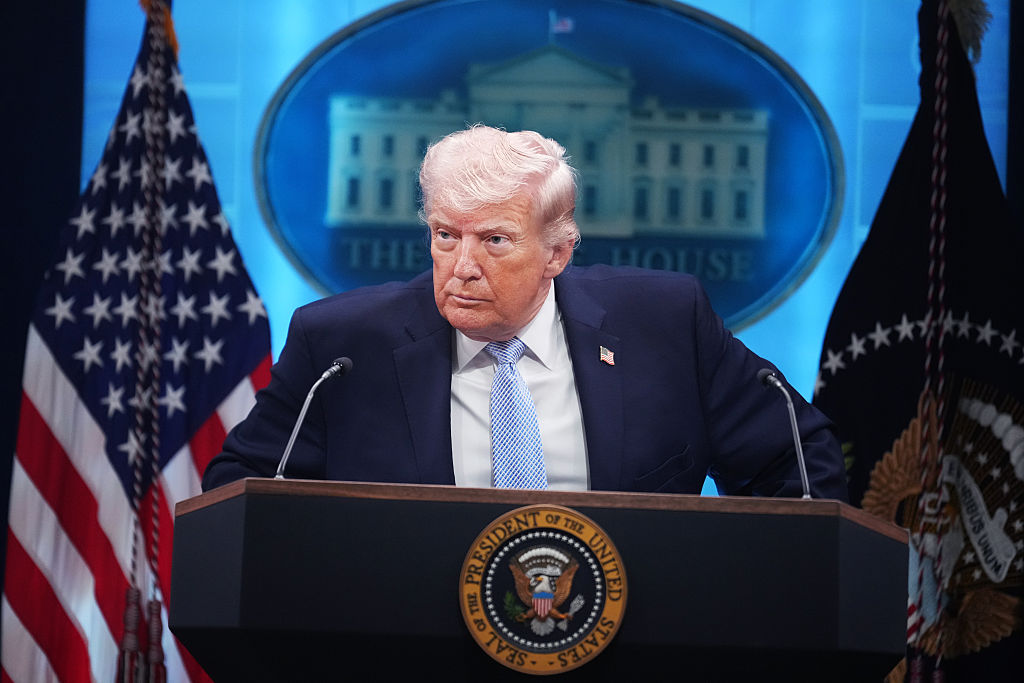
Donald Trump conducts a news conference about the war in Iran on April 6, 2026.

Donald Trump’s war on Iran has been a historic failure. (Tom Williams / CQ-Roll Call, Inc via Getty Images


Interview by
Daniel Finn

Andreas Krieg is an associate professor at the Defence Studies Department of King’s College London and the author of Socio-Political Order and Security in the Arab World. He spoke to Jacobin about the memorandum of understanding between Iran and the United States, whether it will lead to a wider rapprochement between the two states, and what the consequences of the US-Israeli war on Iran have been for the region and the wider world.


Daniel Finn

What do we know so far about what has been agreed between Iran and the United States?

Andreas Krieg

On what has been agreed, I would be very careful with the language. This is not a peace deal and not a comprehensive settlement. It is a memorandum of understanding (MoU) to start a negotiating process. What seems to have been agreed is a framework to extend the ceasefire, reopen the Strait of Hormuz, begin easing parts of the US blockade and sanctions pressure, and establish a follow-on track for nuclear talks. There also appears to be some understanding around frozen Iranian assets, although the exact sequencing and amount remain contested.

The most important point is that this is a deal to begin negotiations, not a deal that resolves the conflict. It is closer to an inked intent on paper. It gives both sides a way to step back from the edge without admitting defeat. But it leaves the hardest issues unresolved: enrichment, the highly enriched uranium stockpile, Iran’s missile capabilities, the Axis of Resistance, Hezbollah, the Houthis, and the future of Gulf security. I would call it an important first step, but not yet a strategic settlement.

Daniel Finn

Rhetoric aside, can the Trump administration point to any gains it has made in comparison to what was on the table back in February, before the US-Israeli attack on Iran?

Andreas Krieg

In comparison with what was on the table in February in Oman, I do not think the Trump administration can credibly claim major gains. Rhetorically, it will say that the war forced Iran to accept talks, that Iran’s military-industrial base was degraded, and that Tehran is now discussing issues it previously refused to discuss. But when you strip away the theater, the United States has not secured the decisive concessions it wanted.

Before the war, there was already a pathway to an arrangement on nuclear limits involving intrusive inspections, stockpile management, and some form of enrichment constraint. What the United States has now is not obviously better. It has paid an enormous strategic price to arrive at a narrower, more fragile, more militarized version of what diplomacy might have produced earlier.

Iran has not surrendered its enrichment program. Its government has not collapsed. Its regional network has not disappeared. Its ability to close Hormuz has been proven rather than deterred. So I would say the war has produced tactical degradation but strategic regression.

Daniel Finn

What did the period between late February and early April show us about the respective military capacities of the two sides? Were the United States and Israel genuinely surprised by Iran’s ability to endure the pressure (and should they have been)?

Andreas Krieg

The period between late February and early April showed that the United States and Israel could impose serious damage, but not to a strategically decisive extent. They could strike facilities, commanders, air defenses, and parts of the military-industrial base. They could hurt Iran badly. But they could not break the government’s center of gravity.

That center of gravity is not one palace, one leader, one air base, or one command node. Iran today is better understood as a militia with a state: dispersed, ideological, asymmetric, and designed to absorb precisely the kind of pressure the United States and Israel can deliver.

I do think the United States and Israel were surprised by Iran’s ability to endure the campaign. They should not have been. The entire Iranian security system has been built around survival under bombardment, sanctions, sabotage, and decapitation threats.

The Israelis and Americans appear to have overestimated the likelihood of regime fracture, popular uprising and leadership paralysis. Instead, the bombing consolidated the grip of the Islamic Revolutionary Guards Corps and gave Tehran an argument that it had endured the most powerful military coalition in the region without collapsing.

Daniel Finn

If Trump had agreed to a ceasefire by the first half of April, why did it take more than two months to conclude the MoU? Did the dynamics change significantly for either side in that time frame?

Andreas Krieg

The reason it took more than two months to get to an MoU is that neither side knew how to translate military stalemate into political language. Iran wanted the United States to move first on sanctions, assets, and Hormuz. Washington wanted Iran to move first on nuclear and maritime restraint. Both sides wanted to say they had forced the other side to blink.

The dynamics also changed in that period. Iran discovered that Hormuz was its strongest card. The United States discovered that military pressure could not force a clean Iranian concession. The Gulf states discovered that American bases made them targets, not just protected partners.

Qatar, Saudi Arabia, and Turkey increasingly pushed Washington toward a smaller, practical deal. And Israel tried to use Lebanon and information operations to keep the conflict alive. So the delay was not just technical. It reflected a wider struggle over who would define the meaning of the war.

Daniel Finn

What role did Israel play while the discussions between Iran and the United States were ongoing? How much substance was there behind reports of serious tension between Israel and its US allies?

Andreas Krieg

Israel’s role was largely disruptive. Israel wanted a much broader outcome than the United States eventually accepted: the destruction of Iran’s enrichment infrastructure, removal of enriched uranium, limits on missile production, and an end to Iranian support for proxies.

None of that was secured in the first phase. Israel therefore tried to preserve leverage by escalating in Lebanon, by pushing the United States to harden its terms, and by arguing that any release of assets would empower Iran’s military and regional network.

The tensions between Israel and the United States were real. I would not exaggerate them into a strategic rupture, but they were not imaginary. Donald Trump wanted a win and did not want Hormuz closed indefinitely. Benjamin Netanyahu wanted the war to continue long enough to reshape the regional balance and rescue his own political position.

Those objectives diverged. Israel was increasingly alone in wanting a return to military confrontation with Iran, while the Gulf states, Turkey, Pakistan, and Qatar all pushed toward de-escalation.

Daniel Finn

What implications (if any) does the MoU have for the Israeli invasion of Lebanon?

Andreas Krieg

For Lebanon, the MoU creates a problem rather than a solution. Iran wants Lebanon included in the ceasefire equation. Israel wants to retain freedom of action against Hezbollah. Hezbollah wants to use the linkage between Lebanon and Iran to restrain Israeli operations. The United States wants the Lebanon front quiet enough not to derail the Iran track.

Those positions do not align. The practical implication is that Lebanon becomes the main spoiler theater. Israel may accept the MoU at the US-Iran level while continuing operations in southern Lebanon, Beirut, or the Beqaa whenever it says it faces a threat.

Iran will then claim that Israel is violating the spirit of the ceasefire. Hezbollah will test the boundaries. So the MoU may freeze the direct US-Iran conflict, but it does not end the Israel-Hezbollah conflict. If anything, it makes Lebanon the place where the MoU will be tested first.

Daniel Finn

What lesson do you think Washington’s Arab allies will have drawn from the events of the past four months?

Andreas Krieg

The lesson for Washington’s Arab allies is brutal. They have learned that the United States can start a war that the Gulf did not choose, but cannot necessarily protect them from its consequences, or end it on terms that serve Gulf interests.

American bases did not shield the Gulf. They made the Gulf a target. Iran struck the softer, nearer prizes because Washington and Tel Aviv were harder to reach.

The Gulf states will also have learned that they need to act together. When Saudi Arabia, Qatar, and the United Arab Emirates are divided, outside powers manipulate them. When they align, they become the center of gravity in the region.

This war showed that Gulf unity can shape Washington’s choices even against strong pro-Israel pressure. The Gulf states are not passive clients anymore. They are net contributors to American power, and they will increasingly expect Washington to treat their security concerns as central rather than secondary.

Daniel Finn

With so many issues deferred to future talks, notably in relation to Iran’s nuclear program, how likely is it that this will develop into a broader agreement or accommodation?

Andreas Krieg

On the chances of this becoming a broader agreement, I am skeptical. A narrow MoU is achievable because everyone needs Hormuz reopened and the immediate war paused. A comprehensive deal is much harder.

The nuclear file remains deeply unresolved, especially enrichment. Iran will not easily accept a full moratorium that looks like surrender. Trump cannot easily sell asset releases or sanctions relief at home. Israel will try to spoil anything that gives Iran time, money, or legitimacy. The Axis of Resistance is not on the table because Tehran sees it as a sovereignty issue, not a bargaining chip.

My view is that this is likely to become a prolonged interim arrangement rather than a grand bargain. It can freeze the conflict. It can create negotiating momentum. It can reduce pressure on shipping and energy markets. But a broad US-Iran accommodation within the next six months remains unlikely.