America After Global Domination
US hegemony across the world seems to be waning. We can either sink deeper into violent, reactionary madness, or build a political alternative in which the United States plays a more constructive role among a community of nations.
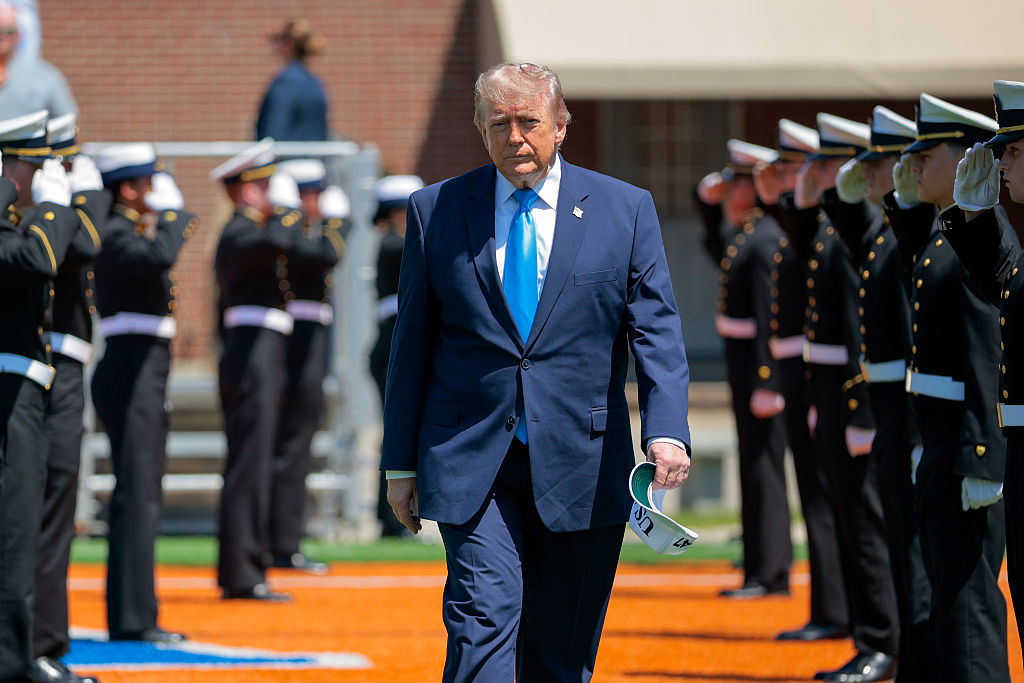
The US military is high-tech, dependent on airpower, bogged down with vulnerable, expensive fixed-capital assets in dangerous regions, and attached to a casualty-averse society with little trust in state institutions to make life better at home or abroad. (Chip Somodevilla / Getty Images)
The American-Israeli war on Iran has not been going to plan. The sweeping assassination campaign and massive aerial bombardment of Tehran’s military and civilian infrastructure did not cause the Islamic Republic to crumble in the opening days of the conflict, and its ability to wreak havoc on American bases and allied energy infrastructure in the Persian Gulf has caught Donald Trump, Pete Hegseth, and their key advisers by surprise. Allied governments in London, Rome, Ottawa, Islamabad, and Seoul have mostly shied away from direct support.
Most of all, Iran’s ability to effectively control maritime traffic flows through the Strait of Hormuz has brought the world economy into a deep crisis that may take years to fully recover from.
Iran’s de facto control over a central artery of global capitalism also punctures the image of American global hegemony. If the United States is unable to ensure free passage through a major conduit for global energy supply and food production, then of what use is American dominance to its key partners across Asia and Europe?
Moreover, the Hormuz crisis itself was precipitated by an unnecessary and ill-conceived adventure undertaken by a pair of increasingly rogue international leaders in Trump and Benjamin Netanyahu. This only increases global perception that the United States is not a stable and farsighted steward of global capital but a cruel and bumbling international saboteur. The particular outcome of this conflict still remains unclear, but the Iran crisis has demonstrated the fundamental weakness of the American global project.
Rumblings of American imperial decline have gotten louder in Western political discourse. This moment is read as an “American Suez Crisis,” an inflection point that demonstrates that American global hegemony, much like the British before, is past the point of no return. From “America First” reactionaries to the anti-imperialist left, arch-realists in international relations departments to liberal op-ed columnists, there is an emerging consensus that the Iran crisis has revealed a deep rot in the mechanisms of the American imperium and the new multipolar world order emerging from its ruins.
This rough consensus leaves many questions unanswered though: How did American global hegemony arise in the first place? What were the mechanisms of its reproduction? How and when did this decline begin? And what might the United States and the world look like in its aftermath?
To address these questions, we can turn to the work of the late American sociologist Richard Lachmann and his synthesis of political Marxism, world-systems theory, and sociological elite theory in the 2020 book First-Class Passengers on a Sinking Ship .
Lachmann argues that global hegemony is a relatively rare condition in which a single state is able to set the geopolitical and economic agenda on a worldwide scale. States achieve global hegemony when domestic elites are able to institutionally manage their competing interests in order to mobilize the collective resources of their societies to project power and coordinate other elites at the necessary planetary scale. American global hegemony, forged in the crises of the 1930s and ’40s, had unraveled by the early 2000s; it seems to be nearly dead in the 2020s. Changes in the American political economy in the latter twentieth century resulted in more autarkic and predatory elites who increasingly lack the capacity to engage in collective action.
Understanding the limitations of US power in the Strait of Hormuz requires an analysis of coordination and conflict between competing factions of ruling class power in the United States and how their changing relations with the American state, finance capital, and foreign ruling classes have progressively constrained their ability to shape the world.
What Was American Hegemony?
While many thinkers use the term “hegemony” to describe the influence that one social formation has over another, Lachmann follows world-systems theorists like Giovanni Arrighi and Immanuel Wallerstein in a more specific meaning. In First-Class Passengers, hegemony refers to the ability of a state and its ruling class to set the terms for trade, finance, and geopolitics around the world.
Global hegemons are not simply large empires that conquer or extract resources from less powerful societies. They also influence other powerful states and structure global finance, trade, and geopolitics in such a way that most other powerful global elites find participation in those structures to be in their own interests. In the wake of World War II, American elites created durable, asymmetric, and mutually beneficial relationships with the ruling classes of other core and semiperipheral regions that resulted in a system of American military bases, dollar dominance, and global trade.
This tracks with a certain reading of Antonio Gramsci, in which hegemony is understood as class leadership, the ability to marshal consensual power alongside raw coercive power, where the interests of one class become understood as the interests of the national or international totality. Overwhelming American military dominance after 1945 was the fundamental enabling condition of its hegemony, but it was sustained because groups of elites in London, Riyadh, Frankfurt, and Tokyo understood their own interests as fundamentally aligned with the systems of American-led global capitalism.
Crucially, First-Class Passengers departs from Arrighi’s and other accounts of “great power cycles” by insisting the global hegemony is not a structural outgrowth of “waves” of capitalist development, nor is it a torch handed automatically from a declining hegemon to a rising one. Rather, hegemony is somewhat contingent, and the roughly five-hundred-year history of global capitalism has featured extensive periods of nonhegemony or multipolarity.
Lachmann dates the Dutch hegemony to a brief few decades in the mid-1600s, while British elites were able to reform and reconstitute their hegemony with institutional flexibility over a much longer period, stretching from roughly the mid-1700s through the late 1800s. The American hegemony, though impressive in its global scope and intensity, was more like the Dutch in its brevity, lasting from 1945 through the early 2000s.
But the varying fortunes of different global hegemons throughout history beg the question: What causes these colossal imperial powers to build and then lose their hegemonic status?

From Elite Coordination to Elite Conflict
For domestic elites to accrue power and influence people in other territories, they need to develop mechanisms to balance intra-elite competition. Struggles between different firms, sectors, geographical bases, or ideological and cultural blocs constitute a constant, centrifugal force that threatens ruling-class power projection. To understand America’s inability to shape events in Iran or even to set agendas in friendly capitals across Europe and Asia, Lachmann reminds us to look first at the disintegrating mechanisms of domestic elite coordination.
This approach challenges dominant assumptions about states that pervade most political analysis. States are not preexisting, solid objects that simply represent the interests of their nations. Rather, states are archipelagos of institutions that are, in the words of Nicos Poulantzas, “material condensations” of the relations of power between classes and class fractions.
Global geopolitics is not best understood as a “game of nations” or a system in which certain countries exploit other countries. Instead, imperial power consists of interlocking contests and compromises between different classes and the institutions that they attempt to build, mobilize, and reconfigure to advance projects that serve ever shifting perceptions of their own interests. And elites’ ability to lead and shape global affairs does not primarily stem from their omnipotence or conspiracy in smoke-filled rooms but from the coherence of institutional arrangements that develop in the context of inter- and intraclass conflict.
The institutional architecture of postwar American hegemony was forged during the New Deal and World War II, in which the twin traumas of Depression and total war transformed the American state and economy. First-Class Passengers specifically identifies the roots of elite stability in New Deal regulations that siloed national-level firms from state-level firms across a wide variety of industries as a method for safeguarding against financial panic. These regulations also helped balance and entrench different firms and industries against each other, keeping any one sector from becoming too powerful while allowing firms to build stable relations with local congressional representatives, who would in turn protect their interests in congressional horse trading. Counterpressure from organized labor helped stabilize the system further, providing a check on American big business within and between major sectors.
The institutional infrastructure of the postwar American business class was buttressed by an unprecedented consensus among American elites on the legitimacy of New Deal state institutions, Cold War anti-communism, Keynesian macroeconomic management, and the pursuit of scientific and expert-driven solutions for managing social life. Unprecedented gains in standards of living and technological achievement seemed to give elites the domestic support and resource base they needed to shape global events in the immediate postwar era.
Lachmann argues that intra-elite conflict escaped containment because of the wave of mergers that swept through American businesses beginning in the late 1960s and expanding into the ’70s and ’80s. As corporate consolidation advanced, aided by deregulation and the crisis of American labor, the tight but widely dispersed linkages between firms and political representation began to disintegrate. Firms made increasingly predatory moves against labor in their companies and competitors within their industries and became increasingly predatory vis-à-vis other sectors of capital.
As these balancing mechanisms broke down and increasingly autarkic elites acted with impunity against the working classes and each other, the political arrangements that buttressed American hegemony began to wane. As Paul Heideman argues in his recent book Rogue Elephant, these economic dynamics have reshaped the Republican Party, the traditional party of American big business. Republican political elites have increasingly accessed money directly from donor networks rather than institutions — the Republican National Convention and its committees, the Chamber of Commerce, and even PACs themselves — designed to coordinate common class and political power.
Comparing the buildup to the 2003 Iraq War to the current war in Iran reveals the degeneration of American-led elite coordination. On the domestic political front, the Trump administration and its outriders put negligible effort into cultivating elites from media, energy corporations, Wall Street, universities, and think tanks. Consider the monthslong campaign orchestrated by the George W. Bush administration that beat the drums of war across in every corner of American life, leveraging the wounded nationalism of post-9/11 America and the apparent early success of the Afghanistan war to build strong majorities in public opinion and across key sectors of the elite.
The international scene offers stark contrasts as well. The “Coalition of the Willing” included meaningful troop and matériel commitments from key G20 countries like the UK, Italy, South Korea, and Australia. Colin Powell made his infamous presentation at the United Nations Security Council in an attempt to win international approval for US warmaking. In both the 1991 Gulf War and the 2003 Iraq War, George H. W. Bush and his son demanded Israeli nonparticipation in order to help consolidate allies across the Arab world into either active support or sympathetic neutrality.
Trump, on the other hand, launched his assault on Iran after sole coordination with Israel, leaving key regional and international allies completely in the dark. In the short term, Gulf Cooperation Council countries may be pushed toward greater hostility with Iran and deeper dependence on the United States. But the Iran crisis has permanently altered the calculation of their elites regarding the terms of their bargain with the United States as a guarantor of regional trade and security.
If the United States’ neglect of its Gulf allies is an indicator of its declining hegemonic influence, then so is its unprecedented relationship with the elite of another Middle Eastern ally: Israel. Lachmann identifies the relations between subimperial elites and elites in the hegemonic core as major potential sources of destabilization. Although Israel is by no means America’s most essential economic or militarily ally, our ruling elites have become integrated to an astonishing degree. In key sectors of our military-industrial complex like technology, intelligence, policing, university research, and weapons manufacturing, groups of Israeli and American elites have become increasingly entangled. The Trump administration features an even more extreme overlap than any previous presidency.

American political discourse has recently overheated on the question of Israeli influence over the American state. While pro-Israel governmental lobbying, Evangelical Christian Zionism, and the traditional support of key Jewish American communal institutions and leaders clearly play a role in shaping American policy, the focus on the directionality of influence misses the bigger picture. Because of the long, durable, and mutual relationship between the two nations’ military-industrial complexes, key segments of the American ruling class understand their own interests as inherently linked to those of Israeli military, intelligence, and tech institutions.
Unfortunately for the American ruling class, as Israel becomes an increasingly rogue state in the Middle East, its elites’ deep entanglement with the United States restricts America’s ability to act in ways that benefit other regional power players. And here at home, the Israeli-American entanglement degrades American popular trust in state elites in ways that further diminish the political resources available to them.
The Curious Demise of American Hard Power
For all the incoherence of American elites, the US military remains the largest and most technologically advanced armed force in the history of humanity. Why, then, does it seem incapable of winning wars against much weaker foes?
Lachmann points to incentives within the military itself, in particular the structures for officers’ career advancement and retirement. He grounds this in the somewhat counterintuitive but compelling observation that US military officers do not primarily command troops but rather weapons systems. Advancement up the chain of command is closely related to ambitious officers’ abilities to master knowledge of expensive, complex, high-tech weapons systems and to lobby for expansion and increased funding for their hardware.
This makes for a good and relatively stable career: these systems tend to stay in one location and tend not to be used in the messy and labor-intensive counterinsurgency operations that have become the actual task of American combat operations since Vietnam. After retirement, this expertise and proven bureaucratic finesse becomes a lucrative asset when those officers take jobs with or consult for the very military contractors who sell those systems. And of course, those same contractors earn much higher profit margins on capital-intensive, high-tech weapons than on lower-tech and more disposable ones.
Because of the way that military brass and arms manufacturers work, the weapons systems procured by the US military tend to not be particularly useful for the wars that America actually fights. Mainstream commentators are correct in the common assessment that the United States is foolishly prepared to fight a fictional ground war against the Soviets in Central Europe. But the reasons for this posture have less to do with outdated doctrine or hangovers of Cold War ideology and more to do with the institutions and incentive structures for military elites in both the state bureaucracy and the private sector. Dwight D. Eisenhower was correct that the development of a public-private military-industrial complex posed a threat to our democratic institutions, but it also ironically became a key limitation in the ability of the American military to police its global hegemony.
Despite this dysfunction, the war on Iran has confirmed the capacity of American (and Israeli) airpower to inflict mass damage on military and civilian infrastructure. But the use of airpower alone runs into a series of obstacles. Iran has used inexpensive drones and ballistic missiles, launched from mobile and hard-to-bomb trucks and speedboats, to retaliate against US bases and Gulf energy infrastructure. While Israeli-American bombers can decimate stationary Iranian military bases, Tehran’s ability to project power into the Gulf relies on more disposable and mobile technologies that avoid airpower countermeasures.
Even before the advent of cheap drones, there was scholarly consensus on the political limitations of airpower. Robert Pape’s work catalogs the 100 percent failure rate of attempted regime change through airpower alone. Ground troops are necessary for that type of operation, and despite his general cluelessness, Trump is acutely aware of the domestic political fallout of ground war.
We might scoff at Pete Hegseth’s denunciation of a weak and “woke” military, reminiscent of postdefeat “they wouldn’t let us fight” narratives spun by German reactionaries after World War I or Americans after Vietnam. But the kernel of truth is that, aside from the industrialized total war of World War II, the United States military has never trained its full capacity on a targeted nation. That’s because war is fundamentally political.
The United States military clearly has the technical capacity to incapacitate Iran’s water, energy, and transportation infrastructure, which would sooner or later result in the collapse of the Islamic Republic and Iranian civil society generally. But what goals would that achieve? How much damage would American assets and personnel absorb? Which groups of key American elites would benefit from that situation? How could elites across Europe and Asia be persuaded that such action would advance their interests?

These are the questions that arise when small cliques of American and Israeli state elites — insulated not only from popular democratic forces but even counterbalancing forces within Wall Street, the petrochemical industry, and the military and intelligence bureaucracies themselves — launch massively destructive military actions without even pretending to consider the interests of the domestic and regional power centers that American global influence depend on.
The United States military is a high-tech, airpower-dependent force, laden down with vulnerable and expensive fixed-capital assets in dangerous regions, attached to a casualty-averse society whose population (and increasingly its elites) have little trust in state institutions to make life better at home or abroad.
The World After American Hegemony
The global bloodshed and authoritarianism of the American hegemony is nothing to be nostalgic for. And even on a practical level, an agenda for American hegemonic revival is a complete dead letter. But that doesn’t mean that socialists in the United States and abroad should be blithely optimistic about the end of American hegemony. The track record of posthegemony, both for the former superpower and the rest of the world, is one of inequality and conflict.
In the case of the Dutch and then the British, Lachmann traces posthegemonic periods that featured extended periods of kaleidoscopic global conflict anchored by rising hegemons-in-waiting. After the eclipse of the Dutch, Britain and France engaged in what amounted to a century of warfare spanning every continent. The War of the Austrian Succession, the Seven Years’ War, and then eventually the wars of the French Revolution and Napoleon resulted in clear British victory, in military terms but even more so in commercial terms. After the British hegemony had declined by the late nineteenth century, it was the rising industrial powers of the United States and Germany that vied for global hegemony. The massive global conflagrations of World War I and World War II confirmed the United States as the key coordinator of global capital accumulation.
This framework has some clear relevance for our current moment but also some key differences. On the one hand, an emerging multipolarity certainly multiplies the danger of open warfare between industrialized powers competing over regional spheres of influence. There is also the high likelihood of regional hegemons exercising raw power on weaker states within their spheres. But there is also a key departure from past nonhegemonic periods: there are no aspiring hegemons jockeying with each other to take the throne.
China is the only country with any capacity to challenge for the position of global hegemon. But, for a variety of reasons, its ruling elites seem uninterested in that task.
First, the unprecedented interdependence of the Chinese and American economies, even in the context of their growing strategic rivalry, presents a pretty steep barrier to open conflict. Although certain more aggressive factions within the People’s Liberation Army might feel emboldened by America’s disastrous war in Iran, key segments of Chinese elites in the party-state and major allied firms seem reluctant to attempt to disrupt a system that has facilitated their world-historic rise. While China clearly wants to cement its place as the East Asian hegemon and a top player in global trade, infrastructure, and technology, that is a far cry from the type of global hegemony exercised during the American (half-)century.

More to the point, even if Chinese elites manage to expand their global trade, infrastructure, and military footprint through Belt and Road and similar initiatives, China’s financial system is ill-equipped to coordinate global capitalism, a key requirement for global hegemony. The People’s Republic of China’s leadership sees its system of capital controls, active stock market management, and lack of free convertibility for Chinese currency as essential for domestic political and economic stability. But those policies render China’s financial system incapable of providing the depth of liquidity and flexibility necessary to become the steward of a global reserve currency or banking system.
Indeed, the value of American financial institutions for global capitalism has arguably deepened over the past twenty years. During both the 2008 and 2020 financial crises, the Federal Reserve demonstrated its central role in coordination and liquidity provision in the global economic system. While there has been some chatter about the Iran war and the “petrodollar” system, political economists Stephen Maher and Scott Aquanno point out that global oil flows are priced in dollars because the dollar is world money and not vice versa. State and corporate elites around the globe still see the Federal Reserve and the dollar system as institutions that massively reward their participation. The lack of a plausible successor to American hegemony in the financial sphere means that, for the foreseeable future, American finance remains central to global capitalism.
On the domestic front, Lachmann’s study of posthegemonic Britain and the Netherlands does not provide any particular case for optimism. In the immediate aftermath of losing their status, these nations did not become wealthier and more equal. But they don’t offer conclusive formulas for predicting the United States’ trajectory in the coming decades.
While a further entrenched “disaster nationalism” is certainly high on the menu, widespread domestic opposition to the Trump regime — its economic policies, its foreign policies, its immigration policies — show a political alternative. If movements on the streets, in our workplaces, and at the ballot box push the United States toward a less warmongering, more social democratic, and more inclusive political future, we may be able to play a more constructive role among a community of nations.
The road to a truly democratic and socialist global future is arduous, but if progressive and working-class politics can rein in our rogue elites, a posthegemonic United States has a shot at playing a positive role in that journey.