Unable to Accept Defeat, Donald Trump Presses On in Iran
Iran has destroyed much of the US’s military infrastructure across West Asia and strengthened its position by controlling the Strait of Hormuz — yet Trump has learned nothing from his defeat.
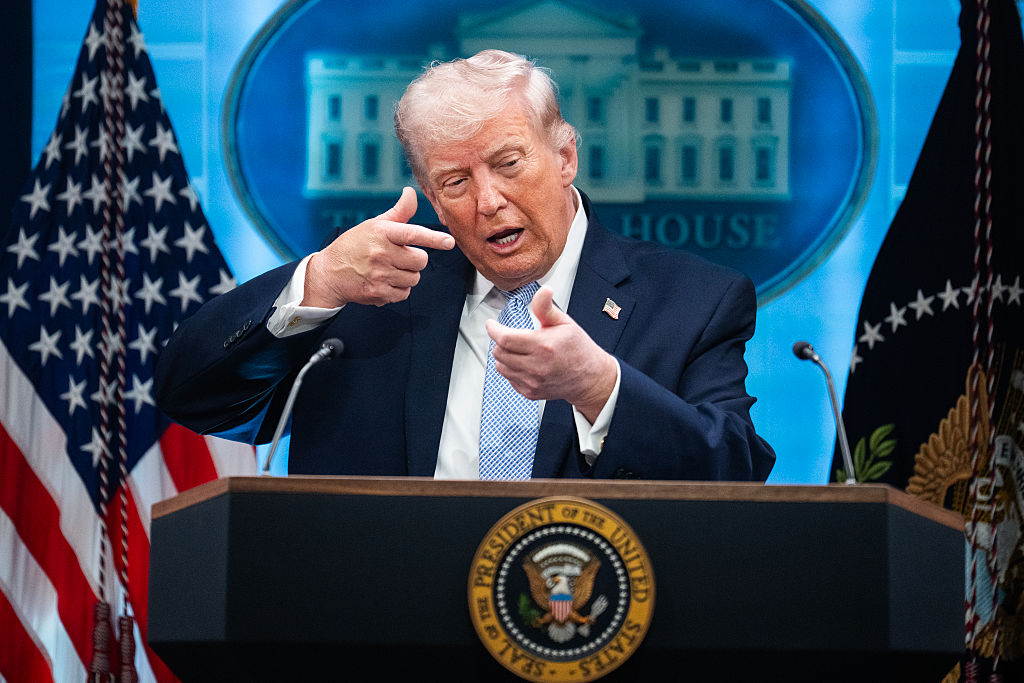
The vaguely worded Memorandum of Understanding that the US and Iran signed last month failed to put the war to an end. But some way or another, Donald Trump will have to accept American defeat and arrive at a settlement the Iranians can live with. (Tom Williams / CQ Roll Call via Getty Images)
The symbolism was hard to miss. Tens of millions of people on the streets in cities across Iran and Iraq trying to catch a sight of Ali Khamenei’s coffin during his weeklong funeral. Khamenei had been Iran’s supreme leader for almost four decades until his February 28 assassination by Israel on the first day of the US-led war. In the run-up to America’s and Israel’s war on Iran, Donald Trump, sounding very much like George W. Bush, suggested that his bombing campaign would be welcomed by the Iranian people.
But the very crowds the Trump administration had expected to overthrow the regime instead turned out to honor it. Meanwhile, Trump, unpopular and neurotic about crowd sizes at his own events, spent the week pressuring FIFA to reverse a US player’s red card, branding Iranians as “scum,” and launching a fresh and ongoing bombing campaign in southern Iran.
“I think it’s over,” Trump told reporters on July 8, referring to the Memorandum of Understanding (MOU), a document that he had signed along with Iran as the basis for a lasting peace accord. “I don’t want to deal with them anymore, they’re scum. They’re led by sick people and they’re vicious, violent people.” Trump was responding to cruise missile attacks by Tehran the previous day against three ships attempting to cross the Strait of Hormuz, the choke point that Tehran weaponized against the US-led economic order in the early days of the war, and through which a fifth of the world’s oil and gas and a third of its fertilizer passes. The attacks preceded several skirmishes, which appear to have resulted in the death of US naval Commander Gabriel Edwards following a helicopter crash near Iran on July 1. In response, Trump removed the waivers on sanctions on Iranian oil and notified Congress that he was launching a new war in Iran.
Central to the MOU, the framework for peace-building between the United States and Iran, is the reopening of the strait, but the language in Article 5 is ambiguous. It is what Al Jazeera’s Ali Hasham described as “a memorandum of misunderstanding.” It stipulates that “the Islamic Republic of Iran will make arrangements using its best efforts for the safe passage of commercial vessels, with no charge for 60 days only, [through the Strait of Hormuz].”
Iran established the Persian Gulf Strait Authority to manage the passage of shipping through the strait by inviting shipping companies to register details online and await approval. But the United States has also sought to establish a “southern corridor” through the strait’s Omani waters, defended by the US Navy, which, if consolidated, would deprive Tehran of its major leverage over the global economy and therefore the United States. Concerned over the threat to its leverage in future negotiations with the United States, both over its nuclear program and the presence of US military assets in the region, Iran attacked, citing a violation of the MOU.
Iran believes that it has militarily defeated the United States and Israel, a view shared by the vast majority of Israelis. US military infrastructure in the Persian Gulf and Jordan is in ruins following thirty-nine days of intense fighting, which drew to a close with the ceasefire on April 7. Trump appears to be incapable of accepting this reality, which he must do to guarantee any lasting peace.
On July 13, the president announced that he would reimpose the US blockade of Iranian shipping imposed just after the ceasefire, another violation of the MOU. In a flurry of Truth Social posts even beyond the standard level of derangement, Trump declared on July 13: “Everything in Iran belongs to America,” he wrote. “The oil, the gold, the food, the gas, we will take it all.” In another post, he wrote that “The Hormuz Strait is OPEN, and will remain OPEN, with or without Iran.” In a third post, he wrote that the Hormuz was controlled by the United States, which would charge a 20 percent toll on all shipping.
This volte-face by the United States is mystifying in and of itself but also for its eerie sense of unreality. Until now, the United States has been consistent in its demands for freedom of shipping and has pushed back strongly on statements by Iranian officials that Tehran would exact a 1–2 percent fee on all cargo to pay for reconstruction of the country. It is Tehran, not Washington, that controls the strait on account of geography and the commercial nature of shipping, as has been demonstrated again in recent days.
Iran can simply spook shippers and insurers by harrying shipping with drones and cruise missiles, while providing safe passage for its own ships — and those of Iraq — heading to East and South Asia. Even if the United States were to wage a full-scale ground invasion of Iran, Iran — either its state or non-state actors — would still maintain the ability to close the strait.
Trump’s refusal to engage with the material reality he has created means that it is likely the United States and Iran will remain in an ambiguous state between war and peace for the foreseeable future. Iran has made no statement to the effect that the MOU is over, and even Trump’s remarks were equivocal — he thinks it is over. By dint of necessity, the MOU will continue to condition future engagement between the United States and Iran and, while it may be violated with threats of violence, tit-for-tat attacks, and Israel’s occupation of Lebanon, it is unlikely to be rescinded or made a dead letter by a return to broad warfare.
In many senses, the United States and Iran are returning to a dynamic that preexisted this conflict. Mojtaba Khamenei is understood to share the same foreign policy outlook as his father, who modulated violence in Iraq and Syria to avoid full-scale broad war. This strategy ultimately failed with the decapitation of Hezbollah and the installation of al-Qaeda leader Ahmed al-Sharaa in Syria as the head of state. But while the so-called Axis of Resistance is degraded, Iran holds a considerably stronger card in the Strait of Hormuz.
Tehran saw off attacks by two nuclear powers and now has the ability to control the flow of vital commodities, and therefore create inflationary spirals in Europe and the United States. Politicians in Iran frame the war as existential and pursue tactics that deprive its enemies the stability they took from it. Global oil inventories, including those in the United States, are nearly empty, as Trump himself said three weeks ago when he signed the MOU.
In the long term, Tehran seeks to use its newly gained leverage to reconfigure the security constellation of West Asia without the United States. A pragmatic alignment appears to be emerging between Iran, Turkey, Pakistan, and Arab Gulf states. Analysts informed on elite thinking in the Middle East say that the ultimate goal is to stop joining international blocs against one another and instead to pursue indivisible security modeled on Europe’s 1975 Helsinki Accords, in which the security of all actors is recognized as interdependent, and no single state should be strengthened at the expense of others. Trump may not wish to deal with Iran, but it is clear after months of war that he has no other choice.