Wartime Iran’s Political Transformation
The US-Israeli war on Iran has strengthened the power of a section of Iran’s elite that earns money in dollars from the sale of oil and petrochemicals. This has unified the state and its elite around an anti-imperialist project but at the cost of permanent austerity.
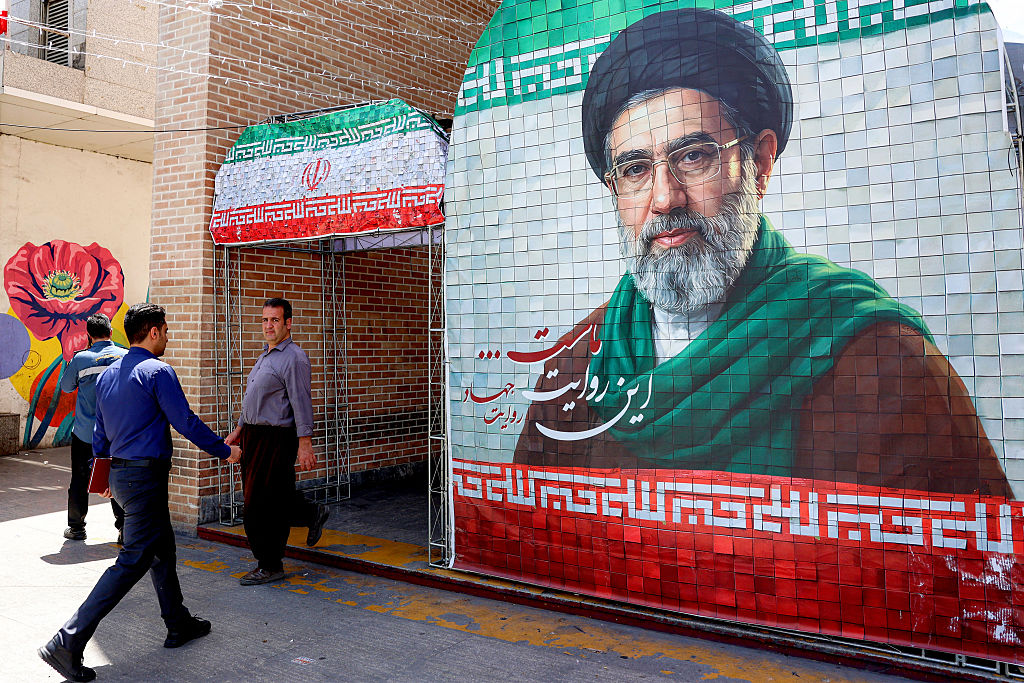
The choice presented to every Iranian is no longer about fiscal policy or subsidy reform. It is about sovereignty versus incorporation into an imperial order that already governs much of the region. (AFP via Getty Images)
For seven weeks, American and Israeli air power dominated Iranian skies. High-altitude surveillance, precision strikes on military infrastructure and apartment buildings in Tehran, and near-uncontested flight paths defined the opening phase of the conflict. Iran absorbed the blows and responded not with the guerrilla tactics of Baghdad’s roads but with long-range missiles, mass-produced drones, and a defensive posture that held the line.
In the final days before the ceasefire, an F-15 and an A10-warthog were downed by optical tracking systems. Whether this was a replicable technical achievement or a fortunate anomaly remains to be seen. What was not ambiguous, however, was the fact that Iran was able to close off the Strait of Hormuz to maritime traffic. In response, global energy markets convulsed. The war had become a world event.
Politics also shifted in Iran. Just a few months ago, in January, the main question there was economic. Inflation. Housing. The price of food. The Masoud Pezeshkian government’s austerity package had hollowed out household budgets and sent tens of thousands into the streets. Today the question is imperial. The war has not erased material suffering — it has reframed it. The choice presented to every Iranian is no longer about fiscal policy or subsidy reform. It is about sovereignty versus incorporation into an imperial order that already governs much of the region.
Donald Trump’s ill-advised war has revealed Iran as a unique formation in modern history: a neoliberal anti-imperialist state. Austerity at home, resistance abroad. On paper, a contradiction, in practice, the state’s operating logic. This is why Iran oscillates between protests against austerity and displays of national solidarity — sometimes within the same month.
The Economic Trigger
This war began in March 2026. Its narrative justification, however, was forged months earlier. In December 2025, the Pezeshkian government — usually not one to make waves — implemented four consecutive financial decisions that together amounted to a harsh and sudden austerity package.
First, a gas price adjustment. Gasoline in Iran remains heavily subsidized; the hike was marginal in absolute terms. But the decision was bold by Tehran’s standards. The last increase, six years earlier under Hassan Rouhani — who was president of Iran between 2017 and 2021 — had triggered violent protests. The move was seen as a signal that the state was willing to touch the untouchable.
Second, a proposed budget that capped public sector salary increases at 20 percent, well below the prevailing inflation rate. This benchmark also disciplines private sector wages, compressing the purchasing power of the salaried middle and working classes across the economy.
Third, an increase in the value-added tax (VAT), a regressive consumption tax, meant the poor and the working class would pay more for daily necessities while heavy tax exemptions for large corporations and religious institutions remained untouched.
Fourth, and most consequentially, the government raised and unified the foreign exchange rate. The official rate jumped nearly 50 percent. Iranian purchasing power fell by the same margin. At the same time, the subsidized dollar for essential food imports — long understood as the state’s baseline promise to keep its people fed — was eliminated. Bread, cooking oil, and medicine were suddenly priced as if Iranian families earned in dollars. The shock was immediate and devastating.
These policies are not random, nor are they specific to the Pezeshkian presidency. They are the local expression of a doctrine that has shaped Iranian economic policy for three decades. The 1979 revolution was a popular project with redistribution at its core. But since the Akbar Hashemi Rafsanjani presidency (1989–1997), the state has slid steadily toward a regime of austerity and upward redistribution.
The slide in living standards became a plunge under Mahmoud Ahmadinejad, who oversaw the large-scale privatization of oil, steel, and petrochemical assets. These were not sold to a competitive free market. They were transferred to a constellation of government-linked “private” entities — pension funds, opaque conglomerates, institutions whose balance sheets blur the boundary between public wealth and private accumulation.
This is where the story of Iranian austerity departs from its neoliberal counterpart in the West. In the United States or Britain, neoliberalism meant deregulation and free trade. In Iran, it meant something else: the quiet unmaking of the revolution’s foundational promise. The 1953 coup, the 1979 revolution, and the decades since have all turned on a single question: Who owns the national resources, and who benefits from them?
Mohammad Mosaddegh answered: the people. The revolution answered: the people. But over thirty years, the downstream products of crude oil — plastics, petrochemicals, motor oil, industrial feedstocks — were gradually transferred out of public ownership and into the hands of the same state-linked entities. Gasoline remained subsidized, a symbolic reminder of the old compact, a few cents per liter to keep the memory of nationalization alive. The value-generating products were privatized.
These products are priced to compete with global markets, even though Iran is cut off from those markets by sanctions. This is the irony at the heart of the system: The state enforces global pricing discipline on its own population while being excluded from global trade. Meanwhile a small oligarchic class of Iranians earns in dollars and pays labor in devalued rials.
When Trump tore up the Joint Comprehensive Plan of Action deal negotiated by Barack Obama and imposed maximum pressure, the rial began to collapse. The dollar-linked oligarchy was insulated. Many profited. The wage-earning population absorbed the entire shock. The pain of devaluation was socialized. The benefit was privatized.
This is the logic of neoliberalism, whatever name one gives it. The national resources that were once nationalized are no longer. The spirit of Mosaddegh lives on at the gas pump. It dies everywhere else.
By December 2025, the material conditions for unrest were fully formed. The pressure points were food and housing, not gasoline. Inflation was at record levels. The state had imposed a regressive tax regime while protecting the asset-holding class that sanctions had paradoxically enriched. The question in the streets was economic. It was about distributive justice. It was about who pays for the state’s survival.
January’s Tragedy
The protests began in rural areas and the bazaar and spread to major cities within a week. What started as an expression of economic grievance was rapidly transformed by external intervention. Fanning the flames, Reza Pahlavi, the exiled son of the deposed shah, issued a public call for escalation. Iran International, the satellite channel with documented ties to Israeli intelligence networks, amplified the protests and provided tactical coverage.
What followed was the greatest tragedy in contemporary Iranian history. Over the span of two days, thousands lost their lives, and many more were injured. The details of the crackdown are grim and well documented elsewhere.
Both the state and the Pahlavi camps had an interest in burying the economic angle. The protests were swiftly reframed as a civilizational clash: Islamic Republic versus monarchical restoration. Both sides gained from this framing because neither could offer a credible answer to the material grievances that had brought people into the streets. Neither had redistributive policies to propose. Neither wanted to talk about the VAT hike, the forex shock, or the rising price of food and rent. So they didn’t. The economic origin story was erased. And so January became about security and treason for one side and freedom and democracy for the other.
Trump Has Joined the Chat
Many Iranians believe that if Trump and Benjamin Netanyahu had not intervened, the freedom-and-democracy narrative might have played out on its own, triggering one internal crisis after another until something gave way. But Netanyahu had no interest in a resolution of the crisis and instead saw it as an opportunity to play his hand. He pitched bombing Iran to Trump. And Trump, always looking for an easy win, fresh off what he considered a competent, clean victory in Venezuela, decided that now was the time to attack.
As we now know, the attack was neither competent nor clean. It did not achieve regime change. It did kill innocent people, including 168 schoolgirls on the first day. That fact alone did more to bolster the state’s anti-imperialist narrative than any speech or sermon could have. The state claimed the moral high ground of defending national sovereignty against two of the strongest militaries on earth. The opposition to the state, particularly its exiled leadership, and even those in Iran that have given up on reform, framed the moment as a war against darkness and autocracy.
When President Trump threatened to blow up bridges and power plants, ordinary people formed human chains around these facilities in an effort to protect them. These were not Islamic Revolutionary Guard Corps soldiers or state-backed militias. They were the same people whose purchasing power had been halved by the forex unification. The same people who had watched their salaries stagnate while inflation reached record levels!
In other words, the war created a binary that had not existed with such clarity before. Side A: the Islamic Republic — however flawed, however economically unjust, however brutal in its internal repression — but the defender of the land and of sovereignty. Side B: the Pahlavi project and its imperial backers, offering less sovereignty but a seat at the empire’s table.
It might seem strange to some, but there is a significant section of the Iranian population who want their country to disengage from its broader commitments to its regional allies and adopt a position closer to Israel’s. Israel has over the last three years killed tens of thousands of Palestinians in Gaza and the West Bank. But for some Iranians, its existence is proof of concept: a non-Arab, non-Christian state in the Middle East that has not only been accepted as part of the American project but one that can shape policy. For these Iranians, the goal is not necessarily a return to Iran’s glorious monarchy. It is to set aside isolationist policies in favor of integration into the current world order, whatever the cost.
This group has no formal representation in Iranian politics. Its adherents view the current system as fundamentally closed to change and therefore conclude that a complete overhaul is preferable to reform. It is too soon to tell whether the war and the damage to civilian infrastructure have caused any meaningful portion of them to regret their earlier position. A great many Iranians have rallied around the flag in the face of foreign attack.
But for Iranians opposed to their country’s anti-imperialist foreign policy, the question is likely to be a partisan one. Rising unemployment and worsening economic conditions lead them, paradoxically, to conclude that the military should have surrendered early and left the Strait of Hormuz open, that the cost of resistance is simply too high. For some of them, this position would become untenable if sanctions were actually lifted. But that is a big if, and the future is deeply unpredictable.
Even though the narratives put forward by the Iranian state and its critics have successfully set aside economic issues, at the core the war is still about material gains. The anti-imperialists see this war as a way to negotiate an end to sanctions and to turn the Strait of Hormuz into a source of revenue — the Majles, Iran’s legislative body, is already working on a bill to allocate 70 percent of toll revenue to household living costs. The Pahlavi backers, who have watched the Saudis and Emiratis rise over the past decade with envy, also want the sanctions lifted and to see a prosperous Iran. They simply believe that integration into the imperial order is the best and most stable way to see relief.
Both sides want the sanctions gone. Both sides want the economy to breathe. The difference is the price they are willing to pay. One side will pay in austerity. The other will pay in sovereignty. The war has made everyone choose which currency they prefer.
The False Choice
The moment we are witnessing now is not an accident. It is not a policy choice that can be reversed with a new president or a new parliament. It is the structural outcome of decades of sanctions and the state’s chosen method of surviving them.
A genuinely anti-imperialist state — one that was transparent, redistributive, and funded by broad-based taxation rather than opaque oil sales — would require a different relationship with the global economy. But Iran has been cut off from that economy for most of the past forty years. It cannot openly sell its oil. It cannot openly buy weapons or technology. It survives through deception: a dark fleet of tankers, front companies in third countries, missile programs that exist nowhere on official budgets. This opacity is not incidental. It is the condition of survival.
And opacity has consequences. When the state must hide its revenue and its spending, it cannot be held accountable by its own population. The same mechanisms that hide oil sales from American sanctions enforcement also hide them from Iranian taxpayers. The state cannot be transparent to its people without becoming transparent to its enemies. So it chooses opacity. And opacity breeds extraction.
The austerity measures of December 2025 were not a betrayal of the anti-imperialist project. They were its logical extension. Devalue the rial to stretch the budget. Put in place a regressive tax so ordinary people pay more. Protect the dollar earners because they are the ones moving oil through the dark fleet. The neoliberal half and the anti-imperialist half are not in tension. They have become one and the same.
And what would sanctions relief bring under either option? Neither the Islamic Republic nor its exiled opposition has shown any commitment to distributive justice. Both are embedded in the same dollar-linked networks, just with different patrons. If sanctions are lifted, the oligarchy will capture the benefits. Ordinary people will see some improvement. The rial will stabilize. Inflation will be better managed. But the underlying structure — the fusion of state power and private extraction — will remain. The war forced a choice between two fractions. Neither offers what ordinary Iranians actually need: an economy that works for them, not just for the people who own it.