We Are Watching the Rise of Democratic Fascism

Carolin Amlinger
Oliver Nachtwey
Loren Balhorn

Bertolt Brecht predicted it in 1942: American fascism would be democratic in the American fashion. He was right. That's precisely what makes it so hard to stop.
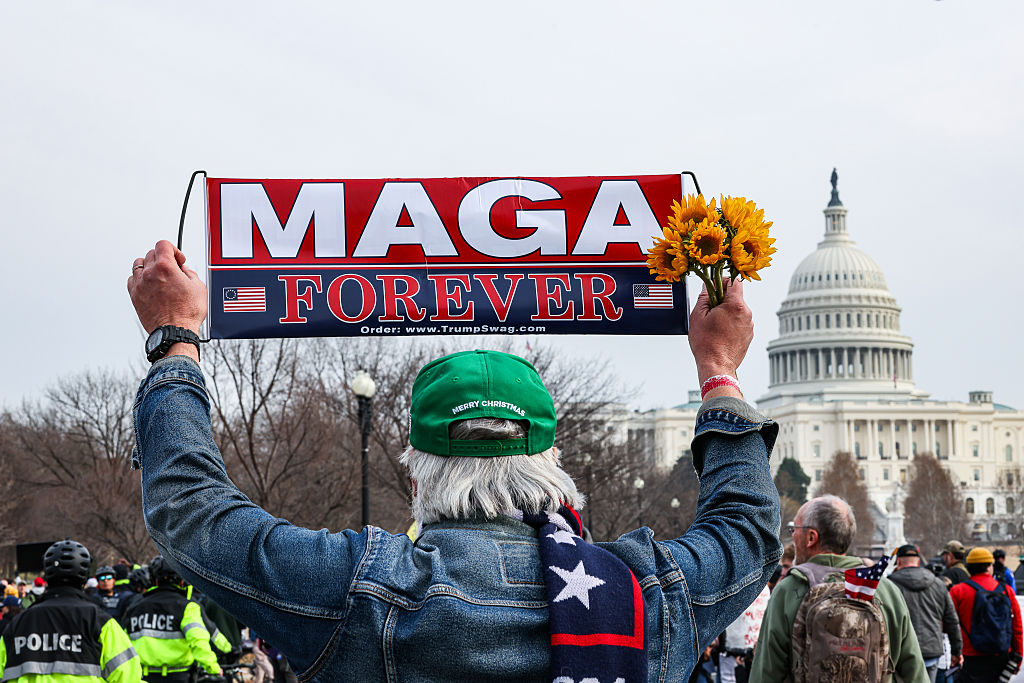
A demonstrator holds a sign that reads "MAGA Forever" outside the US Capitol, marking the fifth anniversary of the riot on January 6, 2021.

Trump was able to gain power by addressing a structure of feeling — a profound alienation from capitalist modernity. He is the perfect resentment entrepreneur, both as a producer and as a representative. The Left has not yet found an effective, durable response. (Valerie Plesch / Bloomberg via Getty Images)


“American fascism would . . . be correspondingly democratic in the American fashion.”

— Bertolt Brecht, Journals

At the end of last year, Donald Trump deployed more than two thousand Immigration and Customs Enforcement (ICE) agents to Minneapolis and St Paul, essentially occupying the Twin Cities and making his previous deployments of the National Guard to Washington, DC, and other Democrat-run cities look like a neighborhood patrol in comparison. Agents hunted down and arrested some three thousand migrants and murdered Reneé Good and Alex Pretti, two US citizens who had joined protests against the operation.

The blitz in Minneapolis made it clear that Trump intended for ICE to function not just as an authoritarian police force with an outsize budget, but as his own political militia. This was evident not least in ICE’s blatant unprofessionalism, with agents often wearing casual clothing and receiving only minimal training, while purposefully and repeatedly undermining local governments and police departments. But it was also meant to be a spectacle: a public display of cruelty toward migrants that simultaneously demonstrated the limits of peaceful protest to his opponents. Even the podcaster Joe Rogan compared ICE to the Gestapo.

Though Rogan’s analogy may have been flawed, it hints at the more fundamental issue of the nature of the Trump administration. During his first term, that question appeared to be settled. Despite his noxious rhetoric, Trump’s track record in office was more or less what could be expected from a Republican president, and with his loss in 2020, it seemed US politics would largely return to normal. That is, until January 6, 2021, when a mob whipped up by Trump’s conspiracy-mongering about a stolen election stormed the Capitol in an attempt to prevent the peaceful transition of power. By then, it should have become clear that Trump was more than just another populist with authoritarian leanings. But was he, then, a fascist?

Historical fascism first came to power some hundred years prior to January 6, in October 1922, when Benito Mussolini led fifty thousand Blackshirts and seized power in the March on Rome (or rather, compelled conservative elites to hand power to him). The storming of the Capitol was obviously not the March on Rome. Trump never explicitly called on anyone to seize anything, and when his supporters finally managed to make it into the building, they mostly milled around and took selfies.

It was a carnivalesque event featuring a wild hodgepodge of protagonists — far-right militiamen, QAnon followers, Tea Party activists, bikers, gamers, manosphere cosplayers — orchestrated through social media but organized only to a limited extent. In that sense, January 6 was symptomatic of a broader trend: today’s far right is not vertically integrated but effectively decentralized, functioning more like a swarm than a combat formation. Moreover, it exhibits a dangerous banality: unlike its twentieth-century predecessors, it plays out in line with the rules of electoral democracy and within our everyday lives. Fascist propaganda is practically ubiquitous on social media platforms like X and increasingly prominent in pop culture. In Spain, a remix of the Falangist hymn “Cara al Sol” topped the Spotify charts, while in Germany, rich kids and skinheads alike delight in chanting xenophobic slogans to the beat of Italian DJ Gigi D’Agostino’s Eurodance hit, “L’amour toujours.” The fascism of today dances to the tune of democracy.

What Is — and What Isn’t — Fascist?

Even during Trump’s first term, debates raged around the extent to which his rule constituted a new form of fascism. While progressives and liberals tended to apply the label quite, well, liberally, critics emphasized that many vital elements of historical fascism were simply not present under Trump. Voices on the left in particular emphasized the roots of Trump’s politics in American democracy and its continuities with the country’s settler-colonial origins.

Fascism is a drastic, historically charged word that is often used merely to provoke a moralistic reaction. In analytical terms, however, it is entirely appropriate to treat fascism as something that is not — or is no longer — exclusively historical. A tsunami of political regression is sweeping across the Western world, and episodes of violence are on the rise, whether shootings of Black Lives Matter activists, the storming of the Capitol, the right-wing riots in the UK, or death threats against politicians in provincial Germany. A slew of parties whose politics go much further than the illiberal authoritarianism of a Viktor Orbán are now within striking distance of power. In eastern Germany, the Alternative für Deutschland (AfD) — whose far-right current dreams of “system change,” meaning an end to parliamentary democracy — is polling at 40 percent.

That by no means implies that all right-wingers are fascists. During the 2024 presidential campaign, Kamala Harris repeatedly called Trump a fascist. What she really meant was that he was an autocrat. The same is true of philosopher Jason Stanley, for whom the United States is already fascist — which is obviously not the case. While the Democrats may be an incompetent, feckless opposition, they are neither outlawed nor persecuted. Militias are not dragging Bernie Sanders and Alexandria Ocasio-Cortez off to the camps. Stanley applies the term to all ultranationalist movements in which the nation is represented by a single leader. By doing so, he loses sight of fascism’s specific characteristics. He also regards the American South during slavery as a form of fascism. Surely, any system that denies a group of people equal rights and subjects them to forced labor is profoundly unjust, but American slave-owning democracy guaranteed free elections, the separation of powers, and comprehensive civil rights for the white majority — things that would be inconceivable in a fascist society. Furthermore, Stanley blurs the distinction between social movement and political regime, lumping together all ultranationalisms regardless of how they emerge or whether they exercise power.

In Germany, many now deploy the term from a gradualist perspective, describing a “fascization” synonymous with the radicalization of neoliberalism or even bourgeois society as a whole. But by expanding the concept of fascism into a catchall category applicable to a wide range of historical injustices, we lose the ability to develop a clear, specific analysis of the present. We also risk underestimating the transformative nature of fascist forces by blurring the qualitative difference between democratic authoritarianism and fascism. After all, just as many deportations were carried out under Barack Obama and Joe Biden, but only Trump turns them into a public spectacle for his supporters to relish.

Neither Tragedy Nor Farce

If the concept of fascism is to be applied to the present day, it must first be placed in historical context. Despite certain similarities in program and style, what is referred to as fascism today is not the same as Nazism, a mass movement based on a virulently racist ideology combining ethnonationalist propaganda with violent pogroms. Nor is fascism returning as a tool to crush the workers’ movement in an era of acute class struggle.

Historically, fascism refers to a specific form of the extreme right during the interwar period characterized by a cult of the leader, organized street violence, dictatorship, and a drive to eliminate all opponents and enemies of the people whether real or imagined. Against this backdrop, authoritarian governments are not necessarily fascist: Italian Prime Minister Giorgia Meloni and former Hungarian Prime Minister Viktor Orbán may have sought to transform their countries into explicitly illiberal democracies, but they are not dictators.

Contemporary far-right currents exhibit more differences from than similarities to historical fascism, while imperialism and colonialism today take on a distinctly different form. For one thing, the European and Atlantic powers are not at war with each other. And while recent wars for geopolitical dominance such as in Afghanistan or the Middle East have certainly produced a lot of veterans, their numbers pale in comparison to the masses of surplus men who found themselves discarded and alienated from mainstream society after World War I.

The sociopolitical and economic conditions are also different. The 2008 financial crisis gave right-wing forces renewed momentum, but today’s economic crises and the associated social fallout are not comparable to the 1930s, when mass unemployment ate away at people’s sense of purpose and clouded their judgment. Today central banks and governments regularly intervene to mitigate crises. The stock market has reached new highs in recent years, and, much unlike the Great Depression, the United States neared full employment during Trump’s first term. By the same token, we have inflation, but no hyperinflation, and instead of a powerful socialist alternative vying for power, our current historical moment is characterized by a profoundly weak left. In this respect, the 2020s are certainly not a repeat of the 1920s and 1930s — neither as tragedy, nor as farce.

Fascism’s Counter-Modernity

The new fascism can thus only be understood within its own historical context. Trump’s authoritarianism reflects an American society that is still shaped by the legacy of slavery, and in which inequality, racism, and violence condition public life far more distinctly than in Europe. Nativism plays a role, as does white supremacy. In Europe, by contrast, far-right parties tend to mobilize a kind of state-oriented nationalism that seeks to combat alleged threats to national unity.

One of the main driving forces behind historical fascism was the fight against social equality, which explains to a large extent its determination to annihilate the social democratic and communist movements. Though the fascists may not have been direct agents of capital enlisted to save capitalism, as Joseph Stalin’s Comintern claimed, fascism would nevertheless have been inconceivable without the support of sections of big capital. Nor was it an irrational movement of sinister seducers and the seduced, as earlier scholarship on fascism claimed. Nevertheless, as Max Horkheimer famously said, “Whoever is not willing to talk about capitalism should also keep quiet about fascism” — for capitalism and fascism are both systems that naturalize inequality.

Contemporary fascism, we argue, is rooted in a specific structure of feeling found in modern societies: the quest for a different kind of modernity. Modern society claims to oppose natural hierarchies and allow reason and rationality to triumph over faith and superstition. It seeks to subjugate nature to humanity, yet simultaneously acknowledges humanity’s natural finitude and limitations. The central promise of modern society, however — that of social integration through upward mobility — no longer holds. The specter of social decline has led to a kind of generalized negativity. Liberal modernity has thus brought forth a destructiveness directed against itself: a new fascism that offers destruction as a means of healing.

Fascism proves attractive in times of rapid social change not least because it fosters a collective narcissistic identification. Every angry and disoriented individual can merge with the community of the nation, which in turn is demarcated from individualistic, multicultural society. The various factions of this community are united by the destructive rebellion against liberal democracy and the desire to restore social hierarchies.

That is why fascism neither was nor is opposed to modernity in the strict sense. In fact, it exhibits many facets of modernity, such as in the way it deals with technology or the economy. Fascism, then, strives not for anti-modernity, but rather an alternative counter-modernity: a mythic order that promises ethos and stability in contrast to the cold rationalities and fluid, crisis-ridden nature of modern bourgeois society. Moreover, it sees itself as an eternal order defined by greatness, in which even the individual can attain such greatness (Peter Thiel or Elon Musk come to mind).

The Oxford historian Roger Griffin developed an influential definition of fascism in the early 1990s. In his view, fascism is a revolutionary movement with a “mythic core,” an imaginary of the nation and its rebirth as a form of “populist ultranationalism.” Fascism always required a national myth about the past in order to turn it toward the future. For fascism was not merely about restoring a bygone utopia, but also about the fantasy of a grand future — a narcissistic identification with the nation to which world-historical greatness was ascribed. Here, one is reminded of the Nazis’ feverish hallucinations of a “thousand-year Reich”.

The Joy of Violence

Fascism scholar Robert Paxton goes beyond Griffin’s ideological dimension on one crucial point, emphasizing the element of practice. According to Paxton, fascism is a “form of political behavior marked by obsessive preoccupation with community decline, humiliation, or victimhood and by compensatory cults of unity, energy, and purity.” Unity, strength, and purity are achieved through exclusion and violence directed against political opponents and minorities. Violence is a defining feature of fascism, but it carries far more significance: it is affective, redemptive, liberating, a means of transgression as well as transcendence through which one becomes one with oneself. Violence also plays a role in the myth of the nation as victim, just as one is oneself a victim of elites, external threats, and foreigners.

There was thus no room for individualism in historical fascist thought: society consisted of regiments and divisions, not individuals. Historical fascism understood itself as the total integration of all social life. Economically, fascism was also a means of renewing capitalism — a capitalism purged of class struggle, its place taken by the national community. The fascist movement purges the nation of its opponents for the sake of transcendence. Everything that stands in the way of its rebirth must be destroyed. Fascism therefore always involved the existence of militias, in which the energies of fascist men can be unleashed according to “rhythm, intoxication, compulsion, and woe,” according to “marching, stamping, climbing, chasing, thrusting, and triumphing,” as the German sociologist Klaus Theweleit once put it.

Italian historian Enzo Traverso summed up the conceptual problem at the heart of our debate in his book The New Faces of Fascism: “In short, the concept of fascism seems both inappropriate and indispensable for understanding this new reality.” What we are dealing with, according to Traverso, is neither a return of the old fascism nor something completely different and new, but rather a hybrid, heterogeneous political movement that draws on the politically restorative imagination of the past, but whose future remains unclear. When asked whether Trump is a fascist, the analysis is binary: either he is or he is not, or one checks off a list of characteristics to see whether enough criteria are met. This perspective is far too static, taking too little account of the dynamics and evolution of the radical right.

A Democratic Fascism?

The original fascists wore the fascist label with pride. This began to change after the crimes of the Holocaust came to light, prompting Theodor W. Adorno to comment on the transformation of the far-right parties’ relationship to democracy: “Openly anti-democratic aspects are removed. On the contrary: they constantly invoke true democracy and accuse the others of being anti-democratic.” It is in this sense that we propose the term democratic fascism to describe the far right emerging today.

At first glance, the concept of democratic fascism appears contradictory, since fascism as a political regime was the negation of democracy. But in the simplistic, catchphrase-driven use of the term, too little attention is paid to the process through which fascism emerges and comes to power within the democratic order, in order to destroy it later on. In Germany, only a few weeks passed between Adolf Hitler’s lawful election and the Enabling Act. In Italy, it took Mussolini three years to establish a full-fledged dictatorship.

The concept of democratic fascism thus reflects the fact that fascism today manifests itself in a contradictory and ambiguous situation. The Trump administration is not a fascist regime, and Germany does not face a fascist putsch. Far-right extremists can achieve certain goals even within a democracy. Despite all their differences, however, historical and contemporary fascist forces share a very similar self-image: they see themselves as national revolutionaries. This was most clearly articulated by Heritage Foundation President Kevin Roberts, who told supporters, “We are in the process of the second American revolution, which will remain bloodless if the left allows it to be.”

The contemporary fascist movement sees itself as renewing democracy with the ultimate aim of undermining it. At least for now, dictatorship is not on the agenda. Thus, the core of democratic fascism is its ambivalent relationship to democracy. Unlike historical fascists, who consistently and openly declared their intent to destroy parliamentarism, democratic fascists (even if they occasionally flirt with monarchist fantasies) seek only to strip democracy of its liberal institutions.

So far, Trump’s brand of fascism has been more of a form of what Steven Levitsky and Lucan Way call “competitive authoritarianism.” There is real competition for political power and elections take place, even if authoritarian incumbents tip the scales of political competition in their favor. The opposition is legal, but the judicial system and the media no longer act independently and undermine political competition. Nevertheless, democratic fascism is based on a fundamentally different conception of democracy than the one we know. It is often grounded in the writings of the German legal scholar Carl Schmitt, the “chief jurist” of the Third Reich who once described the Nazis’ Nuremberg Race Laws as a “constitution of freedom.” Today, Schmitt is one of the central points of reference for Peter Thiel and J. D. Vance.

For Schmitt, democracy was not to be confused with universal suffrage and parliamentary debate — true democracy was the “identity of rulers and ruled.” Democracy, he argued, existed when the general will of the people was expressed in a national leader. This presupposed “a people whose members are similar to one another and who have the will to political existence.” Schmitt made it unmistakably clear what this meant: “Democracy requires, therefore, first homogeneity and second — if the need arises — elimination or eradication of heterogeneity.” In democratic fascism, the homogeneity of the general will manifests itself in majoritarianism — the reshaping of democracy in the interests of the “native” majority, who see their very existence as fundamentally threatened by the expansion of minority rights and whose political and social freedoms must therefore be curtailed. Combined with mass deportations, it is essentially a modernized variant of Schmitt’s thinking.

Trump might be building an authoritarian state to target minorities or the opposition, but he wants to scale back the state’s reach in most other areas, whether education or the environment. Whereas the Nazis sought to control and direct “ordinary people” and the business class, Trump’s state seeks to get out of their way. Businessmen should be able to do what they want — make profits — with state support but without state direction. Historical fascism was an unbridled behemoth, as Franz Neumann called it, a state of lawlessness. Today’s fascism is more like a joint venture in a deregulated state that neither environmental regulations nor antidiscrimination laws can stop. Instead of the total integration promised by historical fascism, democratic fascism is more like a radicalization of neoliberal disintegration.

Democratic fascism is not based on a party following, but on a highly politicized public sphere, a hyperpolitics that forms bonds within affective networks. It constitutes a polymorphous political spectrum unmoored from any rigid set of characteristics. Republicans who have converted to Trump supporters, MAGA enthusiasts, libertarian authoritarians from Silicon Valley, Evangelical Christians, Proud Boys, and angry Tea Party supporters have formed an alliance under Trump’s leadership, but each follows its own logic. If there is such a thing as a common denominator, it is that they are all anti-egalitarian, anti-cosmopolitan, and exclusionary.

In this regard, democratic fascism is obsessively focused on its enemies, while envisioning a modernized form of the nation. Democratic fascists want to roll back the liberalization of personal lifestyles but have no problem with open homosexuality, provided it reproduces social hierarchies. Their attacks on trans people are directed against the non-binary that undermines such hierarchies.

Racism, too, has different layers. Population policy is a key instrument of national governance: the goal is to reduce “low-IQ,” “garbage” migration, as Trump puts it, but not to create a homogeneous national community. When it comes to gender relations, the Right around Trump is strongly femonationalist, attacking abortion rights and promoting traditional family models, but not fundamentally questioning women’s participation in the workforce or political decision-making.

Trump, the Resentment Entrepreneur

Though the new fascism also refers to a mythical national past, it only partially imagines something like a transcendent order. Instead, it is more a kind of restorative origin myth. Donald Trump’s slogan, “Make America Great Again,” is about restoring something: America is to be great again. The new empire has become profane and secular — we want an empire that rules the world, but one that is great on its own.

A broad spectrum of fantasies of order can be found within MAGA’s intellectual milieu, ranging from monarchical market economies with a CEO as emperor, private cities and private states, to dark utopias of technological singularity and colonizing Mars. Trump’s visions of the future, by contrast, appear quite down-to-earth. Transgressive fantasies are found only in memes or hallucinatory AI-generated clips in which he appears alternately as a Roman emperor, a vengeful and punishing superhero, or a golden statue in an ethnically cleansed Gaza.

Neofascists are also less concerned with molecularly restructuring the entire society into a national body: there is no intention to create a comprehensive totalitarian state that dictates politics, the economy, and daily life, despite bans on gender-neutral language, restrictions on abortion rights, and the persecution of Palestine solidarity. Neofascism is about the restoration of a neo-authoritarian hierarchical society, rather than the creation of a totalitarian state.

Trump is not (yet) a dictator, nor is he a fascist of the classical school who promises transcendence and salvation. He comes across more like a vulgar mafia boss. But his political style, as Christopher Browning described it, is fascist: “The inflammatory rallies; the incessant mongering of fear, grievance, and victimization; the casual endorsement of violence; the pervasive embrace of conspiracy theories; the performative cruelty; the feral instinct for targeting marginalized and vulnerable minorities; and the cult of personality.” The fascist spectrum necessarily includes flirting with what the sociologist Michael Mann once called “moralized violence,” used to justify said violence as necessary, legitimate, and right.

The fascist style can also be observed in the AfD, where provincial party leader Björn Höcke gleefully quotes the German philosopher Peter Sloterdijk, who in 2016 spoke of “well-tempered cruelty” when outlining his vision for European migration policy. From a global perspective, both democratic and historical fascism are in many respects aesthetically and affectively oriented. The pioneering thinker of the German New Right, Armin Mohler, once summed this up succinctly: Fascist rhetoric is not about logical connections, but rather about “setting a certain tone, creating a climate, evoking associations.”

Thus far, liberals have tried to stop Trump and other far-right radicals with lawfare. This strategy was bound to fail. First, under capitalism, the balance of forces is reflected in the legal system, and Trump represents the class of property owners. Secondly — and much more importantly — fascism is an affective atmosphere. Trump was able to gain power by addressing a structure of feeling, a profound alienation from capitalist modernity. He is the perfect resentment entrepreneur, both as a producer and as a representative. The Left has not yet found an effective, durable response to him. Still, people are more resilient than we might fear. The resistance to ICE in Minneapolis was so effective in part because it dispelled the American right’s narrative: multiethnic communities demonstrated more cohesion than the right-wing prophets of apocalyptic social decline could ever have imagined.

Share this article

Contributors

Carolin Amlinger is a sociologist of literature and research associate at the Department of Linguistics and Literary Studies at the University of Basel. She is coauthor of Offended Freedom: The Rise of Libertarian Authoritarianism.

Oliver Nachtwey is a professor of sociology at the University of Basel. He is coauthor of Offended Freedom: The Rise of Libertarian Authoritarianism.

Loren Balhorn is editor in chief of Jacobin’s German-language edition.

Filed Under