Germans Are Reading Carl Schmitt in the Ruins of Atlanticism
With Atlanticism fraying, Nazi thinker Carl Schmitt is being reread in Germany as a theorist of a world divided into power blocs, a reading that Donald Trump’s “Donroe Doctrine” is helping to underscore.
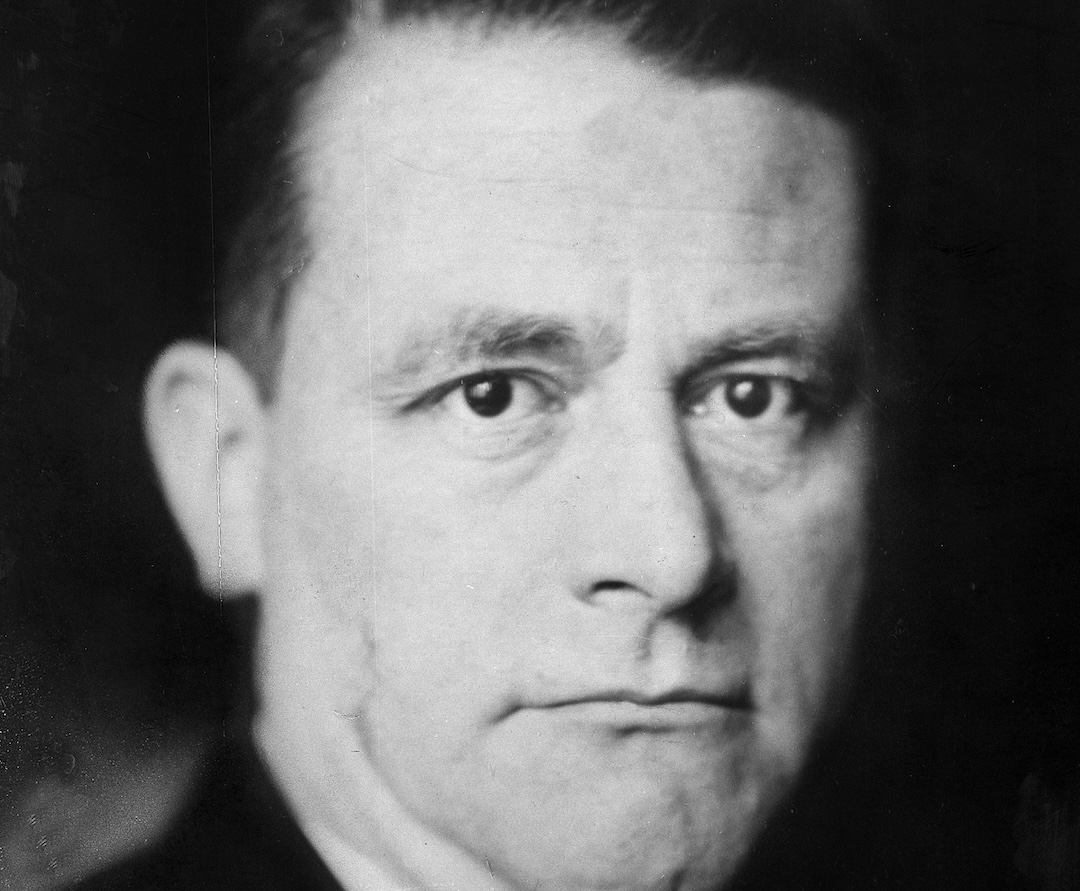
For Carl Schmitt, the international order was not built on universal rules but on “great spaces.” Donald Trump’s “Donroe Doctrine” is helping to highlight this view. (Ullstein Bild via Getty Images)
As the dust settles in Caracas and the penny drops in Copenhagen, Germans too are facing the sobering prospect of a new world order. But there is a difference. A world of continental spaces is hardly new to them. It was devised by a German.
Four decades after his death, the theorist of authoritarianism and critic of liberalism Carl Schmitt is experiencing a sustained revival. A Nazi with links to Francoist Spain, Schmitt is not only revered by Russian and French neofascists today. In the United States too — a country whose universalizing tendencies he despised — Schmitt has acquired a sizable fan club that counts integralists, paleoconservatives, the founder of PayPal, and the US vice president in its ranks.
And yet, it was not Americans but Germans who rushed to Schmitt in early January. Many of the country’s major newspapers and magazines have, in recent days, run pieces mentioning Schmitt in relation to the “Donroe Doctrine” and the wider renaissance of geopolitics.
Political scientist Herfried Münkler, whose books have found themselves on Angela Merkel and Ursula von der Leyen’s laps, was among the first to point to Schmitt’s geopolitical writings as a key to unlock the present moment. Like others, he sees in a world of regional blocs organized around spheres of influence the realization of Schmitt’s schema.
Centrists like Münkler are not alone. After Nicolás Maduro’s abduction, the German-speaking far right too has flocked to a 1939 pamphlet in which Schmitt proposed an order modeled on America’s Monroe Doctrine. Not just Alternative für Deutschland (AfD)’s hard-liner Maximilian “Mad Max” Krah welcomed a new Schmittian Großraumordnung (an order of great spaces) on X. The Austrian activist Martin Sellner, aka “Mr Remigration,” called for a European Monroe doctrine also:
Now more than ever, we must read Carl Schmitt. He recognized that American claims to their hemisphere and the Monroe Doctrine are not a threat, but an opportunity for Europe to finally formulate similar claims.
Schmittian Geopolitics
Schmitt and the far-right AfD — that’s a serious alignment. And not just AfD hard-liners like Krah and Björn Höcke (the latter of whom can justifiably be called a fascist, according to a court ruling) admire Schmitt. The GOP-friendly deputy leader of the parliamentary group, Markus Frohnmaier, has undergone a Schmittian reordering too. Even AfD’s slick and more presentable leader Alice Weidel likes to slip in a reference to the Nazi theorist. If you venture into intellectual circles around AfD ideologue Götz Kubitschek and his publishing house, Antaios, the reverence of Schmitt becomes even more overbearing.
As AfD surges ahead in the polls, it is worth reexamining what Schmitt had to say in this essay the Right now urges us to read. As always, context is crucial. Schmitt published his pamphlet between the invasion of Czechoslovakia and before the Molotov–Ribbentrop Pact. It therefore belongs to the geopolitics of the mature and high imperial stage of the Third Reich — not yet that of Barbarossa and Wannsee. In the 1940s, Schmitt would be superseded by even more radical ideologues inside the Nazi regime who regarded his vision of regionally ordered imperial space as an egalitarian residue that clashed with the idea of Aryan supremacy.
Still hoping to be the Third Reich’s crown jurist in 1939, Schmitt used his essay to hail Adolf Hitler’s promise to protect the rights of ethnic Germans abroad as a new principle of international law, one that would promote the “mutual respect” of European peoples under German control. The Nazi theorist was, of course, quick to exempt the Jews from this protection.
Although Schmitt regarded the United States with great suspicion, he found his inspiration in its Monroe Doctrine. He was interested in the doctrine not as a singular foreign policy instrument, which he felt had been corrupted by America’s universalist tendencies, but as the basis of a world order composed of multiple such spaces. In Schmitt’s account, each greater space would be organized around an imperial core (a “Reich”) that would act as the sovereign within each space. Territorial annexation was legitimate within the confines of this order. Foreign intervention, by contrast, was to be banned from each regional bloc. The consequence, he hoped, would be a new and intercontinental balance of power, much like that European equilibrium that World War I had proven obsolete.
Space, Schmitt thought, tended to retain an abstract and mathematical character — which he also regarded as “liberal” and “Jewish.” Great space, on the other hand, was concrete and political. Liberals like Woodrow Wilson had never understood the Monroe Doctrine’s true essence, instead distorting it into a doctrine of self-determination. Theodore Roosevelt too had been insincere, Schmitt argued, when he had floated the possibility of a Japanese Monroe Doctrine in 1905. Americans simply did not understand their own civilizational achievement. This was, Schmitt would write elsewhere, because they served a rootless form of sea power. They universalized the world while the doctrine’s very point was to continentalize it.
After Atlanticism
After 1945, Schmitt went into self-imposed isolation. His writings became bitter in tone. He retained his deep anti-Americanism just as Atlanticism was becoming the dominant foreign policy orientation for the West German right. Nonetheless, he remained an interlocutor for many German conservative intellectuals and a source of inspiration for the European far right, which for many decades was forced to work on the margins of political debate.
What, then, are we to make of his most recent revival in German public discourse? As long as the far right is not in power, the prospect of a German doctrine of great spaces seems distant. But with AfD ahead in the polls and Schmittian language already coloring the party’s foreign political pronouncements, it is worth pondering what the AfD’s geopolitics might look like.
One thing is clear. Unlike Marine Le Pen and Jordan Bardella’s Rassemblement National (RN) or Giorgia Meloni’s government, AfD has never attempted to break with Vladimir Putin’s Russia — a state that has also been following the Schmittian rule book. Since February 2022, the AfD has consistently opposed and undermined the Ukrainian war effort. When Volodymyr Zelensky visited the Bundestag in 2024, only a handful AfD parliamentarians remained in the chamber. They have since been sidelined. AfD’s pro-Russian stance is not just rooted in the party’s East German and Russian German votership or in its shared political ground with Putinism, but also in its Schmittian respect for what it sees as Russia’s legitimate sphere of influence. (Schmitt, it should be noted, never called for Nazi Germany to invade the Soviet Union and, as a fascist who had no proverbial dog in the fight, did not pick sides in the Cold War).
What if Germany pursued its own sphere of influence in the ruins of liberal Atlanticism, just like Russia or the United States? An order of great spaces would cast Germany as Europe’s imperial core — a Reich empowered to redraw territorial borders within its regional bloc at will, at least if one follows Schmitt to the letter. But although land grabs may be popular in Moscow, Washington, Jerusalem, and perhaps in Beijing too, they have few advocates in Germany.
Whither Great Space?
For many years, it was only the radical but ultimately marginal neo-Nazi Nationaldemokratische Partei Deutschlands (NPD) that advocated for territorial revisionism. Founded in 2013, AfD has largely stayed clear of such rhetoric, not least perhaps to distance itself from the NPD. But the new right too is interested in Germany’s “lost territories,” in German minorities in Poland, and in upholding the memory of the German “victims” of the post-1945 European territorial order. Nineteen forty-five was a German “defeat,” Alice Weidel has said, rejecting the dominant postwar narrative that frames the country’s reckoning primarily in terms of German guilt.
Any territorially revisionist agenda will run up against an obvious problem: Poland. German right-wing circles may have many disagreements with their Polish counterparts that could spark conflict between an AfD-led Germany and its eastern neighbor. But the German minority in Poland is small, and it is virtually nonexistent in the other “lost territories,” such as Russia’s Kaliningrad exclave, Lithuania’s Klaipėda region, and the Czech Republic’s Sudetenland. Germany’s post-Potsdam refugee population is very elderly and rapidly dwindling. What is more, Warsaw is now Europe’s largest defense spender as a percentage of GDP. It is a peer for the Bundeswehr, not a state to be pushed around or carved up.
Another problem for Germany’s Schmittians is where to draw the boundaries around any new order of great spaces. Where does Europe end — and does it, for instance, include Greenland? Is Germany to be what Max Krah calls “America’s Best Friend in Europe” (all in capital letters) or is it to be a Schmittian “Reich” that stands up to the “alien power” across the Atlantic, as Höcke and others in the party would have it? The return to Schmitt obscures the fact that the German right is as conflicted about the Donroe Doctrine as Europe’s centrist governments, not least because it has become abundantly clear, from Iran to Nigeria, that Schmitt’s ban on external intervention applies only to other powers, not to America.
The AfD is, moreover, still not entirely clear on how it wants to position itself in relation to France, the other potential hegemon in continental Europe. After the Russian invasion of Ukraine in 2022, the French and German right went separate ways. Indeed, Le Pen’s RN kicked AfD out of the European Parliament’s Identity and Democracy grouping in 2024 after Krah spoke positively about the Waffen-SS. The issue has weighed on AfD. In recent days, Dimitrios Kisoudis, an advisor to party coleader Tino Chrupalla, has said that the answer to the question of who should be Europe’s hegemon — France or Germany — is to be found in Schmitt. (It is no mystery what the AfD’s answer would be).
Schmitt in the Ruins of Liberalism
Europe’s Schmittians are thus split between those, like Sellner, who have pan-European ambitions, and those whose primary point of reference remains the nation-state. On top of that, there is the conundrum of how to respond to American interference in Europe. Yes, AfD politicians welcomed J. D. Vance’s speech at the Munich Security Conference, but they understand that the pursuit of the American national interest will come at Europe’s — and thus Germany’s — expense. Washington clearly does not abide by the principle of nonintervention it enforces in its own so-called backyard.
Embracing Schmitt’s theory of great spaces does not, in fact, help to resolve any of these matters. Ultimately, there was always a tension in Schmitt’s thought. He argued for equality between great spaces but also envisioned an eternal battle between land powers like Germany and sea powers like Britain and the United States — a life-or-death struggle he ardently wanted Germany and its continental European sphere to win. It is in this contradiction, which can be found too in the Right’s simultaneous embrace of ethnopluralism and white supremacism, that the Schmittians remain caught.
It is thus unclear how Germany’s most recent infatuation with Schmitt’s order of great spaces will translate into political practice. Whether it is the far-right or centrist Schmittians who end up running the show, the likely outcome is not territorial annexation but economic hegemony. The result may be a return to the 2010s, when the centrist Schmittian Herfried Münkler played a key role in promoting German hegemony — as the Greeks remember all too well. Indeed, during that period, Münkler advised Wolfgang Schäuble, the conservative architect of externally imposed austerity and the federal debt brake.
If it seems like Schmitt’s time has come, it is not because he found some arcane truth about a century he did not live to see. It is because he is being read amid the ruins of liberalism.