Can We Break Out of Our Hyperpolitical Moment?
In Western democracies today, intense political polarization is the norm, and mass protests are not uncommon. Yet ordinary people remain far from the levers of power.
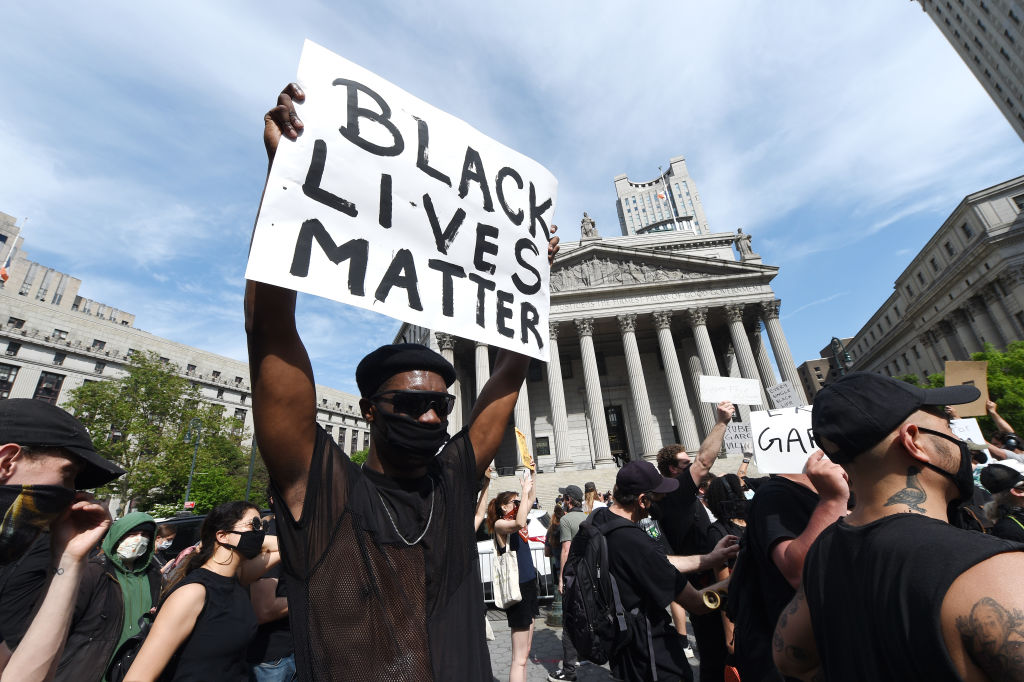
The past decade saw the Left fail to make major policy gains despite massive protest waves. Anton Jäger’s Hyperpolitics explains why. (Kevin Mazur / Getty Images)
In a particularly memorable scene from Eddington (2025), set during the George Floyd protests of 2020, high school student Brian (Cameron Mann) is attempting to explain his newfound racial consciousness to his parents at the dinner table. Brian — who, like his parents, is white — tells them about the need for “changing institutions, dismantling whiteness, and not allowing whiteness to reassert itself.”
“But we’re pretty much light-years away from that,” he concludes.
“What the f—k are you talking about?” Brian’s father replies after a long pause. “You’re white.”
Director Ari Aster plays the exchange for laughs, relying on the fact that similar conversations were commonplace at family dinners, in faculty lounges, in corporate offices, and elsewhere across America during the summer of 2020, reaching even into rural small towns like the fictional Eddington, New Mexico, of the film, thanks to the contagious power of social media.
The scene helps illustrate a core thesis of Anton Jäger’s Hyperpolitics. While Black Lives Matter demonstrations sparked by the police murders of George Floyd and Breonna Taylor amounted to the largest protest movement in US history, they accomplished very little. The outbursts were fed by and fed off of a febrile discourse cycle on social media and in traditional outlets that pulled in even comfortable, previously apolitical, young white people like Brian in remote corners of the country.
The protests may have led to some minor victories, like the mandating of body cameras on police officers and changes in attitudes, but at the national level the material facts remain stubbornly unchanged. The rate of police killings even appears to have slightly increased since 2020, and the deeper inequalities that helped inspire the protests of course persist.
It is a case of “extreme politicization without political consequences,” as the subtitle of Anton Jäger’s book puts it, and one of many in recent years. Whether it’s outrage over COVID-19 policy or conspiracies about stolen elections on the Right, or opposition to the Gaza genocide and Donald Trump’s authoritarianism on the Left, the 2020s have seen recurrent episodes of intense political polarization and mass mobilization.
These episodes, Jäger argues, are characteristic of the era of what he calls hyperpolitics. Everyday life in the United States and other Western democracies is increasingly politicized: our political ideologies, as curated on social media, have become central to our identities and have even increasingly come to structure our closest personal relationships. Yet this heightened politicization has not translated into meaningful policy change. Instead, the public’s dissatisfaction with traditional parties of both the Left and the Right continue to grow, while a panoply of new right-populist formations has managed to win over disaffected voters in ever larger numbers across the developed world. Meanwhile, the core elements of the neoliberal economic program — low taxes, public disinvestment, and corporate handouts — remain the order of the day.
From Mass Politics to Post-Politics
How did we get here? For Jäger, the United States and European countries find themselves at the end of a process of evolution — or, more accurately, devolution — that started with the era of “mass politics” stretching from the late nineteenth century to roughly the fall of the Berlin Wall. Since then, these societies have stumbled through two unstable new orientations toward politics — post-politics and antipolitics — before landing in our current hyperpolitical era.
The era of mass politics began in the late 1800s and ran through both world wars and the Cold War. It was inaugurated by the rise of the trade union movement and mass political parties in Europe, many of them socialist in orientation, that fought for universal suffrage as well as economic and social guarantees. Other types of mass parties emerged and found success as well, but it was the social democratic parties, and the trade unions in which they were institutionally rooted, that organized workers across class lines and that were at the forefront of fights for labor rights and the welfare state. (The United States never developed a mass worker or socialist party; but thanks to Franklin Delano Roosevelt’s New Deal, labor became for a time an important part of the Democratic Party coalition, which acted as a kind of quasi–social democratic analogue to its European counterparts.)
In the postwar era, labor and its parties helped ensure that the fruits of rapid economic growth in the West were broadly shared. They also helped maintain a sense of community and collective identity, with union halls and party organizations often providing the milieu in which workers met, socialized, discussed politics, and raised their children. Yet the “golden age” of capitalism was short-lived.
Trade union density peaked in the 1950s in the United States, in the 1970s in the UK, and was in decline even in social democratic strongholds like Sweden by the 1990s. The ossification of unions, deindustrialization, and — in the United States and the UK — the Thatcher and Reagan revolutions dealt fatal blows to the labor movement. The social democratic parties soon turned against their working-class bases as well, prioritizing policies to boost capital’s profits — like tax cuts, financial deregulation, and free-trade deals — in an attempt to juice private investment. Consequently, these parties underwent a process of “class dealignment,” attracting more affluent and highly educated professionals while the loyalty of their traditional working-class constituencies faded.
In Jäger’s chronology, the collapse of the Soviet Union is an inflection point. The fall of the long-enduring “workers’ state” and its satellites meant a final death blow to the idea of an alternative, non-capitalist form of society; this moment marks the transition into the post-political era: a period when it seemed, as Francis Fukuyama put it, that history had ended. In the 1990s, the thoroughly neoliberalized, “Third Way” Democratic Party of Bill Clinton and Labour Party of Tony Blair presided over booming economies and an increasingly atomized, consumption-oriented culture.
From Post-Politics to Antipolitics
The post-political era came to a close with the 2008 financial crisis and the austerity that governments imposed in its aftermath. The devastation wrought by the crisis destroyed the prior mood of economic optimism and began the brief era Jäger calls “antipolitics,” a period marked by both mass protests and organized challenges to the political establishment.
On the European continent, a variety of both left- and right-populist parties became ascendant in the early 2010s, channeling discontent with neoliberal governance. By the end of the decade, however, the right-wing populists were seeing much more success than their left-wing counterparts.
Similar events played out on a different timeline in the United States and the UK. A libertarian protest movement known as the Tea Party emerged in the wake of the great financial crisis in the United States as a reaction against federal government bailouts and stimulus efforts, pushing the Republican Party rightward. The year 2011 saw a left-wing answer in the form of Occupy Wall Street, a series of demonstrations that condemned the Obama administration for letting the “1 percent” off the hook for wrecking the financial system while abandoning the “99 percent.”
This left-populist current found its formal political expression belatedly with Bernie Sanders’s surprise 2016 bid for the Democratic Party presidential nomination. Sanders was defeated by establishment standard-bearer Hillary Clinton; Clinton proceeded to lose to Donald Trump, who had married anger over neoliberal economic policies with conservative cultural grievances to take over the Republican Party.
In Great Britain, longtime left-wing Labour Party MP Jeremy Corbyn was elected leader of the party, in a rebuke to the legacy of Tony Blair, who had sought to reject the Labour Party’s socialist traditions. After a strong performance in the 2017 general election, however, Labour collapsed against Boris Johnson’s Conservatives in 2019. There is no doubt that Corbyn was undermined by centrist opponents within his own party. But his failure was in part due to the toxic question of Brexit, on which Labour unsuccessfully sought to triangulate.
Breaking Out of Hyperpolitics
Jäger argues that the failure of the left-wing populists, and the increasing success of their right-wing opponents, set the stage for the hyperpolitical moment beginning in 2020. What happened was a broad “repoliticization” of society, albeit one that took place in the absence of the formal membership-based institutions — in particular, the mass parties and the trade unions — that had previously structured political conflict:
In the years after 2008, [antipolitical] repoliticization was largely confined to specific subsections of society: the traditional conservative petty bourgeoisie and frustrated, downwardly mobile millennials. But now the formerly passive, postpolitical liberal center underwent a kind of reactive shock-politicization. In parallel, movements like #MeToo and Black Lives Matter showed that the demands of groups long marginalized under mass democracy had reached a tipping point. . . . As history returned in the form of a global pandemic and inflation was triggered by Russia’s invasion of Ukraine . . . OECD countries found themselves engulfed in a kind of permanent Dreyfus Affair, one that extended to family gatherings, circles of friends, and workplace cliques.
This heightened politicization has not meant more popular control over the state however, with policy diverging more widely from public opinion. And in the United States at least, the Right is maintaining its grip on power largely through exploiting antimajoritarian features of the Constitution and now, perhaps, by more explicitly authoritarian means.
Is there a way out of this impasse for the Left? Jäger’s proposal, which he acknowledges may be unrealistic, is a revitalization of the mass party and the labor movement. Only through “reinstitutionalization” of politics can the Left cohere a social force powerful, and durable, enough to confront capital and the parties of the Right. It is hard to disagree with this diagnosis in its broad outlines; many Jacobin writers (myself included) have made similar proposals over the past decade.
The real questions concern how to actually do this. On this score, Jäger does not have much to say, which is no fault of his account. But his reading of the present political situation in the United States unhelpfully elides promising starts at left-wing institution-building. In a new preface for the English edition of Hyperpolitics, he writes that “after a decade of experimentation with semi-independent party activity, a Squad that still sees itself as an anxious battalion for a better Democratic Party is the main remnant of America’s left-populist wave.” This assessment is too gloomy.
The Democratic Socialists of America (DSA), which was given new life by Sanders’s 2016 campaign, now stands at around one hundred thousand members and boasts a growing presence in local and state legislatures across the country. While it is still quite small in the grand scheme of things — and for the most part has weak links to what remains of organized labor — the group has muscle. The electoral machine that DSA built in New York City incubated the political career of Zohran Mamdani and then helped power him to victory in the city’s mayoral election over establishment Democrat Andrew Cuomo, who was backed by a flood of cash from the ultrarich and the Israel lobby.
Mamdani ran and won on an ambitious platform of tackling the city’s affordability crisis through increased public investment — a universal childcare program, fare-free buses, city-owned grocery stores, social housing — and more aggressive regulation of private actors — freezing the rent in rent-stabilized apartments, cracking down on junk fees and lawbreaking by landlords and employers. His initial moves on these fronts are promising, and his administration suggests that the Left’s electoral momentum is far from spent. (Victories like this that have seen socialists punch far above their social weight are no doubt possible in part because of the deinstitutionalization of politics that Hyperpolitics describes.)
But Jäger is correct that left electoral activity, unmoored from civic associational life and, in particular, a strong labor movement that can give socialists structural leverage over employers and the state, will sooner or later see its forward momentum halted. The questions of how to revitalize and grow the labor movement, and to connect it to the socialist project, are therefore of crucial importance for today’s left.
There are no easy answers, with US union density remaining near record lows. Still, it is encouraging that DSA and fellow travelers have been building an ecosystem of projects devoted to building and strengthening unions, including the Emergency Workplace Organizing Committee (EWOC), the Rank & File Project, and Workers Organizing Workers. The growth of this ecosystem has coincided with waves of new organizing at Starbucks, Amazon, and elsewhere, with young progressives and socialists often playing a leading role. And other efforts to build community through political activity — whether through tenant unions or, in the second Trump administration, people organizing to defend their neighbors against authoritarian immigration police — have also shown promise.
If the path to reinstitutionalizing politics is otherwise obscure, Jäger is surely right that “the prospects for any renewal will have to be sought in everyday life — in those circumstances in which people still regularly enter into contact with others, in which common concerns are self-evident.” It is to Jäger’s credit that his diagnosis of our current political malaise points us to this fact. And it is a hopeful sign that many on the Left today seem increasingly to be grasping this as well.