How the Alternative für Deutschland Radicalized the German Right
- Loren Balhorn
Ten years since its creation, the Alternative für Deutschland has established itself as a constant presence in Germany’s parliament. Now, it’s challenging the Christian Democrats — and seeking to tear down the historic barriers to the far right.
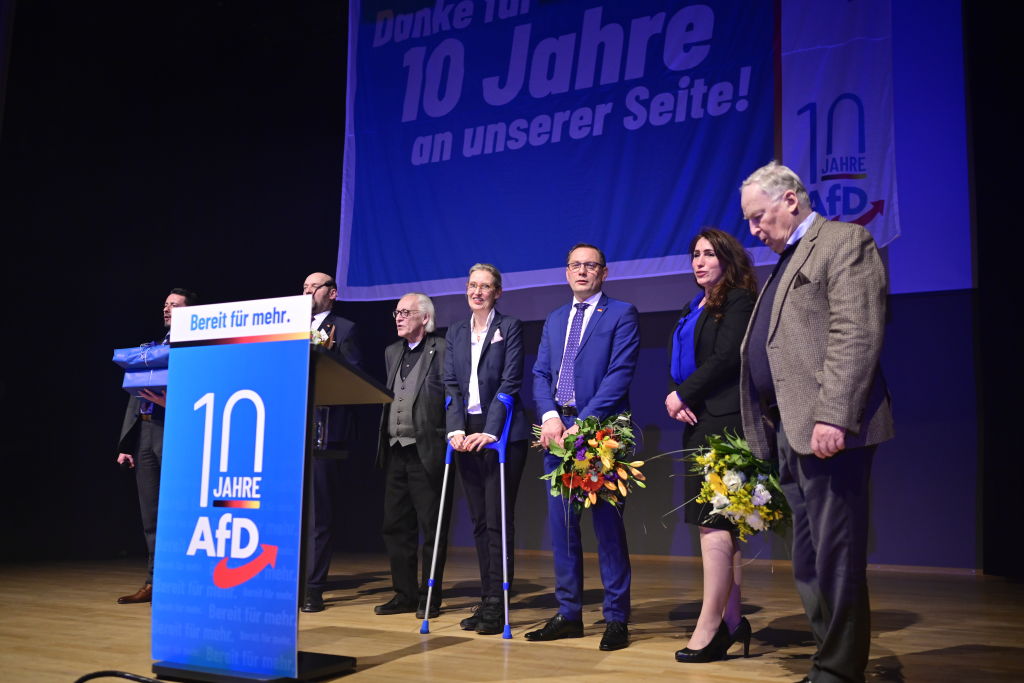
Leaders of the AfD attend the party’s tenth anniversary celebration on February 6, 2023 in Koenigstein, Germany. (Thomas Lohnes / Getty Images)
When Friedrich Merz first threw his hat into the ring to succeed Angela Merkel as chair of the Christian Democratic Union (CDU) in November 2018, he set himself an ambitious goal. Merz told the German tabloid Bild that he wanted to “halve” the right-populist Alternative für Deutschland (AfD), meaning to say he sought to win back half of its voters for the CDU. Back then, the AfD was hovering at around 15 percent in the polls. In fact, over the last five years its numbers have largely stayed the same — but the party now leads the polls in several states, successfully uniting wide swathes of the Right behind it.
This was hardly a foregone conclusion. Back in April 2013, more than one thousand people squeezed into a packed hotel conference room to attend the AfD’s founding congress. They cheered on an economics professor named Bernd Lucke who, his sights firmly trained on the CDU, spoke dismissively of the “old parties” and argued that Germany should step back from the EU, leave managing the economy to the market, and take a more conservative approach to social policy. Alongside Lucke, a chemist named Frauke Petry and a former journalist named Konrad Adam were also elected to the leadership of the AfD. All three have since left the party.
Ten years after its founding, the face of the AfD has changed dramatically: whereas conservative Euroscepticism represented the dominant theme in its early days, the AfD today is largely a far-right party. Nevertheless, one constant runs between the original and the current AfD: from the beginning, it sought to unite the political spectrum to the right of the CDU and its traditional coalition partner, the neoliberal Free Democrats (FDP).