A Diaspora Turned Against Itself
An Iranian American reflects on how the diaspora, grieving for the Iranians caught between domestic repression and imperialist intervention, came to be at war with itself.
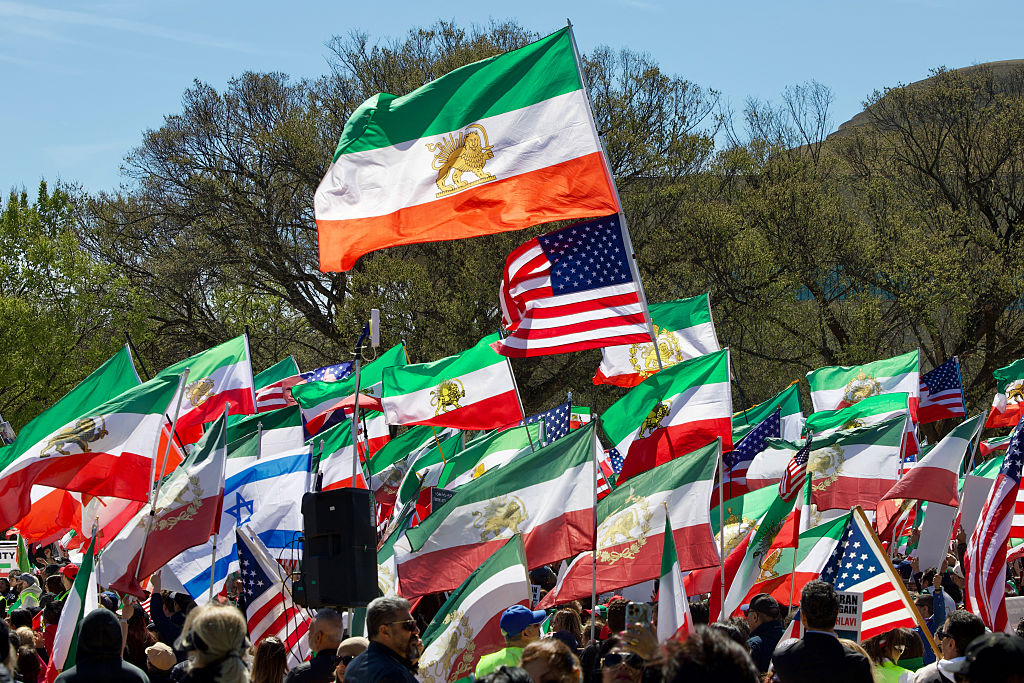
The unjustifiable US-Israeli war on the Iranian people has undermined decades of social uprisings in Iran, interrupting revolutionary struggles and replacing them with a nationalism that has emboldened hard-liners. (Amid Farahi / AFP via Getty Images)
Home may be perilous and the destination out of reach
But there are no paths without an end, do not grieve
My cousin’s message arrived on January 21 at 8:39 p.m. After the January massacres in Iran. Before the war and its precarious ceasefire.
She wrote to me on WhatsApp:
I don’t see you and others who share your views against the war as human beings. Their hands are also bloody. I have nothing more to say to someone like you. This is long past the point of dialogue. Tomorrow in a free Iran, with the leadership of Reza Pahlavi, I hope no traitor like you ever steps in.
Leila is twenty-eight, three years younger than me. (Her name has been changed to protect her privacy.) She grew up in Iran (though she no longer lives there), and I grew up in the United States. And yet despite the distance, we always seemed to agree that boys were not worth our time, that we would never be too old for bastani aroosaki (chocolate and vanilla ice cream fashioned into a face on a stick, mostly given to children), and that the Iranian people have been righteously fighting for liberation, caught between domestic repression and foreign intervention. I spent many mornings waking up in her family’s house in Karaj to the sound of morning doves, the muted clatter of my aunt washing dishes in the kitchen, and, when we were both much younger, the sound of Leila and her younger sister pacing and giggling behind my door, waiting for me to wake up from my jet lag–induced sleep so we could play together.
During my last visit to Iran, in 2022, I was called in for interrogation. The state had decided my political speech made me dangerous, or at least unwelcome. I realized this would be my last trip home, as returning to Iran again could result in imprisonment, or worse. On the last night of my last visit, Leila and I wept on her bright purple couch, which somehow matched the light pink Persian carpet underneath. Neither we nor a room so bright were prepared for such grief.
Now we were thousands of miles apart. Her messages suddenly calling me a traitor and wishing I would never return to Iran surfaced a new grief. How did those of us who opposed both foreign intervention and domestic oppression — as she had merely a month earlier — become recast as the primary enemy? Why, in her opposition to the Iranian state, did she wish for me the very thing the Iranian government had already accomplished — my exile? And why was the world of possibilities reduced to a binary, with both options — either pro–Iranian government or pro–foreign intervention and Reza Pahlavi (son of the previous US-installed dictator) — coming at the expense of Iranian people?
My mother called me later that day. Despite the weeks-long internet shutdown, she had finally been able to contact Leila’s family in Iran. “They’re okay, khodarashokr, but I don’t think you should try to contact them right now.” I didn’t have the heart to tell my mother that Leila had already contacted me, or that I didn’t need to ask why her family in Iran didn’t reply to my messages checking in. My unanswered messages had already answered my questions.
A week before Leila’s message, I watched videos from Iran with despair, as bodies were laid out in rows outside the morgues, zipped in black bags with dates of birth and names scratched hastily in white — at least for those who could be identified. I paused the video and could just barely make out a few of the dates. I did the math. A child. Parents, with death on their face, plead for their children who do not answer.
In January, it is likely the Iranian state killed thousands across the streets of Iran. While the exact numbers are not confirmed, it is estimated that several thousand were killed in a matter of days and several thousand more arrested under the cover of an imposed digital silence. The protests started in December in response to skyrocketing inflation, triggered primarily by UN snapback sanctions and exacerbated by corruption that deepened inequality. Mossad — Israel’s intelligence agency — tweeted that they were with the Iranians in the streets, thereby throwing fuel on the Iranian state’s crackdown, which labeled protesters as foreign agents. Months later, Israeli officials would gloat about their role in the escalation.
Without question, Israel played a role in the deadly January uprisings. It likely also played a role in killing Iranians — police or protesters — inflating the total killed and deepening the outrage. And yet the reality of thousands of Iranians pouring into the streets and risking their lives to demand another world cannot be erased or discarded on account of Israel’s divergent agenda. We will likely never know the entire truth. But it is precisely these messy, asymmetrical information gaps, exacerbated by AI and disinformation, that reactionary elements exploit — in the media, with violence — to set the tone and shift people toward their policies.
Because so few videos managed to escape the web of censorship, the scattered videos of body bags at morgues and images of death were shared and reshared until they were carved into memory, the stench of death penetrating every communication and social media app. A friend in Tehran managed to get a few words back to me, passed along orally through three people. Zendeh am. Hamin. I’m alive. That’s it. I do not ask questions; they do not answer them. We both know better. The absence of language tells me more than I can bear to hear. The silence is its own kind of evidence.
Roughly a week later, the United States moved military assets to the Middle East. “Just in case,” Donald Trump says. Masked US forces had just killed Renée Good in Minneapolis. Tel Aviv and Washington’s threats of attacks — and quick retractions — are issued with neckbreaking whiplash. More days pass and I still do not hear back from anyone else. My messages are sent but not received. Calls ring into emptiness.
As word from Iran arrives to the diaspora in quiet, inconsistent drops through various informal pathways, the mourning of faceless compatriots becomes the mourning of loved ones. While Iran often criminalizes and erases the mourning of those killed by the state, for the diaspora new questions emerged, not about what to feel but where to place it. Is grief neutral from the seat of empire? And, in the information gaps, who was controlling the narrative — and at what cost?
With this grief came radicalization, organic and manufactured.
On the internet, the diaspora’s grief devolved into a commodity, harvested and sold by blood merchants on the algorithmic market. The silence of ninety-three million Iranians offline is filled instead with Iranians in the diaspora trampling over each other to speak in their place, despite the disconnection.
While many Iranians in Iran urged the diaspora not to translate their repression into foreign intervention, overnight, Iranian actresses, real estate influencers, and investors who voted the Right into power in the United States suddenly developed a new political consciousness for the working class in Iran. Diaspora figures paid by the State Department called on President Trump to save the Iranian people from the Iranian government, and to “finish the job.” Comments sections on social media were filled with positive invocations of the felled monarchy, the hashtag #RezaPahlavi overtaking thousands of Iran-related posts.
The rawness of rage, the live processing of anger and grief, was extracted by empire and repackaged into demands for more blood: To bomb Iran into oblivion. To reproduce the violence we witnessed far away into death threats, harassment, and vows of vengeance against those who opposed war, sanctions, and escalated foreign intervention. To replace a theocratic dictatorship with a US puppet dictatorship of Reza Pahlavi, son of Mohammed Reza Pahlavi, the US-installed dictator overthrown by the 1979 revolution. It was the perfect storm.
So while graves were dug across Iran in January, Pahlavi — who encouraged people to take to the streets, yet never put himself on the line — etched his flag on their tombstones. The Iranian dead became their own kind of currency, and Iran International — the Persian-language, Saudi-funded, and Pahlavi-supporting diaspora media company based in London — attempted to flood the market. Tallying the number of Iranians killed in Iran became the diaspora’s battlefield, and those invested in intervention (including Israel and the United States) wielded grief as their weapon of choice. By announcing unverified numbers of 36,500 dead (based allegedly on undisclosed, private sources) — or even higher — Iran International and the interventionists incited a frenzy in the diaspora. Doing so reframed the entire conversation, ignoring the Iranians in Iran demanding bottom-up, economic, and revolutionary change and instead proposing a simple calculation: How many dead Iranians is enough to justify foreign bombs?
It was a pattern and policy that Israel perfected in Gaza, where distorting reality is not merely about manufacturing consent but reframing public discussion around limited parameters. If the public is focused on whether or not a Gazan hospital hides Hamas tunnels, it has lost the plot: that Israel is committing a genocide of an occupied people. In the meantime, Israel destroys Gaza’s entire health care system.
These efforts are not simply for the purpose of manufacturing consent for war. As domestic authoritarianism quickly ramps up in the United States, and the government wages wars despite overwhelming public opposition, the Trump administration has made clear that consent is not of primary concern. Rather, the deeper danger in these interventionist reframings lies in the impact they have on our people and on our movements. We learn to internalize helplessness and that there is nothing we can do. That we are incapable of defining our own futures and seeking our own justice and instead must outsource our agency to the states that bomb us and oppress us as our only hope for salvation.
Indeed, many progressive Iranians and non-Iranians have internalized the same worldview. They see Iran’s government exclusively as a bulwark against US imperialism and Israeli genocide and ignore its repression against its own people. In doing so, they, too, are stripping the agency of progressive movements in Iran and the people who compose them — including the imprisoned or executed labor organizers, environmental and student activists, journalists, and progressives who seek to build a just society.
Sure enough, by early February, diaspora social media influencers — some funded by the United States or Israel, others who simply align themselves — announced new reductive red lines, suggesting that anyone who does not support Pahlavi (as the so-called, self-identified transitional leadership) is a traitor who supports the Islamic Republic. These threats circulated widely on social media, with thousands of comments tagging those of us vocal against Pahlavi and labeling us enemies. (At least one Iranian vocal against Pahlavi has been killed by pro-monarchy Iranians in the diaspora.) The diaspora was plunged further into conservatism. These threats echoed those broadcasted by the Iranian state only weeks before, threatening that anyone who rioted would be labeled a traitor and dealt with accordingly. Lists are made and circulated on both sides.
The threats were not just restricted to social media. An Iranian American beauty investor living in California, Moj Mahdara, made repeated appearances on Fox News, CNN, and other mainstream media boldly claiming to represent Iranian interests. They listed antiwar Iranians by name on air, slandering these Iranians as regime apologists and demanding they be deported from the United States, Mahdara’s legitimacy to speak on foreign affairs based on sheer follower count on social media.
The same week, I opened Leila’s Instagram stories, searching for insight into her sudden political shift. Only months before we were laughing together at Pahlavi memes and exchanging frustrations with niche diaspora warmongers. But now she had shared a list with my name and photograph, alongside a dozen other Iranian American scholars, journalists, and organizers. Instructions followed: block, boycott, and harass. We were falsely smeared as lobbyists for the Islamic Republic who worked to “fragment opposition” and “smear critics.” Those of us named had one thing in common: we used our platforms to vocally oppose both the Iranian government and the US-Israel intervention in Iran. Curiously, those Iranians in the diaspora outspoken in their support of the Iranian government did not make the list. It seemed we were only dangerous if we opposed the binary.
Catastrophe and desperation shrink the horizon of possibilities into a reactionary world of black and white, good and evil, and traitors and heroes. And those of us who refuse this world are seen as traitors by all sides.
I can imagine Leila swept up in the waves of desperation that countless Iranians found ourselves drowning in after the January massacre. But the Iranian diaspora’s support for today’s war against Iran did not form overnight.
It was not the first time I had seen the witch-hunting lists circulating online with our names and photographs, threats attached to them like postage.
Rather, this campaign has taken shape online as part of a years-long disinformation campaign funded by the United States, Israel, and Saudi Arabia and channeled through paid spokespeople (such as Masih Alinejad and Emily Schrader) and Persian-language media apparatuses (Iran International and Manoto) nestled safely in the United States and UK, far from the consequences of what they broadcast and the bodies their words helped bury. Indeed, Israel has built an entire, well-funded Persian-language social media operation directed at Iranians inside Iran and in the diaspora, complete with right-wing Israeli influencers speaking to and for Iranians with an audacity that borders on parody.
This machinery has two functions, as all good disinformation does: to build up and to tear down. To cultivate reverence for Pahlavi — a man who has never governed and never uttered a word of support for the working class, ethnic minorities, and political figures his father had tortured while serving as a foreign-appointed king — and to destroy those of us who refused to kneel, often through disinformation campaigns.
Residing in Virginia for the past forty years and admitting that he’s too rooted in the United States to ever return to Iran more than part-time, Reza Pahlavi has long aligned himself with conservative factions in the United States and Israel to advocate for a war to destroy the Iranian state. Once the last bomb was dropped, he could safely parachute into the devastation and declare himself king. Indeed, Pahlavi casting his lot with Israeli and US war criminals — as opposed to building grassroots coalitions of compatriots within Iran — makes clear that the only path to Pahlavi leadership would come at a great cost to Iranian life, the environment, and infrastructure by way of foreign military intervention. It’s a sacrifice he seems more than willing to make.
Many Iranians who support Pahlavi argue that Iranians have tried everything, and that military intervention is the only option left. Yet they conveniently ignore the decades of worker strikes and calls for relief from sanctions that could permit the Iranian people the agency and resources needed to build revolutionary foundations; fail to build coalitions within Iran that present alternative views for the country; and denounce any opposition that does not end with Pahlavi as king. In fact, military intervention has been tried time and time again across the Middle East and has failed repeatedly, replacing the Taliban with the Taliban in Afghanistan and one dictatorship with another elsewhere.
This interventionist disinformation campaign culminated in 2022 during the Woman, Life, Freedom uprisings in Iran. Young women, including my cousin Leila, risked their lives to take to the streets with their bare hands and their fury, chanting against the government and the crown — against every structure that had claimed ownership of their bodies, past and present. It was a liberatory, imaginative revolution, precise and unambiguous in its refusal of all masters.
But in the diaspora, alongside the images of Iranian bravery, we were flooded by pro-Pahlavi bots, backed by the United States and Israel, part of an attempted coup from abroad.
The narrative was managed not through argument and discussion — despite the warmongers’ claims that they would bring freedom of speech to Iran — but rather through coordinated attacks, the manipulation of grief, and the stoking of fear, mirroring the tactics of the government they claimed to oppose.
From mid-September 2022 until January 2023, I received thousands, sometimes tens of thousands of notifications a day on social media, many of which were death threats and threats of sexual violence. With each refresh of my notifications, hundreds more would take their place. This repeated in twenty-four-hour cycles. Clips of interviews from a decade prior were excerpted, mistranslated into Persian, and shared until viral. Journalists whom I spoke to were harassed until they agreed to platform pro-interventionist voices after or in lieu of mine.
Major mainstream television channels invited me on air and then canceled the interview ten minutes before airtime, replacing me with Masih Alinejad, a former Voice of America spokesperson funded by US taxpayer money to demand a military intervention in Iran she would never have to experience. Iranian American friends who had platforms online were harassed to publicly denounce me or share my fate, and the diaspora community began to cannibalize itself. One by one, vocal progressives defected, sometimes making hostage-style apology videos denouncing those of us who remained in order to save themselves. This did save some of them from harassment. And for others, it helped them launch a new career.
For example, in just the first month of the Woman, Life, Freedom protests, Moj Mahdara and their wife, Roya Rastegar, former acquaintances, switched from publicly and privately sharing my work on Iran and celebrating my voice to denouncing me as a regime apologist after getting attacked for associating with me on social media. They subsequently launched an Instagram page and began claiming to speak on behalf of the Iranian diaspora, later landing interviews on Fox News and CNN calling for intervention. Others gained tens of thousands of followers overnight by simply weaving together and circulating posts allegedly exposing us as foreign agents, boosted by a network of state-funded bots. With new followers came relevance and legitimacy in the eyes of mainstream US media, and soon a new ecosystem was composed, built off the character assassinations of public-facing progressive Iranians in the diaspora and the co-optation of the struggles of Iranians in Iran.
At the time, I was in my third year at Berkeley Law School. The death threats followed me to class, promising to hunt me down on campus and hang me from the light poles. I received an unprecedented accommodation to finish my semester from home, where friends arrived at my door to leave lecture notes, as if I were under a kind of house arrest imposed from the digital world. From the stress, I was eventually hospitalized.
A new epistemology, assembled from bots and threats, continues to have a hold over much of the diaspora community today. Positions that rejected US imperialism, rejected bombing young revolutionary women as a means of supporting them, were defined as complicity in the Iranian state’s crimes. Merely mentioning that US economic sanctions brought widespread misery to everyday Iranian people while empowering and fortifying state actors — a well-documented fact — could bring thousands of messages accusing the interlocutor of being a regime apologist or collaborator. The National Iranian American Council (NIAC), the only grassroots Iranian American antiwar nonprofit organization, was falsely smeared as a lobby for the Iranian government. Being “NIAC-y” became a slur in the Persian language.
Indeed, as Palestinians remind us, every Israeli accusation is an admission. Years later, in 2025, it became clear that Israel has been paying social media influencers thousands of dollars per post to share pro-Israel propaganda across the internet.
It did not matter that, as the only visible Muslim Iranian woman in the diaspora with a platform, I had dedicated much of my life to consistently standing against state repression and the co-optation of Islam as well as US sanctions and foreign intervention. For that I had been forced to forever give up returning to Iran — and with it seeing my family and friends.
The disinformation campaign sharply narrowed the discourse through which Iranians could see their predicament. And while the interventionist campaign was unsuccessful in advocating for the bombing of Iran during a youth-led uprising in 2022, in the diaspora it won a narrative battle that claimed progressive and left-wing Iranians as casualties. It severed the progressive social movement in Iran from its context and instead redirected it into regressive contrary demands for intervention by diaspora figures who claimed to represent them. And in doing so, it replaced our people’s collective agency with foreign intervention.
So, when Iranians rose up again in December 2025, the interventionists had helped complete the necessary groundwork.
And then the bombs started to fall.
Domestic massacres evolved into annihilation at the hands of foreign powers. The grief of mothers mourning their dead children begot the grief of mothers mourning their dead children.
Per Islamic tradition, mourning families returned to the graves of their loved ones on the fortieth day after they were killed by the Iranian government. On the same day, Iranian mothers were digging new, child-sized graves for the over 120 children killed in Minab after a US-made and -launched Tomahawk missile struck a children’s school in southern Iran.
The US and Israeli war on Iran, allegedly undertaken on Iranians’ behalf, has been a nightmare. The scenes in Iran have been apocalyptic. US-Israeli bombing of civilian oil infrastructure in Tehran — a war crime — engulfed the city of ten million in toxic storms and black rain. Experts suggest the destruction will damage health and environmental outcomes for generations. The fiery oil poured out from attacked facilities into the small waterways running alongside the sidewalks of Tehran, lighting the streets on fire, as if the United States and Israel had opened the gates of hell itself.
In the diaspora, many are starting to feel buyer’s remorse, realizing that the ruthlessness of the attacks, the bombardment without restraint or red lines, reveals that Gaza was not the exception but the new rule; that Iranian bodies are not mere currency in their purchase of power; and that grief begets vengeance in lieu of justice, accountability, and revolutionary optimism.
At the time of writing, over 3,300 Iranians have been killed, and much civilian infrastructure has been targeted and destroyed. Cultural and historical sites older than the states of Israel and the United States combined have suffered severe, possibly irreparable damage. Israel and the United States carried out a process of deindustrializing Iran by targeting production facilities necessary for civilian life, such as pharmaceutical companies and basic infrastructure. As a result, today hundreds of thousands of workers across the country find themselves unemployed in the aftermath of the destruction of their jobsites.
Indeed, Iran’s defense against Israeli and US hegemony and their illegal wars of aggression is necessary and legitimate. It has shattered conceptions of invincible American and Zionist imperialism throughout the region and world. When posing existential threats of annihilation, it is the United States and Israel that have collapsed the binary: there are no social movements, no uprisings, no progressive revolutions under conditions of state collapse. A turnkey regime change package only works when the people affected do not hold the key. Our future cannot be in our own hands until Iran is free from constant threats of foreign annihilation.
This is what activist friends in Iran have told me. This unjustifiable war on the Iranian people has undermined decades of social uprisings and peoples’ struggles in Iran, and our revolutionary struggles have been interrupted and replaced with a nationalism that has emboldened hard-liners. Indeed, the newly emboldened Iranian government, riding off the energy of successfully keeping the United States and Israel at bay, continues to carry out executions of young dissidents, indiscriminately accusing them of being foreign agents.
Leila and I haven’t spoken since January. Last week, I sent her another message. I know exactly the alienation many of us hyphenated Iranians can feel in diaspora, severed from our communities. And as Leila is a new member of this diaspora, I can only imagine that she too is feeling a version of the same. I let her know I will never stop fighting, regardless of the state of the world, to keep her in my life. She responded today, saying she wants to talk again.
In this new world that we have entered, disinformation and unregulated grief have become tools sharpened to turn our social movements against themselves, convincing us of the need for external saviors. Truth will only become increasingly indiscernible, and we must be prepared to navigate unknowns with principled consistency. How we respond in these moments of mass disinformation and misinformation will define our futures.
There is a version of us — fractured, furious, exhausted, in despair — that is capable of more. We are still here and will continue to fight for a world without Zionist genocide and US imperialism, without monarchism or theocratic dictatorships. A world where human life and the natural world aren’t disposable. It is precisely because I believe in our people’s righteous, collective right to self-determination and struggle for liberation that I believe we are capable of forging a path beyond the dullness of a binary, where our struggle for anti-imperialism from within the empire does not undermine liberation movements abroad. For those of us living in the Western empire, this struggle begins here at home.
Far from equivocation or whataboutism, we must strive for paths forward that can hold contradiction and full truths, and refuse lazy or simple answers that cede our agency to our oppressors. We are the only way out.