Trump’s Intervention in Iran Will Be a Disaster
Iranians have been trying to complete their democratic revolution for over a century. Every time the US gets involved, it sets that project back by decades.
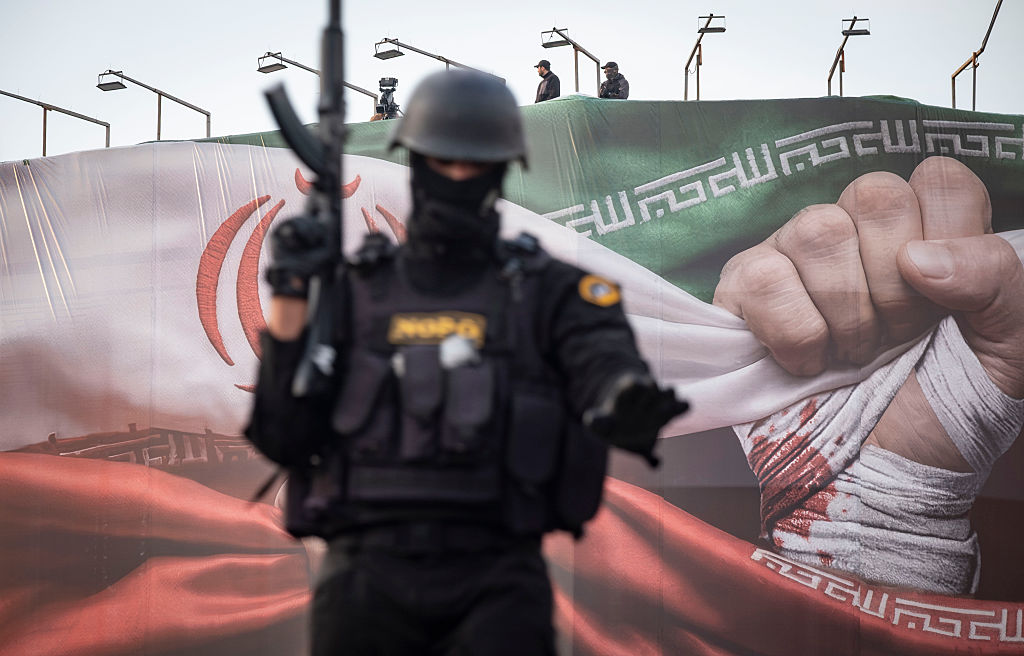
Most of the Iranian population is living very precariously — and the lack of political freedoms has eroded all state legitimacy.(Morteza Nikoubazl / NurPhoto via Getty Images)
- Interview by
- Melissa Naschek
The Trump administration has ramped up its bellicose rhetoric against the Iranian regime after it clamped down on the latest wave of protests. And now, a growing number of reports hint that a major war with Iran is a very real possibility — and very soon.
In this episode of the Jacobin Radio podcast Confronting Capitalism, Vivek Chibber and Melissa Naschek contrast the Iranian Revolution of 1979 with the current protests and discuss what makes a revolution possible.
Confronting Capitalism with Vivek Chibber is produced by Catalyst: A Journal of Theory and Strategy and published by Jacobin. You can listen to the full episode here. This transcript has been edited for clarity.
Iran recently experienced a huge wave of protests that were so significant that the government actually shut down all internet access within the state. In short, what is going on in Iran right now?
What we’re seeing in Iran is just the latest in a series of waves of mobilization that stretch back to at least 2009. After 2009, there was a bit of a hiatus. Then, beginning in 2017 and escalating through 2019, 2021–22, and now 2025–26, there has been a series of mobilizations against the Islamist regime, which has been incorporating more and more layers of the population. Impressively, in the last couple of waves, this has included more sections of Iranian labor as well.
There are two significant things here. One is that you have wave after wave of mobilizations. The second is that these waves of mobilizations do not succeed. Both things are important to understand.
It’s not so hard to understand why there are uprisings because this is an autocratic, undemocratic regime. It has also faced very difficult economic problems because it has been crippled by very severe sanctions by the United States, which have hobbled its ability to use its main economic asset: oil. At the same time, it’s been a very neoliberal, privatizing regime, in an odd sort of way.
It has privatized a lot of assets in the sense that it has brought in a lot of private actors who ostensibly run them, but in fact, these private actors are very closely linked to the state. While it’s liberalizing in one sense, all the key players are inside the state. The army is a major owner of these assets, along with the cousins and families of important people in the state and the bureaucracy, but the losers have consistently been the masses.
Right now, somewhere around 90 percent of Iranians are economically precarious, which means they are in the informal sector and have almost no rights economically. The support base of this regime, which was quite broad even into the 1990s and early 2000s, has been getting narrower and narrower both among the masses and whatever elites there are outside the Iranian state. So it’s easy to understand why the mobilizations are occurring. But it’s equally significant that they fail over and over and over again.
What Brings About a Revolution?
There are some surface similarities between what’s going on right now and the way this regime came to power in 1978–79. There was a massive protest movement, huge mobilizations, and ultimately, this brought down a very autocratic, antidemocratic regime. So how does what’s going on today compare to what happened in 1979?
In very summary form, the difference is that in 1979, you had a big mobilization, but on top of that, the power structures collapsed. Today there’s no sign that they’re collapsing, that’s the big difference. And to understand why the power structures collapsed then and why they’re probably not right now, you have to look at the background conditions in both instances and how they differ.
So what was going on in 1978 that made the Iranian state so unstable?
The Iranian Revolution was very unusual because it didn’t conform to what we know about revolutions and what brings them about. So what is it that we know about revolutions?
I think the best summary statement of how revolutions occur was made by Lenin, and it’s been largely confirmed in all the social scientific research since he made it. The basic gist of it is that revolutions occur when those who are ruled can no longer accept their conditions and those who are ruling them are no longer able to rule.
What did he mean when he said that?
Well, everybody on the Left understands that revolutions require huge mobilization, bringing people together, and hitting the streets. And especially on the activist left, this sometimes leads to a misconception that you can have a revolution if you just organize people, rile them up, and bring enough of them out. And we call that voluntarism.
I’m laughing because of how many years I’ve spent arguing with people about this.
Yeah, “Let’s have a revolution, we need a revolution,” you know, that kind of thing.
You’d also be shocked at how many times we’ve been just on the brink of a revolution.
So the error there is that it assumes that if you just try hard enough, you’ll have a revolution. And it’s called voluntaristic because it just assumes that there are no real constraints, that there are no underlying structural problems or structural limits to what people can do.
I was waiting for you to say “the S word.”
It’s the most important word there is for anybody on the Left. If you want to be serious about politics, you have to understand structures and how they work.
So, of course, everybody understands that you need to mobilize. But the thing is, most of the time when people mobilize, they’re defeated. Why is that? It’s because the second half of what’s required for revolutions isn’t also present, which is that there needs to be a collapse of state power.
In any class society, you have organs of authority and power over the people, right? Because, of course, in any class society, there’s exploitation going on. There’s a lot of domination. People resent that domination, and they’re routinely trying to, in whatever way they can, do something about it, either on an individual level or at a collective level.
Now, most of the time, people just go about their business and do the best they can. But it’s very common, whether it’s in a premodern society like feudalism, a capitalist society, or some kind of state socialist society, for people to also try coming together and collectively try to change things. In those situations, the normal institutions of order and rule have already broken down because people are coming together to change things. They’re hitting the streets. They’re protesting. They’re mobilizing.
In those situations, elites need a way to deal with collective protests. The way they do it is through violence, intimidation, or coercion. As long as those organs of intimidation and coercion are intact, it’s very, very hard for people to succeed in revolutions because all the guns and armaments are with the state.
This reminds me of the last episode we just did on American exceptionalism and the preliminary fights that led to the New Deal. We talked a lot about how huge and significant the labor movement demonstrations were, with tens of thousands of people in the streets clashing with police, fighting for their right to unionize and fair wages, all that kind of stuff.
That was a very intense and often violent conflict. So, to your point, even though the state tried everything it could to fight against it, and even though it faced huge power from below in the form of a more organized protest movement, the state was still able to incorporate it and continue to exist.
Yeah. What you got was reforms, not revolution.
Now, the reason you need the state power to collapse is that modern states are incredibly powerful. The weaponry that they have, the means of surveillance, the means of coercion and intimidation, it’s very difficult for citizens and workers to come together at a scale where they can just overcome that if the state remains unified.
The normal precondition to any successful revolution has been that divisions within ruling blocks and blocks of power occur so that at least some sections of the state either break away from the power structures and say, “We’re on the side of the people now,” or they get paralyzed in some way, or there’s deep disagreements within them. But the normal means of exerting power and control over the masses disappears. This is what you saw in Russia in 1917. It’s what you saw in China between 1930 and 1949.
The Iranian Revolution, 1978–79
My understanding of the relationship between the Iranian state and the US in 1978 and 1979 is that the shah was not just a US puppet; there was a very close relationship due to extensive exchange of military knowledge and training. Would you say it was a clientelistic relationship?
Absolutely. It was clientelistic. The shah was a favored client of the United States in the 1970s.
Indeed, the pillars of the Middle Eastern order through the 1960s were Saudi Arabia and Iran. Israel only really becomes a power there after 1967. Until 1979, the shah was considered one of the most important backers of American power in the region.
When we ask what happened in 1979, we’re really asking not just how the shah’s ability to repress and coerce weakened but also what the United States was doing. Because the US was very much present from 1977 onward. As the movements grew, the US took a very active interest in all of this.
Let’s start with why the state itself was so weak, and then we can talk more about the US’s role.
Indeed, let’s take a step back and examine what was happening at the street level. Because, as I said, the Iranian Revolution is strange.
Let’s compare it to the Russian Revolution. The Russian Revolution is the classic case of there being a very well-organized working class, an extremely tight political party that is ideologically coherent, internally disciplined, has a very clear vision of what it wants to do, and is well positioned in the nodes of power, which are the factories and the cities as well as strong bases in the countryside.
On one side, therefore, Russia is very well positioned when you think of revolutionary forces from below. Then, when you look at the Russian tsarist state — it’s crippled by World War I, and the Russian nobility starts coming at loggerheads with the tsar in 1916–17, which paralyzes the state. Finally, the army defects. You have all three things happening.
Now, when you turn to Iran, there isn’t a well-organized party that’s bringing the masses together. If you look to the Left, the Tudeh Party, the Iranian communist party, was very powerful in the 1940s and 1950s. In fact, you could say it was one of the three or four most well-organized communist parties in the Global South at the time. It had hundreds of thousands of workers as its base and held a really important position in the oil fields, which were the nerve center of the Iranian economy. It’s probably the only really organized political force of any kind outside the monarchy — even bigger than the bourgeois parties at the time.
But there was this coup the US organized in 1953 that overthrew [Mohammad] Mossadegh, who was the nationalist leader of Iran at the time. In the aftermath of the coup, the communist party took a real beating. It had to go underground. There were also a lot of factional fights within it.
The Left having factional fights?
Yeah [chuckling], it was probably the only communist party that’s ever had factional fights. . .
Right after the Sino-Soviet split, the Iranian communists underwent three splits of their own within a matter of like eighteen months.
So by the late 1960s and early 1970s, the communist party has really taken a beating. Now there are guerrillas known as the fedayeen, and they have a base in the countryside. But as with all guerrilla movements in the countryside, as long as the state is coherent and consistent, it’s very hard for them to succeed.
Were the guerrillas also communists?
They came out of the communist movement, but there was also an infusion of Maoism after the late 1960s. So there was a confluence of different kinds of ideological influences. The point is that by the middle of the 1970s, there was a Left in Iran, and it was especially influential among intellectuals and students. And there was a very strong secular left-wing current in Iran as well, but it was not especially well organized. So that ingredient was missing.
Political parties were also not very well organized. The nationalist parties in Iran existed, but the shah had a widespread secret service and draconian measures that severely constrained and contained them.
Yeah. I saw something that said the two major parties at the time were nicknamed “Yes” and “Can Do,” something like that.
Yeah, that’s right. And in 1975, the shah banned even those parties and set up a new party of his own called the Resurgence Party.
Interesting side note: apparently, that party, which turned Iran into a one-party state, was suggested to the shah by American PhD students who were studying with Samuel Huntington at the time, the Harvard political scientist. And Huntington’s view was that in rapidly modernizing countries in the Global South, you need one-party rule that connects the state to the masses. So he advocated, in typical American fashion — Huntington’s official line is that you want to take liberal values to the East, but the way you do it is by imposing a one-party state on them.
Right. And then later, I’m sure the criticism is like, “They’re a one-party state. How undemocratic! We have to do something about this.” It’s maddening.
But the point is, politically organized elements in Iran at that time were very weak, and it doesn’t conform to what we think leads to revolutionary situations, where you need a well-organized opposition. What there is in Iran at the time is informal networks through what’s called the bazaar. The bazaar is a merchant network in urban centers and mosques, which are the religious institutions where, even though they also face a lot of repression, the shah has to watch himself against them because they are also very well resourced. They have a lot of money.
What was the protest movement concretely demanding?
It was demanding a democratic republic. There has been this sense that because Ruhollah Khomeini won and was the most popular figure, there was a demand for an Islamic republic in Iran, but that wasn’t the case. The demands were basically secular.
And even among the religious leaders of the movements, they basically promised full democratic rights for the Iranian people. I don’t think there’s any basis for saying that there was a mass demand for an Islamic state in Iran. It was for democratic rights and religious freedom, of course. It was for respecting religion but also rights for women, trade unionists, students, and educational reform, and full freedom of speech.
And as I said earlier, Khomeini seemed to be going along with this all the way into the spring and summer of 1979, even at the time of the revolution. So what the people were fighting for was the first real republic or democratic republic in Iran. And we know this because it took nearly a year for Khomeini to crush the Left, to wipe out all dissent and establish what was essentially a theocracy at the time.
This was, we could call it, Khomeini’s counterrevolution. So first of all, looking at the alignment of forces on the side of the masses, the communist party was very weak and disorganized. There was a guerrilla movement that was largely in the countryside, and not tiny, it was sizable, but it didn’t have the kind of weight that, say, the Chinese communist guerrillas had in the 1930s.
That leaves a very wide opening for other social groupings to take an important role in political organizing. And that ends up being these networks of what’s called bazaaris, the shopkeepers and merchants, and then the religious leaders, the mullahs, who have an incredibly important role in Iranian society, not because Iranians are intrinsically religious. In fact, much of the movement in the ’70s was secular.
So, the absence of a viable left and of well-organized bourgeois parties means that these informal networks of organization become much more important at the time. On the other side of the ledger is the Iranian state.
Right, what is going on in the state at this time, and how are they trying to respond to the protest movement? Why aren’t they successful?
Well, here, there are lessons for the Left. Everybody who was looking at Iran in the 1970s, all the way up to the spring, summer, and fall of 1978, was saying, “The regime is stable.” Even Fred Halliday’s book on Iran and Iranian dictatorship came out right at the time of the revolution. And it was kind of embarrassing, because in that book he said, “It’s an awful state, but it’s basically stable.”
So the lesson here is that, in the face of an autocracy, it’s not so easy to say this is teetering and on the verge of collapse. Post-facto, you can ask, well, what actually happened? But in 1978, it looked stable. It looked like the opposition was disorganized: there was no left, no bourgeois parties. And moreover that this autocracy, this dictatorship, had everything under control.
Now, after it fell in the early weeks and months of 1979, the question arises: How could this happen? And when you looked at it after the events, certain facts about it emerged, which made it less surprising that the regime had fallen.
And the reason for it is this. While the political opposition was not as well organized as, say, in Russia in 1917, the state was a lot less coherent and cohesive internally than it appeared at the time.
Can you explain why?
Normally, a stable class rule requires not just that the government have lots of guns and the army be in good shape but that there be a political support base among the wealthy classes. And the reason for that is those wealthy classes get their wealth by exploiting the labor of working people, whether it’s in the countryside, if you’re in the Global South, landlords, the nobility, rural oligarchs, agribusinesses, or in the urban areas, capitalists. Why does that matter?
Well, because it’s a contradictory fact about class societies that even though you’re exploiting people, those people are also dependent on you, and you have influence on them. Under normal circumstances, you can rely on rural oligarchs, on urban capitalists to help you maintain order because people keep coming to them every day to work. They’re dependent on them and they also listen to them.
At the time, in Iran, there was a rural landed class, but it was very weak. First of all, it was weakened by a series of land reforms in the early 1960s. Those land reforms were supposed to give land to ordinary peasants, thereby wiping out a rural landed oligarchy. And while they did redistribute some land to peasants, the reforms were carried out, for the most part, in a way that left a small group of families with huge holdings in the countryside.
Now, that should have been a good thing for the shah. Those families should have been wedded to the regime as a support base for the regime. But, in fact, what happened was he excluded them from power.
He excluded them from power through the Resurgence Party, which, as I said, emerged in 1975. It was basically his personal plaything, with only those from his extended kin network or individuals who declared fealty and support allowed any real entry into it.
In the agrarian areas, there wasn’t a strong support base in the landed classes. Now, he could have had a support base within the peasantry, the middle peasants, but there, too, the economic conditions were such that they were actually more resentful of the regime than a viable support base.
In the urban areas, in a normal capitalist economy, there’d be a capitalist class that the state could rely on for support, both political and economic support. Well, there wasn’t much of a capitalist class in Iran because, really, the oil sector overshadows everything else. The oil sector is one in which you have a combination of public and private control and ownership.
Why was it a public-private enterprise?
This was true across the board. After Mossadegh’s attempt to nationalize the oil industry in 1953, when the shah took power, he reversed the nationalizations. Even though Iran had a huge oil economy, there was no class of oil tycoons who supported the monarchy.
In fact, the state controlled oil in tandem with a foreign-owned Iranian oil consortium. Insofar as there were private owners of Iranian oil, they were multinationals, not the Iranian state. The monarchy was poised atop a country with a huge gap between the monarchy and the masses.
There was not much of a buffer of elites, economic or political, in between them. That just leaves, then, one other base of support, which is the army. Indeed, from the 1960s, when the shah consolidated his power, through the 1970s, he relied on the army and the secret police.
When the Iranian mobilizations started — and they really started in the spring and summer of 1978 — there was a standoff. They were faced with the shah and the army, and not much else in between. The key question then becomes: What is the army going to do?
Under normal circumstances, in a situation like this, you would expect the army to come down and really take the hammer to the social movements. There was every indication that that was going to happen.
If that happened, it would look like, say, China in 1989 with Tiananmen Square. The Tiananmen Square mobilization was massive. It bled outside the square. Beijing itself became a liberated zone, and it spread across China. In 1989, everybody expected China to follow the Soviet Union in its transformation and fall.
What happened instead was that the state crushed the mobilization. The reason it was crushed was that the army remained loyal to the regime. When you see mobilizations like this, the question is always: Is there going to be a fissure within the ruling bloc, within the state, or not?
What happened in Iran at the time is really interesting. It looked like the state was collapsing because, in the winter of 1978–79, the shah fled the country. When he fled the country, who was left to take care of the country? The army and the United States.
At the time, Jimmy Carter was president of the United States. And Carter was a big proponent of human rights. But as it turns out, this big proponent of human rights says to his ambassador and to the Iranian army, “I want you to stage a coup and impose a dictatorship.”
That sounds very human rights–y to me.
Well, there were moments in Carter’s presidency when he was true to that. But he really got religion after he was president. He became a big critic of Israel and a big proponent of democratic rights in his own weird way.
The important point is that, at the time, the United States wanted to have a military government in Iran. But it didn’t get it. Why not? The basic answer seems to be that the army experienced a moment of panic. Why would it experience a moment of panic? This goes back to the shah’s power structure.
The shah did something very interesting. He must have read Samuel Huntington and other social scientists, because the way things were in the ’60s and ’70s, he must have thought, “Nobody could possibly challenge me except the army. What I’m going to do is make sure the army cannot have an independent worldview, organizational capacity, or esprit de corps of its own.”
So the way he blocked the army from challenging him was essentially by preventing the emergence of a unified chief of staff and a unified army corps at the very top. The way he did that was by making every member of the top staff of the Iranian army report to him individually and by not allowing them independent organizational communication or coordination.
That sounds disastrous.
It worked while it worked. The problem was that it was a hub-and-spoke model, where he was the hub and all these spokes extended to the various sides of the army.
And then he fled.
Exactly. When the hub disappeared, the problem was that there just wasn’t that confidence in the army that they had it together enough and had a cohesive enough worldview and internal culture to deal with one of the largest mass uprisings the world has seen. By some estimates, in 1978 and 1979, upward of 10 percent of the Iranian population participated in protests and movements.
Why did he flee? Do we know?
It’s a good question. Now it comes down to personalities. The Iranian people were blessed, or cursed, with a shah who was incredibly weak-willed, incredibly unconfident, and didn’t have the stomach to do “what needed to be done.”
Ironically, Jimmy Carter and the United States groomed this guy for twenty-five years. But at the end of the day, when they asked him to take the hammer and bring it down on the Iranian masses, he lost his nerve. Once he left, the army refused to take the necessary measures. There were elements in them that were willing to do it, but the top levels of the army didn’t do it.
Structuralism and Contingency
It’s so interesting because it just goes to show that, even though so much theory and structure are needed for our understanding of history and these political situations, there are also just these strange quirks.
Absolutely. On both sides of the ledger. If you’re in Russia in 1917, Lenin was the only one in the Central Committee who argued in the summer of 1917 that they needed to take power. The rest of the Central Committee was saying, “We’re not ready, we’re not ready, we’re not ready.”
Counterfactually, you can actually say, if there had been no Lenin, there might not have been a seizure of power in Russia in 1917.
I joked earlier about structuralism being a curse word because so many people on the American left treat it as a curse word, but that’s a total misunderstanding. I feel like you talk about structuralism and people say, “Oh, everything is predetermined then, I guess, because there are these constraints.” But for people who follow structural arguments, the constraints and preconditions are not completely determinative.
What structures do is they enable or disable your outcomes. It’s like the slope on a hill. What a structure does is set the gradient of that slope. It sets the conditions for your actions, but structures don’t unilaterally determine actions.
So, what’s the point of understanding structures? It’s that if you don’t understand them, you think everybody can do anything they want all the time. It’s not that everything is predetermined. It’s that structures rule out certain courses of action, and then on the courses of action that still remain, they set the terms. How hard will you have to work? What will you have to do? If you don’t understand that, you can’t do any action whatsoever.
So if a different person had been the shah of Iran in 1979, there would have been no revolution. They, in fact, would have been able to crush the mobilization, in my view, but there’s this accident of history: this particular guy was the Shah, and the army didn’t have the will or wherewithal to crush the movement.
In a way, it conforms to what Lenin said. Lenin said that the reason you need a crisis of the state is that if the state remains cohesive, it can come down and crush a movement. What happened in Iran was that the state didn’t split. There weren’t fissures within the ruling elites, per se. It’s just that the ruling elites were paralyzed, lost their nerve.
Now, partly they lost their nerve because of the movement, no doubt about that, but there’s also a movement today. The reason we’ve looked at 1979 so far is that we want to understand why these massive mobilizations back then succeeded, and why there have been wave after wave of mobilization in Iran since the 2010s that have not succeeded.
You could probably say that these mobilizations aren’t as big as they were back then, but they have certainly crossed the threshold of being big enough to trigger a political crisis. That’s not the real difference.
The real difference is that what’s happening at the top in the Iranian political economy is fundamentally qualitatively different from what happened back then.
The Iranian Protests, 2026
Can you explain what’s going on in the Iranian state right now?
All of it is shrouded right now because there’s an information blackout. We’re having to infer what’s going on by looking at outcomes. What’s clear as day though is that so far, there is no fissure, split, or paralysis within the Iranian state.
The army has remained very, very steadfast and loyal. It is not afraid to use force. The force they have available to them is so overwhelming that, even though the mobilizations are massive, they still suffer from two problems.
One is that they do not have the kind of paralysis or abdication from the state that the Iranians in 1979 were able to enjoy. The second one is that in 1979, there weren’t centrally organized political parties leading it, but there still was a central figure, the ayatollah. There were still informal organizations leading and directing.
Today both of those seem to be largely missing. We don’t know. There may be informal organizations that are involved. We don’t know. But none of them have made themselves apparent.
There certainly isn’t a central figure. There is Reza Pahlavi, a son of the shah who is, in fact, still a monarchist, and he wants to establish a monarchy. He is trying to take advantage of it and insert himself into the movements, but he doesn’t have anywhere near the standing that Khomeini had in 1977–78.
So the movement in Iran doesn’t have the kind of force, organization, or morale it had back then. But the biggest problem right now is that the Iranian state remains highly unified.
Why is the state so much more stable now compared to 1978–79?
We should say, first of all, if we were doing this podcast in the winter of 1977–78 in Iran, we would have said, “The state’s perfectly unified, there’s no crisis.” So we have to be very, very humble in our prognoses.
We should start by saying that for all we know, there are in fact fissures within the ruling council and within the Islamic Revolutionary Guard Corps (IRGC) that we don’t know about, which they’re keeping papered over.
But based on appearances right now, they are not. And the reason they are not is that the Iranian army is extremely well organized, much more so than it was in 1977–78. It has not been kept dysfunctional and organizationally splintered, as the shah kept his.
They also have an enormous stake in this country. The Iranian state currently presides over a vast array of assets. And those assets are these very shadowy public-private entities in which you have private actors and the government co-owning them. But the private actors themselves are orbiting around the state in that they are friends, cousins, and family members of state actors, or are themselves state actors.
Now, that means there is an Iranian ruling class that is a state ruling class. The political elite are also the economic elite, which means they have an enormous stake in making sure that these mobilizations are crushed.
In normal circumstances, the army is a bureaucratic entity that sees its function as protecting the constitution. And when it sees that either the revolution is threatening the constitution or that the state is no longer abiding by the constitution, it can independently come down on one or the other side. But in Iran right now, the army is part of the ruling class. The state is the ruling class.
So the army does not view the mobilizations from an independent lens and then decide to react because the mobilizations might be against someone else — like the state, the ruling class, the capitalist class, or the nobility. They are mobilized against the army itself. The army, therefore, has a direct interest in maintaining its power.
One possibility is that the army might split from the religious entities, from Ali Khamenei. Now, if that happens, in my opinion, it’s equally possible that what you’ll see is not so much a breakup the way you saw in 1979 as much as the actual Jimmy Carter fantasy coming true, which is the transition to a military dictatorship.
The Iranian Regime and Trump
So earlier we talked about how in the previous regime, Iran had this clientelistic relationship with the US. Is there any kind of similar relationship between Iran and other countries today? Obviously not with the US given how openly hostile the US has been toward Iran, but I’m wondering if any other countries have kind of stepped in.
Nothing like what you saw in the postwar era with the shah.
Iran today is a regional power, and it’s true that it was bolstered and buoyed through its alliances with Syria and Hezbollah. But of course, Israel knocked both of them out of the running in the past two years. So Iran has been largely isolated.
There are elements within the Iranian ruling bloc that have reached out to China and have established relations with China and Russia, but there’s no way those countries are going to intervene in any way to maintain this regime. It would open up a can of worms for them.
So what’s happening right now is that three years ago, Iran was sitting pretty. It had intact regional alliances, and it was, in fact, Israel that looked like it could be in trouble. But today, it looks like Iran is teetering, and the army is facing a dilemma, which is whether it continues to try to wipe out the popular movement — and at this very moment, as we’re recording, it looks like it has succeeded.
But the very fact that there has been an accelerating pace of mobilizations from 2017 onward suggests it’s not going to stop. And if the army comes to the conclusion that they can’t wipe this thing out, they could very well move in and establish their own direct rule. Whether that’ll be secular, whether it’ll be Islamist, we don’t know right now.
But if I had to put money on it, I’m skeptical that there’s a popular mobilizational road to regime change in Iran right now. With all the caveats and the humility that we could be dead wrong, I think the most likely scenario is that the regime continues as is in the short run.
In the middle run, it’s hard to imagine this regime continuing. It just really is. It’s in a profound economic crisis. It’s in a deep political crisis. And the ruling elite, the ruling block is getting narrower and narrower, which means that the most viable power base in the country, which is the army and the IRGC, could very well decide that it’s time for a change of characters — this would mean some kind of military resolution to this on top.
My sense is that this regime is what we would call an organic crisis — a deep, irresolvable crisis. The sanctions the US has imposed are a big contributing factor. It’s also a contributing factor that the economy has been in the doldrums for decades. Most of the population is living very precariously. And the lack of political freedoms on top of everything else has eroded all legitimacy.
In the last couple of weeks, the Trump administration has put out some pretty inflammatory rhetoric about Iran and seems to be suggesting that he would be willing to use American military force to help the protest movement. Is that something that we should see positively?
No. Now, look, there are circumstances in which American involvement in a country can do some good. You can imagine if there’s a famine or a genuine civil war, if the US has no stake in it. Iran is not one of those. And let me say a couple of reasons why.
There is never a situation in which the United States has an interest in a country where it would intervene in a way that is in the general interest of the people there. Unless there’s some weird confluence — there’s some weird situation in which American oil companies, American corporations, and the American elite have the same interest as the general masses of a country. And that is absolutely not the case in Iran.
Yeah. Not to say without historical precedent of any kind.
On the surface, it might seem like, look, this is a dictatorial regime. There’s a movement that’s trying to overthrow it, and the US intervenes on its side. Isn’t that a good thing?
The reason it might seem like a good thing is, well, this will give it the final push to overthrow the regime. But that’s only good if, after helping the final push, the US says, “Okay, my job is done here.” And it leaves the denouement, the resolution of the conflict, up to the Iranian population.
Well, that is not going to happen. If the US intervenes, it’s going to want to see a resolution on its own terms. And right now, it looks like its terms mean probably restoring the monarchy with the shah’s son.
Now, even if that isn’t the case, even if they have some quisling of their own, look at what it did in Iraq. The US went into Iraq, and it set up a corrupt, illegitimate regime of charlatans, hacks, and crooks, because they were the only people the US could trust.
Iran sits atop gigantic oil reserves. Iran is an absolutely central region geopolitically. It is at the hub of this part that connects West Asia to South Asia and Europe. There is no way the United States is going to play a neutral role in this. What needs to happen is that the progressives in the US should say, “Keep your hands off Iran, keep Israel out of Iran, and let the Iranian democratic revolution unfold.”
It might not be successful right now. It might take five, ten, or fifteen years. But the fact of the matter is, Iran led and initiated the revolutionary process in the Middle East with its constitutional revolution in 1905.
Since then, Europe and the United States have not left that region alone. That region has for a century been embroiled in what you would call a democratic revolution that’s been unfolding. The US has not let it unfold. That is the reason why you’ve had these theocratic autocracies ranging from the Gulf states all the way to Iran.
Our job, instead of this constant urge on the part of the United States left to steer events — well-intentioned, but nevertheless an urge to steer events — the main job is to get the American government and its regional allies off the backs of those people and let them organize their movements on their own. Because in the end, they’ll win.
These regimes have no legitimacy. If you just let the events unfold, after a certain amount of time, they will win. Every time the US intervenes, the end result ends up being worse than it was.
As I said, there are instances in which you can imagine good outcomes. This isn’t one of them. And so every time [Donald] Trump says, “I’m getting ready to go in there and help the democratic forces,” your response should be to say, “Stay out. Just stay out.”