For Pedro Sánchez, Europe Has to Leave the US’s Shadow
Spain’s Premier Pedro Sánchez has emerged as a sharp critic of Donald Trump. But he's also pushed for a broader realignment of European policy, recognizing the need for new international partnerships after the end of US hegemony.
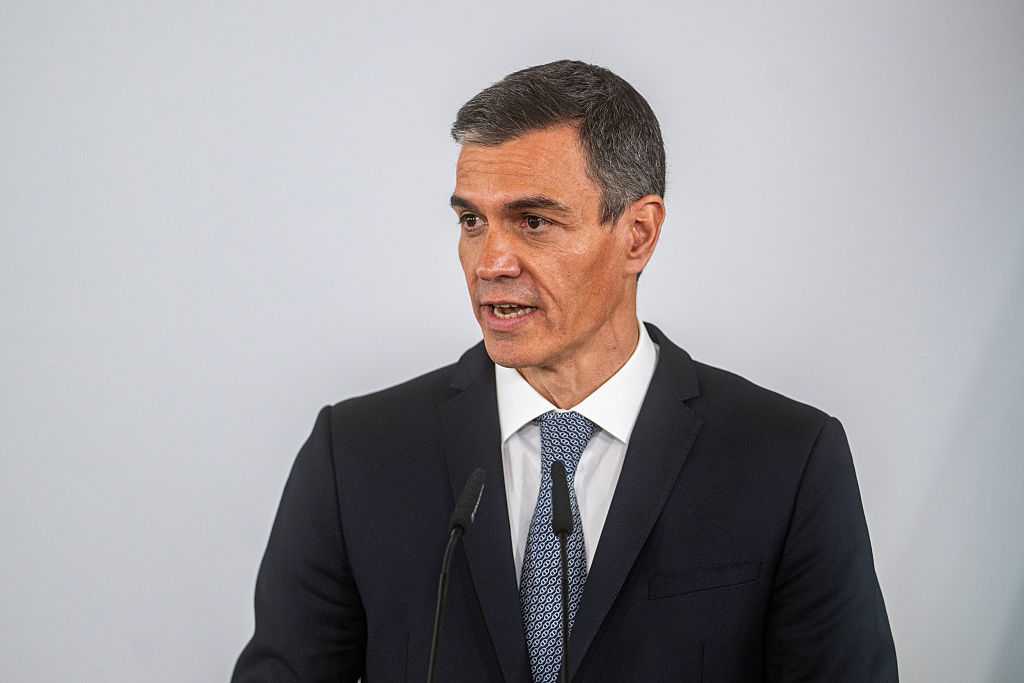
Faced with an aggressive United States, Spanish Premier Pedro Sánchez has called for Europe to seek closer ties with China and Latin America. He’s one of few EU leaders who talks seriously about Europe’s future place in a multipolar world. (Lorena Sopena / NurPhoto via Getty Images)
Over the past two months, Spanish Prime Minister Pedro Sánchez has drawn international attention as the most prominent European critic of the US-Israeli war on Iran. As clips of his speeches have gone viral on social media, the Financial Times dubbed him “Trump's nemesis”; the Independent “Europe’s conscience”; while the New York Times described him as “a progressive superhero for many on the global left.”
It’s easy to see why. As fellow European leaders shrank from openly opposing Washington’s military aggression, Sánchez’s outspoken rhetoric cut through with progressives across the globe. Before the Spanish parliament in March, he described the war as “illegal, absurd, and cruel,” while in a recent op-ed in Le Monde Diplomatique he called out “the unilateral attempts by the United States to engineer regime change in Venezuela and Iran — all without seeking even a veneer of international approval.”
Nor did his defiance stop at words. From the beginning of the war, Sánchez’s center-left administration has refused the United States use of jointly run air bases on Spanish soil — which saw President Donald Trump threaten Spain with a trade embargo in retaliation. Then on March 11, Sánchez’s government permanently withdrew its ambassador to Israel, followed on March 30 by its closing of Spanish airspace to all US military aircraft involved in the bombing.
These moves were highly popular, with two-thirds of Spanish voters telling pollsters that they oppose the war and 57 percent explicitly backing the government’s position. In this respect, domestic political advantage was one major factor driving Sánchez's uncompromising antiwar stance. His successful projection of moral leadership and his positioning as an anti-Trump figurehead has allowed his embattled Partido Socialista Obrero Español (PSOE) to regain traction at home after months on the back foot over a major corruption scandal and its failure to respond to the country’s housing crisis.
It was also no coincidence that Sánchez was the one European head of government to grasp this political opening. As a politician whose instincts were honed through a near decade-long battle to hold off the left-populist challenge of Podemos, he is the center-left leader in Europe most attuned to the need to represent and mobilize, rather than simply retreat behind claims of responsible governance.
Yet alongside this domestic dimension, his stance on Iran is also informed by a wider diplomatic calculation over the potential to renegotiate Spain’s place in a rapidly changing international order. At the heart of this recalibration is a push for closer engagement with China as well as with other Global South actors, with Sánchez insisting that the European Union must diversify its alliances before a declining and increasingly aggressive United States. For all his challenges at home, such as continued wage stagnation, this external repositioning represents one of the only serious attempts in Europe to grapple with the multipolar, post-American world.
New Partners
The Spanish government has been actively showcasing this agenda in recent weeks. On April 11, Sánchez undertook his fourth official trip to China in just over three years — a frequency unmatched by any of his EU peers. A week later, he hosted a global “Progressive Mobilization” summit in Barcelona that brought together European social democrats with heads of government such as Brazil’s Luiz Inácio Lula da Silva, Mexico’s Claudia Sheinbaum, and South Africa’s Cyril Ramaphosa. Both engagements highlighted his administration's mix of diplomatic and developmental ambitions, as it looks to position Spain as a privileged link between Europe and the Global South while also cementing its position as the green energy hub of the Western Mediterranean.
These strategic objectives did not emerge overnight. Instead, having already invested significant political capital in developing relations with the non-Western world in recent years as well as prioritizing the rapid rollout of renewable energy capacity, the Sánchez administration has been better positioned than most EU governments to respond to the profound geopolitical shifts that have accelerated under Trump’s second term.
Sánchez's condemnation of the Israeli slaughter in Gaza, and his willingness to name it as genocide, created an opening diplomatically in the Arab world, particularly in repairing frayed relations with Spain’s major gas supplier, Algeria. Meanwhile, as the EU’s center of gravity shifted rightward, his administration also strengthened ties with the Latin American left, with Sánchez joining Lula’s initiative for progressive governments in the region, La Reunión en Defensa de la Democracia, from 2024. Together he and Lula also pushed for the EU-Mercosur trade agreement, framing it as a counterweight to Trump’s coercive protectionism — despite reservations from Spanish trade unions over the deal's lack of labor protections. A bilateral agreement signed in Barcelona in March will also see Brazil’s rare earths processed domestically in collaboration with Spanish companies.
Yet most significant, as he undertook his first official trip to China in 2023, Sánchez adopted a pro-engagement line, positioning his government as an alternative interlocutor for Beijing among leading EU states. In the context of Italy’s withdrawal from China’s Belt and Road Initiative that same year and Germany’s then Foreign Minister Annalena Baerbock describing Beijing as “more and more a systemic rival,” he moved to fill the space left open.
China’s leadership looked favorably on Spain's abstention in the vote on EU tariffs for Chinese electric vehicles in October 2024, as well as Sánchez’s call for them to be reconsidered. But a key turning point was the Spanish prime minister's willingness to meet with the Chinese president, Xi Jinping, the same week that Trump unveiled his sweeping “Liberation Day” tariffs last year, despite US Treasury Secretary Scott Bessent warning that the encounter was tantamount to Spain “cutting [its] own throat.”
“China makes up one sixth of the world’s population and is expected to account for 30 percent of global industrial output by 2030, so any major global challenge such as tackling climate change or rebuilding multilateral governance requires cooperation between Europe and China,” insists Catalan Socialist and Vice President of the European Parliament Javi López. He tells Jacobin that Spain’s China policy is based “not on choosing blocs” but on “defending European and Spanish interests in the current panorama . . . in which the US has approved a national security strategy openly hostile to Europe and has directly attacked our interests with its tariff policy.”
The Reverse Deng
In this respect, as political economist Miguel Otero noted in a recent study for the Friedrich-Ebert-Stiftung, Sánchez’s overture is motivated by both national “economic realism” and unease at the European Commission’s “excessive alignment” with the US’s China policy, based on containment and systemic rivalry. In terms of economic gains, Sánchez’s diplomatic offensive has been one key factor behind the 331 percent increase in Chinese investment in Spain last year — going from €149 million in 2024 to €643 million in 2025.
“This still remains a relatively low figure, particularly when compared to the total US investment in 2025, but it is also a question of its quality,” international relations analyst Mario Esteban tells Jacobin. “A significant portion of the US inflow belongs to vulture funds investing in things like real estate whereas Chinese investments tend to be more in manufacturing sectors that could potentially expand and strengthen Spain’s industrial base.” Esteban sees the Sánchez administration as attempting to balance the risks of a new overdependency on China and a worrying trade deficit with the potential “to embed Spain within emerging global value chains in sectors such as green technologies and electric vehicles.”
In this respect, he points to the €4.1 billion partnership between Chinese clean technology giant Contemporary Amperex Technology Co., Limited (CATL) and the multinational car manufacturer Stellanis to construct one of the EU's largest lithium-iron battery factories at the old Opel plant outside of Zaragoza. At the same time, Spain looks increasingly set to become the main manufacturing hub for Chinese EVs in the EU after a series of agreements were announced with Chinese manufacturers. Chery is investing €400 million to reactivate the ex-Nissan plant in Barcelona, and Desay SV will reopen the Linares plant in Jaén, while on April 24 Chinese state company SAIC Motor announced that the first MG factory in the EU would be built in Spain.
“Spain has been determined to arrive early to the station on green industrialization,” López maintains, pointing to the competitive advantage it now enjoys with “60 percent of its total energy mix coming from renewables.” He also sees the Spanish government as aiming to secure “technological transfers in green industry,” using Chinese foreign direct investment to build domestic technological capabilities and expertise, as China did with Western companies in previous decades.
Yet Esteban insists that success depends on the fine print of these deals: “It remains to be seen to what extent some of these investments will actually generate spillover effects within the local productive sector, because it is not the same for these factories to simply assemble parts that come from China as it is for these components to be manufactured within Spain, with a genuine localization of productive activity.”
Esteban says this will also be a test for China, to see “whether, in the face of the European Commission’s skepticism, it can demonstrate a genuine willingness to reach a more balanced economic relationship with Spain.” That would give credence to Sánchez’s wider policy vision for the EU on China, which Esteban describes as “managed interdependence.” He explains that it is centered on “rebalancing the relationship not primarily by withdrawal, and depending less on China as a means to reduce trade deficits but by making China more dependent on the EU in key industrial sectors where Europe holds a comparative advantage, while also incorporating Chinese technology to strengthen Europe’s industry in other areas.”
Multipolarity
If the EU is serious about reducing its dependencies on the United States around energy, digital communications, and industries like defense, it will need to combine de-risking and diversification of supply chains with this type of more calibrated approach to China. According to Otero, even under Joe Biden’s administration, the Sánchez government believed that rolling in behind the US in Cold War–style bloc politics “risked narrowing Europe’s diplomatic autonomy and limiting its economic room for maneuver” on China — concerns that have only multiplied during Trump´s second term.
In a recent speech on the future of Europe, Sánchez called on EU leaders “not to bow down” before the United States but to “take brave decisions” that enable “a more autonomous and free Europe.” In particular, he singled out his government’s lone refusal among NATO states to commit to Trump’s target of spending 5 percent of GDP on defense by 2035, resources that he reiterated would simply “end up going to the US arms industry” rather than developing European industrial capacity given the commitment’s tight time frame.
“On NATO, Spain has been an outlier,” maintains the director of PSOE’s Avanza think tank, Berna León. “It won't fulfill a specific administration's desires around targets that are not tied to our real security needs and capabilities,” he argues. “It is more this than an open opposition to the project itself — although I think the future of NATO is now open to question but because of this administration's decisions and what I think can be described as a terrible job of its current secretary general, [Mark] Rutte.”
“Europe needs to understand that we no longer form part of the core of the global system but now occupy a more ambiguous in-between position,” León continues. He believes that “the Spanish government is the first in Europe to wake up from this fantasy“ — referencing Sánchez’s recent speech at Tsinghua University where he declared multipolarity “not a hypothesis . . . or a wish but already a reality” that “we cannot change.”
Yet for all Sánchez’s frenetic diplomacy in recent months, there are few signs of Europe's willingness to pivot from an obsolete Atlanticism. Over the past eighteen months, European Commission President Ursula von der Leyen and German Chancellor Friedrich Merz have made concessions to Trump’s ultimatums their default setting, while Poland and the Baltic states continue to see the United States as the ultimate guarantor against the perceived existential threat from Russia. Even the Iran war does not seem to have shifted such acquiescence. Indeed, on the same day Lula was in Barcelona praising Sánchez’s “bravery” over his stance, Merz was in Paris insisting that “the war must not turn into a transatlantic stress test.”
Domestic Limits
Alongside a difficult battle over Merz’s deregulation agenda in Brussels, Sánchez also faces a likely general election over the next twelve months — in which he is betting his elevated international profile will be able to mobilize a large part of Podemos’s former electorate and consolidate PSOE’s renewed hegemony over the broad-left vote. Yet despite his party’s numbers improving since the beginning of the Iran war, most polls still have the right-wing bloc on course for an absolute majority, if by a narrowing margin. An underlying issue facing PSOE and coalition partner Sumar is that despite Spain’s impressive headline growth figures and reduced unemployment, real wages fell by 0.3 percent between 2019 and 2025, while rent prices have risen 72 percent over the last decade — way above the EU average of 58 percent.
As Jorge Tamames wrote in Phenomenal World last year, this in part reflects the fact that Spain “seems caught between its new and old growth models,” with the labor market still overreliant on tourism, construction, and low-paid seasonal work, while green industrialization remains at “the budding stages.” Yet it also points to the limits of Sánchez's redistribution agenda, particularly since his government has had to operate without a clear working majority in parliament since 2023, as well as his lack of political will to tackle the housing crisis across his eight years in office.
In this context, the general election could coincide with the US midterms or more likely the French presidential elections next spring so as to reinforce Sánchez’s preferred international lens and his binary framing of “democracy or authoritarianism.” A repeated message at the Global Progressive Mobilization summit in Barcelona was that the far-right wave is now breaking under the weight of Trump’s foreign policy disasters. The reelection bid of Europe’s most prominent center-left figure will be a major test of that thesis.