The Roots of Karl Marx’s Anti-Colonialism
Through his relationship with the Chartist radical and labor poet Ernest Jones, Karl Marx came to realize the necessity of opposing slavery and colonialism in ending capitalism.
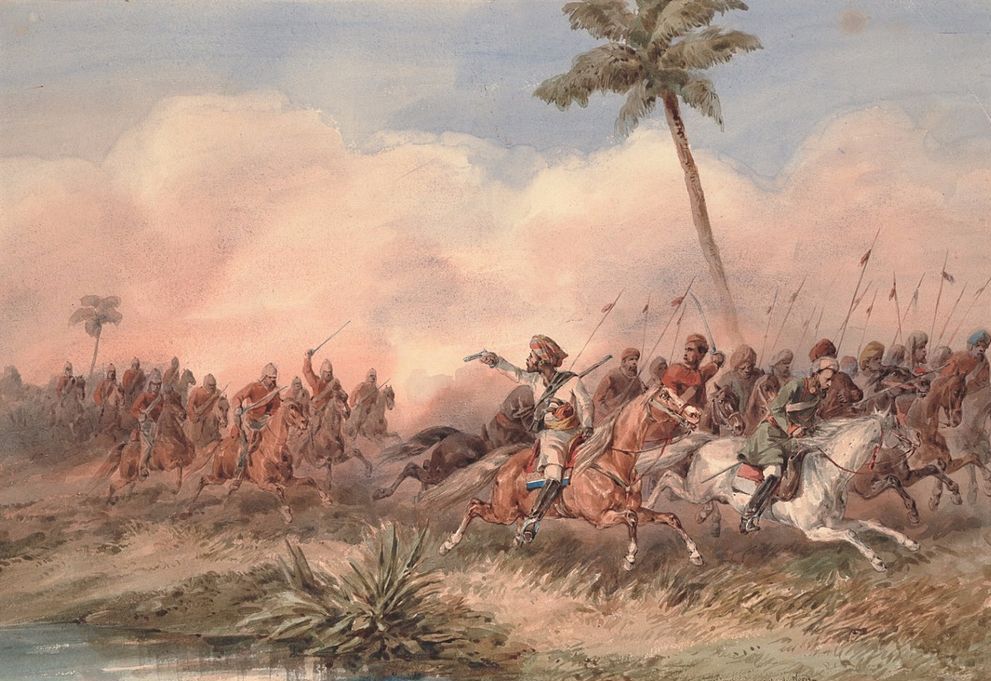
The 2nd Dragoon Guards, British Army cavalry, pursuing rebels in Lucknow, Uttar Pradesh, during the 1857 rebellion.Orlando Norie / Brown University
In his film The Young Karl Marx, director Raoul Peck features a scene where an anonymous Frenchman of African descent makes a heartfelt intervention during one of Pierre-Joseph Proudhon’s outdoor speeches in Paris. Contrasting with the crowd of laborers gathered around him, the elegantly dressed, top-hatted black gentleman briefly interrupts the famous orator to urge him to speak of liberty not only for artisans, whose crafts were increasingly threatened by industry, but also for the underclass of proletarians — “the navvies, the mechanics, the smelters!” he exclaims. Marx and his life partner and co-thinker, Jenny, are sitting next to the citoyen de couleur, both looking delighted by his critical remark to the father of French anarchism.
The scene is memorable, to be sure, for it is not Marx but a black person — who was tied perhaps directly or by ancestry to colonialism and slavery — who exhorts Proudhon to hold a conception of the working class inclusive of the factory proletariat. The discussion in the scene never turns explicitly to the question of the racialized and enslaved proletarians of the colonial world. Implicitly, however, it does. Because through his black character Peck reminds us that Marx was then living in and thinking from the heart of a colonial empire, with overseas possessions still dominated by racial slavery, and that this larger context inexorably shaped the composition of the working class in the metropolitan core.
Yet in the film as in history, the Parisian Marx was not yet preoccupied intellectually and politically with colonialism and slavery. Peck, therefore, does not make his Marx go talk to the black interlocutor, with whom he clearly shared the same outlook, but to Proudhon, of whom he was highly critical.