Flowers at the Tomb of a Fascist
- Eoghan Gilmartin
The remains of Spain’s fascist dictator Francisco Franco lie in a monument built for him by Republican prisoners of war. At last, the government is trying to rectify that.
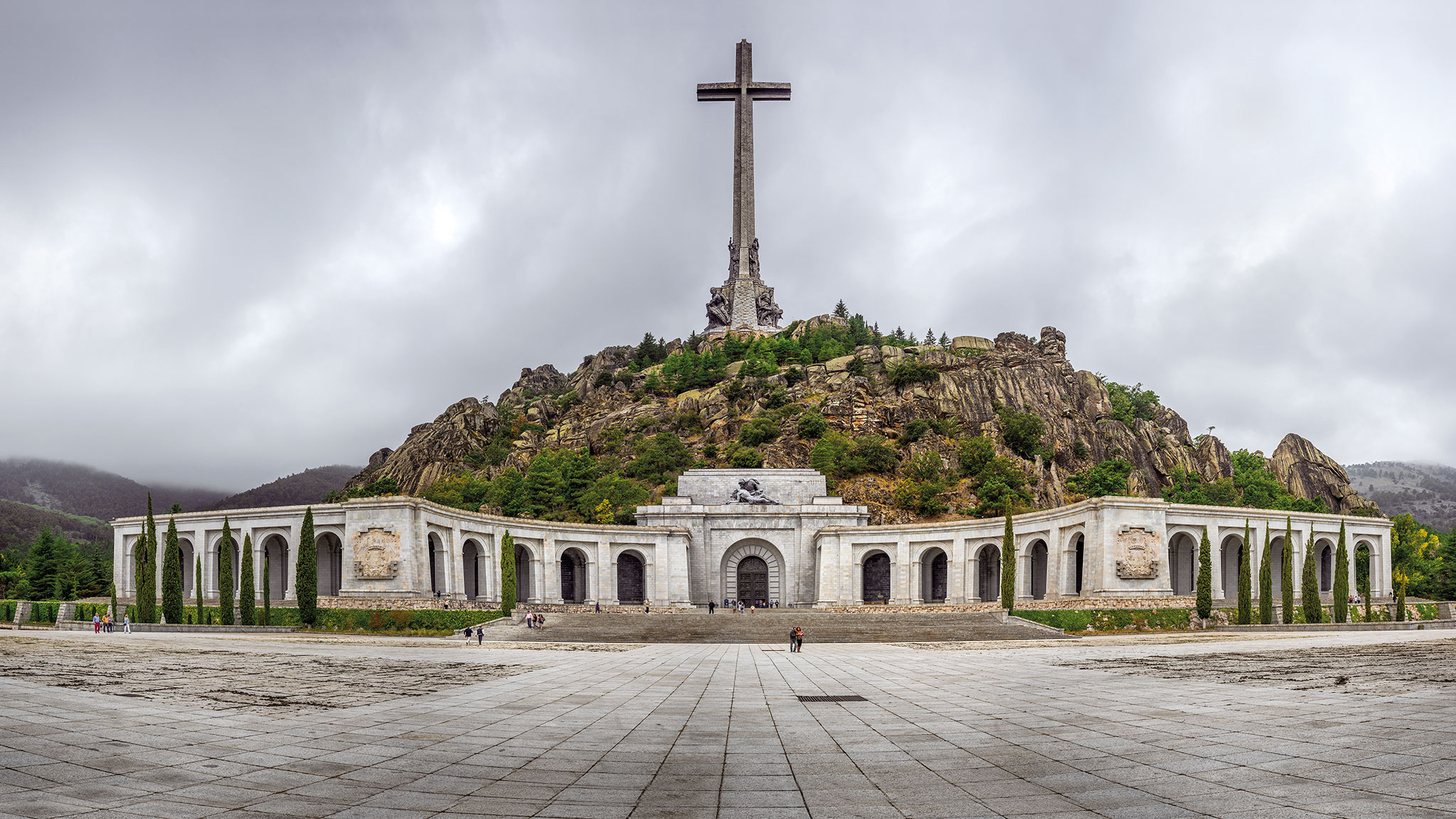
Valle de los Caídos, ‘The Valley of the Fallen,’ where Spanish dictator Francisco Franco is buried.
It’s Thursday, 11 AM at the Valley of the Fallen. A gaunt middle-aged man with a yellow t-shirt and black fanny pack waits for the staff to allow visitors to approach the tomb of Francisco Franco. The rosary has just finished with the words “for Spain, its youth, and its families.” As the mass continues, the abbot evokes the martyrs of which he and his fellow Benedictian monks are the custodians. The humidity, which makes the walls sweat, gets into our bones as we wait behind the cordon for the service to end. In the vaults of the crypt below there are more than 20,000 victims of Francoism interred in the same dampness. The chants of the monks and the strong smell of incense add to the oppressive atmosphere. At last the mass finishes and we are ushered in to pay our respects to the dictator.
Spanish history can be grasped through the funeral rites of its protagonists. The great Spanish writer Federico García Lorca was left to rot in an unmarked pit in the hills outside Granada after his assassination by Falangists. Meanwhile, the man responsible for his murder, the Spanish dictator Francisco Franco, rests in a mausoleum fit for an Egyptian pharaoh. This is a fate quite distinct from the glory afforded other fascist dictators in Europe. Mussolini was strung up outside an Esso gas station near Milan, while the body of Adolf Hitler was burnt with that of Eva Braun in a crater that is now the sandpit of a Berlin playground. But Franco lies in an abbey built by Republican slaves and maintained by public money. And it is no accident. Spain was a fascist anomaly in postwar Europe, which built its democratic order with a strong antifascist component.
A Morbid Symbol
Work on the Valley of the Fallen began in 1940, a year after the end of the Spanish Civil War, when Franco issued two decrees stating the need to honor those who had given their lives in the “glorious national crusade.” Built deep within a mountainside in the Sierra de Guadarrama, sixty kilometers from Madrid, the massive complex houses the bodies not only of soldiers from the fascist army but thousands of republicans who were interred there without their families’ permission. Its 150-meter cross, which sits atop a mountain peak, is visible throughout a long stretch of the A Coruña motorway, one of the country’s busiest roads.