Spain Against Itself
On the 40th anniversary of Spain's post-dictatorship constitution, the center is wracked by crisis, the far right is on the rise, and tensions over Catalonia continue to rise.
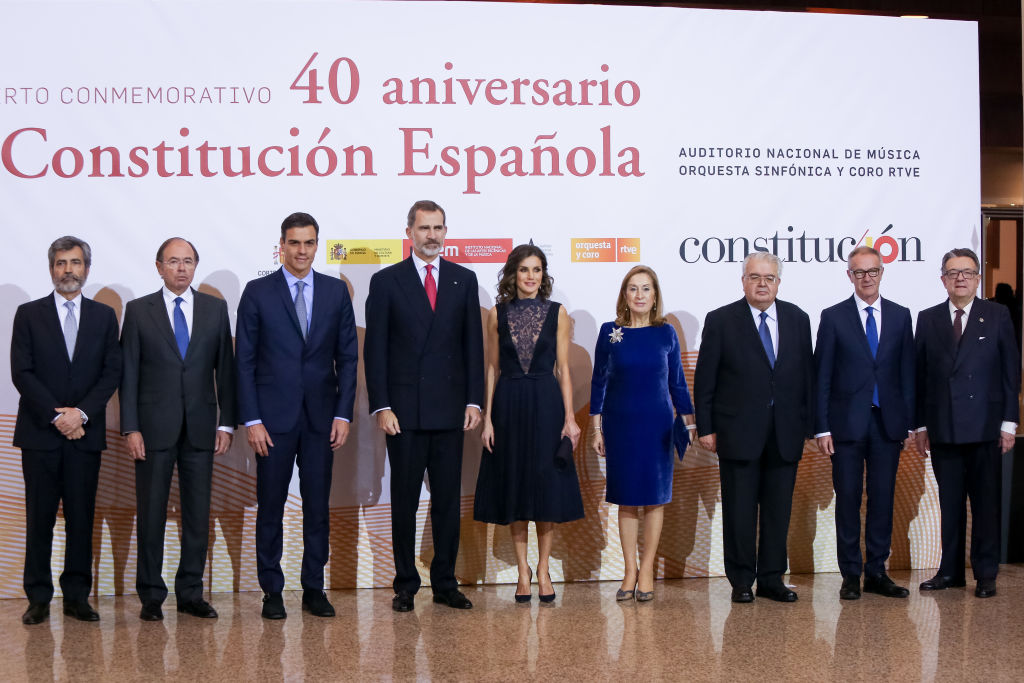
Prime Minister Pedro Sanchez (3L) Queen Letizia of Spain (c) and King Felipe VI of Spain (4L) attend a concert to commemorate the 40th anniversary of the Spanish Constitution on December 5, 2018 in Madrid, Spain. Pablo Cuadra / Getty Images
Spain celebrates the fortieth anniversary of its constitution amid a climate of fear and instability. This document, passed by referendum on December 6, 1978, is widely described as the jewel in the crown of the transition from Franco’s dictatorship to a parliamentary monarchy; it is celebrated as the result of opposed political forces setting their differences aside in a spirit of shared consensus. This cornerstone of the nation’s institutional order can only be amended at the behest of Brussels, for the sake of disciplining the public finances.
But despite the official platitudes, Spain is far from a country reconciled with itself. Post-Franco democracy has been rattled by the impact of economic recession, austerity policies, and widespread corruption scandals. The crisis unleashed by the Catalan government’s failed bid for independence is far from over — assuming it can indeed be resolved, rather than just managed with a greater or lesser degree of tact. Making matters worse, Spain’s status as an exception to the rising tide of xenophobia in Europe is no more. Sunday’s elections in Andalusia witnessed the far-right party Vox obtain an unexpected 11 percent of the vote — its first electoral breakthrough, which allows it to end four decades of center-left Spanish Socialist Workers Party (PSOE) rule by joining a right-wing coalition.
The post-Franco order’s legitimacy has been significantly eroded over the last decade, which began with the financial crisis and has since seen the emergence of the indignados movement, Podemos, and Catalonia’s bid for independence. As a result, centrist attempts to recast the status quo have little staying power.