Time to Bury the Dead
Eighty years after the end of the Spanish Civil War, tens of thousands of Franco's victims still lie in unmarked graves. Identifying the dead is a vital means of providing Spain with closure — and making sure fascism doesn't rear its head again.
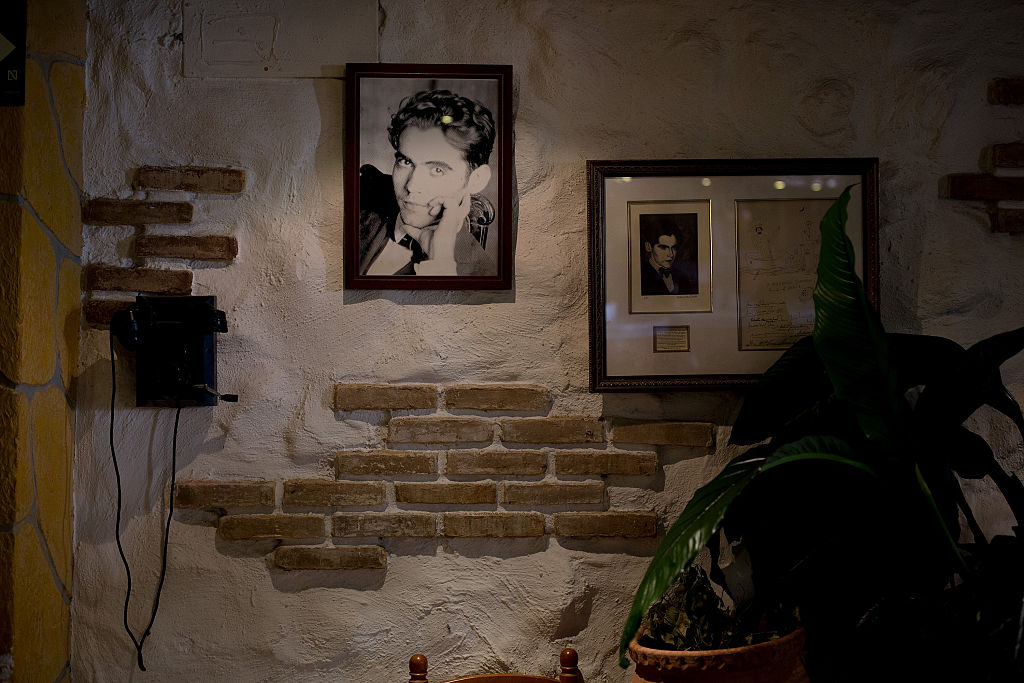
A portrait of Federico Garcia Lorca hangs from a wall in a restaurant near the site where archaeologists are searching for a mass grave of victims of the civil war on November 19, 2014 in Alfacar, near Granada, Spain.Pablo Blazquez Dominguez / Getty
The Spanish Civil War came to an end on April 1, 1939, only days after Francisco Franco’s Nationalist troops entered Madrid. By the time the capital fell, following a long siege, the war’s body count had reached nearly half a million. About 150,000 of those deaths directly owed to the Francoite terror; a further 20,000 Republican prisoners would be executed in the immediate wake of the Nationalists’ victory. Thousands more died in concentration camps across the country or in refugee camps over the border in southern France.
In the words of Francoite general Queipo de Llano, it was “necessary to spread terror . . . to create the impression of mastery, eliminating without scruples or hesitation all those who do not think as we do.” Historian Paul Preston later called it the “Spanish Holocaust.” Yet it seems difficult for the country to reflect on the dead and those who orchestrated the mass killings. The bloodbath at the foundation of the Franco regime now lies decades in the past; Spanish democracy was re-founded in the 1970s precisely on the “pact to forget” and a bipartisan amnesty.
Nonetheless, since Pedro Sánchez’s Socialist-led government assumed office last summer, historical memory has returned to the forefront of the political agenda. Just a month into his term as premier, Sánchez announced that Franco’s remains, along with those of Falange founder Antonio Primo de Rivera, would be exhumed from the shrine built for the two at the Valley of the Fallen, just north of Madrid. The dictator built the monument for himself with the forced labor of thousands of Republican prisoners, who all now lie in unmarked graves. Decades later, the site is finally to be “resignified” in a belated effort to tackle this dark chapter of Spanish history.