The UAW Bet on Abdul El-Sayed and Won
The United Auto Workers backed Abdul El-Sayed in a close Senate primary, then mobilized members across Michigan. Its sights are set on the next fight with the Big Three.
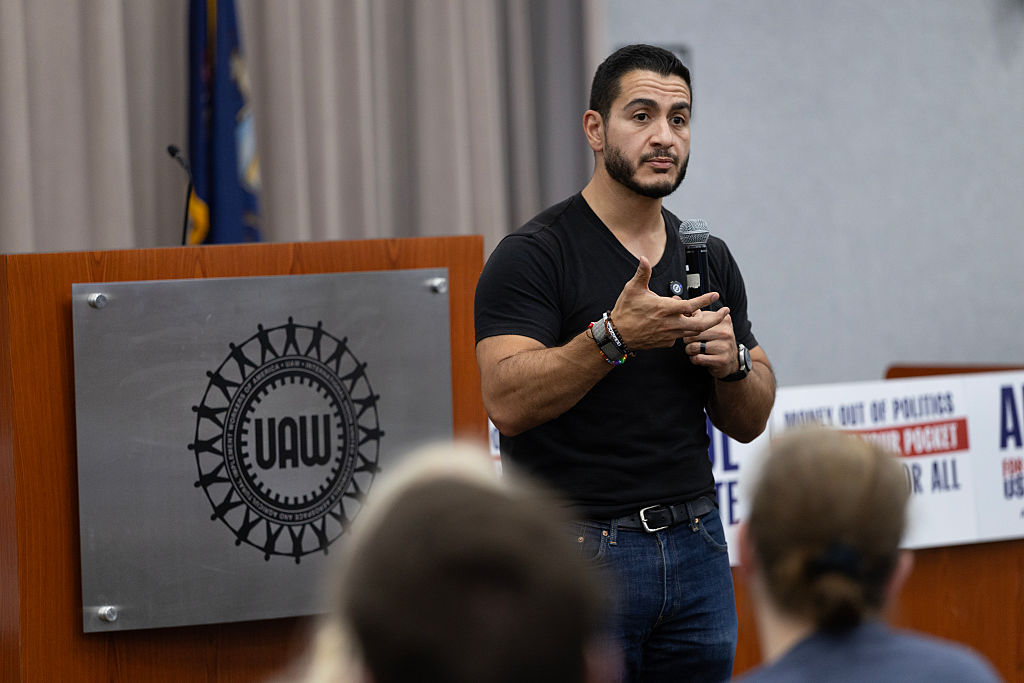
The UAW played a key role backing Abdul El-Sayed’s Senate campaign in both the primary and the general. (Scott Olson / Getty Images)
Three Rivers, Michigan, is a factory town in a county where Donald Trump won 66.2 percent of the vote in 2024. Its biggest employer is American Axle, whose workers belong to United Auto Workers (UAW) Local 2093. In 2008, the company demanded major concessions, arguing that it needed lower labor costs to remain competitive and keep the plant open. Workers spent nearly three months on strike before accepting a contract that halved some workers’ pay, from $29 an hour to $14.50. The plant survived, but by this spring, production workers still topped out at only $22 an hour.
Workers spent years trying to recover what they had lost. Yet when members voted to authorize a strike in 2021, the international union did not support them walking out, according to Rosemary Dodge, a machine operator and trustee of Local 2093. Members were angry at the company and at the union leaders who wouldn’t back a strike.
“People’s attitudes toward our international union were very negative,” she told Jacobin.
This year, Dodge took time away from the plant to campaign for Abdul El-Sayed in his run for Senate. Her local had struck with the international’s backing in June, and El-Sayed had spent hours on their picket line.
“I had not seen that kind of solidarity in our union up until that point,” she said of the contract fight.
The UAW, Michigan’s largest union, counts more than 350,000 members, active and retired, in the state. It backed the Medicare for All advocate in a primary where Governor Gretchen Whitmer and retiring Senator Gary Peters supported Haley Stevens, El-Sayed’s opponent, and other major unions stayed neutral or backed Stevens. El-Sayed’s campaign called the UAW’s backing “critical” to his 1 point primary victory.
Dodge, sixty-four, works on the paint line and has been at American Axle for almost eleven years. “The starting wage was not enough for people to both have a place to live and have a vehicle to get to work,” she told Jacobin, describing what coworkers faced before this year’s contract fight. “There were people that were either walking or riding bikes to work, or people that were living in their cars.”
But by the time Local 2093 prepared to bargain again this year, things had changed inside the international union. Two former UAW presidents were among the officials convicted in a federal corruption investigation. Members subsequently won direct elections of their top officers and elected Shawn Fain president in 2023. That fall, the UAW struck all three major US automakers.
In the lead-up to the 2026 contract fight at American Axle, the local bargaining committee had spent a year preparing, including tracking parts shipments and the company’s efforts to build inventory. Members began “working to rule” to resist management’s stockpiling efforts, and hundreds attended the local’s meetings.
“We had a really strong bargaining committee that was very well prepared, and when the international saw that, it was on board and helping us,” Dodge said. “Since we’ve had the change at the top of the international with Shawn Fain and one member, one vote, the international leadership and its willingness to back us changed a lot of people’s minds.”
Fain and Michigan Lieutenant Governor Garlin Gilchrist attended a rally to kick off contract negotiations at Axle, she recalled. “We were like, ‘All right, the lieutenant governor’s here, and we’ve got the president of the international here.’” Members could see that people had their backs, she said. “That made a big difference in people’s attitudes.”
On June 1, nearly one thousand American Axle workers walked off the job. They wanted a $30 hourly rate by 2030, no increases in out-of-pocket health care costs, and stronger protections for their personal time.
Four days later, the UAW endorsed El-Sayed’s primary campaign for Michigan’s open US Senate seat. The candidate joined Local 2093 members on the picket line that day.
“Abdul was the one who spent hours on our line, talking to the people of our union, walking with us, while there were so many other politicians who came and showed up just for a photo op,” Dodge said.
“We are going to make sure that they hear you nationwide,” El-Sayed told the strikers at the time, pointing to the concessions workers had made to keep the plant open and accusing the company of failing to share the gains from their work.
In mid-June, Axle’s workers ratified a contract with a $30 top rate by 2030, with additional paid time off and no concessions on existing health care costs. Those hired before May 31, 2012, received an immediate $8 hourly increase.
“[El-Sayed] genuinely cared about how we were doing, and he was one of the first ones to call and congratulate us when we got a great contract,” Dodge said.
In a September Abdul for Senate television ad, Local 2093 Bargaining Chair Josh Jager contrasted his more than twenty years on the line with Rogers’s political career. “Mike Rogers has been in office for over twenty years — not good years,” he said. “Every day, I show up on the line and build stuff. Every day, Mike shows up for his corporate donors.”
Dodge joined the UAW’s political program before the August primary, taking release time from the plant to knock doors, make calls, and rally her fellow members to back the progressive challenger. Despite the barrage of attacks on El-Sayed — including from Trump, whom some members had supported — Dodge said the majority of the union households whose doors she knocked on were polite even when they disagreed (though one did call them communist sympathizers and order them off his property).
“I believe that Abdul is someone who does respect working people, and that’s what earned my respect for him,” she said.
“We were pleasantly surprised when we started at how many people were really receptive to hearing the information we had to share about Abdul,” Dodge said.
El-Sayed won both of the city’s precincts. Unofficial returns show him receiving 1,318 votes to Republican Mike Rogers’s 1,060, or 53.6 percent to 43.1 percent. Two years earlier, Rogers beat UAW-endorsed Democrat Elissa Slotkin in the city, while Trump beat Kamala Harris.
Choosing Their Candidate
The union’s endorsement of El-Sayed in the primary mentioned his stance on Medicare for All, banning stock buybacks, and May Day 2028. Its Big Three contracts expire April 30 that year, allowing a strike on May Day; the UAW has urged other unions to align their contracts so they can strike together.
The endorsement decision came through Michigan’s member-elected Community Action Program (CAP) board, following candidate forums and member surveys. Endorsement required a two-thirds majority of the board, where a plant representative’s vote carried the same weight as that of the international president.
Three Democrats — Stevens, El-Sayed, and Mallory McMorrow — participated in a candidate forum at the UAW’s national CAP conference in Washington in February. Fain said the union had invited Rogers too, but the Republican candidate “didn’t even bother to respond.” The union invited the candidates to another forum in Detroit. “Again, Rogers didn’t show up, didn’t bother to respond,” Fain recounted.
Members quickly warmed to El-Sayed, who secured the endorsement on the board’s first vote.
“When he talks to people, they understand who he is, and they understand that he cares about working-class issues,” Fain said. “Our members really drove this decision, and that’s what I’m really proud of.”
Back in Three Rivers, rising costs were eating into the contract’s hard-won gains, leaving members open to what El-Sayed had to say. “People were frustrated by that,” Dodge said. “They said we worked so hard to get this better contract, and it’s not really showing. I think they were willing to hear other options.”
At a Wednesday press conference after El-Sayed defeated Republican Mike Rogers, Fain recalled hearing from Three Rivers members at the union’s June convention.
“There were so many people coming up to me from Three Rivers, Michigan, saying, ‘This guy speaks my language. He understands me,’” Fain said. “This was an area where they were Trump supporters in ’24.”
To turn that support into votes, fifty Michigan UAW members left their workplaces to serve as full-time political organizers, the union’s “power squad.” Fain put the program’s totals at more than half a million calls made and more than one hundred thousand doors knocked.
The political program emphasized shop-floor conversations, with coworkers talking about wages, health care, retirement, and time off. Those conversations were also meant to get more members organizing inside their plants ahead of a possible strike in 2028.
James “Jay Jay” Jewell has worked at Ford’s Sterling Axle plant for fourteen years and is a district committeeman in Local 228. He began working full-time on the election in early September. As a recruitment lead, he made calls and organized one-on-one to get members to volunteer. “This was very structured,” he said. “This is very intentional work happening.”
“Money out of politics; money in your pockets; Medicare for All,” Jewell said of El-Sayed’s appeal, echoing the now-senator-elect’s key campaign slogan. “We have a lot of faith that the political structure and system in this country might be ready to turn around if regular working people have it in their hands. It’ll take time and work and more organizing, but the tools are there now.”
“It was far from lukewarm,” he said of volunteer recruitment among his fellow UAW members. “It was amazing how many people were raising their hands to do it, how many people were picking up the phone when I was calling.”
Jewell lives and works in Macomb County, where Trump won by nearly 14 points in 2024 and Rogers beat Slotkin 53.3–43.6 percent. This year, unofficial returns there put El-Sayed just 7,526 votes behind Rogers, fewer than 2 percentage points.
Jewell had seen how a contract win could change members’ expectations of their union. For him, talking with conservative members about the election meant pointing to those gains. “When we have progress and wins, we just have to name it and make it clear and simple,” he said.
The 2023 Ford agreement had eliminated wage tiers at Sterling Axle and Rawsonville, bringing substantial raises for workers on the lower wage scales. Jewell himself had benefited from the union’s more aggressive bargaining. “My plant got rid of two tiers, so more than half my plant got a $12 raise overnight,” he said. “Made whole, including myself.”
“It’s no coincidence,” he said of the union’s bargaining and electoral victories. “They’re going to feed off each other: we get policy and legislation out of the people that got elected.” Better contracts, in turn, build confidence in the leadership and in collective solidarity. “It’s going to be self-perpetuating if we do this right.”
Building Power for 2028
“What we win at the bargaining table can be taken away in the halls of power the next day,” Fain said Wednesday. “The days of us blindly endorsing people because of party affiliation — those days are way behind us.”
The UAW put money behind that choice, with its V-CAP political action committee giving Fighting for Michigan PAC, an independent expenditure group backing El-Sayed, $300,000 in July and another $600,000 by October. The union still gave to Senate Majority PAC, but it broke with Democratic Party leaders in Michigan’s primary and put its money and members behind El-Sayed.
“We’re going to target races. We’re going to target people. We’re going to put our resources behind candidates that want to carry that agenda and want to stay with working-class people,” Fain said. “And I don’t care if you’re Democrat, Republican, independent. If you’re not with us, we’re not going to be there for you.”
Fain described the political program as part of the changes he had run to make inside the union.
“I was very frustrated with where we were politically: how we approached politics, how we approached bargaining, how we approached organizing, pretty much every aspect of our union. That’s why I ran for president,” he said Wednesday. “Right out the gate, it was about Big Three bargaining, going into new organizing, winning at places like Volkswagen, and the next stage of that is controlling our politics.”
El-Sayed won amid a broader Democratic sweep in Michigan. Unofficial returns showed El-Sayed led Rogers 52.5 to 45.5 percent as of November 5. Slotkin had beaten Rogers by just 19,006 votes (0.3 percent) two years earlier. Democrats also won back the state house, giving them control of both legislative chambers and the governor’s office.
El-Sayed ran about 2 points behind Michigan Secretary of State Jocelyn Benson, who received 54.5 percent in the governor’s race. His campaign faced repeated Islamophobic attacks, with Trump labeling him a jihadist and advertisements falsely suggesting he had ties to terrorist organizations. He will be the first Muslim elected to the US Senate.
“Corporate Democrats are as big of a problem as any right-wing Republican,” Fain said when asked whether the election results nationwide vindicated the party’s moderates or progressives. “I do believe that the progressive people in the party are speaking more the language that resonates with working-class people.”
He warned Democrats against assuming the results showed confidence in the party. “They’re voting Democrat because they’re pissed off, because they’re frustrated with where they are in life right now, and they can’t afford to live,” he said. “If the Democrats do not heed that warning and come out with a platform and go to work to fix the problems in this country,” he warned, “they’ll be voting the other damn way.”
Jewell said the objections he heard while canvassing concerned El-Sayed’s race and religion; there was little disagreement over his platform. “I did not have a single member in two months who really wanted to argue against anything that he wanted to deliver,” he said.
In Three Rivers, Dodge did hear concerns about Medicare for All from some members who had just fought to preserve their insurance. But she supported El-Sayed’s health care politics. Even with union coverage, she said, a catastrophic illness could leave a worker in debt.
Tielece Perry, a thirty-year worker at Detroit Assembly Complex–Jefferson and a member of Local 7, chairs the union’s Region 1 CAP Council. She said conversations with coworkers often concerned their parents and the cost of their care.
“We’re raising our kids, but we’re also taking care of our elderly parents, and we still have to work full time,” she said. “So when someone like that has to make a choice between whether they’re going to have medication or groceries, that’s a real challenge.”
Asked what she wanted El-Sayed to do in office, Perry said, “We’re going to hold him accountable. I would like to see him be successful with Medicare for All.”
“He understands that when you work hard, you want to have a life outside of work,” Dodge said. At American Axle, she said, departments were still being placed on “critical status,” allowing management to mandate up to seven days of work a week. “We tried to get that language improved in our contract; it’s not as strong as we wanted it to be.”
El-Sayed had included “the freedom to spend time with your family” among the promises of his campaign. “These principles aren’t radical,” he said. “They’re the baseline for a more equitable Michigan and America.”
When Michigan’s new legislature convenes in January, passing unemployment insurance for striking workers will be among the UAW’s priorities ahead of its 2028 contract fight, Fain told reporters Wednesday.
“We plan to carry the power that we built in 2026 into our next major fight, which is the 2028 Big Three contract negotiations,” Fain said.
“We don’t do this much organizing and winning to get unemployment for striking workers and that’s it. No, we need a whole revamp of the system,” Jewell said. His priorities included the Protecting the Right to Organize (PRO) Act, which would make employers pay fines for breaking labor law and prevent them from indefinitely stalling negotiations for a first contract, and finding a way to undo Citizens United.
Asked by Jacobin whether he saw a path to passing the PRO Act or similar legislation, Fain stressed the need for stronger enforcement of workers’ rights. “We would love to see the PRO Act pass,” he said. “They fire people. They threaten people. They intimidate people,” he said of employers. “And there’s zero repercussions for corporate America when they do this.”
Jewell expected the candidates the UAW had helped elect to strengthen workers’ rights and curb corporate influence in politics. “I need them to go be aggressive as f — ,” he said. “They already know what we need. It’s not a secret.”
In his election night victory speech, El-Sayed mentioned Local 2093 bargaining chair Josh Jager and the strike he and his fellow members had waged at American Axle. “And they won that fight,” he said. “His hope?” the senator-elect continued, referring to Jager. “An America where every single worker gets the right to a union.”