Can the DSA Build Working-Class Power?
The Democratic Socialists of America have gone from political obscurity to a major force in American politics. Vivek Chibber and Paul Heideman discuss its remarkable rise — and why electoral victories alone won’t build lasting working-class power.
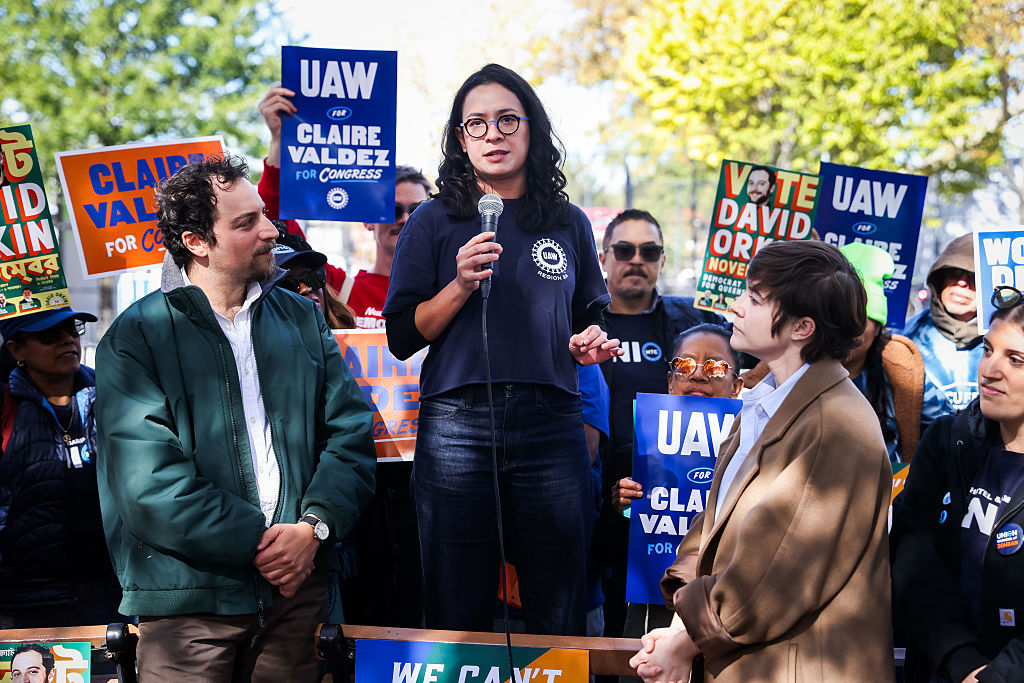
Electoral victories have made DSA a force in American politics. Turning that success into lasting socialist power will require rebuilding the labor movement. (Michael Nagle / Bloomberg via Getty Images)
- Interview by
- Cale Brooks
Over the past decade, the Democratic Socialists of America (DSA) has moved from an obscure Cold War holdover to one of the most influential organizations in US politics. But even with continued electoral success, is it at risk of stalling out?
On this latest episode of the Jacobin Radio podcast Confronting Capitalism, Vivek Chibber discusses the rise of DSA with Paul Heideman, author of the new Catalyst essay, “Where is DSA Going?” Vivek and Paul look at DSA members’ class interests and geographic concentration to get a sense of the organization’s relative strength and longevity.
Confronting Capitalism with Vivek Chibber is produced by Catalyst: A Journal of Theory and Strategy and published by Jacobin. You can listen to the full episode here.
Cale Brooks
Due to the midterms, there’s been quite a bit of media focus on the Democratic Socialists of America (DSA). We previously looked at the broad historical contours of the American left and its relationship to both electoral politics and labor organizing, but today I thought we could get into more specifics of left organizing.
Since Bernie Sanders’s first presidential run, democratic socialist candidates have been racking up a lot of electoral wins. Paul, is this the most relevant democratic socialism has ever been in American politics?
Paul Heideman
It’s close to the most relevant any kind of socialism has ever been in American politics, I would say.
On a per capita basis, DSA is still smaller than the Socialist Party of the era of Eugene Debs before World War I. But in terms of an impact on American politics, I think DSA is having as much of an impact as the Socialist Party ever did, partially because its strategy of running these kinds of insurgent primary campaigns in the Democratic Party has such a direct impact on the rest of party politics in the country. Republicans now run ads that say things like “This candidate is a socialist just like DSA.” Democrats also have to have some kind of position toward DSA and DSA candidates. And for many of them, it can’t simply be one of disavowal. So, I think in terms of influence on American politics, this is a peak for socialism in general.
Vivek Chibber
The very fact that the Republicans are having to reach into their bag of tricks and bring up Cold War rhetoric about communists and communism is very indicative of the fact they’re worried.
The Democrats, on the other hand, are interesting because for ten years, they waged a silent battle against Bernie Sanders and his wing of the party. In my opinion, they took him to be a bigger threat than Donald Trump. We’ve said before on the show that they would rather lose to Trump than win with Bernie Sanders. And that’s been their agenda from 2016 util Zohran Mamdani’s victory in New York.
Now there’s a substantial portion of the Democratic Party, not just the self-avowed Sanders wing but even the center left of the party, that’s talking about national health care, that’s running on economic issues and not taking up the race essentialism and wokeness that defined the party for about five years in the Biden era. That switch is a tacit acknowledgement that the energy and the political vision now stands with the Sanders wing of the party. And because of that, there’s been a tremendous change in national political culture.
I would just make one addendum to what Paul said. I think it’s true to say that this is the most relevant democratic socialism or socialism has ever been in the electoral arena over the last century. But I would hesitate to say that it’s the most relevant it’s been to American politics, because there is nothing today that is reminiscent of the impact that the Communist Party had through the Congress of Industrial Organizations (CIO) and the labor movement in the 1930s and 1940s.
One might argue that that is technically not politics, but it absolutely is, because as the labor movement goes, so goes the Left. And the fact that the Communist Party was able to energize the CIO, not just on labor issues but importantly also on race issues, changed American politics. That was the fulcrum on which the entire New Deal era was really resting.
So, I would say that the Sanders wing and DSA have taken an important first step that was inconceivable twelve years ago. But as we’ve said many times on the show, that first step might be the last step, unless the Left does what it did in the interwar years, which is rebuild the labor movement.
Paul Heideman
I think Zohran Mamdani encapsulates how DSA is reshaping politics in the electoral arena. His victory on an affordability agenda, starting from a campaign that very few people in the city even knew about, showed candidates all over the country that this is the winning agenda. This kind of attention to people’s basic material needs is what is capable of mobilizing people against Republicans and bringing back those layers of voters that went with Donald Trump in 2024.
Vivek Chibber
This is particularly true for working-class voters, and this has led to a huge change within the American left. For the last twenty-five years, bringing up economic issues prompted accusations of “class reductionism” or “economic reductionism,” as if it’s a bad thing. That’s gone now. That debate is over.
Right now, in the electoral arena, the economic issues are central. This has not been to the exclusion of everything else, but it’s understood that economic interests are what binds together any viable coalition capable of carrying a progressive agenda forward. And it’s pushed back the entire professional identitarian class, which represented the class interests of the elite layer of the historically marginalized groups.
The fact that that debate is over is a massive leap forward. Now the Left actually has a future instead of being stuck in a cul-de-sac that it looked like it would never come out of. And there’s hope that the working class drift to the right could come to an end.
Paul Heideman
We should remember that within the Democratic Party, the mobilization of identity essentialism really arose and achieved prominence as a way of attacking Bernie Sanders. It was things like Hillary Clinton saying, “Breaking up the big banks won’t end sexism” that made those politics so central to the Democratic Party. And it allowed itself to drive into a ditch in so many ways during the Biden administration.
I think Mamdani really showed that there’s a different way to do politics that can actually win. If you look at the Democratic candidates all over the country right now who flipped seats and are nationally prominent, none of them are doing the kind of identity essentialism that was all over the party four years ago.
Vivek Chibber
And it’s significant and very helpful that many of these candidates are nonwhite. It gives visibility to the possibility that a left-wing politician can be a person of color and still have some kind of universalistic political program that working people of all races and genders can come to.
Cale Brooks
Coming back to this emerging Sanders-Mamdani wing of the Democratic Party, DSA has almost exclusively concentrated their efforts on running candidates within the Democratic Party. And commonsensically, one could argue, “That’s because the Democrats are just the most left-wing party. So, of course the left-wing politicians run in the Democratic Party.” But Paul, you argue that this decision isn’t obvious. Why is it that DSA is running for seats through the Democratic Party?
Paul Heideman
Historically, one of the most successful left political projects in US history was the People’s Party in the late nineteenth century, which was organized as a third party. There were governors and senators and representatives who were elected on the People’s Party ticket. And they won a substantial portion of the vote in the late 1880s and early 1890s in the United States.
One might think that if the People’s Party model was among our most successful projects, then maybe third-partyism is the way to go. But there’s a historical chasm separating our moment from that moment because of the reorganization of electoral institutions in the United States since then. A couple features of that stand out.
First is the primary system. There weren’t party primaries back then. So if you wanted to challenge a party or if you wanted to oppose what the leadership of a party was doing, the only way to do so was through another party. You couldn’t just enter into their primaries and try to displace them from within. That’s because the nomination process was entirely controlled by party bosses. So, challengers had to be in third parties; it was forced on the Left to an extent.
That’s no longer true. Today the Democratic establishment in New York City did not want Zohran Mamdani to run for mayor, let alone win. But he did, and it’s because the parties set up these institutions called party primaries that they couldn’t stop him. In a sense, primaries have opened a door for the Left that was closed before the institution of primaries was mandated through state law all over the country.
The second feature that’s really important is the restriction of ballot access for third parties. Since the 1930s and really in response to the growth of the Communist Party, the two main parties have agreed to increase the requirements for ballot access. Generally, this is the number of signatures required; sometimes it’s the number of votes. Ghis has made it much more difficult to organize a third-party campaign in the United States compared to the time of the populists. So, in a way, this has shut a door for third-party challenges.
I think these two things together have really changed which strategy makes the most sense for the Left when it comes to electoral politics.
Vivek Chibber
There’s another factor worth mentioning, even though I don’t think it is as important as the ones that Paul has just laid out. The third factor separating that era from this one is fusion voting. Where there was fusion in that earlier era, candidates could run on more than one party’s ballot line. That enabled upstart, emerging parties to bring out their voters to support the mainstream parties.
So something like the People’s Party could run its candidate and also have the Democratic Party support for that same candidate. And then, at the end of the election, if that candidate wins, the People’s Party goes to the Democrats and says, “Look, X number of the voters for your Democratic candidate were actually voting for the People’s Party.” This gave the People’s Party entrée because the candidate owes them something, and it’s able to use that to build the party’s legitimacy and visibility.
By the early twentieth century, fusion had been outlawed, and it continues to be outlawed now in all but three or four states. This means that in most circumstances, if you want to run your own candidate, you’re shut out of the two main parties as Paul was saying. And now, you have to run an insurgent campaign, which in most places is an uphill task because people think that if they vote for you, they’re wasting their vote. And most voters are not going to do that.
There have been scores upon scores of attempts to start third parties in state after state, and they always fail. And a good rule of thumb in politics and in life is when you try something a hundred times and it always fails, it’s not on you; there is an underlying structural problem. And that’s the problem that the DSA left has to come to terms with: that right now, however problematic they are and however awful they are, the Democrats are the only game in town. And it is a curious fact about American politics that the party bosses have lost control over who gets onto the ballot line. That’s something the Left can take advantage of, which is far more propitious for them to start their own electoral engagements with than with a branded third party that frankly is not going to have any chance of success.
Paul Heideman
Absolutely. There’s a lot of discourse online about the need to break from the Democrats. But those kinds of arguments fail to engage with the fact that this has been tried. People have been breaking with the Democrats for decades now in tiny little projects that have never gone anywhere. And for a socialist movement to be able to change anything in the world, it needs to first actually build up a level of organization that is capable of sustaining something more than a few dozen or a few hundred members.
DSA is the only project in the United States that has succeeded in that effort in decades. So, I think the argument that there needs to be a break from the Democrats has been disproven now pretty conclusively by American political experience.
Vivek Chibber
If there is going to be a break at some point, it’s going to have to be from a position of strength. It’s going to have to be at a point when the Left knows it can take a huge mass of the electorate with it. And there must exist an organizational apparatus to be able to sustain that break and then the building of a constituency on top of that.
Unfortunately, the Left currently is nowhere close to having that kind of influence. To talk about breaking with the Democrats is profoundly unrealistic.
I think the intuitions behind calling for breaking with the Democrats and the skepticism around the Democrats are absolutely correct. Every socialist and left-winger should come to that thought because the Democratic Party is a corporate party. But if you think that doing an end run around the Democrats is the most effective way to move, you haven’t learned the lessons of the last ten years.
In our lifetime, we have not seen a transformation of political culture the way we have since 2016. And that has all come in and around the Democratic Party. If you compare the Ralph Nader era with the Bernie Sanders era, they’re completely different. And we can think of the difference as a kind of natural experiment, to shift the political culture as an independent versus shifting the political culture through the party. I think the verdict is in for that.
The Uneven Rise of DSA
Cale Brooks
DSA has been around for over forty years now, but it hasn’t always looked the way it does now. How should we understand when and why DSA’s membership has grown?
Paul Heideman
DSA was founded in the early 1980s out of a merger between a group called the Democratic Socialist Organizing Committee (DSOC), which was led by an American socialist intellectual named Michael Harrington, and a group called the New American Movement (NAM), which was essentially a group of veterans of New Left groups like Students for a Democratic Society (SDS) who were trying to regroup a kind of socialist politics in the 1970s. In the early 1980s, those two groups merged and formed DSA.
Unfortunately, from basically the moment of this merger, DSA more or less stagnated. The 1980s, of course, were not a particularly good time to be building a socialist organization in the United States. And for the next few decades, DSA largely stagnated and got older and older, such that by 2014, the average member was of retirement age.
The real explosive growth of DSA came about through the first Sanders run for the presidency in 2015 and 2016. I think part of that occurred because Bernie Sanders called himself a “democratic socialist,” and this is the group with “democratic socialism” in the name. Part of it also was that DSA had very low barriers to entry compared to a number of other existing socialist groups, which required people to go to a lot of reading groups and things like that before they became a member. I think that helped DSA as well.
It was in the course of about two years that DSA went from being a group of roughly six thousand members, again, mostly of retirement age, to a group of nearly 30,000 people who were decades younger, in their late twenties and early thirties mostly. The Sanders campaign is overwhelmingly the main force that powered that transformation.
Vivek Chibber
It was the only force. There’s no question about it. No Bernie Sanders means no explosive growth of DSA.
The other thing I would say is that it also helped that the alphabet soup of far-left socialist organizations in 2015–16 were at best ambivalent toward Sanders. Their whole attitude was, nothing is good enough until somebody is vetted in a hundred different ways, until they come to the kind of sectarian campus politics that was dominant at the time. DSA also had historic links with a more mainstream view of electoral politics. Frankly, I think it probably had a lower quotient of crazies in it than the Left that both Paul and I were associated with. And that left disappeared almost overnight.
It’s important to keep in mind that what was called the socialist left coming out of the 1980s and 1990s, which was mostly post-Trotskyists but also some post-Maoists, immediately became either totally marginal or dissolved with the emergence of Bernie Sanders. Partly it was because there was such a rush of people into DSA that it made the others seem trivial in size. But it also triggered an internal crisis in many of these organizations, where some proportion of the activists who were sincere and who saw what was happening said, “Look, we need to join the Sanders moment right now.” And then the diehards insisted that he still wasn’t good enough or that he wasn’t right on this issue or that issue. That split resulted in a big chunk of the inherited left simply merging into DSA and the rest of them presiding over the dissolution of their organizations.
Cale Brooks
Across DSA’s many local chapters and its national leadership, there’s a range of political cultures and organizing strategies. How should we understand the geographic landscape of the DSA today?
Paul Heideman
DSA is unevenly distributed across the American geography. There are a few branches that are particularly large. New York City is the largest by far with over eighteen thousand members. In fact, if New York were split into two branches, each of those would be the first- and second-largest branches. Chicago and Los Angeles are quite large, but both are below ten thousand members. And then, there are many smaller chapters in places you might not expect to find them, with membership numbers that trail off considerably.
Vivek Chibber
So basically, New York City is orders of magnitude bigger than even the number two and three, and those are orders of magnitude bigger than the rest. And yet the national membership is somewhere above one hundred thousand.
Paul Heideman
Yes, the membership is well over one hundred thousand now. So, there are lots and lots of DSA branches in places you wouldn’t expect. There are multiple branches in Idaho, for example. There are DSA chapters in very red areas and in very rural areas, and that imposes different constraints on members.
In New York, for instance, there are a lot of districts that were voting for fairly left-wing Democrats before DSA. But in places where DSA branches are more politically isolated, their task is much more difficult.
Often in these rural chapters, running on a Democratic ticket is a dead end, because Democrats don’t win any votes there. Running inside a Republican primary has not been tried on any scale that I’m aware of. Maybe people have tried it on a very local level in city council races or something, but it hasn’t really met with much success.
In these places where branches are kind of shut out from electoral work, they suffer in a number of ways, because electoral work imposes a certain discipline on people who undertake it — if they undertake it in a serious way and actually want to win. Because if you’re knocking on doors and asking people to vote for someone, and everyone at the doors is saying, “We don’t agree with what this person is offering,” you really have two choices. Either you can go down to “a noble defeat,” telling the electorate they’re wrong, or you can readjust your politics in response. On a broader level, it forces people to get outside of the activist subculture of the Left, in which everyone agrees with each other and there’s this common etiquette on what is acceptable to say and what’s not.
Vivek Chibber
In these marginal, subcultural spaces, there’s also a kind of competitive leftism. Who’s the most left-wing person in the room? That’s going to be “the best person” in the room.
Paul Heideman
Which, of course, most people don’t care about in the slightest.
Vivek Chibber
That’s the perverseness of a marginal left culture, which occurs when there are twenty people in a room and eighteen of them want to abolish at least half a dozen things. Abolitionism becomes the culture of the time, rather than figuring out how to attract people to your politics.
Paul Heideman
In small groups, that kind of insecurity can breed like crazy and proliferate. In places where people are able to undertake serious electoral work, that kind of thing is held in check more. So, I think in the branches that are more politically isolated, you do see some more of this political culture that is continuous with the less healthy aspects of the American left: the competitive leftism, the focus on rhetorical maximalism, all that kind of stuff that can be self-isolating.
So, the current DSA has a very uneven experience, in that some chapters are really changing national politics, while others remain mired in doing study groups on Maoism 101.
Vivek Chibber
The distinction Paul is bringing up is an important one. For those of us who lived through the 1990s on the Left, one of the things you noticed was that the organizations locally were so small. Typically, a branch of a socialist organization would have ten or twelve people, or something like that. You were so small that all you could do was the occasional activism. You might put up some posters, host an event, maybe go to a march, but the march was never organized by you. It was organized by somebody else.
But once your organization reaches a certain size, like in New York City or in Chicago, it can actually move things. You can move events. You can actually mobilize people in large numbers and, at least to some extent, even think about setting the political agenda. What happens when you’re very, very small is that you’re piggybacking on things that other people are doing.
What that means then is that you don’t have to worry too much about your own program or about your own internal culture, because you’re not trying to attract people to your politics. At best, what you’re doing is attracting people to your organization.
If your local organization is mainly filled with people who engage in purity politics or competitive oppression or these various kinds of identitarian stacking, you will attract people like yourself. And you generally repel people who just want to be engaged in politics, trying to figure out how to make their lives better, trying to figure out how to get people more jobs and housing and medical care. Instead, what ends up happening is people leave once they come to one or two meetings. The ones who stick around are the ones you’d never want around because they’re the ones who will continue to repel other people.
So, we can identify two divergent cultures inside an organization like the DSA. One is reminiscent of the 1990s and early 2000s, which we might call an activist culture, where it’s mainly inward-looking and thinking about how to be the purest and most ultra person in the room. Another occurs in those branches that grow to the point where they can actually start reaching out to people. Paul talked about door-knocking, but it goes beyond just door-knocking. It involves actually moving local events like we’ve seen in New York City DSA.
In the latter, they are forced to go outside of the organization, talk to working-class people who are not spending their time going through What Is to Be Done? and therefore, through that, make themselves relevant to those people.
There’s a reason why DSA has evolved over the last ten years away from campus culture toward a kind of relevant left-wing culture. It’s because in a lot of the bigger branches that have been successful, it found that the hobby horses of the performative left are a dead end. And the only way to become successful is to craft the agenda around these universal issues.
Mamdani is the best example of that transformation. If you look at him five years ago, he was emblematic of that activist culture. Now, what is he today? He is the face of an economically driven agenda that’s attracting working-class people of all races. That’s the lesson.
Paul Heideman
Another thing you see in branches that are more committed to this kind of activist vision of political culture is a focus on activities that can never be said to fail — mutual aid, for example, or organizing to fix brake lights, or organizing to get people food. Obviously it’s a good thing to get people food, but it’s not a campaign that can be judged to succeed or fail. They’re activities that make the people doing them feel like they’re doing something, rather than the kinds of campaigns that have hard goals and thresholds: We got this person elected or we didn’t. We ran for union office or supported this strike, and it won or it didn’t. Those kinds of activities often become less prominent, and you get more study groups and mutual aid.
Cale Brooks
For successful chapters, would you say the defining factor is the density of DSA membership or the organizational strength of the local Democratic Party political machinery?
Paul Heideman
I don’t think we have granular enough data to be able to separate those two out with any precision. I think both clearly matter. And the interaction of the two is the places where you see DSA quite strong and having a lot of success in electing mayors and city council members and building a large, strong organization that’s really relevant in the area’s politics.
Debate and Demands
Cale Brooks
Looking at the overall organization, what have been the most important concerns that have shaped DSA in the last decade?
Paul Heideman
The campaign for Medicare for All has been absolutely central. Bernie Sanders made it the centerpiece of his presidential campaigns, and it was adopted by DSA. Particularly from 2016 to about 2022, Medicare for All was probably the defining DSA issue to the extent that there was one.
Cale Brooks
Not without controversy.
Paul Heideman
Yes, absolutely. But to the extent that you can say there’s kind of wide programmatic agreement, Medicare for All would probably be the defining issue.
Since 2022, that has receded for a few reasons. First, the Biden administration clearly had no intention of passing Medicare for All, and it wasn’t exactly clear what the way forward for the campaign was. Second, after October 7, 2023, in particular, Palestine became an absolutely central issue. Foreign policy acquired, I would say, more prominence than it had previously had in the group.
It had been building before that, but after October 7 in particular, Palestine became really central to the group. And it’s been central in electoral races. I think it has worked as kind of a signal of credibility for candidates like Zohran Mamdani or Melat Kiros in Colorado for people to say some basic truths about what’s happening in Gaza when the entire Democratic establishment has seemed bent on suppressing those truths. I think in electoral campaigns, having a willingness to say, “Here’s what’s happening. I’m against it — no qualifications.” For a lot of voters who’ve also been changing their minds quite quickly, Palestine has also been a really important issue.
Vivek Chibber
It’s given DSA two issues that resonate with the general public in a massive way and that shows their consistency and a level of principle attached to their politics, which contrasts with what’s typical in the Democratic Party. These issues became a magnet for progressivism on the left flank of the Democratic Party, and this has been a tremendous boost for it.
I would also say, I think Paul is absolutely right that around 2021 or 2022, there was a retreat from or at least a dilution of the Medicare for All energy. But I think that was in part also because after 2021, there was a general ebbing of the whole Bernie Sanders campaign.
Some of this had to do with the fact that Sanders’s project was folded into the Biden administration. The thing about Sanders is he always tells you exactly why he’s doing what he’s doing; he never lies. He gave his reason, which was that he thought he could move some of his items onto the Biden administration’s agenda. This meant he kind of ceased being the left-wing pole and instead became a kind of an element inside the Biden administration.
Now, one can disagree with that. I personally think it was a mistake. And I do think it took some of the energy out of that movement.
I think the flight into the kind of race reductionism that happened between 2020 and 2024 was also a factor that confused the DSA. And you saw some of the worst elements really coming forward inside the DSA with an incredibly narrow and highly bourgeois, elitist characterization of what anti-racism is. And that was pitted against the class and universalistic policies of Bernie Sanders, exactly as the Democrats wanted. I think it turned a lot of people off from the Left.
Mamdani’s campaign is important because he was the central, singular figure that reinstated the essence and the core of the Sanders 2016 agenda in the most visible city in the world, and as a person of color. He was both committed to Bernie’s economic agenda and to supporting Palestinian rights. Both of these issues crystallized, as Paul is saying, as the lodestones of the current left-wing agenda. That’s reinvigorated the movement.
Cale Brooks
Within the organization, there’s a distinction between the active membership and the paper membership. In other words, there is a subset of the one hundred thousand DSA members that is actively going to meetings, and then there’s a much larger portion of the membership that pays their dues but don’t actually do too much beyond maybe voting in an election here or there.
Paul, what would you say the center of gravity is within the organization as a whole? And how does the active membership differ from that?
Paul Heideman
Among the membership as a whole, I think there’s no doubt that there is a supermajority committed to the politics of Bernie Sanders and Mamdani and figures like that. That’s why most people join DSA.
Vivek Chibber
Let’s lay out what those defining elements are.
Paul Heideman
That includes the kind of universalist politics of expanded social programs, opposition to US intervention all over the world, opposition to support for Israel, support for a kind of basic class politics, and hatred of the billionaires. All of that is what leads people to join DSA in the first place.
If you look at when people join DSA, they join when there’s a big electoral campaign, and particularly when there’s a big victory like Mamdani’s or when there’s a big campaign like Sanders, even if he doesn’t win. That’s when people join. And DSA’s membership declines when those kinds of campaigns aren’t happening, through simple attrition. People just leave after they don’t renew their membership. Those kinds of campaigns are what really bring people in. So, it’s no surprise that the people who join largely agree with the principles of those campaigns.
Among the active membership in DSA, I would say those politics are more controversial. There is a larger layer among the active membership who see the goal of socialist politics as drawing red lines for other socialists in various ways: whether it is things like declaring themselves an anti-Zionist as opposed to a general supporter of Palestinian rights, or whether it is all kinds of things regarding policing.
The way this plays out in DSA is there will be big internal fights over this stuff among the active membership. But then, when voting happens and large numbers of people who don’t regularly go to meetings or aren’t posting in online forums or aren’t in the group chats cast their vote, we see supermajorities for the kind of basic Berniecrat politics that we’ve been describing here.
There is a real difference between the active membership, which is self-selecting, and the wider membership. The active membership is to some extent people who like or at least don’t mind going to meetings a lot. And those people are weird; I’m among them. Those people are not representative of the general population. They’re not even really representative of the inactive membership of DSA, the people who aren’t spending multiple nights a week going to meetings, doing things like that.
We shouldn’t be surprised that there’s this kind of heterogeneity there. But I think because the engaged membership is nonrepresentative but also very active, you hear a lot more from them. It’s easy to get a misleading picture of the politics of the average DSA member.
Cale Brooks
Let’s look at that issue more deeply. Paul’s essay brings up that there’s a divergence between the political demands of DSA, national and various chapters, and much of the actual material interest of the membership. Can you explain what that means, and what it may portend for the future?
Paul Heideman
DSA’s class base at this point is really concentrated on the lower ends of the salaried professional classes. That includes teachers or nurses or tech workers who are not making, say, $200,000 or $300,000 a year, but people in a technical job making between, say, $80,000 and $130,000.
Cale Brooks
How do we know this biographical information?
Paul Heideman
DSA has done a few member surveys that have published information on some basic things, like what percent are union members, what level of education people have, what sector of industry they work in, and so on. So, we have some picture of where members are at. These are people who are still connected to the working class in various ways but are not necessarily closely connected to the bulk of the working class, which in the United States is really concentrated in categories like logistics or retail.
That has a few consequences. As Vivek said, it can induce a certain division between the demands of the group and the immediate economic priorities of the members, such that there’s just not necessarily a really close connection between what’s being demanded and the lives of the people in the room.
I don’t want to overgeneralize this. There are plenty of demands that are widely felt throughout the organization. In New York City, for example, Mamdani’s free childcare campaign would really improve a lot of people’s lives inside the ranks of DSA. But there are other issues where I think the divergence is a little starker.
For example, on taxation, there’s been a rapid retreat in the United States generally from the principle of broad-based taxation to fund social programs. The George W. Bush and Donald Trump tax cuts have slashed the American tax base radically. If we want to fund a European-style welfare state, if our ambition is to win that level of decommodification, it’s going to take a lot more than taxing the rich. It’s going to take increasing the taxes on people making $100,000 to $200,000 a year as well. That kind of thing has just not really been organized for in DSA.
There’s been a lot of focus on taxing the rich, which is of course great, but the main benefit of taxing the rich is not the amount of money you bring in, but limiting their power and limiting the amount of money they have. If we want to win the kind of welfare state that we say we want, we need to increase taxes on ourselves. I’m not sure how widely that’s necessarily appreciated within the organization.
Vivek Chibber
There are two issues involved when you look at an organization’s class membership for the Left. One is how class membership affects the internal culture of the organization, its goals, how it conducts its meetings, how many meetings it has every week, what the rules are regarding them, who it lets in, who it doesn’t. The second is its ability to actually impact politics locally and nationally.
We have a hundred years of experience with this issue. What was the typical left organization between, say, 1905 and 1990? A left-wing organization was of two kinds: either a trade union or a socialist party. And both of them had one thing in common, which was that the bulk of their membership was actually working class. This often meant blue-collar back in the day when manufacturing was really a big thing, but not exclusively. It also meant people who worked in services, people who worked in logistics, people who worked in warehouses. But the main thing is these were people who worked for a wage, whichever sector they happened to be in.
Because of that class base, both in the trade unions and the political party, it had something vested in that organization’s success, which also meant it had a stake in its internal culture, in making it viable, and in making sure that it attracted the right sorts of people, making sure that it actually had some kind of mechanism whereby if somebody lost a vote, they would still have to agree to the outcome.
What is the difference between that and something like DSA? DSA has no rules about who enters except their willingness to pay, and their at least pro forma agreement to something called a platform. And that changes quite a bit. The platform is actually a statement of principles more than a program or a platform. So, in fact, anyone can join.
Who are the people we would expect to join? It’s basically people who have time on their hands, who can come to a meeting at the end of a day. Some of those enjoy attending meetings because that’s how they seek fulfillment in the world. Therefore, it’s people who do not have a vested interest in the internal structure and culture of the organization. Some of them will have jobs where you can organize them into a union, and that union could be attached to the organization. But that’s not a goal of the organization itself. The goal of the organization is to bring in more members.
Now, these factors are going to affect the internal culture, depending on who the members are. Paul says they’re mostly lower levels of the professional classes, etc. That’s true. But there’s also a lot of hangers-on and students and random people who want to be relevant in some way, but who do not have anything really attached to the life or the success of the organization in its stated goals, which are to move events and bring workers in.
What’s the result of that? These social aspects will have a momentum toward what’s typically called activist-ism, which is the culture where just being active, showing up, saying the right things, outflanking the other person is where the premium is gained, rather than succeeding in actually moving things. And because of that, it’s a different kind of socialist organization than we’ve seen historically.
Historically, socialist organizations were populated by working people and judged themselves, as Paul said earlier, on whether they succeeded in very specific goals, which were articulated in discrete meanings and were changed as circumstances changed. That is not what DSA is in its entirety right now. And that is one of the things that is holding it back.
The Labor Question
Cale Brooks
We talk a lot on Confronting Capitalism about the political importance of the labor movement. What could DSA or the electeds connected to DSA do to either build organized labor or give the labor movement greater fighting power?
Paul Heideman
That’s a really difficult question. The American labor movement is in a truly terrible position at this point. They’ve been bleeding members for decades and decades. The vast majority of workers have no idea what a union would look like in their workplace, have no experience with the union. So, the question of what it would take to revive American labor is a big one that I don’t think anyone has a solid answer to, unfortunately.
But I think there are a number of things DSA members and elected officials can do. Elected officials in Congress pushing for labor law reform is absolutely central. That would include something like the Employee Free Choice Act that was promised under Barack Obama and never delivered. Organizing on that basis is really important, and bringing unions in with campaigns and with elected offices and creating those kind of connections with the unionized workforce that does exist is really important.
For DSA members, I think the main thing is getting involved with the labor movement in jobs where that makes sense, undertaking organizing campaigns, which some people are already doing. People have been doing really great work through things like the Emergency Workplace Organizing Committee (EWOC), which was started by a coalition between DSA and the United Electrical Workers (UE), a historic left-wing union in the US.
There are a number of things that people have done and are doing, but no one has the big answer at the end of the day. The question of how to revive American labor is massive. One of the things that we can do is recognize that, in some ways, that is the decisive question and devote more attention to thinking about how to answer it, because it’s not going to answer itself.
Vivek Chibber
No one knows the garden path to reviving the labor movement. If anybody knew it, we’d have made substantial progress toward that end right now. But it is absolutely essential that we recognize that this is the question.
American labor law shouldn’t be called “labor law.” It’s actually corporate law, which is used against unions right now. And it is so hard to succeed in an organizing drive. Then after that, it is so difficult to get a contract, and the numbers are in: the union virtually always loses. So, I do think something like the Employee Free Choice Act is the starting point.
That’s not going to happen on its own. It’s going to mean getting people elected. And it’s going to mean some union activity, not just in elections, but in workers starting their own union campaigns, even if the law is not yet passed. At the end of the day, I think without labor law reform, I’m very pessimistic that you’re going to get the labor movement off the ground.
That means that there’s a real space for active electoral organizing of people into the federal offices — in the House, the Senate, the presidency, if we can manage it — who are singularly committed to this. In that regard, DSA has already taken a huge first step, and they’re to be congratulated. The facts that this is a big national organization, that it’s learning actual politics and not performative politics, that it’s trying to get candidates in office who will be committed to this, and that the members understand that labor law is absolutely foundational for getting the labor movement off the ground, are all major positives. I think the electoral component of this process is already something that the DSA has lighted upon and is going to continue with.
Paul Heideman
Here’s a concrete example of what some of this work looks like. In New York City right now, a DSA-elected city council member has put forward the Delivery Protection Act, which would require services like Amazon to actually directly employ the people who drive up to your house in an Amazon car wearing an Amazon vest to deliver your Amazon packages. This legislation is needed right now because those workers are all subcontractors. Currently, when one of those people gets into an accident, or when something happens, Amazon says, “That’s not our employee. We’re not liable — not our business.” This act would require them to directly employ those drivers. So, in New York right now, DSA members are canvassing for this act, trying to whip up support for it, alongside the Teamsters union, which has been the main union supporting this work.
Finding opportunities for that kind of work, for working closely with the existing union movement, and for bringing these kinds of issues to the forefront is already happening. We need to look for more opportunities for work that look like that.
Vivek Chibber
We should also stress, however, that the electoral work is but one component of reactivating the labor movement. Getting elected officials into office who will highlight labor issues and who will work concretely on labor law is really important. On that, DSA is already the most effective organization in the country right now.
But there’s a second component, which is directly organizing the working class, through what is called salting or industrializing. This essentially involves sending people into workplaces the way the Communist Party or the Socialist and the Trotskyist parties used to in the 1930s and ’40s. This means sending them into workplaces in groups — not one at a time so that they are left out to dry or get absorbed, but in groups so they can support each other. They figure out how to activate the workers in those workplaces, how to catalyze them, so that the most influential ones, the most vibrant ones, the most respected ones become supporters of the union. And so, you catalyze an organizing drive.
On that, I think there is already work being done inside DSA. But I do think on that score, there needs to be a great deal more work. Because as we said in our episode on electoralism, if there is not a vibrant working-class movement and real strength on the ground, your electoral work is going to drift rightward. There’s no way around that; it’s almost an iron law of politics.
So, there’s an opening, but there’s also a kind of time limit on how far you can go in the electoral components, unless you actually pour resources into figuring out how to organize labor and then send people in to actually do it. That’s going to be hard given DSA’s social base, but it’s not impossible. I hope the organization actually puts some thought into this, rather than the kind of performative stuff that still attracts a lot of people to the organization.
Paul Heideman
You can find internal documents from the American Communist Party in the 1930s, where party leaders are complaining, “Only 50 percent of our members are union members. This is unacceptable. It needs to be much higher than that.”
Vivek Chibber
When you look at the party-branch correspondence, the first question that the central party organization would ask the branches is, “How many workers did you bring into your party branch in the last month?” Every branch was judged on how many workers they were bringing in — not how many members they had, but how many members of a specific class background.
It would be great if the contemporary Left thought in the same way. And for all you identitarians out there, if you actually did that, you would have the most diverse organization you’ve ever seen, because the American working class is white, black, and brown. If you just go out and organize them, you will find that all the obsession with race will start taking care of itself.