The War in Ukraine Is Spiraling Out of Control
After years of warnings that the war in Ukraine could spiral into a full-on Russia-Europe conflagration, the conflict has reached a point where this is a real possibliity. It’s a prospect that threatens not just European lives but the entire globe.
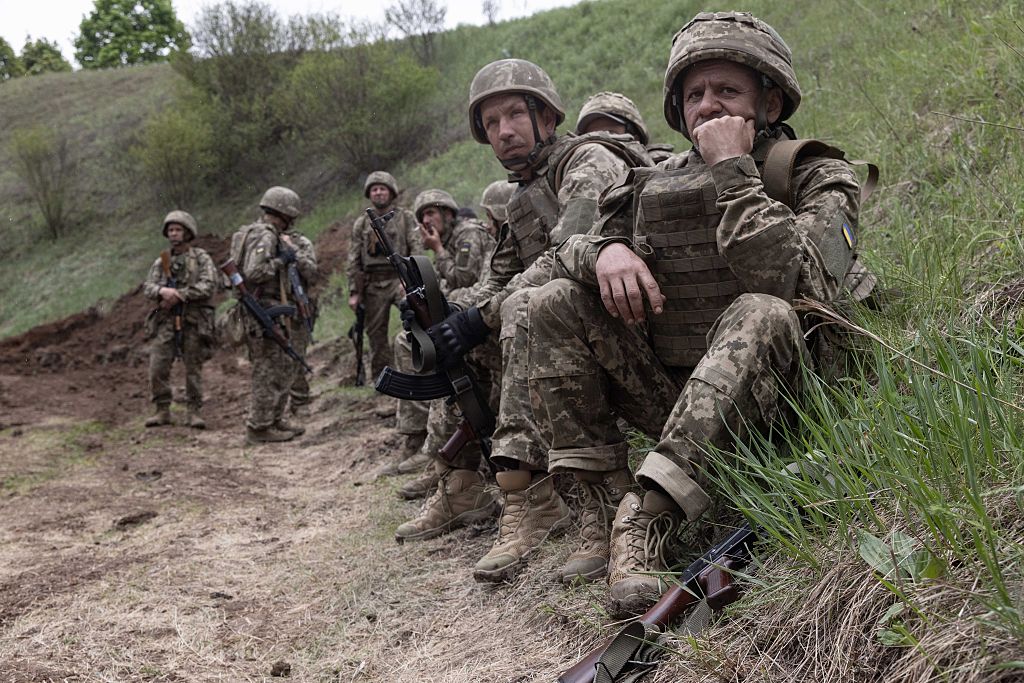
Hawks deemed Russia a paper tiger for not responding to Europe’s deepening involvement in the Ukraine war. Reported Russian drone attacks show they’re underestimating the risk of an escalating tit for tat. (Yevhen Titov / Global Images Ukraine via Getty Images)
War is in the air in Europe. Over the four years and counting that it’s raged, the Ukraine war has often been compared to the two world wars, being the largest land war the continent’s seen since the second of those and having surpassed the length of the first this past June. But unlike those disastrous conflicts, the fighting in Ukraine has not become a true continent-wide affair that’s dragged the rest of Europe’s powers into the fray — so far.
It is becoming alarmingly uncertain how much longer that will hold. For nearly five years, both Russia and European North Atlantic Treaty Organization (NATO) states have been at pains to avoid being pulled into direct war with each other. But as Ukraine’s war effort falters, there are mounting signs of the conflict spiraling into generalized warfare. Between escalations, accidents, and a thick haze of sometimes purposeful misinformation, the risk that the conflict may spin out from yet another European bloodbath to something even more cataclysmic has perhaps never been higher.
It’s a bitter vindication for antiwar voices who warned for years that NATO member states were sleepwalking into a wider, more dangerous confrontation with Russia. The question now is what can be done to forestall their darkest predictions.
Threats and Accidents
The stakes of a direct Russian-European war are high. Experts have long argued that any such conflict would quickly turn nuclear, precisely because, as a 2022 Brown University paper argued, Russia’s conventional military weakness versus NATO makes it more likely to reach for the nuclear option.
“I think the mainstream media has downplayed these risks, because it would severely undermine support for Ukraine,” says Lyle Goldstein, senior fellow at the Watson Institute for International and Public Affairs at Brown University, and the author of that report.
With Russia and NATO’s non-American member states holding nearly five thousand active nuclear warheads between them, any nuclear exchange between the two would not just likely kill millions but imperil the very future of humanity. This is why world leaders for decades painstakingly restrained any conflict between the alliance and the then–Soviet Union, right down to their public rhetoric.
And yet hardly a month goes by these days without European and Russian officials openly threatening one another.
This past April, Vladimir Putin ally Dmitry Medvedev, the former president of Russia who now serves as the deputy chair of its security council, publicly declared a list of European drone-making facilities a “register of potential legitimate targets”; a month later he warned EU citizens that their “peaceful sleep is over” and that their leaders had “unilaterally entered into a war with Russia.” Meanwhile, the head of Germany’s air force has vowed to swiftly bomb Russia in the event of war, while Poland’s foreign minister, Radosław Sikorski, has boasted that Europe could destroy Russian fuel refineries in “six days” and defeat it in a war “quite quickly.”
These verbal salvos hit an alarming peak last week, after Moscow — which two years ago officially lowered its threshold for the use nuclear weapons — formally warned NATO that it was prepared to use nukes against the alliance, which it charged with taking steps that risked “the outbreak of direct armed conflict.” It came in the wake of statements and leaked plans identifying Kaliningrad — the Russian exclave between Lithuania and Poland that serves as a key Russian military outpost — as a top early target in the event of a war between Russia and NATO.
All the while, a monthslong drumbeat of warnings has sounded from NATO state officials and intelligence agencies that war with Russia may be right around the corner, or is already underway. The Baltic states have put in place mass evacuation plans, German hospitals are bracing for future mass casualties, and the British government wants citizens to start stockpiling food and water. European capitals are hearing talk of military conscription to meet what seems like an almost inevitable conflict.
This war of words is a function of what increasingly resembles a literal war.
European officials accuse Russia of a spree of sabotage incidents at defense industrial facilities and other sites across Europe, just as Medvedev warned in April — most infamously, a set of explosive-laden drones discovered at and around Leipzig airport, a logistics hub for NATO’s supplies to Ukraine. One German commentator described the incident as the country’s version of 9/11 — a questionable comparison, since no one died at Leipzig, but an ominous one given the US foreign policy choices that followed those attacks.
This adds to a growing list of accidental incursions. During Russia’s now monthslong air assault on Ukraine, Russian munitions, drones, and other aircraft have crossed into the airspace or onto the soil of NATO states dozens of times, including just last week. Russian drones have reportedly violated NATO member Romania’s airspace twenty-three times this year: more than all such incidents over the previous three years combined.
So far none have reached the danger of November 2022, when an errant pair of rockets wrongly blamed on Russia killed two farmers on the Polish side of the border, triggering calls for war and an urgent NATO meeting to discuss a response — an emergency only defused when it turned out that Ukraine had been accidentally responsible.
“If any one of the incidents that we’ve seen in the past four months had happened in 2023, it would have been game-changing, everyone would’ve been freaking out about it,” says Emma Ashford, senior fellow with the Stimson Center’s Reimagining US Grand Strategy program. “We’ve become so inured to this conflict going on, there was not a huge reaction to any of these.”
But it may be a matter of time: in another instance last month, a Russian warship fired two emergency flares at a Danish helicopter conducting surveillance, narrowly missing it.
“As these hybrid incidents get more frequent, their kinetic nature intensifies,” says Jennifer Kavanagh, director of military analysis at Defense Priorities. “Without a dialogue channel, there’s always a risk that Russia inadvertently steps over a line and triggers escalation.”
Tit for Tat for Tit for Tat
That risk became viscerally real last month, after a Russian drone destroyed part of a train near the Ukrainian-Polish border mere minutes after a group of US and European officials were shuttled away. Seemingly calibrated to be a near miss, the attack could have easily triggered what one ex-CIA official described as an “escalatory chain” leading to war had it been slightly off.
“The Russian motivation here is to impose costs on Europe, to retaliate for the costs that Ukraine is imposing on Russia,” says Kavanagh. “The Russians understand European money is funding Ukraine’s war effort and that Europe is giving it drones.”
Those drones have, by Putin’s own admission, been used to inflict damage on Russia worth 1 percent of its GDP, or, according to Kyiv, to knock out half of its oil refining capacity. NATO states have not just furnished the arms to do this but, through the US and French governments, provided the intelligence that Ukraine has used to select targets and help its drones evade Russian air defenses.
As heartening as this might be for Ukraine’s war effort, it has come with real risk, as the line blurs between simply providing military support, which NATO states view themselves as doing, and becoming full-on cobelligerents. To get a sense of how potentially inflammatory such support might be in Moscow, consider the outrage sparked in Washington and Brussels when it was revealed earlier this year that Russia was providing Iran with a similar kind of support to what NATO states are now giving Ukraine.
Consider, too, that this support blows well past the lines that Western officials themselves drew earlier in the war to limit the risk of escalation. Long gone are the days when US and European officials thought that merely helping Ukraine obtain fighter jets was too risky, let alone approving long-range strikes into Russian territory. Instead, convinced that the lack of Russian retaliation for these moves over the years meant that “Putin’s red lines are just a bluff intended to scare the West,” as the hawkish Atlantic Council put it, Western leaders appear to be throwing caution to the wind.
“It’s notable how far escalation has progressed without a real Russian response,” says Kavanagh.
“There is definitely a school of thought in the Western securicratic community that suggests that Russia’s a paper tiger, so we can cross as many red lines as we want,” says Leonid Ragozin, a Russian journalist and Putin critic in exile. “They believe Russia can be provoked endlessly and at some point it will reach a breaking point. But if you hear the signals from Moscow, I think they are quite unequivocal, they are going to retaliate.”
In other words, Moscow’s sabotage campaign currently threatening to draw Europe directly into the conflict may well be a Russian attempt to belatedly restore deterrence.
“That is absolutely the viewpoint in Moscow, that they needed to demonstrate that Europe could not continue to do the things it was doing with impunity,” says Ashford.
That Moscow is now making good on the warnings it issued for years should be sobering, given how frequently and consistently it has similarly warned about its willingness to reach for the nuclear option — and how often those, too, have been dismissed in the West. The Financial Times’ Gideon Rachman recently observed that Putin’s failure to follow through on past nuclear threats perversely means they “no longer work” as a deterrent.
Yet both former CIA Director Bill Burns and former Under Secretary of Defense for Policy Colin Kahl say Russian leaders were dead serious about reaching for a nuke in fall 2022, when then-President Joe Biden told a group of donors the world was hurtling toward possible “Armageddon.” Since then, Russian military strategists have continued to talk about the need to keep nuclear use on the table against a complacent West and have carried out tests and military exercises to that end.
“For many years I’ve been concerned that Russian admirals are making the argument to the Kremlin, ‘The West has really lost its mind, we need to take out a French frigate to teach them a lesson about what happens when you mess with the Russians,’” says Goldstein. “I really feel that we’re close to that moment.”
Fog in a Spiral
This would all be fraught enough in a perfect information environment. But a combination of the fog of war and deliberate misinformation has made it especially hard to sort what’s true from what isn’t.
“We know both sides distort the truth pretty systematically,” says Goldstein.
The intelligence agencies and leaders of Finland, Denmark, Estonia, and Lithuania as well as the NATO secretary general and the EU defense commissioner, have all come out in the past week to say there is no imminent threat from Russia nor intelligence suggesting one. Yet, for months, many of these same voices were saying the exact opposite, sowing public fear.
“When I talk to sources particularly in Ukraine, they connect the hype to the adoption of the long-term budget of the EU for the period 2028–2034,” says Ragozin. “They believe it boils down to a battle for funding for the next six years.”
“Some of the language coming out of Germany and the UK seems to me mostly driven by generating the political appetite for defense funding,” says Kavanagh.
Sure enough, some European governments appear to be using the specter of war with Russia to lay the groundwork for a pump-priming policy of military Keynesianism, including in Britain, whose new chancellor has promised a “new age of industrialization” centered on rebuilding naval infrastructure. In Poland, meanwhile, a top official in the president’s office accused Sikorski and Donald Tusk, who is prime minister, of exploiting fears of Russia for their own political purposes.
Experts are skeptical about the appetite of either side to actually make good on their most hawkish rhetoric.
“I think they know in the backs of their minds how devastating this would be,” says Goldstein.
Some European officials have effectively acknowledged outright they’re not yet ready to take on Russia. Meanwhile, for a Russia that believes it’s winning what has become a grinding attritional war, getting Europe involved could be a complication it can’t afford.
Still, as countless military crises have shown, intentions don’t always matter. One reason is the way that adversaries tend to misread both each other’s actions and the way their own actions appear to the other side.
If Moscow’s sabotage campaign was intended to send a message of deterrence to NATO, European and US officials are instead reading it as a deliberate “test” of, or attempt to weaken, the alliance’s solidarity — one that calls for their own efforts to restore deterrence against Russia, since in their view, this behavior confirms that “strength” is the “one language” that Putin understands. To that end, the EU is now exploring a NATO-like way to respond with their own form of “hybrid warfare” that, like Russia’s, theoretically falls short of a full-scale attack but proves “painful in a similar way.”
“The Russians think they’re signaling that Europe is getting too comfortable with the idea that they can aid Ukraine, and Europe is seeing it as a Russian attempt to escalate conflict with them,” says Ashford.
“Europe wants to believe they’re not combatants, that what they’re doing is normal and non-threatening,” says Kavanagh. “Of course, the Russians don’t see it that way and want to make that clear. Europe sees all the escalation from the Russian side and don’t seem to recognize the ways in which their own behavior is contributing to the escalation spiral.”
The other reason is the extent to which European leadership has staked their own prestige on an increasingly unlikely outcome: Ukrainian military victory.
The Best Outcome for All
The level of physical destruction inflicted on Russia notwithstanding, Ukraine’s drone campaign this past summer proved to be just the latest costly military gambit that failed to achieve its goals: when the dust had settled, they had not succeeded in pressuring Putin to end the war or in engineering political unrest within Russia. And while Ukraine has regained some territory since, the overall state of the battlefield hasn’t fundamentally changed in its favor.
“There has been tangible success, but at the tactical not strategic level,” says Ragozin. “Ukraine is showing resilience on the battlefield, but there is no breakthrough. The picture isn’t rosy for the Russians, but it’s pretty dark for the Ukrainians.”
The Ukrainian government is now mired in a mushrooming political crisis of its own, suffering from serious (and sometimes literal) political infighting and looking at a massive budget shortfall — all as it weathers the most brutal Russian bombing campaign yet with little ability to defend itself, the US war with Iran having drained global supplies of missile interceptors. After years of European leaders insisting not only that Ukraine would win the war, but that it must, predicting a dark future for all of Europe if it didn’t, Ukrainian officials are now starting to openly say that their country is losing.
“The leadership in Europe is so invested in this narrative of Ukrainian victory, to even slightly walk back from that and say, ‘Well, everything we’ve said for the last five years is over the top’ — they’re not going to do that,” says Goldstein.
The alternatives are to escalate further — with all the risks that come with it — in the hopes of some future breakthrough or an option that European officials have tended to frame as being just as unacceptable as defeat: making painful concessions in peace talks.
“It’s been clear for years what Russia wants, what its conditions are,” says Ragozin. Those conditions include Ukraine formally relinquishing its aspirations to joining NATO and, most contentiously, giving up Crimea, the Donbas, and other territories that Russian forces have illegally occupied since 2022. While Zelensky has publicly acknowledged that Ukraine lacks the means to militarily retake the Donbas and, especially Crimea, the idea of formally relinquishing these territories in negotiations remains a nonstarter in Kyiv.
“The problem with Russia is it’s absolutely entrenched in those positions and not moving an inch,” says Ragozin. “Russia is ready to negotiate, but it’s not ready to compromise.”
Yet the longer the war goes on in the hope of avoiding this unjust outcome, the bleaker Ukraine’s future looks.
According to Poland’s Tusk, Ukraine is suffering a staggering casualty rate of 27,000 killed or wounded per month, prompting talk of drafting women and leading to aggressive and unpopular recruitment tactics that have met with increasingly violent resistance from Ukrainians. Together with a mass exodus to avoid both the war and the prospect of fighting in it, the country’s population has dramatically shrunk, and its birth rate now lags way behind its mortality rate, foreshadowing future demographic, pension, and labor crises. Under air strikes that it can no longer repel, the country’s iron and steel industry — about 5.5 percent of its GDP last year — has effectively shut down.
In other words, seeking a negotiated end to the war, however, unfair the terms, could not just help shut off the current escalatory spiral and avoid a Europe-wide catastrophe but may also in the long run benefit Ukraine.
“We should recognize any peace is going to be bad. No one is going to like it. It’s still better than continuing the war,” says Kavanagh.