Ukraine Faces an Imperial Carve-Up

The Trump administration’s proposals for peace in Ukraine sound like a real estate deal, where the United States gets a payoff for handing over Ukrainian land. But with Kyiv’s leverage shrinking, the country may be forced to swallow a grim deal.
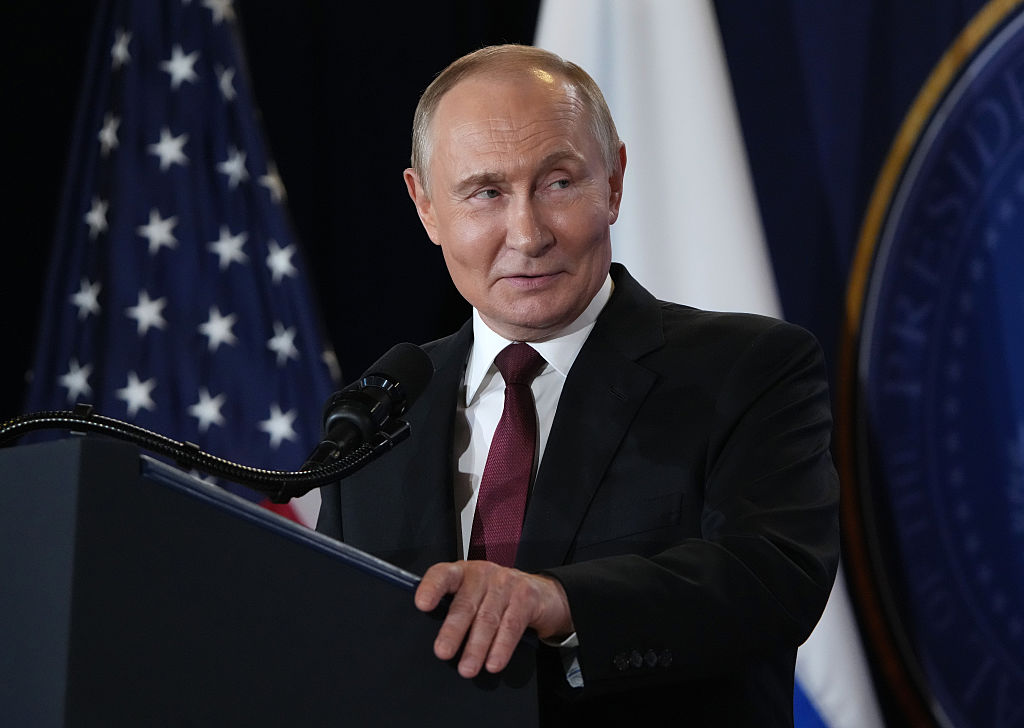
Russia has made it clear that it remains ready to achieve its overall aims in Ukraine through military means — a position that leaves little room for compromise. (Andrew Harnik / Getty Images)

On November 21, Ukrainians found themselves staring at a peace proposal that demanded near-immediate acceptance. The leaked twenty-eight-point peace plan, drafted by Donald Trump’s envoy Steve Witkoff and Russian official Kirill Dmitriev, reads like a real estate transaction. Russia gets the land, the United States takes its cut, Europe foots the bill, and Ukraine can choose between surrendering now or surrendering later. Under pressure, Ukraine’s president, Volodymyr Zelensky, addressed the nation bluntly: “Loss of dignity or of a key partner. Twenty-eight difficult points or an extraordinarily difficult winter.”

Stunned European leaders — taken aback by the initiative’s provisions — scrambled to improvise counterproposals. Amid outrage in the White House over the leak, emergency talks in Geneva produced a revised nineteen-point framework, deferring the hardest questions to future high-level dialogue. Trump declared ”tremendous progress” and announced Witkoff’s sixth visit to Moscow this year. The Kremlin, meanwhile, dismissed European revisions and signaled that only the initial twenty-eight points matched the “spirit of Anchorage” — that is, Trump’s overtures to Vladimir Putin at their summit in Alaska this summer. Russia has made it clear that it remains ready to achieve its overall aims through military means — a position that leaves little room for compromise.

Thanksgiving passed, and Ukraine’s position weakened further. On November 28, just before his departure to Miami for another round of consultations, Andriy Yermak, Zelensky’s chief of staff and lead peace negotiator, resigned after anti-corruption investigators raided his home as part of a $100 million energy sector kickback probe. That same day, reports emerged that Washington was prepared to unilaterally recognize Russian control over Crimea and other occupied territories. The next day, Ukraine’s former commander in chief Valeriy Zaluzhny lamented the absence of clear political goals, noting that even a temporary peace could offer a window to recover and prepare for what comes next.

This chain of events might not end the war — the latest talks in the Kremlin on Tuesday were inconclusive — but it exposes how the major powers currently imagine its outcomes and how little Russia’s core demands have changed even as Ukraine’s leverage has shrunk. Moscow has made marginal concessions from its maximalist positions expressed this June but still expects to coerce Kyiv into permanent neutrality, secure recognition of Russian territorial conquests, impose military restrictions packaged as “demilitarization,” and extract ideological concessions under the label of “denazification.” What has changed is not the substance but rather the context: a more exhausted Ukraine, a more divided West, and a geopolitical environment more conducive to pressure than to any even rhetorical notion of justice.

Neutrality as Imperial Veto

Russia’s fixation on Ukraine’s neutrality predates the invasion. It was articulated most clearly in Moscow’s December 2021 draft treaties, which requested that not only Ukraine but the entire former socialist bloc be treated effectively as a buffer zone. It is the main one of the “ambiguities of the last 30 years” (as the twenty-eight points call them) that the Kremlin aims to settle. This obsession with keeping Ukraine out of NATO isn’t about “indivisible security” but a Russian sphere of influence in which smaller states’ security needs are ignored. Ukraine is the test case for whether Moscow can veto its neighbors’ foreign policy, in a Monroe Doctrine with a Russian accent.

Russia demands formal assurances regarding Ukraine’s permanent neutrality not only from Kyiv but also from NATO members. The original clauses requiring states to terminate or not enter into treaties that would violate these neutrality obligations could affect even Ukraine’s future path to European Union membership, should Brussels strengthen its mutual defense clause. The United States, meanwhile, doesn’t seem prepared to provide anything beyond its current involvement, let alone offer security guarantees akin to NATO’s Article 5, which stipulates the grounds for a response to an attack. If Russia strikes again, Washington is only committed to voiding the agreement and an unspecified “decisive coordinated military response.” This leaves Kyiv responsible for its own security, armed with promises that Moscow can ignore.

Demilitarized and Defenseless

It is hard to imagine a scenario that involves Ukraine invading Russia first. The Kremlin’s talking points on demilitarization have always had one purpose: undermine Kyiv’s capacity to resist, and then dictate terms.

The Istanbul negotiations in April 2022 proposed the maximum number of Ukraine’s troops to be set at between 85,000 and 250,000, with restricted air defense ranges and artillery. The Witkoff–Dmitriev draft more than doubled the upper limit to 600,000 troops and maintained the ban on a foreign military presence, killing any chance for peacekeeping or deterrence forces. After strong pushback, prospects for peacekeepers were put back on the table, and the ceiling for troop numbers was raised as well. But while these revisions await Kremlin endorsement, the entire debate focuses on the wrong question. Why should Ukraine maintain a war-sized army in peacetime, and more important, who is going to pay for it in a destroyed country?

Arguably, even the worst scenario to come out of the Istanbul talks three years ago doesn’t preclude Ukraine from building a robust defense. If public support holds, Kyiv can rely on a large number of reservists, some trained abroad on advanced weapons systems that could be rapidly redeployed when hostilities resume. But any deal that restricts Western assistance in that would institutionalize asymmetry and render Ukraine helpless if Russia violates another agreement it has signed.

“Denazification” and the Genocide Lie

The ideological component of the Russian demands — “denazification” — functions as a political framing rather than a practical agenda. Russian forces routinely refer to Ukrainian troops as “Germans,” and Moscow continues to justify the invasion as a response to “genocide” in Donbas, even when numbers expose the lie. In the last three years before the full-scale war (2019–2021), conflict-related civilian deaths in the region totaled below one hundred. Since Russia’s so-called rescue mission began, thousands have died, and hundreds of thousands have become displaced in these two regions alone, after over a dozen cities with a combined prewar population of around one million have been destroyed.

The Russian authorities’ weaponization of fears of the far right, even while they themselves promote neofascism both at home and abroad, are blatant propaganda. Yet the demand for this symbolic victory remains. In 2022, the Kremlin listed extensive legal changes as proof of Ukraine’s deradicalization. The Witkoff–Dmitriev proposal already uses more neutral language. However, in Ukraine, even legitimate debates about nationalism, memory politics, or minority rights have been discredited by Russia’s use of all these as pretexts for aggression. Obligations extracted under military threat would hardly moderate Ukrainian politics so much as entrench polarization and hand nationalists their strongest grievance.

Dividing the Spoils

The territorial dimension remains the core of Russia’s position. Moscow’s anxiety over the nonrecognition of its conquests in Ukraine is now counted among the “root causes of the conflict.” Now the Kremlin claims five Ukrainian regions — Crimea, Donetsk, Luhansk, Kherson, and Zaporizhzhia — even though it fully controls only two. Russia’s bottom line: recognize this new “reality on the ground.”

The justifications have shifted with the changes on the battlefield. Initially Moscow claimed to be “protecting” the nominally independent Donetsk and Luhansk “people’s republics” but later decided that the best protection was their absorption into Russia proper. To cement its land bridge to Crimea, Russia further annexed what it held in Kherson and Zaporizhzhia and continued claiming the parts it didn’t. The proposed Russian-owned “demilitarized buffer zones” in parts of the Donetsk region that Ukraine still controls have a clear purpose: to force Ukrainian withdrawal from strategic positions while Russia’s fortified occupied territories remain untouched.

Ukraine cannot regain all occupied territories by force under current conditions. But neither can it afford to grant Moscow irreversible rights over them. Kyiv’s position is limited to refusing recognition while accepting the line of contact as a reference point for future negotiations, and excluding military means from dispute settlement.

Precedents exist for lasting ceasefires even when underlying territorial claims remained unresolved — Cyprus since 1974, Korea since 1953, Kashmir since 1972. But Cyprus has United Nations peacekeepers and foreign troops on both sides. Korea has one of the world’s most militarized borders. Kashmir sees regular outbreaks of violence, prevented from full war only by nuclear deterrence. None offers templates for sustainable peace in Ukraine fitting the deals discussed.

The plan’s economic provisions reveal its mercenary character. Moscow gets gradual sanctions relief, effective dispensation from responsibility for war crimes, readmission to the G8, and lucrative economic cooperation. Washington receives compensation for guarantees, profits from frozen Russian assets, and Trump personally chairing the “Peace Council” enforcement body. This isn’t a conflict of interest, we are led to believe  just the business model. Europe, in this scheme, becomes a coperpetrator, made as responsible for rebuilding Ukraine as the actual aggressor. Notwithstanding that Russia’s damage to Ukraine exceeds half a trillion euros, Moscow’s financial accountability is limited to parts of the assets already held by EU authorities.

The proposals further expect commitments from all NATO members — changing the open-door policy, blocking Ukraine’s membership, limiting deployments — ready to impose them on thirty-one out of thirty-two countries. The role of Ukraine and its European allies seems limited to protesting, pushing changes, and trying to postpone sensitive topics. And once Moscow rejects those objections, the cycle simply repeats itself.

In 2024, Ukrainian left-wing group Sotsialnyi Rukh (Social Movement), while criticizing the state’s wartime response, called for “dialogue about achievable goals” for the first time. This was in striking contrast to attitudes from two years before, when the emphasis was on full victory and Russia’s defeat. The same year, roughly half of Ukrainians still considered negotiations with Moscow either impossible or acceptable only after full territorial liberation.

By the second half of 2025, according to Kyiv International Institute of Sociology polling, popular attitudes had shifted further. While under 20 percent are ready to accept the Kremlin’s terms and only 39 percent would agree with US recognition of Russia’s annexation of Crimea, over three-quarters could live with freezing the conflict at the current front lines. They would even see it as at least a partial success so long as Russia’s land grabs are not legitimized, Western military and financial support continues, airspace is closed to Russian strikes, and sanctions are maintained until genuine peace is achieved. Washington and Moscow offer none of this, showing that the Ukrainian public’s will matters little without the ability to influence outcomes.

Dependency Trap

Ultimately, these negotiations aren’t decided by diplomatic skill but by the material facts of the matter. Ukraine’s vulnerability extends beyond a lack of military manpower and funds. The United States provides roughly 30 percent of the weapons Kyiv uses, including Patriot air defense, F-16 missiles, HIMARS rockets, satellite imagery, and targeting data. Washington also controls their transfers from the stocks of other parties. Without US intelligence, even Ukraine’s air defense protecting civilians and infrastructure would be crippled. Access to Starlink, essential for Ukrainian communications, can be cut off by Elon Musk at will.

European alternatives are absent or remain inadequate. While artillery production is approaching two million rounds, Patriots have no European replacement as French-Italian SAMP/T systems exist only in small numbers. The IRIS² satellite constellation won’t match US capabilities for years. Alternatives to HIMARS are produced only in South Korea and Israel.

European NATO members themselves spend more on US suppliers than on domestic procurement, partly to buy American loyalty and partly because there is nothing else available on short notice. Moreover, the United States contributes to Europe’s defense by keeping 84,000 troops stationed across European bases and by extending its nuclear umbrella. Trump isn’t inventing anything new, simply exploiting the dependence that is already there.

Justice?

A just peace would require Russian withdrawal from occupied areas, security guarantees with actual enforcement mechanisms, accountability for war crimes, and reparations beyond frozen Russian assets. None of this appears in any proposal that Moscow entertains or that the Trump administration is talking about. The Kremlin isn’t ready for compromise either, having rejected every peace initiative that did not rest on its maximalist demands. What’s now labeled “peace” is an imperial settlement drafted by two powers, with terms imposed from above and the countries most directly affected consulted last.

The tragedy is that Trump’s cynicism, Europe’s unpreparedness, and Ukraine’s weakness may force acceptance anyway. This is the logic of imperial power, which has never brought lasting peace, and no deadline will change that. All that remains is to have no illusions and name this settlement for what it is: a pause before the next war begins.