The Wargame Is Wretched Propaganda
The new docudrama The Wargame imagines Britain responding to a Russian military attack. Its cast is full of real-life politicians — often figures with ties to the weapons industry using the show to demand more money for the armed forces.
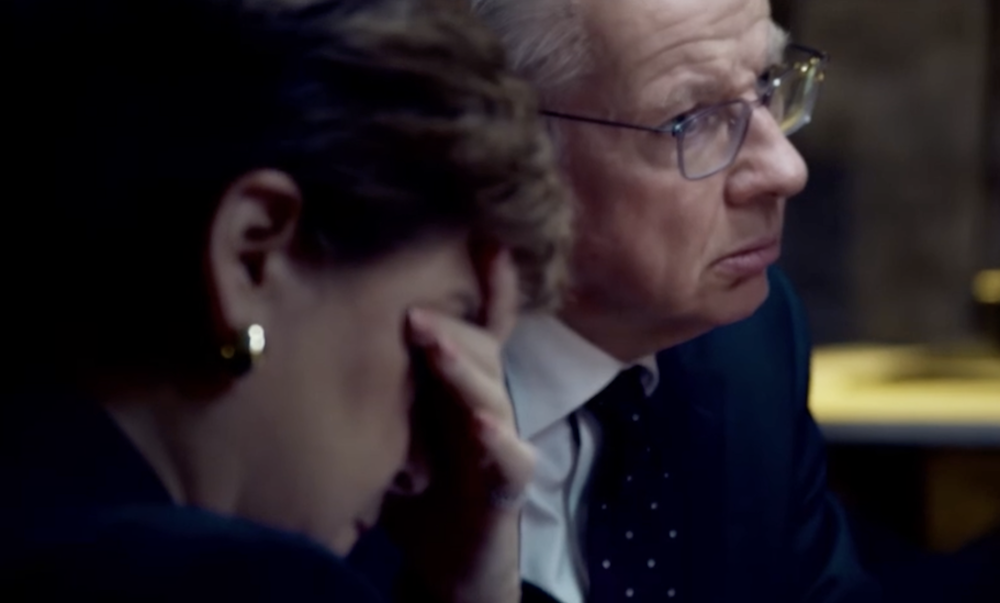
Sky TV’s “The Wargame” features Tory, Labour, and Scottish nationalist leaders joining together to insist on the need to raise weapons spending. It’s a show of elite unity in which doubtful public opinion is cast as a mere inconvenience. (Sky Studios)
Politicians are often accused of playing toy soldiers. Rarely, however, do they actually do it. The Wargame is an exception. Sky TV’s new four-part docudrama, which features a cast of prominent former ministers and securocrats, follows the British government as it responds to an imminent attack from Russia. Described by GQ magazine as “the most terrifying show” of the year, events escalate throughout the production and conclude with the fictional cabinet stationed safely in a secure bunker while the rest of the country faces the possibility of nuclear annihilation.
Despite its attempt at sincerity, bolstered by visual effects showing missiles raining down on London, the absurdity of the program gives The Wargame a certain comic character. Having tried and failed to become British prime minister back in 2017, Michael Gove, a leading Tory, achieves his lifelong ambition, but only for four hours in a Sky TV drama. His fictional deputy, Nicola Sturgeon, a Scottish nationalist, expresses no qualms about sitting atop the state she has been nominally committed to breaking up for most of her adult life. Foreign Secretary Jim Murphy, meanwhile, is hung out to dry in attempting to placate the US State Department after spending years justifying the war on terror as a New Labour minister. Tempting as it may be to dismiss the show as a well-paid retirement activity for a collection of career politicians, The Wargame’s true motivations are far more sinister.
War Footing
“This is not real,” warn the opening credits, “but it could be.” Britain, the show’s narrative implies, is not ready for possible war. The problem is simple: the nation does not spend enough on the navy or the air force to fend off a foreign attack and must change course urgently. The Wargame’s cast, however, are far more than just bad actors with an opinion.
Many have skin in the game. Jim Murphy’s appearance, which the Guardian glowingly compared to that of an “MGM movie star,” was only an extension of his day job. After losing his seat in parliament in 2015, the former foreign office minister founded Arden Strategies and has worked as a political lobbyist ever since. Serving the “Defence and Security” sector, which the firm promises to help “successfully navigate politics and policy,” is a core part of Arden’s business model. Murphy’s recent client list includes the US military contractor Northrop Grumman, one of the world’s largest arms companies and a major partner of the British Ministry of Defence. Only last year, then-Prime Minister Keir Starmer’s government awarded Northrop a £20.5 million contract to provide navigation support across new Royal Navy vessels. Sat around the fictional cabinet table on Sky’s set, Murphy barely had to stray from the script he’s been delivering for over a decade. He wasn’t the only one.
General Sir Richard Barrons, who plays the chief of the defence staff, currently serves as the cochair of Universal Defence & Security Solutions. The consultancy, which lists the UK Government and a range of arms companies among its clients, specializes in “defence modernisation” and “professional military education.” Pleading with his colleagues to “understand how under-resourced we are as a nation,” Barrons uses Sky’s simulation to advance his own view that social spending should be slashed to pay for war. There is “no point worrying about our welfare if the cities are in ashes,” he blustered earlier this year.
Around a third of The Wargame’s cast has financial ties to the weapons sector. While Sky omitted these crucial details from the cast’s biographies, the show is hardly subtle. Instead the production is an act of regime stenography with a clear message: Britain’s political class has put their sworn differences aside in service of protecting the nation, and the public should follow suit. Attending the premiere, UK defence secretary and Atlanticist poster boy Wes Streeting — who handed National Health Service patient data to Peter Thiel’s Palantir while a health minister — heaped praise on the show for “making people think about where they would put defence in the order of priorities as voters.”
Clash of Civilizations
His comments reflect one of The Wargame’s most important myths. Sky’s scenario, set just six months in the future, relies on the implication that conflict is inevitable, and Britain must act accordingly. Explanations for the hypothetical attack are limited to nationalistic platitudes, like Gove’s suggestion that Russia has declared war on “our way of life.” Western chauvinism litters the series as the cast frequently frames events in civilizational terms, recycling the language many of them deployed to justify imperial intervention in the Middle East a quarter-century ago.
By quietly invoking Samuel P. Huntington, Gove and his colleagues reveal the intellectual weakness of the wider rearmament agenda. Geopolitical conflict, they insist, arises from hostility to “British values” rather than a rupture within the American-led system. This is neatly illustrated in the simulation when, after a request for Washington’s military support is rebuffed, Jim Murphy quickly points out that “if the shoe were on the other foot, we would rally to the US defence.”
Instead, The Wargame signifies the coalescence of political, state, and media interests around military Keynesianism as a solution to Britain’s crises. As the world of transatlantic liberalism collapses, rearmament is presented not only as an opportunity for industrialization but a short-term route back to Donald Trump’s good graces. This is one part of Keir Starmer’s legacy Andy Burnham is keen to safeguard, committing to carry forward his predecessor’s unfunded “Defence Investment Plan.” While redistributing public wealth to private companies, Britain’s militarization promises to discipline the population, curtail the public’s democratic rights — as Elbit Systems have already demonstrated — and narrow the scope of ideological contestation. One does not need to look to dramatic fiction for examples of these effects.
Days before The Wargame aired, the BBC News website ran a headline asking if the British people were psychologically ready for the coming conflict. “Do you know what would be expected of you?” the article asked. The Liberal Democrats were quick to respond, proposing that the prime minister establish a register of civilian volunteers who could be called up in the event of an invasion. For the British governing class and liberal democracies across Europe, the war drive is the last resort of an elite desperate to save itself from contradictions of its own making.
One might expect Michael Gove, who suggested awarding the Israel Defense Forces the Nobel Peace Prize in 2025, or Harriet Harman, a Labour minister who voted for the invasion of Iraq in 2003, to turn up in a program like The Wargame. What conveys hegemonic support for the military-industrial complex, however, is the presence of seemingly more dissident figures: Nicola Sturgeon and, to a lesser extent, Baroness Sayeeda Warsi, who resigned from the Conservatives’ front bench in 2024 over the party’s failure to condemn Israel’s genocide.
The former first minister of Scotland, Sturgeon has been a member of the Campaign for Nuclear Disarmament since she was a teenager, yet emerged from Sky’s studio with a changed mind on militarization. The simulation of conflict, she said, led her to “think a bit differently” about “defence as something that should be deprioritised in favour of health and education and welfare.” This was no damascene conversion. In March 2022, six months after she called for North Atlantic Treaty Organization (NATO) troops to remain in Afghanistan for “as long as is necessary,” Sturgeon suggested that NATO should implement a no-fly zone over Ukraine following Russia’s invasion, risking catastrophic escalation. Warsi also grew more hawkish in Sky’s secret bunker, reflecting afterward that Britain was “woefully underprepared for war.”
In the third part of the docudrama, Sturgeon dismisses the Left’s “butter not guns” approach, instead stressing the need to avoid a “divided government” in Britain faced with “Kremlin aggression.” Whitewashing the program’s jingoistic propaganda, such comments delegitimize antiwar sentiment and convey to the masses that even their ostensibly progressive politicians have embraced the case for conflict.
Dissent
Real war games, meanwhile, are already afoot in the North Atlantic. Late last month, a US-UK weapons firing exercise sank the decommissioned USS Klakring off the Scottish coast. The following day, Chancellor John Healey announced that his £6 billion investment to upgrade the Trident nuclear submarine fleet would anchor “a new age of reindustrialisation.” Rearmament is rapidly reorganizing the British economy as the establishment rushes to manufacture consent for war.
Hysterical interventions like The Wargame, however, portray this reality with total transparency. In so doing, they draw clear dividing lines between hawkish politicians and their constituents, to whom Sky’s production denies any real agency or voice. The public instead appears as an inconvenient obstruction to the military’s grand plans: so much so that at one stage Harriet Harman suggests banning social media, and Jim Murphy proposes taking control of the nation’s airwaves.
Recent polling confirms that less than a quarter of Brits support increasing defense spending at the expense of public services. The Wargame was explicitly designed to change that. This is the tension that opponents of militarism must look to exploit, working to build organization among the people whose concerns Michael Gove and his fictional cabinet are determined to ignore while simultaneously gambling with their lives.