In Russia’s Election, Nothing Happened, but Things Got Worse
The stability of Vladimir Putin’s rule has long relied on encouraging citizens to ignore politics. But last month’s wartime elections instead saw a different approach, staging popular support for a further centralization of power.
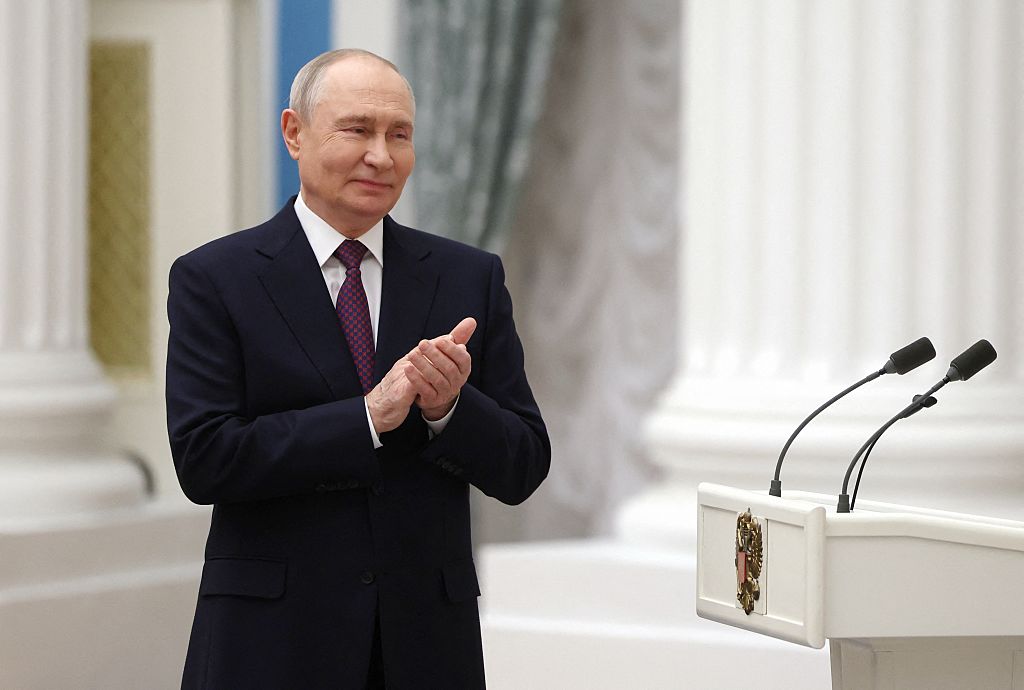
Real democratic life has only sporadically developed in post-Soviet Russia, and Vladimir Putin’s rule has long relied on widespread depoliticization. Last month’s elections went further in pressuring citizens to actively express support for the government. (Vyacheslav Prokofyev / Pool / AFP via Getty Images)
Between September 18 and 20, Russians voted for a new State Duma, along with several regional parliaments and governors. According to the Central Election Commission, turnout reached 59.8 percent, up eight points since 2021. The result was the one everyone expected.
Vladimir Putin’s United Russia took almost 58 percent of the party-list vote and 349 of the Duma’s 450 seats, up from 310 in the outgoing chamber. Forty-one of its new MPs are veterans of the invasion of Ukraine. The Communist Party (KPRF) came a distant second with thirty-seven seats, followed by the Liberal Democratic Party (LDPR) with twenty-three, New People with nineteen, A Just Russia with seventeen, and Rodina with one. Four independents complete the total.
Voters received two ballots: one for a nationwide party list (225 seats) and one for a candidate in their local single-member district (the other 225). Yabloko, the only registered party running on an openly antiwar platform, was removed from the party-list ballot after the Supreme Court canceled its federal slate in August following a lawsuit brought by Rodina. Yabloko could thus be voted for only on the district ballot and only where one of its individual candidates had survived registration challenges, i.e., in roughly a hundred districts. Outside those districts, and on the national party list everywhere, Yabloko was not an option.