Pope Leo XIV Against the Market’s Techno-Dehumanization

Pope Leo XIV’s first encyclical has been presented as a defense of humanity against artificial intelligence. But on a closer reading, the threat he identifies is not software development but the capitalist market logic that impels it. 
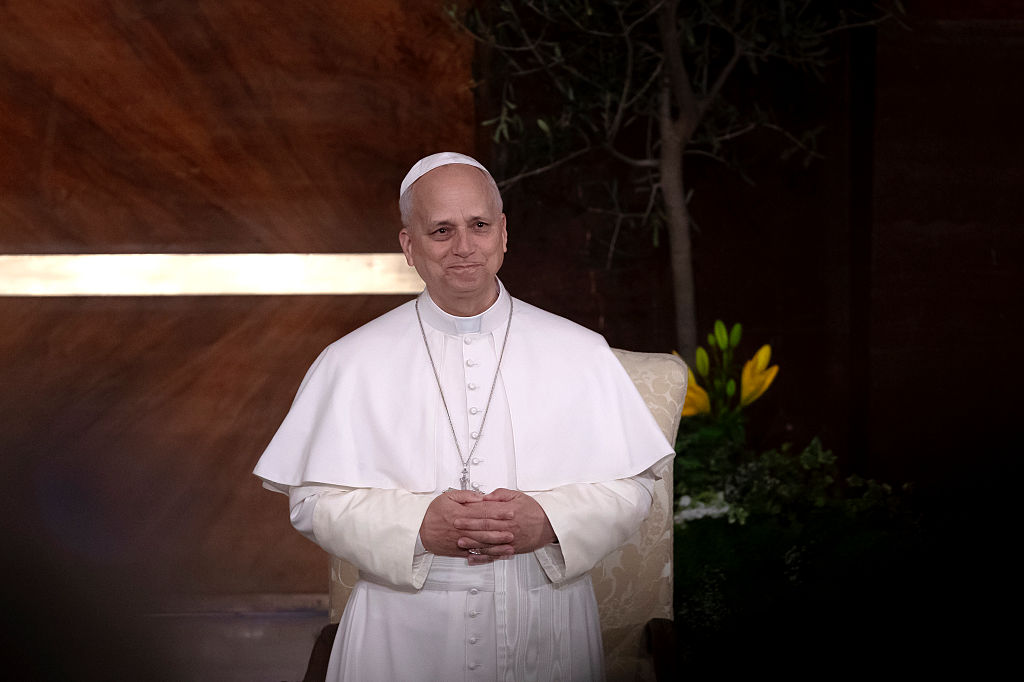
Pope Leo XIV visits Sapienza University in Rome, Italy, on May 14, 2026.

Pope Leo’s encyclical seems to envision a radical reordering of our economy, in which decisions at “every phase of economic activity” are drawn out of the private realm. (Maria Grazia Picciarella / SOPA Images / LightRocket via Getty Images)


The folk wisdom in Rome is that “a fat pope follows a thin pope” — that each pope tends to be the opposite of his predecessor. In the initial days of Leo XIV’s pontificate, it seemed as if this adage might hold true. Leo chose to wear the traditional red garments of the papacy, whereas Francis insisted on a simple white cassock. Instead of Francis’s off-the-cuff remarks — which often sent Vatican officials scurrying to do damage control — Leo prefers to read carefully from prepared statements.

For those Catholics who resented Francis’s interventions on questions of political economy and ecology, or were made uncomfortable by his advocacy for migrants, these stylistic differences seemed like a sign that Leo might be “their” pope. But with the publication of his first encyclical, Magnifica humanitas, Leo XIV has shown clearly that he intends to continue Francis’s intellectual and moral legacy.

In recent centuries, papal encyclicals have been the most authoritative and formal documents published by the Holy See, allowing popes to define the intellectual agenda for the church, to weigh in on controverted questions — and, on occasion, to pronounce formal condemnations against their enemies. But in Magnifica humanitas, Leo is clear that his intended audience is not limited to Catholics. His letter “on safeguarding the human person in the age of artificial intelligence” is addressed to the whole world, and its arguments for the most part are cast in human terms: Leo’s aim is not to compel submission to his religious authority, but to persuade. This may disappoint some Catholics who had hoped for a thundering anathema against AI from the Throne of Peter. But it is a clear continuation of Francis’s desire that the church should engage with the broader world on terms the world can understand through arguments that appeal beyond the boundaries of the faith.

Duty to Remain Human

On a superficial level, Magnifica humanitas is presented as a response to the development of new AI technologies, drawing an explicit parallel to Leo XIII’s 1891 letter Rerum novarum that addressed the social consequences of the Industrial Revolution. The Holy See’s own official statements about the encyclical, the presence of a representative of Anthropic at its formal promulgation, and the official description of the document all support this presentation. But the text has little to say about the technology itself, and what it does say is highly general: “Technology should not be considered, in itself, a force antagonistic to humanity,” but it “can cause harm when not oriented toward the good.”

While the pope offers a few basic moral guidelines for the use of AI technologies — thou shalt not spread false information, thou shalt not create autonomous weapons, thou shalt not use algorithms to perpetrate discriminatory policies, etc. — Magnifica humanitas does not purport to offer a comprehensive view of how such tools can or should be used.

In fact, in Magnifica humanitas, Leo chooses to bypass most of the debates about artificial intelligence that we most commonly encounter. Despite the encyclical’s length, there’s nothing about whether an AI can be “conscious,” and the question — so gleefully and menacingly proposed by today’s venture capitalists — of whether human capabilities can actually be replaced or surpassed by AI is dismissed without serious engagement. Leo’s theme is the “duty to remain human,” yet the threat to humanity that he perceives comes not from robots or from “AI agents” but from the inhuman behavior and antisocial ambitions of other humans.

Unlike the nineteenth century Pope Gregory XVI, who fulminated against gas lighting and railroads, Leo takes pains to clarify that he has no objections to technological progress in itself. And he is prepared to accept that there may be morally correct and socially useful applications of artificial intelligence. But his view is not that AI tools are to be judged by the use we make of them. Rather, he says, “technology is never neutral, because it takes on the characteristics of those who devise, finance, regulate and use it.” Leo’s criticism of artificial intelligence depends on a prior criticism of the culture and priorities of the people who develop it and underwrite its development.

It is this broader perspective that gives rise to a radical critique of political economy that runs throughout Magnifica humanitas. The enemy, for Leo, is not any kind of tool, but rather what he calls a “culture of power . . . in which the availability of resources and the ability to dominate tend to dictate the agenda and criteria for decision-making.” It is easy to recognize this culture of unaccountability, impunity, and indifference to our common humanity among today’s tech barons, independent of the details of any particular technology they develop.

The Idolatry of Profit 

While the stated topic of the encyclical is “artificial intelligence,” the real subject of Magnifica humanitas is the economic structures within which all of our technological developments are produced. Leo is concerned about the prospect of private companies acquiring more power and influence than the state, to the point where they are able to crush civic institutions and escape regulation. He is concerned by the subordination of workers’ welfare to ever-greater demands for efficiency and productivity.

He is concerned that the manipulation of media promotes falsehoods and prevents citizens from recognizing their shared interests. And he insists that the common good must never be neglected in favor of the “idolatry of profit.” Leo focuses his criticism on the potential for artificial intelligence to accelerate these antihuman tendencies, but it is almost impossible not to see a broader critique of the capitalist order under which we live.

At the heart of the critique is the concept of the common good. In Catholic discourse, language about the “common good” is often little more than an empty slogan, deployed by parties on all sides of every political question. But in Magnifica humanitas, Leo emphasizes two aspects of Catholic thinking about the common good that have clear implications for political economy. The first is its properly collective character:

The common good cannot be reduced to a mere list of conditions or institutions. It is not the sum total of individual benefits, nor the intersection of their particular interests; it is a greater good that belongs to everyone, and it can only be achieved, nurtured and protected by our collective efforts. . . .  In this sense, we can say that the whole is “greater than the sum of its parts” and that, for this very reason, “the mere sum of individual interests is not capable of generating a better world for the whole human family.”

While Leo’s quotations here are from relatively recent documents of Pope Francis, his argument is consistent with the most ancient traditions of Christian political thought, which from the time of the first apostles through the Middle Ages consistently emphasized the “universal destination of goods” — that is, the primacy of the common good over any private right to property.

This doctrine may be surprising to many Catholics, particularly today’s American Catholic intellectuals, who tend to cling to a Cold War–era horror of collectivism and understand the “common good” merely as the conditions for the private flourishing of individual families. But in Magnifica humanitas, Leo is uncompromising about the collective character of the common good and includes no caveats to suggest that he shies away from the radical implications of this ancient teaching.

The Means of Production 

Leo also explicitly insists that the collective demands of the common good are not something to be addressed by redistribution after market forces have played out but must be enshrined in the processes of investment and production themselves. His position here is opposed not only to the new robber barons of the tech sector, but also to their liberal critics who view the developments of the market economy as an inexorable, extra-political force, and aspire only to mitigate its impact through regulation or through redistributive taxes. In Leo’s view, both positions make the same mistake: they treat economic trends as inevitable, assuming that the political and social arrangements that make them possible are brute facts of nature. Leo claims instead that they are political choices that could have been made differently and may be made differently in the future. In Magnifica humanitas, he exhorts us not to overlook the political character of political economy:

[T]he pursuit of social justice should not be considered a separate issue that follows only after the production of wealth, with politicians intervening only afterwards in order to distribute it. Indeed, justice concerns every phase of economic activity, from resource acquisition to financing, and from production to consumption. . . .  Politics has the task of orientating economies and technologies to the common good.

While Magnifica humanitas introduces this argument to make a point about AI, nothing about the logic of this argument confines it to discussions of the technology sector. In insisting on the political character of economic development, Leo suggests not only that it is fair game for political critique, but also that it ought to be the object of deliberate debate and public-spirited decision-making. Leo’s encyclical seems to envision a radical reordering of our economy, in which decisions at “every phase of economic activity” are drawn out of the private realm, subjected to political scrutiny, and evaluated not by their potential to generate a return on capital but by their contribution to the common good of all. Socialists, naturally, will have ready suggestions for how Leo’s proposals might be realized, but the pope provides none of his own. Nevertheless, it is remarkable that a pope should have made this critique so directly, and with such a sharp political edge.

The Common Good

Arguably, the omissions in Magnifica humanitas are as significant as its arguments. Throughout the corpus of papal writings on political economy, beginning 125 years ago with Leo XIII, one encounters repeated and impassioned denunciations of “socialism” and “Marxism.” Even when the popes have professed not to endorse a particular program in political economy, they have traditionally missed no opportunity to make clear which particular program wasn’t allowed. But in more than forty thousand words, Magnifica humanitas contains none of the traditional papal left-punching, nor a single mention of “socialism.”

Even when Leo cites and summarizes the writings of the nineteenth- and twentieth-century popes, the anti-socialist aspect of their thought is completely omitted. It is hard not to think that Leo’s choice to ignore a central current of his predecessors’ work was deliberate and meaningful.

Of course, if Leo had wanted to make a formal endorsement of democratic socialism as a Catholic political program, he could simply have said so. But it can hardly be an accident that Magnifica humanitas reinterprets the history of the popes’ engagement with political economy in a way that minimizes long-standing papal antagonism toward left-wing movements and emphasizes the ongoing need for a politics that subordinates the interests and ambitions of private capital to the organizing principle of the common good.

For those Catholics who hope to revive the dormant tradition of Christian socialism, this papal encyclical is an encouraging sign. Pope Leo’s choice of artificial intelligence as a topic shows his eagerness to address contemporary trends — and what he chose to say about it shows a clear intention that Catholic engagement with political economy in the twenty-first century should finally shake free of the anti-socialist assumptions inherited from the nineteenth.