The Human Soul of the Fight to Control AI
Pope Leo XIV issued a welcome call to defend the human person in the age of artificial intelligence. Yet compared to his predecessor, Pope Francis, he is less clear about who exactly can mobilize against our corporate overlords.
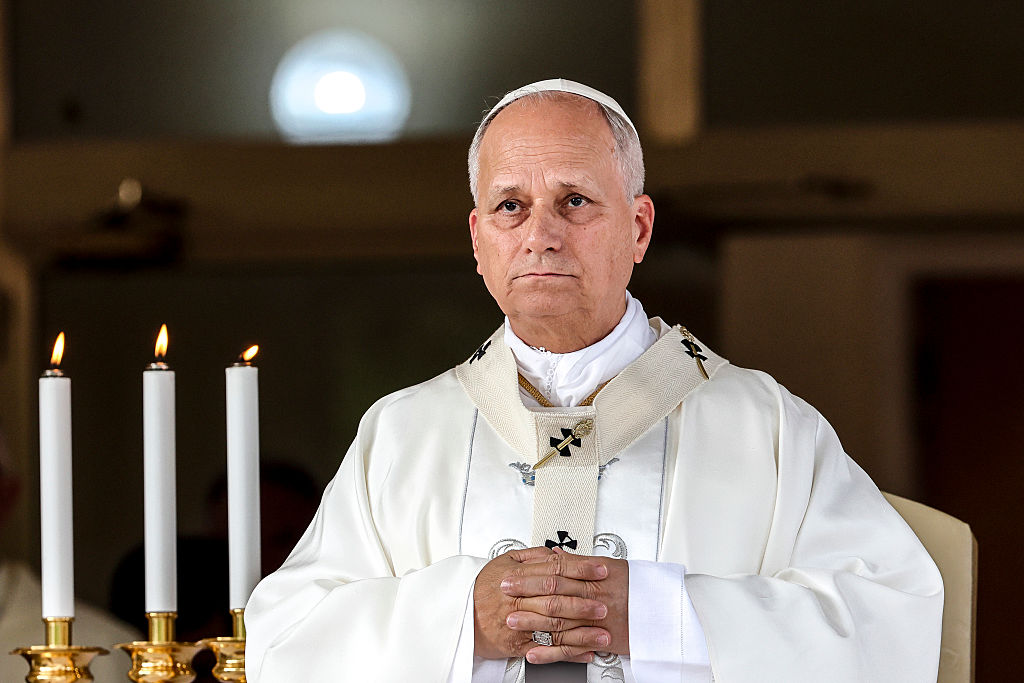
Pope Francis actively sought to strengthen the popular movements and labor unions that might resist modern social fragmentation. In combating the effects of AI, Pope Leo XIV would do well to follow his example. (Galaska Vatican Pool / Corbis / Getty Images)
During World War II, bomber pilots would tell each other, “if you’re taking flak, you’re over the target.” Don’t demur, you’ve struck a nerve. Opposition, at times, isn’t all that bad a sign — if anything, it could point to something good, or at least true. Judged by that standard, the reception of Pope Leo XIV’s pronouncement on artificial Intelligence has been curious. Some have fought over its account of just war theory; others have questioned its denial of machine sentience. Yet its diagnosis of the politics AI relies on, and the fixes needed to guard against it, has gone almost entirely unchallenged, especially among technologists.
In a recent article for the Financial Times, theologian and AI sceptic Carmody Grey insists that Leo’s Magnifica Humanitas is unique. It not only represents the voice of “17.8 per cent of the world’s population,” Grey writes, but focuses on AI’s users more than the technology itself: to the humans whose dignity AI risks undercutting. Rather than offering any proposal or suggestion, Grey suggests, it offers a “style or approach” that surpasses “the narrow menu of contemporary moral thought. . . . and frames the ethics of AI as downstream of much deeper orientations regarding the purpose of human life.”
But is this true? Part of the problem is about process. The broad-based consultation inaugurated under Pope Francis was not carried over into the making of Magnifica Humanitas. And it shows. While the long-standing Catholic anxiety about social fragmentation remains, it has been pushed toward the margins of the argument. This leaves Leo with a critique of capitalism that is less institutionally specific than those offered by previous popes: structural injustices are clearly identified, but the organized social forces capable of confronting them are much harder to find.
Leo’s church may be yet to be captured, but its political ambivalence may unintentionally weaken the church’s institutional role in the fight against the effects of AI and the splintered society on which it relies. Unless carefully implemented, Magnifica Humanitas may give rise to a Catholicism less able to resist the social world embodied by the technologies of today.
The Silent Work of Millions
But first the good news. Or, better, the bad news Leo gets right. We find ourselves at a crossroads, Magnifica Humanitas stresses: either we create a new Tower of Babel and are crushed under our own hubris, or we rebuild a new Jerusalem from its ruins, one that can “safeguard the human person in the time of AI.” The Pope’s letter recognizes, at least, that today’s technologies represent a challenge, and one that’s not neutral.
While AI may not necessarily be antagonistic to humanity, it emerges from worlds and minds that don’t have a firm grip on what dignity and the “common good” demand. “Each phase of progress,” the letter reads, reveals an “ambiguity of tools that can cause harm when not oriented toward the good.” This may emerge by falsely imputing large-language models (LLMs) qualities — feelings and consciousness — that they don’t have. Leo is keen to deny AI any sentience; he did so even when Chris Olah, one of Anthropic’s cofounders, was present at Magnifica Humanitas’s launch in Rome onMay 25. At the press conference, Olah insisted on finding “evidence of introspection: we find internal states that functionally mirror joy, satisfaction, fear, grief and unease.” Yet for Leo, “nothing in the world of AI is immaterial or magical.”
Rather, the problem is also material. AI is part of a new economy that plunders the spoils of old colonizers, Leo insists. And, in the process, it creates a new cadre of the poor and exploited: from data labelers and content moderators to those engaged in the harsher work of extracting the materials necessary for hardware, today’s technologies and the industries built on them rely on the “silent work of millions.”
Its cause is as anthropological as it is political. Many of those involved in AI’s development are beholden to transhumanist and posthumanist ideas, which see technology’s role as engineering away the limits and frictions of the human condition. In the name of progress, of augmenting human performance and capabilities, Leo warns, “the human being is treated as something to be perfected or surpassed.” As a result, “it becomes easier to accept that some lives are less useful, less desirable or less worthy.” And for some, the sacrifice of others becomes necessary.
This vision is bound to thrive in a network of checks and balances that has so far proven ineffective. Today’s technologies exist in a world in which, on Magnifica Humanitas’s telling, the state no longer rules supreme. Instead, it is “major economic and technological actors” who “exercise de facto power.” They control knowledge and the data we produce (and that they farm) and wield the authority that comes with actually making decisions. And because of this, these “companies and platforms” have a near-totalizing presence in our lives, defining society’s “conditions of access, rules of visibility, forms of interaction and even economic opportunities.”
Collaborative Movements
What’s to be done? On this, Leo is less scathing. And he’s not all that clear, either. One suggestion is to embody a culture of limits, restraining those urges AI feeds, as well as placing guardrails on the technology as it develops. But while the objects of vigilance are clear enough, the institutional politics of imposing these limits is much less so.
Similarly ambiguous is the “culture of shared responsibility” the letter calls on “all people of goodwill” to assume. While Leo does point to civil society’s many “communities,” from trade unions to universities, the language adopted is too capacious to mean much. This produces a vision of politics without a clear account of how these various organized constituencies operate. Nor are we given much sense of how they’re to acquire the leverage, or build the kinds of alliances, needed to combat the concentration of power.
Previous popes were more precise. Catholic social thought, since the late nineteenth century, didn’t just diagnose modernity but also charted a path through it. For Leo XIII, who was Pope from 1878 to 1903, it ran through civil society, especially trade unions — bodies that could answer democracy’s call for participation while protecting workers from market forces. The commitment held, unevenly, into the next century: watching states capitulate in the interwar period, Pius XI called for an alliance between unions and local parishes, despite his reticence toward “organizations of Socialists and Communists,” reasoning that, given their increasingly overlapping membership rolls, Catholics and socialists would have to work together.
Pope Francis was no different. When still archbishop of Buenos Aires, he forged an alliance with the movimientos populares, championing their fight for tierra, techo, y trabajo (land, a roof, and work). This continued when he moved to Rome: strengthening social movements and associations formed the heart of his pontificate. They were also to be brought into the church’s decision-making processes, in the Vatican as well as locally. This culminated, if only anecdotally, in an overlooked letter he wrote in support of a union’s cleaners’ branch in East London. Francis’s advocacy for the grassroots led to a slew of global meetings in which lay leaders and association members became co-constitutive of what Catholicism thought and did about society.
What Magnifica Humanitas has to say about our institutions is less pronounced. Most immediately, it foregoes detailed advice. And this wouldn’t be too much of a problem if it didn’t present a flattened picture of civil society: unions and associations are clustered alongside other groups, with the slightly vague encouragement to find solutions at national as well as local levels. And in a style reminiscent of corporate feel-good statements, Leo calls for “well-structured models, local initiatives, progressive redistribution and new rights of access to essential goods.”
It may have to do with the vision of politics Magnifica Humanitas holds to. For example, unions are invited into “collaborative efforts” with governments and business; yet this mistakes the order of operations: regulation presupposes the very organized social power it’s meant to check, and that power has to be built before it can be deployed, not summoned by the same process it’s supposed to constrain. AI, moreover, isn’t a fixed target waiting to be regulated: its categories keep shifting under use. What’s needed is less a seat at the table than the prior, slower work of reforging the bonds that make a table possible at all — anticipatory, even prefigurative, rather than reactive.
But the theory isn’t the only problem. Despite being involved in the initial stages of the church’s reflection on AI — which largely began under Francis — the very bodies that represent the people, from social movements to trade unions, were not part of the process when Leo took over. Magnifica Humanitas did not come out of any broader consultative process — the document, in fact, was released earlier than many expected — with collaborators principally being academics and clerics.
This is odd. More forcefully than any previous social encyclical, the document sees discernment as the motor force behind Catholic social thought. Yet who Leo thinks should do this is telling: though he speaks of the “whole People of God”, he gives pastors and theologians a privileged role in making sense of the “voices of our times.” Unlike what Francis attempted to embody, Magnifica Humanitas imagines an all-too-benevolent caste of interpreters through whom communities are heard, rather than pushing for them to be intimately involved in the church’s discernment from the start.
Methodological Individualism
This might not just be an oversight. Leo’s Augustinian emphasis on the personal over the popular helps to explain why; it may also be tied to his training as a priest in the United States, where ecclesial power was never wholly antagonistic to business — and never terribly keen to issue calls of solidarity.
For most of its history, Catholic social thought professed a deeper vision of human life: one in which individuals exist as parts of a whole. Society is not merely an aggregation of many interests, nor a spontaneous entity that overrides its constitutive parts: meaning, neither the units liberals wanted to herd and administer nor the tribes that would stampede the nationalists into office. Rather, it is the result of the deliberate and very difficult task of forging and maintaining bonds and institutions. Sociability, to use a term previous popes reached for, was a gift to be treasured and guarded.
Its opposite, social fragmentation, was one of modernity’s greatest threats. In its own way, this formed the core of Francis’s effort to rebuild practices of “social friendship” within and outside the church. This culminated in the clunkily named “synodal way,” a concern with the building blocks of fellowship and coexistence. His answer to individualism was, therefore, not simply to remind individuals that they belonged to one another, but to create practices and institutions through which they might actually do so.
Magnifica Humanitas represents a shift in this sense. While it doesn’t abandon the fear of the “individualistic and technical view of humanity,” the “network of relationships” that Leo proposes is a bit too similar to the “networked individualism” of apparent proximity that scholars believe AI produces: a social body without any real substance. In fact, much of Magnifica Humanitas’s diagnosis is markedly centered on the person: a struggle between rightly and wrongly ordered loves, between one directed at God and one’s neighbor or the “exclusive love of the self.” All this, Leo writes, “begins within each one of us.” Even communal life, he stresses, mainly acquires meaning insofar as it allows and guarantees individuals to flourish, personal freedom to be guarded, and private enterprise to be supported.
This may be a question of emphasis, but its implications are significant. There is a danger that problems of social organization become too readily issues of personal orientation. Magnifica Humanitas is aware that AI can lead to isolation, even distorting and manipulating the relationships we have. But it stops short of seeing how its antidote is greater, deeper, and stronger practices of association and not just better governance. While only mentioned in passing, Leo’s sense of individualism, as a result, appears primarily as a malformed way of seeing the human person: not, that is, the structural architecture of the social world that we inhabit.
This explains the letter’s attitude toward capitalism, as well as the liberalism that Catholics once demonized. While Leo remains critical of the underpinnings of today’s political economy, he has shifted the church’s posture toward its remedies. What will redirect our institutions toward dignity and the common good, it appears, has less to do with the painful task of rebuilding social bonds and practices than the Catholic social tradition once thought. For all its talk of better governance, only this would allow these rules to come into being and to be maintained.
Social Thought?
When Leo chose his name, he signaled to the world that Catholic social thought would be the centerpiece of his pontificate. This can hardly be denied. Barely a year after his election, his first doctrinal pronouncement has been on society. Yet beneath the continuity lies a change, and one that is not merely gradual. The tone as well as the substance of Magnifica Humanitas, when read against other titles in the genre, corresponds to a transformation of outlook.
The description Leo offers of civil society, to use a term dear to technologists, functionally mirrors that of his predecessors. But this isn’t enough. In her Financial Times article, Grey references the philosopher John Searle’s “Chinese Room” thought-experiment: just because an output is produced on command doesn’t mean that there’s someone, somewhere, who subjectively understands what it’s been asked. This can be applied to Magnifica Humanitas. Though it contains the familiar language of solidarity and subsidiarity, what remains unclear is the subject that will make them a reality.
To avoid becoming Catholic social thought’s own Chinese Room, the church must have more than the right vocabulary: it will need to lend its support to the people and institutions through which sociability is actually built.