Five Essential Books for Understanding Imperialism
Vivek Chibber recommends five books that explain how empires work, how capitalism divides the world, and how Marxists have argued about imperialism.
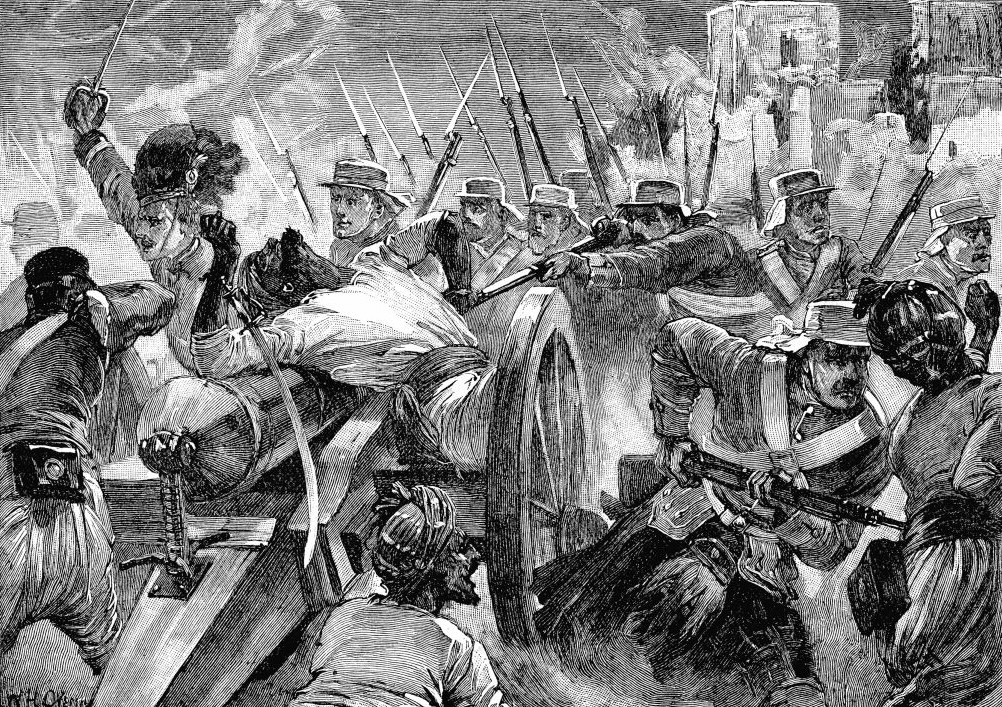
Highlanders capture the mutineers’ guns at Cawnpore during the Indian Rebellion of 1857 (illustration from circa 1895). (Ann Ronan Pictures / Print Collector / Getty Images)
Marxist Theories of Imperialism: A Critical Survey
Anthony Brewer
1980
There is a wide range of literature theorizing imperialism, and the best place to start is an overview that is judicious, encompassing, and careful. Brewer’s book is that. It covers not only the classical theories of Vladimir Lenin and Rosa Luxemburg but also the postwar theories, like the unequal exchange arguments of Giovanni Arrighi, Immanuel Wallerstein, and Samir Amin and dependency theory. Brewer is good on all of these, laying out what each theory claims and subjecting it to serious critical scrutiny. Any socialist who reads this book will come away literate in the broad landscape of Marxist theorizing on empire.
From Value to Uneven Development: Selected Writings by John Weeks in the Marxist Tradition
John Weeks, ed. Ben Fine, Simon Mohun, and Alfredo Saad-Filho
2020
The most astute and penetrating critic of the postwar economic theories of imperialism, Weeks was one of the leading Marxist economists of his generation and spent years studying the empirical realities of the Global South, particularly in Africa and Latin America. He was therefore deeply committed to building a theory that captured those dynamics. His selected writings present the best sympathetic critique of Wallerstein and the dependency school available anywhere.
Britain’s Imperial Century, 1815–1914
Ronald Hyam
1976
Hyam’s book is the finest single-volume account of British imperial expansion, covering the full sweep from 1815 to 1914. It went through three editions; the third, from Palgrave Macmillan in 2002, strikes the best balance between covering the high years of empire and engaging with the analytical debates that surround them. Hyam is equally good at narrating the story of expansion and pausing to examine the forces and contradictions that drove it. For any reader who wants to understand what British imperialism was, how it worked, and why it took the forms it did, this is indispensable.
Mammon and the Pursuit of Empire: The Political Economy of British Imperialism, 1860–1912
Lance E. Davis and Robert A. Huttenback
1986
Alongside the narrative history, you need to understand the economic dynamics of colonialism. What were the costs of colonial empires to the metropole, and what was actually produced by the colonies? Davis and Huttenback’s book is the most careful study of the data on the profits of imperialism ever produced, and its findings are arresting. Empire was likely a net drain on the British economy rather than an engine of growth. No serious student of imperialism can afford to ignore it.
The Enigma of Colonialism: British Policy in West Africa
Anne Phillips
1989
The final piece of the puzzle is understanding how empire consolidated itself in the Global South, and the best guide to that question is this short and beautifully written book. Phillips studies the onset and dynamics of British Empire in West Africa from the 1880s into the 1940s. Where thinkers like Luxemburg had predicted that colonialism would commodify the economy, dissolve traditional social relations, and integrate the colonized into a market for British goods, Phillips shows that it did the opposite. It consolidated peasant property and put the brakes on capitalist development. The reason was the political logic of colonial rule itself. British capitalists were never particularly interested in West Africa, and the colonial state’s overriding need was stability, not transformation.