US Imperialism Is Burning the Planet
The United States hasn’t just ignored the threat of climate change at home; it has used its military and financial might to accelerate environmental destruction around the world. In an interview with Jacobin, geographer Matt Huber explains how US imperialism stokes the fires of a burning planet.
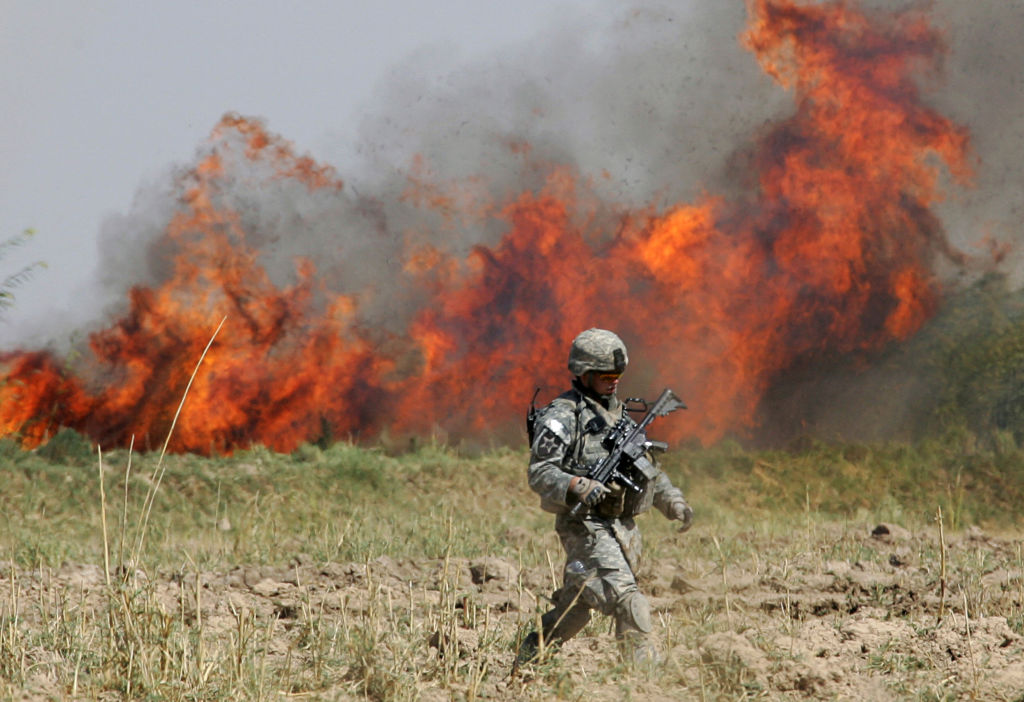
There is no serious climate politics that leaves empire untouched. (Alexander Nemenov / AFP via Getty Images)
Jacobin
What is ecological imperialism?
Matt Huber
Many on the Marxist left define imperialism in terms of value transfers or unequal exchange between the Global North and South, but relations of value extraction and exploitation are also central to our theories of capitalism. I follow the work of Leo Panitch and Sam Gindin, who make three important points. First, we need to keep capitalism and imperialism as two separate concepts. Second, the concept of imperialism must center on the capitalist state and its ability to coerce or limit the sovereignty of other nations and populations. Third, since World War II, the main imperial state has been the United States, whose military and economic power has been mostly incontestable, especially since the fall of the Soviet Union.
To understand what is “ecological” about US imperialism, we can draw from traditions of ecological economics and Marxism that connect ecology to energy and the productive forces. The US military empire is a fossil-fueled planetary machine, with over 750 bases around the world. As the top global arms dealer, at around 42 percent of the total, the United States runs an unprecedented regime of automated warfare that is fundamentally different from warfare powered by human and animal muscle power prior to the twentieth century. “Ecology” can also refer to the relations and conditions of life itself. On that front, it is worth noting that the US military is a major polluter, but more important is Panitch and Gindin’s understanding of the US state as an economic empire overseeing global relations of debt, finance, and trade. The US economic empire is one that privileges capital the world over at the expense of life and ecological health.