Hardt and Negri’s Empire Got Everything Wrong
Michael Hardt and Antonio Negri’s Empire became a campus sensation because it offered a master theory for globalization at a moment when old Marxist categories seemed exhausted. But the capitalist internationalism they saw as permanent has now crashed and burned.
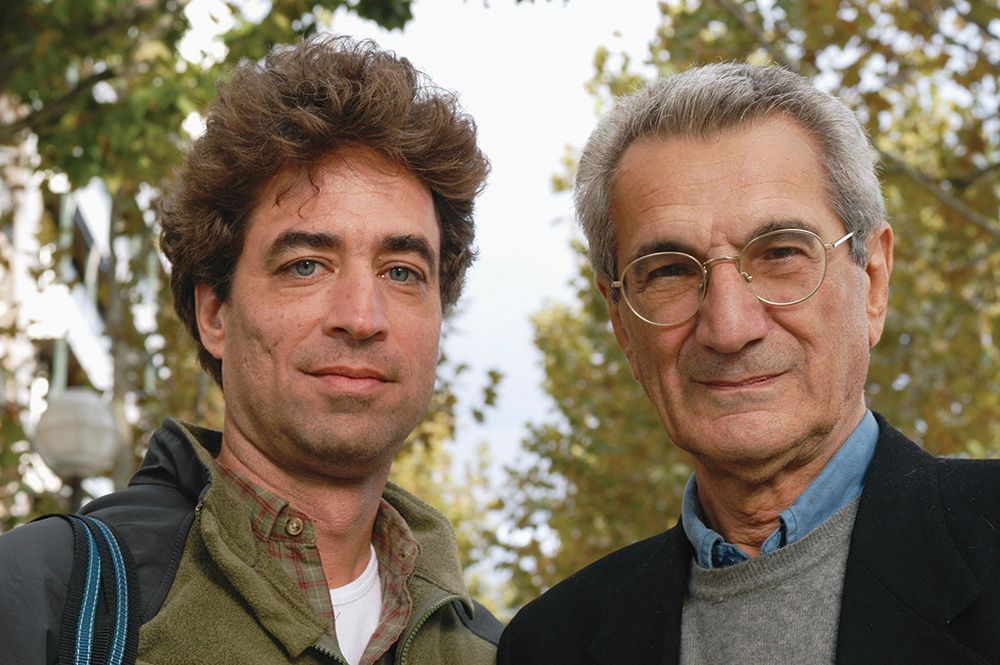
Michael Hardt and Antonio Negri, pictured here in Paris in 2004, collaborated from the mid-1990s until Negri’s death in 2023.
A few months ago, my partner and I met a liberal, fortysomething history professor who told us that for his next book he’d been reading up on late-1990s alter-globalization movements. As the millennium neared, global capitalism seemingly stood unchallenged. Social democrats and ex-communists praised the free market, and groupings like the World Trade Organization (WTO) integrated Russian and Chinese leaders. Yet this, he had discovered, wasn’t the whole story. It turned out that each of these elite conferences had been confronted by mass protests calling for an alternative global community. This rainbow coalition hadn’t detailed exactly what it wanted. But it had, he said, a world-changing ambition hard to find on today’s Left.
It was odd to hear him discuss this period like a lost Atlantis. When I moved into an East London squat in the late 2000s, it wasn’t even clearly in the past; its activists, its media, and its meetups were still with us, shaping the mass opposition to the ongoing war in Iraq. People still derided the practice of “summit hopping” from city to city to protest the gatherings of statesmen; some activists ironically identified with the term. These had, for many, been inspiring mobilizations. When the G8 met in Genoa in 2001, the repression culminated in the police shooting dead the young activist Carlo Giuliani. When we protested the G20 in London in 2009, a police officer killed Ian Tomlinson, a newspaper seller wandering through the demonstration, and then the authorities lied about it.
Upon the quarter-century anniversaries of similar summit protests, many accounts have emphasized their uncontrollable energy, with no single strategic leadership. While trade unions did join in, organized labor, political parties, and national governments were hardly center stage. Rather, at these protests and at countersummits like the World Social Forum, there were a variety of forces and personally chosen affinity groups: farmers, indigenous collectives, NGOs, tax-justice campaigns, and masked-up activists dressed in white overalls. If a word like “socialism” had for decades meant different things to different people, even such a vague future ambition had slipped from view.