America Brings the World Cup to a New Low
Other recent World Cup hosts used sports to prettify their image. But Donald Trump isn’t so much “sportswashing” as using the World Cup to show off the United States’ ability to discriminate against other teams and their fans.
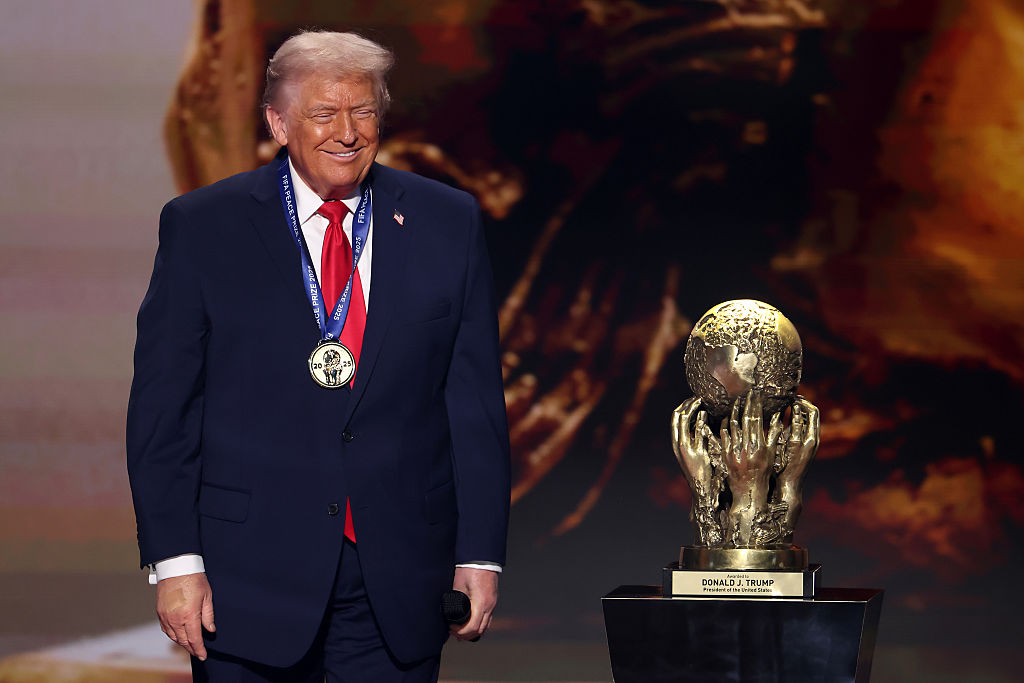
President Donald Trump receives the FIFA Peace Prize during the draw in Washington, DC, this past December. (Hector Vivas - FIFA/FIFA via Getty Images)
Sycophants, grifters, and ego-massaging billionaires so strongly define Donald Trump’s second term, we might easily forget that openly associating with him used to be controversial. Still, looking back to his inauguration reminds us what was already eyebrow-raising back then, and what was still to come.
On that January day, there were scheming tech giants like Elon Musk, Mark Zuckerberg, Sam Altman, and Jeff Bezos. There were Trumpist sporting icons and influencers like Jake and Logan Paul, Conor McGregor, Ultimate Fighting Championship CEO Dana White, and Joe Rogan. There was even a quartet of slightly bewildered former presidents. But among them all sat a gleaming head most Americans likely wouldn’t recognize: FIFA president Gianni Infantino.
The Italian Swiss sports administrator might be relatively anonymous, but this masks his global importance. Infantino, who has grown remarkably close to Trump in recent years, has helped turn the upcoming World Cup, held in the United States, Mexico, and Canada, into a Trump-dominated circus. The 2026 World Cup will be a new low for the sport, representing a clear distillation of both Trump’s approach to “sportswashing” and FIFA’s degradation.
According to professor and author Jules Boykoff, “Infantino treats the United States like FIFA’s private money pump while Trump gets to appear important, lording his mug over the biggest, most-watched sporting even on earth, gleaning football’s shine.”
Boykoff’s new book, Red Card, is a handy guide for anyone trying to make sense of just how the World Cup got to be such a mess, and what this says about encroaching authoritarianism in sports and politics worldwide. Though FIFA’s pandering to Trump has been widely reported, Boykoff — who is also an occasional Jacobin contributor — has sifted through every nauseating scandal and scam. It’s a useful book for both those closely following the Trump and Infantino show and those with more traditional American sporting preferences hastily Wikipedia-ing “World Cup” before kickoff.
Sports Personified
True, Trump often carries himself like he’d be more at home commentating on celebrity red-carpet attire than a sporting event (though, as Boykoff notes, he has spent one in four days of his second term golfing). Yet the President surely has proven astute at glomming on to the popularity of sports at every opportunity.
“Because Trump is a megalomaniac with a crude, transactional governing style and zero commitment to truth, he is well situated to leverage the toxic gangsterism of sports,” writes Boykoff. While Trump’s established links to MMA and wrestling and savvy co-opting of Olympic hockey glory have become foundational elements of his domestic politicking, hosting the World Cup is a step up onto the global stage.
Trump hasn’t exactly prioritized welcoming the world with open arms. As so often when we are confronted with direct Trump quotes, or even just sober, factual descriptions of his actions, Red Card’s account of Trump’s foray into world football is dizzying. It’s unprecedented territory for the World Cup that a host country (the United States) started a war with a participating country (Iran) and hasn’t even been able to commit to ensuring the latter team’s safety during the tournament. With the United States’ violent deportation machine in full swing, ICE is set to play an important role in tournament security.
Travel bans and racist, restrictive border policies will make visiting what ought to be a global celebration next to impossible for countless fans. Commitments to inclusivity and human rights, which were central to the pan–North American hosting bid, have failed to materialize.
Despite widespread criticism regarding the United States’ approach to hosting the tournament, FIFA has only served to abet and enable Trump’s worst instincts. For Boykoff, this shouldn’t be surprising considering Infantino’s iron grip on the organization and his blasé relationship to democratic structures and accountability.
“More than any leader in sport, Infantino has enabled the global swerve toward fascism,” writes Boykoff. The head of an organization committed to political neutrality, Infantino has not shied away from picking sides. Despite swift action to remove Russia from competitions after the invasion of Ukraine, FIFA has allowed Israel to compete as usual in the midst of a genocide. Infantino himself has been closely involved in Trump’s Board of Peace and its grossly cynical promises to rebuild Gaza. He even took a break from grinning ear to ear in a bright-red USA hat provided by Trump to pledge $75 million on behalf of FIFA to build football infrastructure, including a twenty-thousand-seat stadium in the rubble Trump helped create in the first place.
This is rooted both in Infantino’s deference to power and his own twisted interpretation of football’s global standing. If football is the world’s most popular sport, surely the head of its governing body must have the same influence on international affairs as a head of state. Why else would he think it’s normal to attend high-profile Gaza ceasefire summits in Egypt or awkwardly attempt to get Palestinian and Israeli football administrators to shake hands at the FIFA congress? You get the feeling Infantino, like Trump, might actually believe his own PR.
Certainly Infantino’s close relations to Qatar and Saudi Arabia (and role in facilitating the 2022 and 2034 World Cups) already exhibited an openness to authoritarians. Yet he’s particular cozy with Trump. He moved the World Cup draw to DC and let the awarding of the coveted FIFA Peace Prize,” created for the US president personally, to totally overshadow the tournament draw. He babies Trump, jumping through his arbitrary and constantly moving hoops for one reason: money.
FIFA is hoping to squeeze $11 billion out of the 2026 World Cup. Record-shattering ticket prices — including a “dynamic pricing” system and resale platform that allows FIFA to take 15 percent off buyers and sellers, charging hundreds for parking spots and instituting mandatory “hydration breaks” in each half that just happen to be ripe opportunities for commercials, are Infantino’s sole focus. Placating Trump to ensure the cash grab comes off is a small price to pay.
Not Quite Textbook Sportswashing?
While Infantino’s open support of Trump and gluttonous exploitation of soccer on the back of its fans is novel in how far he’s taking it, it’s not entirely new. Red Card provides a snappy, engaging history of sports’ knotty entanglement with politics. It traces the evolution of sportswashing, “when political leaders use sports to appear important or legitimate on the world stage while stoking nationalism and deflecting attention from chronic social problems and human-rights woes at home,” from the bread and circuses of ancient Rome, to the 1930s sporting jamborees in Fascist Italy and Nazi Germany, to the football World Cup held under the Argentine military junta in 1978, to modern editions in Russia, Qatar, and North America.
If you’re familiar with Boykoff’s work, much of this likely won’t be news. He’s the Maradona of hating on exploitative sports institutions and has written a handful of books about the unyielding antisocial corruption rotting sports mega-events. While some of his other books, like Power Games: A Political History of the Olympics, explore the roots of modern sportswashing in greater depth, Red Card’s expanded historical context on the football World Cup is helpful, especially in illustrating where Trump diverges from past examples.
Trump seems indifferent about building global legitimacy or deflecting from domestic human-rights abuses. Sure, he won’t mind if the tournament distracts from the Epstein files, and he’s certainly happy to be aligned with something as globally popular and prestigious as the World Cup. But Trump has never been one to moderate his behavior for audiences, domestic or global.
Reflecting his presidency writ large, Trump has produced a unique mutation of sportswashing that centers grift and open financial corruption but pays zero attention to shaping positive media narratives. Qatar spent a lot of money and effort hosting the 2022 World Cup in order to launder its international reputation. That meant paying close attention to spinning critical international reporting around its deadly migrant labor practices and stumbling over itself to ensure fans that did come had a safe, smooth experience. The aim: to shift Western public opinion about life on the ground.
The United States is a different case. It has been as belligerent abroad and wrathfully repressive at home as ever heading into the World Cup, and Trump seems like he doesn’t care if any foreign visitors come for the tournament, let alone have a good time, despite constantly boasting that it’ll be the biggest World Cup ever.
Given Red Card’s thoughtful analysis of sportswashing generally, more nuanced attention to how Trump fits into (or breaks from) previous models and what that means for the coming World Cup would have been edifying. Similarly, while Boykoff does a fantastic job situating the importance of sports as a vital cultural, economic, and political lever in a rightward-lurching world, the concrete relationship between the two could at times be more clearly illuminated.
“Under Trump we’re witnessing the slow-motion slide into authoritarianism,” writes Boykoff. “Hosting the World Cup unequivocally assists with this grim descent.” But clearer causal ties could be made between Trump’s repressive regime and the mechanisms of hosting this tournament. Otherwise, this occasionally comes across as simply listing a series of concurrent bad things.
Trump’s administration has indeed been eroding democracy and murdering protesters in the run up to the World Cup. As Boykoff notes, the National Special Security Event (NSSE) designation, which Joe Biden initially declared in 2024 in the runup to the 2028 Los Angeles Olympics, “triggers widespread latitude for numerous federal agencies, including ICE.” It’s less clear whether Trump cares about the leeway granted by the NSSE in particular, and whether autocratic clampdowns are directly related to the World Cup.
Trump has been plenty repressive without the World Cup, and given soccer’s secondary position on the US sporting map, it hasn’t been used to justify crackdowns on dissent as frequently as in other cases, where the World Cup was an all-encompassing national project. The tournament has been shaped by this dark, festering context, but if it’s truly been driving autocracy as in other Olympics and World Cups, clearer analysis would have strengthened Boykoff’s already thorough and thoughtful research.
No Bread, but a Circus
Boykoff closes Red Card with a point that should be fairly obvious but has long been drowned out by the cacophony of absurd and depressing stories about the repressive, corporate bastardization facing the World Cup: the United States simply should not be hosting it. Along with an examination of sportswashing’s historic development, the book highlights sporting mega-events as sites of popular struggle and magnets for protest.
While the 2026 World Cup has not seen global criticism like Qatar 2022 or been tied to widespread domestic outrage like the 2016 Olympics in Brazil, Boykoff profiles a number of local activists pushing back against the World Cup and its greedy, likely brutal implementation. Zohran Mamdani leading the charge of local host-city officials against FIFA demonstrates that resistance can utilize official outlets in addition to grassroots action.
It’s tragically too little, too late to make this World Cup a part of the people’s game it should be. But it also shows that such institutions can be fought — we just have to be a lot earlier, angrier, and more organized. If not, one of the last good things we have left will be used to rip us off and entrench despotic power. Red Card traces how we got here. Heeding its message could help inspire a way out in the future.