Why Mexico Welcomed Iran’s National Team With Open Arms

After the Trump administration denied visas to the Iranian team, its participation in the 2026 World Cup seemed unlikely. Mexico’s decision to host the players was rooted in its shared struggle for sovereignty in the face of US aggression.
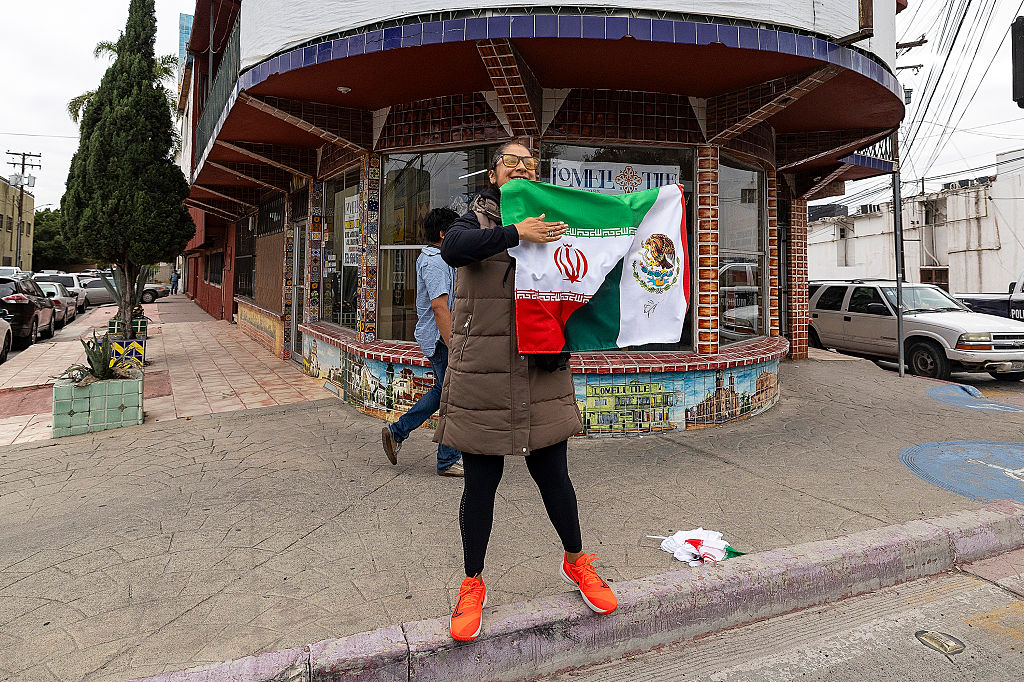
A soccer fan in Tijuana, Mexico, holds a flag of Iran and Mexico and bids farewell to the players of Iran after it participated in the 2026 World Cup.

For the Mexican people, cheering for Iran on and off the pitch this World Cup offered an outlet for expressing their nation’s own increasingly frustrated sovereignty — similarly threatened by an unhinged and belligerent United States. (Francisco Vega / Getty Images)


The Mexican city of Tijuana, right across the border from California, had three teams this World Cup. First, and most obvious, is Mexico. Then there was Haiti, on account of the large Haitian migrant population that has put down roots in the city after being denied entry to the United States. And — last but not least — was the national team of Iran, which made its base camp in Tijuana after being denied entry to the United States other than for the actual games.

Earlier this year, Iran’s participation in the 2026 World Cup seemed in doubt. With FIFA unwilling to move Iran’s games out of the United States and the Trump administration unwilling to let the team into the country for an extended stay, it seemed unlikely Iran would play its group stage games in Los Angeles and Seattle.

Mexico offered the solution. The progressive government of President Claudia Sheinbaum offered to host the Iranian team in Tijuana, which would then travel to its games in the United States just for the day. Scenes of Mexican affinity for Iran followed. Mexicans turned out in large numbers to cheer the Iranian team in Tijuana and locals hosted watch parties for Iran’s games. Mexico’s enthusiasm for the Iranian team did not go unnoticed. Following Iran’s elimination from the tournament, the result of a controversial offside call disallowing a last minute victory against Egypt, the Iranian team itself acknowledged the extraordinary support it received from the Mexican public, writing “Your act will stay in our hearts.”

Mexico’s decision to host the Iranian team in Tijuana is just the latest reflection of a decades-long affinity between Iran and Mexico, rooted in their mutual struggles for sovereignty in the face of US power.

A Tale of Two Gulfs

Even before the announcement of the Iranian team’s stay in Tijuana, popular sentiment in Mexico has been largely sympathetic to Iran in the war with the United States and Israel. After the illegal surprise attacks on Iran in late February, crowds gathered outside the Iranian embassy in Mexico City in solidarity; the US and Israeli embassies received only protests. President Sheinbaum no doubt spoke for most Mexicans when she criticized the US and Israeli attack on Iran, specifically citing the US bombing of a school that left 168 Iranian children dead, a massacre which the Iranian national team has also immortalized in the form of pins.

Mexico’s own history of US invasion is no doubt a major factor influencing this organic solidarity. Of the eleven World Cup venues in the United States, four — Los Angeles, San Francisco, Dallas, and Houston — are within formerly Mexican territory lost to the US invasion in 1848. While most Mexicans need no introduction to this history, the Iranian embassy in Mexico City has also been eagerly fanning Mexican concerns about its powerful northern neighbor. The Iranian ambassador to Mexico warned “that if the US wins something in Iran, it will not be difficult for them to try to win in Cuba or even in Mexico.” These warnings ring true in Mexico City, where both the US oil blockade around Cuba and the prospect of US intervention in Mexico’s drug war have caused deep discomfort in Mexico City.

The Iranian embassy has also drawn a comparison in the nomenclature debates over the “Persian” versus “Arabian” Gulf and the “Mexican” versus “American” Gulf. For Iran as for Mexico, the effort to rename a body of water long associated with their own name has wounded national pride. While Iranians have long insisted that the body of water to its southwest be called the “Persian” — and not “Arabian” — Gulf, the“Arabian Gulf,” is the preferred term of the US military, in part because it helps them please the Arab hosts of some of the US military’s most significant bases. In Mexico, President Donald Trump’s effort to rename the Gulf of Mexico has been received with similar offense. Though President Sheinbaum publicly laughed off President Trump’s renaming of the Gulf as “the Gulf of America” — jokingly proposing to instead rename the formerly Mexican territories in the US Southwest as “Mexican America” — the Mexican government also took formal legal action against Google for adopting the name on Google Maps.

Yet for all of Sheinbaum’s public bravado, there is real fear that the Trump administration may take military action against Mexico yet again. The Trump administration has done everything it can to intimidate the country, including officially celebrating the Mexican-American War, invading Venezuela, and warning the government not to send oil to Cuba — a threat Mexico has so far heeded, humanitarian aid and public professions of solidarity notwithstanding. Stuck between a rock and a hard place, Sheinbaum has largely accommodated the US demands for a more militarized approach to Mexican criminal groups in hopes of avoiding direct US strikes on the country, something Trump has often threatened.

In these circumstances, cheering on the Iranian national team as it competes on US soil counts as a small act of defiance from ordinary Mexicans in the face of the bully to its north.

Mossadegh’s Mexican Example

While the Trump administration’s belligerence has helped deepen the solidarity felt between peoples of the two nations, the ties between Mexico and Iran are older. Indeed, the example of the Mexican Revolution — which deserved to be understood as the first great twentieth- century revolt for sovereignty — did much to set the stage for Iran’s subsequent history, particularly on the question of sovereignty over natural resources.

During the recent war, Iran’s ambassador in Mexico claimed that Iranian secular nationalist leader Mohammed Mossadegh’s effort to nationalize Iran’s oil industry in the early 1950s was inspired by Mexico’s successful nationalization of its oil industry in 1938. Indeed, the parallels are numerous. Both nationalizations were preceded by major strikes by local oil workers upset by unfair treatment by foreign oil companies. Both also ran into determined opposition from Britain. Yet ultimately, the divergent US reaction to Mexico’s nationalization of foreign oil companies in the 1930s to Iran’s nationalization of foreign oil companies in the 1950s would set the two nations on very different courses.

Like Mexico before its revolution, Iran was a vast but underdeveloped country with significant oil resources under foreign control. In 1950, Iran’s oil was entirely in British hands. It was with this concern in mind that Mossadegh had been democratically elected, with the aim of ensuring more of Iran’s vast oil wealth would be invested in its people. Yet just as it had been in Mexico fifteen years earlier, Britain was again fiercely opposed to seeing its oil companies nationalized.

Here the United States could have gone its own way, as it had in Mexico in 1938, and as it would again in Egypt in 1956, recognizing General Gamal Abdel Nasser’s nationalization of the Suez Canal over British objections. Yet rather than display the United States’ traditional independence from Britain’s rival imperial interests, the Eisenhower administration chose to join the British in overthrowing Mossadegh in a military coup.

Iranian oil nationalization was not to be. Iran’s fragile democracy was destroyed. Instead, the shah would rule Iran as an absolute ruler until 1979, after which he traveled the world, spending large amounts of time in the picturesque Mexican city of Cuernavaca when the United States was unwilling to grant him entry. The US choice to run roughshod over Iran’s sovereignty in 1953 would poison relations between the two countries to this day, setting the world on the path to the recent and still not resolved conflict in the Persian Gulf.

Good Neighbors?

The US response to Mexico’s nationalization of its oil in 1938 was very different. This divergence is largely due to President Franklin Delano Roosevelt’s adopting the “Good Neighbor Policy,” which briefly committed the United States to the principle of nonintervention in Latin American affairs.

At the time, Mexico was still in the throes of the Mexican Revolution, which had started in 1910 as a revolt against the decades-long rule of Porfirio Díaz, who welcomed foreign capital to Mexico, and spiraled into a nationwide social uprising followed by the adoption of one of the world’s first social democratic constitutions, codifying economic and political rights for Mexicans. By 1938, Mexico’s leader, Lázaro Cárdenas — who had personally fought in many of the revolution’s battles — took the dramatic step of seizing foreign-owned oil companies after a series of strikes by Mexican oil workers against British and American oil companies. Though US elites pushed hard for intervention, Roosevelt in large part accepted Cárdenas’s nationalization of US companies. The 1938 expropriation continues to play a large role in Mexico’s political culture — a blockbuster film was recently produced about Cárdenas’s oil expropriation and the history is treated almost religiously by the ruling MORENA party.

Unlike the Roosevelt administration, Britain took a far harsher line toward Mexico’s oil nationalization, imposing sanctions and severing diplomatic relations with the country. Tellingly, Britain’s hard line with Mexico was motivated in large part by fear of “contagion” of similar oil nationalization efforts in Iran — foreshadowing the confrontation with Mossadegh fifteen years later. Crucially however, Roosevelt refused to join Britain’s coercive efforts to violate Mexican sovereignty over its natural resources as Eisenhower would do against Iran. Roosevelt’s conciliatory approach would ultimately turn Mexico into an ally during World War II. With US recognition of Mexico’s oil nationalization, Mexico would continue to be a major supplier of oil to the United States. After the sinking of Mexican oil tankers in the Gulf of Mexico by German U-Boats in 1942, Mexico joined the war on the side of the Allies, eventually sending oil, agricultural workers, and even a Mexican fighter plane squadron to support the US war effort in the Pacific.

Sovereignty on the Pitch

Today, of course, the Mexican sovereignty that was hard-won by the Mexican Revolution is under threat from the United States in ways unprecedented since the last US invasion of Mexico in 1917. The “Donroe Doctrine” has replaced the Good Neighbor Policy. The dilemmas facing the Sheinbaum government are more like those encountered by Mossadegh than Cárdenas — how to maintain national sovereignty in the face of such a hostile and powerful force?

In this context, it is little surprise that Mexicans and Iranians have taken inspiration from each other. Just as Mossadegh was inspired by Cárdenas’s oil nationalization, so too are some commentators in Mexico beginning to see Iran’s ability to successfully fight the United States to a standstill as something worth emulating. With President Trump threatening Mexico’s sovereignty, Iran’s combative approach is attractive to Mexicans growing weary of President Sheinbaum’s repeated concessions on Cuba, migration, and the drug war. For now, cooler heads prevail in Mexico City, where the risks of a conflict with the United States are understood to be existential. But for a frustrated Mexican populace, cheering for Iran on and off the pitch offers one outlet for expressing Mexico’s own increasingly frustrated sovereignty. Even the very act of hosting Iran on Mexican soil served as a modest but meaningful reminder that Mexico continues to treasure and to exercise its independence from its northern neighbor in whatever way it can. As Mexican crowds gathered in Tijuana to bid goodbye to their city’s adopted team, the renewed connection between Mexico and Iran could last long after the 2026 World Cup is over.