Senegal Is in the World Cup but Hardly Made Welcome

One of Africa’s top teams, Senegal has good reason to look forward to the World Cup. But the US government has put up major barriers to its fans and journalists visiting the country, in a policy of deep discrimination against Senegalese citizens.
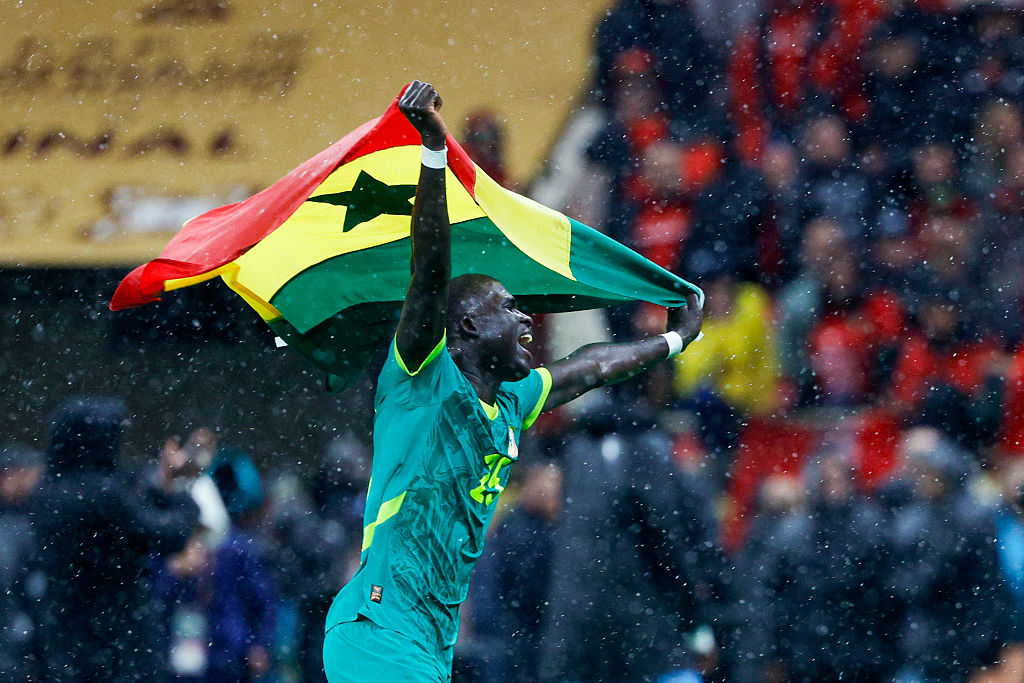
Senegal's defender El Hadji Malick Diouf celebrates his team’s victory at the end of the Africa Cup of Nations on January 18, 2026.

Senegal qualified for its third World Cup in a row, but the games are harder than ever for its fans to attend. Their treatment illustrates how the Trump administration is using the World Cup to show off its anti-immigration policies. (Abdel Majid Bziouat / AFP via Getty Images)


He’s frustrated, but he’s keeping in his anger. Abdoulaye — the pseudonym of a famous Senegalese journalist who spoke to Jacobin — just doesn’t know if he’ll be able to cover his country’s match against Iraq, scheduled to take place Toronto on June 26 as part of the upcoming football World Cup. Known as the Lions of Teranga, the Senegal team are in Group I alongside two other opponents, France and Norway, who they’ll face at New Jersey’s MetLife Stadium on June 16 and 22.

Accredited by FIFA and with the necessary visas in hand, Abdoulaye sums up his dilemma: “From the United States, I can enter Canadian territory, but I’m not sure I’ll be able to return to US soil” for the potential continuation of the competition. The fault, he says, lies with the restrictive anti-immigration measures enacted by the Trump administration, the impact of which could affect the forty or so journalists heading to North America from Senegal. “FIFA will have to step up and make the American organizers see reason,” our colleague notes. In any case, Abdoulaye is still in a privileged position, as thousands of his compatriots have already for months faced a wall of concrete and steel erected by the US Embassy in Dakar to cut off the legal pathway to American visas.

These drastic, often final restrictions already affect thousands of young Senegalese students eager to pursue their studies in the United States, as an extension of the famous American dream that has shaped many of their educational journeys, as well as businesspeople seeking to expand their firms in the homeland of unbridled capitalism. Other ordinary citizens — whether or not they have relatives in the United States — are simply drawn by the joy of discovering “the Great America” and its majestic symbols, such as the Statue of Liberty, the Golden Gate Bridge, and so on. Yet the Trump administration’s ideological blindness has taken its toll.

Executive Order

This January, Executive Order 10998, issued by the US president, placed Senegal on the list of countries now subject to the Visa Bond. This requires applicants for tourist (B1) and business (B2) visas to pay a bond ranging from $5,000 (approximately 2.8 million CFA francs) to $15,000 (approximately 8.5 million CFA francs). In the eyes of US diplomats, these amounts serve as a guarantee against any temptation among admitted individuals to vanish into thin air once they arrive on US soil.

A financial bond of this magnitude appears to be a brutal measure of exclusion based on money, as few ordinary Senegalese will have the means to satisfy the appetite of US consular officials. This is pure Trumpism: every transaction must be an opportunity to rake in money, far removed from the ethics involved.

These deterrent measures taken ahead of the World Cup seem clearly discriminatory. They have their own sordid objectives: to limit to the absolute minimum the number of Senegalese lucky enough to experience the sporting celebration in person; to rake in funds by crudely fleecing as many people as possible; and reaping the political dividends of these diplomatic and administrative blunders by linking them to Donald Trump’s campaign pledges for a zero-tolerance line on immigration.

The hunt for — and surveillance of — the “lucky” Senegalese who get to experience the World Cup in person is therefore unlikely to let up. All of them may feel humiliated right up until the end of the adventure. Indeed, one of the provisions of Executive Order 10998, in addition to the security deposit required (payable on a US government website), requires them to enter US territory through the airport designated for them by the consular authorities themselves. These diplomatic agents, vested with full discretion over each case, naturally appear as the enforcers of a discriminatory machinery tasked with providing the MAGA administration with “positive” statistics to justify the continuation of indiscriminate repression against migration flows.

Even the Senegalese who have cleared the financial hurdle are not out of the woods yet. The Trump administration’s repressive machinery has also erected digital barriers that deliberately violate their privacy and freedom of expression. This inquisition imperiously demands the contents of all their communications from the past five years on every platform they use. An omission or a false statement is treated as an attempt to conceal information, punished by the rejection of the application, without appeal.

Not Allowed to Set Foot

Access to US territory has become harder for most citizens of countries whose nationals require a visa. For Senegalese, this difficulty has tended to become institutionalized since President Trump’s return to the White House in January 2025. A year later, the White House dropped an administrative bombshell on tens of millions of people across the globe. The executive order suspends all issuance of immigrant visas, a measure that makes family reunification impossible — at least until further notice. It also blocks global access to the “Green Card” through the annual lottery. For the Trump administration, migrants of all categories are an unbearable burden on US public finances and said to lower Americans’ living standards. Since Senegalese are deemed part of this source of “evil,” the bulk must therefore be prevented from setting foot in the United States.

According to State Department figures, the rejection rate for Senegalese applicants for tourist and business visas (B1/B2) in 2025 was a whopping 74 percent, likely among the world’s highest. The number of student visas (F1) issued between September 2022 and October 2024 had gone up from 393 to 426. But they do little to hide an estimated acceptance rate that declined from 65.2 percent in October 2022 to 59 percent in October 2024.

Clearly, immigrant visas are no longer an option for thousands of potential legal immigrants. Suspicion, prejudice, and the mass-scale rejection of applications dominate the process choosing who “deserves” to enter the United States. Under Trump, hundreds of Senegalese families (or ones of Senegalese background) who hoped to come to the United States through the legal family reunification system now see their plans put on hold indefinitely. According to an estimate by the Department of Homeland Security, in 2022–23 there were approximately thirty-four thousand Senegalese born in Senegal who had immigrated to the United States, with around twenty-five to thirty thousand legal residents. This figure does not include Americans of Senegalese origin. In this figure lie many human tragedies related to the freeze on family reunifications. But the migration crisis is no longer sparing even the sporting aspect of relations between Dakar and Washington. The diplomatic coldness governing US immigration policy is more unrelenting than ever before.

Sporting Bans

Already in June 2025, the US Embassy in Dakar denied visas to twelve members of Senegal’s women’s national basketball team — including five players — who were scheduled to travel to the United States for a ten-day training camp.

Outraged by this decision, then-Senegalese Prime Minister Ousmane Sonko canceled the trip and ordered the training camp to be relocated within the country, “in a sovereign setting conducive to performance.”

Among much of the Senegalese public, there is almost total incomprehension — that is, setting aside the views of those who defend the United States’ untrammeled “sovereignty” in matters of immigration. Interviewed by the BBC for a report on the organization of the World Cup, Aliou Ngom, a Senegalese fan who attended the previous tournaments in Qatar (2022) and Russia (2018), laments that this World Cup won’t be a moment for “cultures coming together from all over the world.”

The systemic chaos surrounding the 2026 World Cup, even before it begins, is stirring the entire planet. The organization of the world’s biggest sporting event is in turmoil, bringing together racism, restrictions, discrimination, visa selection based on ability to pay, digital screening, and even attempts to humiliate some of the tournament participants themselves. This organized chaos, compounded by the headache of pricey stadium tickets and the selective body searches of teams upon their arrival on American soil, is being condemned around the world.

The Senegalese players and coaching staff experienced this firsthand when they were searched at Raleigh Airport on their way to San Antonio. Still, in a press release published on its various platforms, the Senegalese Football Federation played down the episode, emphasizing that the frisking of the staff and players “took place in respect for the relevant airport security rules and no particular incident was observed.”

Ultimately, Trump’s tragicomic governance is again a subject of derision. If past administrations built up soft-power tools for “selling” America and its promise to the world’s youth — including in countries like Senegal — this is now badly compromised. At the same time, China, Russia, India, and even Turkey continue to refine their strategies for quietly expanding into new territories and partnerships that could shape the global power balance for years to come.