The Americanization of the World Cup Is Here to Stay

Unwarranted ad breaks, entry bans on some foreign nationals, and political tampering with the game all made this a Trumpian World Cup. But if Donald Trump put his stamp on the world’s game, it’s also set a precedent for future FIFA-organized tournaments.
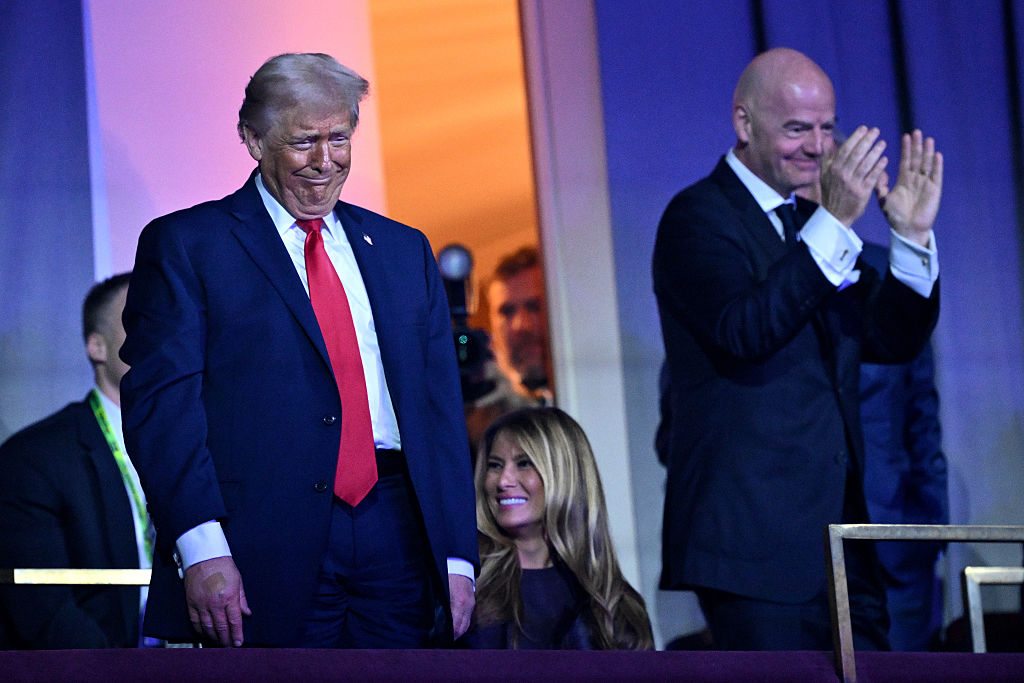
Donald Trump, Melania Trump, and Gianni Infantino react during the FIFA World Cup 2026 Official Draw at the Kennedy Center on December 5, 2025, in Washington, DC.

Football has become a commercial product distant from its working-class roots. But the era of Donald Trump and Gianni Infantino has done something more, as FIFA’s rampant corruption undermines the sporting integrity of the game itself. (Mandel Ngan / Pool / AFP via Getty Images)


The 2026 World Cup had three host countries, but it will always be remembered as an American event. And like most American things in the last decade, Donald Trump made much of it about himself. Bombing a participating nation, loudly bragging about corrupting the game, cramming himself into the final. . . .  even if Trump had a couple uncharacteristic spells out of the limelight, his makeup-caked hands were all over this World Cup.

And though the record attendances (and, more importantly for organizer FIFA, revenue), thrilling footballing highlights, and viral fan moments demonstrate that this World Cup wasn’t a total bust, something has felt off about it. We saw sickening ticket prices and the related tame atmospheres; a limited number of fans able to travel from abroad; and rampant commercialism, jarring even for an organization as soulless and corporate as FIFA. The worst elements of this World Cup have been its most Trumpian.

The United States has put its stamp on the world’s game, and we’re all worse off for it. Football’s long-creeping Americanization has been cemented by this tournament, combining both ruthless financialization and rampant corruption that directly affected play like never before. Sadly, all of this will outlive Trump and the United States’ hosting of the World Cup.

It’s Not All Bad?

Still, given the low expectations surrounding a World Cup doubling as a testament to Trump’s friendship with FIFA chief Gianni Infantino, many ended up pleasantly surprised. On the field, where crooked administrators usually manage to mess up least, it was generally a success. Spain played their usual suffocatingly beautiful football, and Lionel Messi reminded us how fortunate we are to witness his work. Germany found exciting new ways to prove they’re no longer a football power — and this time no one will try to blame wokeness for their failure.

Though at times cumbersome and guilty of forcing us to do more math, the expanded forty-eight-team format worked moderately well — even if it was largely a play to sell more tickets, and for FIFA to shore up support in Asia and Africa. Tournament debutants Uzbekistan, Jordan, and Curaçao brought fresh flair, while fellow newcomer Cape Verde put in remarkable performances.

Stadiums were packed, including for less-marketable group stage matches. Ticket demand exceeded expectations, as fans weren’t dissuaded even by eye-watering prices. The tournament at times resembled a six-week display of unstoppable consumerist purchasing power (and/or credit card debt) than a soccer tournament. It also showcased a deep-rooted cultural love for being blatantly ripped off. Where else would anyone cheerily admit to paying $4,000 for a group stage match, let alone argue it was worth it?

Another reason stadiums were full was simply the diversity of the US population. Massive, proud diasporas ensured no side went unsupported. This at least briefly shifted Trump’s tournament into what resembled a feel-good liberal dream. Few other countries are diverse enough to pull this off at such a scale, and the World Cup often provided an opportunity to celebrate immigrant life. This, too, allowed an alternative to Trumpism’s narrow expression of American identity.

The United States also seemed to impress the international fans that did make it across. There were the Scottish fans charmingly teaching Boston how to drink. Many individual European fans went viral when they gawked at the size of grocery aisles and fast-food portions. (Accounts like Freddy’s easily stirred enthusiasm among Americans of all political stripes, eager for positivity). But overall, many visitors found the United States and its people much more charming than expectations set by Trump-centric international reporting. The $5 billion air-conditioned football stadiums also looked unlike anything most fans have ever seen — but that’s also because most of the world elects to subsidize youth sports and not billionaire-owned sports arenas.

Thankfully, the legitimate pre-tournament fears of Immigration and Customs Enforcement (ICE) using games as an easy opportunity to round up immigrants didn’t materialize. Though American policing had little direct impact on the World Cup, it’s a sign of ICE’s brutality that it could murder multiple people even during the tournament and still be seen as on its best behavior. For much of the World Cup, it looked like FIFA and Trump had managed to pull off a public relations coup, overcoming expectations and encouraging positive vibes.

Stealing the Spotlight

That goodwill could only last as long as Trump’s inauspicious silence around the tournament. However, Trump being Trump, he was bound to make things about himself at some point.

The president’s direct intervention to pressure FIFA into overturning US men’s team striker Folarin Balogun’s red card ban prior to the knockout match against Belgium was an egregious overreach. That Trump’s addled brain thought the best way to handle an obvious case of on-field corruption was to brag about it fits him to a T. Infantino’s FIFA bowing to political pressure is nothing new, but doing it to directly tip the scales on the field is also a new low, which was only served karmic justice by the United States flaming out stupendously against Belgium despite being handed the advantage.

Even former FIFA President Sepp Blatter joined in on the criticism of Infantino. He surely has an axe to grind — Infantino took the top job in 2016 after Blatter had been forced out over a corruption scandal. Given Blatter’s record, it’s hardly a good sign if he is criticizing your ethical judgement. Yet Infantino’s open kowtowing to despots did reach a new nadir. At least Blatter and his ilk knew to be somewhat subtle about their corruption — Infantino has been infected by the Trumpist proclivity to flaunt misdeeds as openly as possible.

Balogun was the most discussed but not likely the most egregious case of Trump’s antics actually affecting the football. In a ghastly affront to the fraternal spirit of international sport, a host nation raining bombs on fellow participant Iran throughout this World Cup wasn’t just unprecedented, it also had sporting ramifications.

Because of the war, the Iranian league, where most of its national team play, was suspended for months leading into the tournament. Shortly before things kicked off, Iran was forced to move its team base from the United States to Mexico — with the team only provided short-term visas around each match, forcing them to immediately return to Tijuana, and with some staff unable to actually enter the United States for matches at all.

Despite the tired Iranian players’ obvious sporting disadvantage — and the sheer moral depravity of the United States imposing such rules — the World Cup went on as though nothing out of the ordinary was happening.

And while the vibrant celebration of American immigrant life was often genuinely moving, the World Cup often relied on diasporas to fill stadiums because getting into the country was next to impossible for others. The United States’ border regime did the dirty work so that ICE raids never had to materialize during the tournament. Iran, Haiti, Ivory Coast, and Senegal all had at least partial travel bans to the United States despite playing.

A Foreboding Blueprint?

Many of the worst elements of this World Cup — the open corruption, the cynical cash grabs, and the insistence on tinkering with the world’s most beloved sport — are only likely to be further entrenched.

If fans in other countries aren’t as comfortable as Americans in shelling out dizzying sums of cash for tickets, perhaps they’d better get used to it. Even if pricing drops in the future, it’s unlikely to resemble pre-2026 levels. The overwhelming US-style financialization of this World Cup, most clearly manifested in the “dynamic pricing” system that made buying tickets reminiscent of prediction markets and the poisonous spread of sports gambling, will likely accompany future FIFA competitions. The mandatory “hydration breaks” — a change to the format of the sport rammed through by FIFA to allow more advertising even when not called for by temperature — are also unlikely to disappear.

FIFA made such changes without US fans needing to pressure them to do so. The same is true of the nearly half-hour Super Bowl–style halftime show planned for the final (the break is usually only fifteen minutes). Literally no one is asking for Justin Bieber and BTS to interrupt the world’s most important sporting contest, but it’s happening anyway. Whether people like it or not, FIFA will stonily maintain that it was a roaring success.

Outside of international competitions, football has long been increasingly dominated by billionaires and speculative private equity. The World Cup shifts will only serve to further entrench capital’s grip on the global game, and these reforms being tested on the biggest stage will make them easier to bring to other competitions.

Corporate greed infecting football is not new — the game’s working-class roots have been brutally undermined over decades. But it now threatens to render football unrecognizable. And because FIFA, the sport’s most important institution, is an irredeemable racket, the cronyism intensified under a Trump-tinged World Cup will likely prevent anyone from stopping this.

Perhaps Infantino has gone too far, and (unlike the last two times) he looks likely to have actual opposition in next year’s FIFA presidential election. Yet he still seems largely untouchable. He’s responded to fiery criticism from Europe by floating a further expansion of the World Cup, this time from forty-eight to sixty-four nations, in an unsubtle attempt to secure votes from Asian, African, and Central American federations that would benefit from a lower entry threshold.

With the 2030 World Cup a sprawling monster taking place over three continents, and the 2034 edition slotted for Saudi Arabia, there is plenty of potential for further graft and sportswashing regardless of who is at FIFA’s helm.

And even with the World Cup moving across the world, the self-absorbed parochialism of the United States — a host country filled with pundits who boast of not understanding the sport’s culture — will be exported. An expanded number of participant countries is ostensibly widening the tent, yet FIFA’s obsession with revenue at all costs will instead shrink the worldwide footprint of fans who can really attend.

The multi-continent affair in 2030 will be even more logistically difficult, and possibly even more expensive for fans, than the current one. And like Qatar in 2022, Saudi Arabia 2034 will likely prove an unwelcoming and unappealing destination for female and queer fans. Football’s long-term degradation makes all of this feel like a logical follow-up to 2026.

But if 2026 teaches us anything, it should be that it doesn’t have to be this way. Despite it all, six weeks of football in North America brought joy to the world. It — if not always — demonstrated that even in the most hostile of conditions, football can bring people together and help reconstitute conceptions of community and belonging. It’s this power that shows us the sport must be protected, not used against us.

Victories in affordability and community-building, like those in Zohran Mamdani’s New York, prove football’s fetid institutions can indeed be challenged. We just have to do it before there’s nothing to win back.