Socialists Won Big in NYC Last Night and Aren’t Done Winning
With a clean sweep of electoral wins for Zohran Mamdani’s endorsees and nine out of ten victories for NYC Democratic Socialists of America last night, it’s clear the socialist mayor and socialist movement are major political forces to be reckoned with.
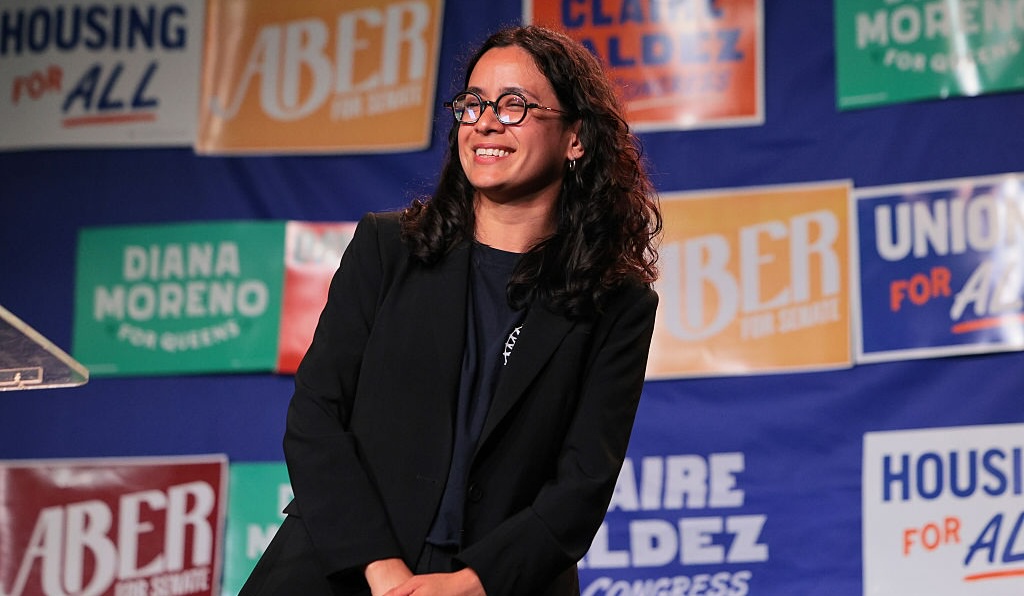
Last night’s elections showed that New York City socialists can mobilize on the scale of last year’s Mamdani campaign — and that the socialist mayor’s victory last year wasn’t a fluke. (Michael M. Santiago / Getty Images)
Everyone agreed that New York City’s primary Tuesday was high stakes. Could Mayor Zohran Mamdani’s charisma, ideas, and volunteer power translate into electoral victories for his allies? And could the New York City Democratic Socialists of America (NYC-DSA) keep up its electoral momentum after the group’s historic upset in last year’s mayoral race? Last night’s answer to both questions was a massive, resounding yes.
The socialist victories far surpassed anyone’s predictions. In an open primary to replace retiring progressive giant Rep. Nydia Velázquez, State Assembly Member Claire Valdez’s race against Brooklyn Borough President Antonio Reynoso was the subject of significant attention, since Velázquez openly denounced Mamdani for not backing a candidate personally approved by her as a successor and the Working Families Party (WFP) endorsed the borough president. The race was expected to be a close one.
Reynoso is an undeniable progressive with a substantive history of independence from the Democratic Party establishment. But Reynoso was more embedded in traditional backroom political dealmaking and backed by the low-expectations wing of the labor movement, in which politics is mostly a matter of making safe bets on electing and reelecting traditional corporate Democrats — even in cities and neighborhoods where it’s clear that the horizons have shifted in a more expansive pro-worker direction.
That approach to politics was decisively defeated last night.

In keeping with the DSA theory of change, Claire Valdez had ground game. She drew volunteers mostly from DSA but also my union, United Auto Workers (UAW) Region 9A, which takes a more ambitious approach to elections than most, as well from rank-and-file unionists all over the city. Volunteers were excited to turn out for someone who was not only championed by everyone’s favorites from the Left and the labor movement — Mamdani, UAW President Shawn Fain, Bernie Sanders — but also an organizer who came out of the Left and the labor movement.
Valdez was an early NYC-DSA activist and a unit chair in her UAW local. At every rally and canvass throughout the campaign, speakers would recall Valdez’s participation in every significant labor and left fight of recent years, which quickly led to the ubiquitous chant, “Claire was there!”
In the end, it was not even close: Valdez prevailed with 56.1 percent of the vote to Reynoso’s 35.8 percent, a margin of more than 13,000 votes. Valdez showed that even without a horrific opponent like Andrew Cuomo, socialists can win with a positive vision for the working class and defeat the more tepid and transactional politics of traditional urban progressivism. Valdez is a product and champion of the labor movement yet faced opposition from most of the city’s politically active unions and the WFP; the fact that she and her UAW and DSA backers trounced Reynoso suggests a changed political landscape in the city in which those unions and the WFP may not matter as much as they have in the past.
Elsewhere there was no shortage of horrific opponents. In Uptown Manhattan and the Bronx, Darializa Avila Chevalier won a much more startling victory over Rep. Adriano Espaillat, an incumbent Democratic Party power broker and chair of the Congressional Hispanic Caucus. Espaillat’s campaign was heavily backed by the American Israel Public Affairs Committee (AIPAC); relatedly, he acted with appalling indifference when constituent Mahmoud Khalil, a Columbia University graduate student and pro-Palestine protest leader, was kidnapped, shipped to Louisiana, and detained for months for speaking out about genocide in Gaza.
Espaillat did himself no favors by mobilizing AIPAC money to fend off this challenge, and his allies did not help him either, as racist attacks by right-wing Dominicans painting his opponent as Haitian also backfired.
As bad as Espaillat was, Chevalier won by organizing people, and her outspoken advocacy for Palestine was a huge draw, especially as Donald Trump’s war with Iran further exposed the perils of the US relationship with Israel. As a Columbia student, she was active in that university’s protests on behalf of the Palestinian people and was moved to challenge Espaillat because of that issue and his inaction on behalf of Khalil.
At the beginning, even on the Left, her campaign wasn’t taken seriously: Chevalier was young and inexperienced, the powerful incumbent protected by key neighborhood institutions. Much was made of her past tweets, from a previous era of what socialist City Council Member Chi Osse has called “Woke 1,” and positions like prison abolition that are outside the political mainstream.
But in the end, Chevalier defied expectations and won by more than two thousand votes.
Palestine was also on the ballot in former Comptroller Brad Lander’s race against another AIPAC-funded incumbent, Rep. Dan Goldman in New York’s Tenth District, who has been a steadfast friend of Israel and an apologist for that country’s genocide. While that urgent moral issue was the most obvious reason for the Left to oppose him, Goldman was also lavishly supported by real estate and finance interests — exactly the kind of politician that the newly elected socialist mayor would not want in Congress.

While not an NYC-DSA race as Lander was not endorsed by the group, it was an important race for the Left, because it was one that the mayor needed to win, and because Lander is a strong DSA ally on nearly all issues as well as an important envoy to liberal Jewish voters who, because of Palestine, need reassurance that the right-wing propaganda about Mamdani’s antisemitism is untrue. Of all the challengers on yesterday’s ballot, Lander enjoyed the night’s biggest victory, winning 65.8 percent of the vote to Goldman’s 34 percent.
At the state level, the socialist victories were equally impressive and distributed all over the city: in Queens, Aber Kawas became a state senator, while all but one of the assembly candidates — Christian Celeste Tate, Eon Huntley, IIlapa Sairitupac, David Orkin, and Samantha Kattan — also won by significant margins. UAW organizer and public defender Conrad Blackburn, who faced an uphill battle against a generations-deep Harlem political machine, did not prevail but is well-positioned to run again in the future; Huntley and Sairitupac lost their races the first time too.
Also in the assembly, DSA-backed candidate Adam Bojak won in Buffalo, and Maurice Brown looks likely to win in Syracuse (though that race is too close to call). Several NYC-DSA incumbent legislators also faced challengers, and they all won handily to keep their seats.
Mamdani is a world-historical political star: during the election last year, people would show up to poll sites just because they heard he might be there, or they might be able to acquire merchandise with his name on it, as if he was a K-pop singer. What’s remarkable about this election is that it shows the mayor has retained that public love even amid the prosaic challenges of governing.
But NYC-DSA also showed they can pull off big victories without his direct support. In contrast to his bold approach to congressional races, Mamdani avoided the wrath of state legislative leadership by opting not to endorse any assembly challenges, instead backing only candidates in open seats. Nonetheless, all the DSA assembly candidates prevailed but one.
Tuesday night showed that New York City socialists can mobilize on the scale of last year’s Mamdani campaign. NYC-DSA is not even close to reaching the ceiling of what the Left in this city can achieve. AIPAC money, racist attacks, and other evil and formidable facts of American life proved weaker than the superpower of thousands of sweaty and smiling volunteers committed to a vision of a better world.
Early Tuesday morning, Gustavo Gordillo, cochair of NYC-DSA, told me that the group had, this election cycle, knocked on 650,000 doors across the city for its endorsed candidates. The night before the election, DSA held possibly its largest phone bank ever, with six hundred people making 100,000 phone calls. Mamdani won his primary last year with 4,600 volunteers getting out the vote on election eve and primary day; even with no one of comparable Beatlemania star power, this year’s slate’s day-before and day-of efforts drew 3,500 volunteers.
An enormous number of Americans are sick of the relentless horror that is our national politics and are not confident that traditional Democrats have solutions to any of the real problems we face: Trumpism, affordability, climate crisis, war. Socialists are offering concrete solutions, a fighting stance against the ruling class, and the kinds of candidates who might be able to credibly take on the challenges of our time, like antiwar and labor movement leaders committed to the working class.
Socialists defeated AIPAC, racism, media cynicism that amplified every sign of division among the Left and the electorate, and, yes, also the Working Families Party. As a New Yorker, it’s impossible not to hear an echo of the astonishing triumph of New York’s basketball team earlier this month, who became the reigning champions of the NBA against towering odds. Just last week, after the Knicks’ championship parade, Mayor Mamdani compared the team to ordinary New Yorkers, who, he said, “look at a. 4 percent chance of success and ask, ‘Why are you giving me a head start?’” Today socialists all throughout New York City could ask the same question.