Socialists Are Winning Using Old-Fashioned Democratic Means
Too many explanations of socialist electoral victories have ignored the democratic politics at the heart of the socialist movement today: employing many volunteers to engage face-to-face with voters and earnestly make the case that socialism is the answer.
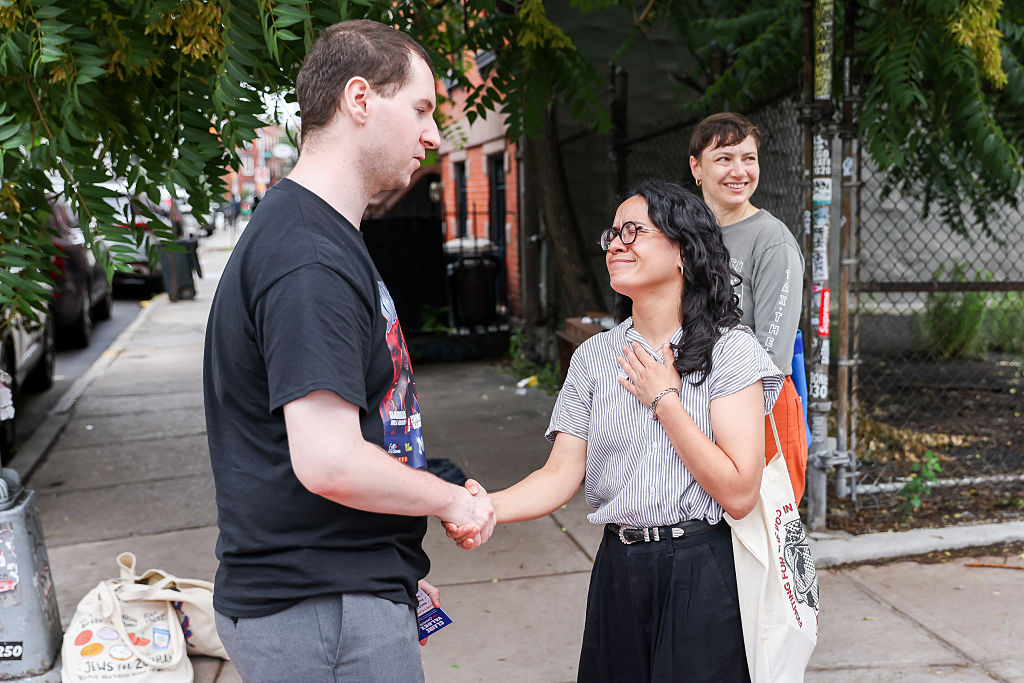
There are few better ways to test and develop socialist politics than by bringing them to voters directly, face-to-face. Basic democratic ways of doing politics are at the heart of socialist strategy today in the United States — and they’re working. (Michael Nagle / Bloomberg via Getty Images)
It feels good to be a socialist right now. Last year, Zohran Mamdani’s upset victory in the 2025 New York City mayoral election shook the political world at home and abroad. This June, New York City Democratic Socialists of America (NYC-DSA) won a near sweep in nine out of the ten New York City congressional and state legislative primaries that we ran in, along with an upset win in Buffalo and the unseating of a twenty-eight-year incumbent in Syracuse. Outside of New York State, we have seen victories in Philadelphia, Washington, DC, and most recently in Denver, where Melat Kiros defeated an incumbent who had held that seat longer than Kiros has been alive.
The political media has spent a lot of time trying and failing to explain DSA’s success, trying to place us as a left-wing Tea Party or arguing that we are riding the wave of anger among the Democratic base following the humiliating defeat of the party establishment to Donald Trump and the GOP for a second time in the presidential election of 2024. Others focus on the vertical videos and social media virality that did have a role in helping propel Zohran to Gracie Mansion and that have been aped ever since by candidates to our right, with little success.
Most of these arguments downplay one thing that you cannot explain the democratic socialist wave without: that we prioritize member democracy, where dues-paying members get a voice and a vote as to which campaigns we will endorse, electoral or otherwise. This is a model for the vision of democratic socialism we wish to build in the United States more broadly: namely, that those who labor have a right to control what they labor for.
I signed up for my first Zohran canvassing shift in January 2025, thinking that I would do a shift or two, complete my civic duty, and then go back to my usual routine. Within a few months, I became a regular canvasser, then a field lead for the Alexa Avilés city council campaign, knocking doors simultaneously for Avilés and Mamdani. When the primary ended, by then a member of DSA, I ran for and was elected to be a delegate to our national convention in Chicago, and a few months later to be the South Brooklyn branch representative to the Citywide Electoral Working Group.
I spent the winter, spring, and early summer of 2026 knocking doors for our socialist slate. In short order, I went from feeling apathy and depression after the 2024 election to becoming an active member and organizer internally to DSA and externally to the wider voting public of NYC.
It was not, contra the media’s new go-to line, due to one man’s incredible charisma. I like Zohran, but I don’t put too much stock in the personalities of individual politicians. The reason I became such an active member and organizer in DSA is that the Zohran campaign made me feel that by working in concert with a hundred thousand others, I had the ability to reclaim some small amount of control in shaping a world where political outcomes often seem predetermined by the powerful, with no role for the public to influence them.
Take It to the People
It is not easy to knock on a stranger’s door. It can be demoralizing. When people do open their doors, as often as not they close them just as quickly. On rare occasions, people will get downright rude or hostile. You knock in the rain, on days when any sane person would rather be indoors, and in the heat, when any sane person would rather be at the beach. Despite all the frustrations that come with it, there are few better ways to test and develop your politics than by bringing them to voters directly and making the case for the candidates running on a socialist platform.
We live in an intensely atomized society, and at no point have we been more alone than today, when the old bonds of community have largely eroded after decades of neoliberalism. In their place, we spend our free time in the online hyperfilter called the “For You Page,” which creates the illusion of community based in passive consumption of reels and posts. This is a major stumbling block to our socialist project. It removes us from physical community and creates the illusion that we can either scroll past politics or do our part solely through posting that has no follow-through and is not part of any organized strategy. Politics becomes a consumer choice, and in politics as consumerism, we allow ourselves to cultivate precise, specific, “correct lines” in our head about most issues.
It is when you are actually knocking doors that the politics that sound so convincing in your head and in your online echo chamber are actually tested. More often than not, they are improved as a result.
When I got involved in earnest with the Zohran campaign, I quickly realized that I was embarking on a grand tour of New York City; unlike the tourist, however, who experiences the city as a series of landmarks and attractions, my expeditions to the many neighborhoods of Brooklyn, Manhattan, and Queens led me to the doors of the working people who each have a hand in making New York function, and who were still stuck in uncertain conditions, squeezed by the hoarding of the immense wealth they create and maintain through their labor.
Still, despite the pressures created by an increasing cost of living without a commensurate increase in wages, it is not a given that somebody who is experiencing the same material squeeze as you are will accept as common sense your solution to the problem, and it is almost a guarantee that if one begins to describe the problem and the answer in the jargon-heavy way that is so common to the online left, you will fail to make much of an impression in the precious few minutes you have with a voter who you or the campaign may never reach again. In “Politics and the English Language,” George Orwell wrote, regarding this style of argumentation, “If one gets rid of these habits one can think more clearly, and to think clearly is a necessary first step toward political regeneration.”
You learn quickly therefore to do far more listening than talking, and when you talk, to talk simply. It sounds like common sense, but it is a practice that cuts against instinct. Politics is about persuasion, and persuasion is often interpreted as you pushing the correct answer (or “line”) on the voter. What is more important is to let the voter convince themselves: to let them tell you what is important to them and to only then tie that into the platform and make the connection clear.
When this is connected to a project of expanding the electorate instead of only trying to persuade frequent voters, at its best, the result is a feeling of equality and common cause between the canvasser and the voter: you knocked on my door, nobody ever knocked on my door before, and you brought to my attention a vision of politics which I hadn’t before been exposed to. I and others have even on occasion recruited people to DSA in this way, after winning a voter over to our candidates.
We Can Make a Different Path Forward
It is also something of a feedback loop, where the more one listens to people’s concerns at their door, the more a volunteer gets a sense of which parts of the platform are most relevant to different kinds of people and can bring that back to the campaign to better inform future canvassing and other forms of voter outreach. In that sense, it is an opportunity for democratic feedback from the public even before a candidate is elected.
While DSA did not invent canvassing, we are the organization that uses it most regularly and effectively to continue building power. A program of regular contact with voters through repeated canvassing, year after year, forces you to constantly be on the watch for how the political climate is shifting for the average person, and thus puts DSA, for whom a strong door-knocking operation is a core part of all their campaigns, in a better position to try and strategize ways to shape the constantly shifting common sense of politics to the benefit of the movement.
This is not a purely urban phenomenon, as evidenced by some of our victories in districts that include suburban and exurban areas, as well as smaller, more conservative cities. It is something that I believe can be scaled and adjusted to any district if the underlying conditions for a socialist candidacy are right.
Some on the Left who are outside of DSA criticize our prioritization of electoral politics, arguing that this is a strategy that lends itself to a moderation unsuited to the drastic need for change as we face down a degrading capitalism, buffeted by the climate crisis and buttressed by far-right political movements at home and abroad. On the contrary, it is a necessary and a profoundly radical experience to go to people who are not intimately familiar with left political theory, and to get the chance to speak with them about how the many-faced crisis of capitalism strains their own lives. It is also surprising and reassuring to realize, in the course of these conversations, how many people are already able to connect the dots — even if they do not put them in theoretical terms — between the United States’ violent foreign policy abroad and the abandonment of its working class at home.
In doing so, we can sidestep the conventional wisdom that the political and media establishment have spoon-fed us for the better part of the past forty years. We are also at the personal level able to understand that we are not alone in our anxieties and fears over the direction the world is moving in; that many others, in fact a majority, feel the way we do, and that through collective action we can make a different path forward for ourselves.
That same political and media establishment, here localized in New York City, has spent every moment since June 2025 attacking the mayor and his supporters and voters as out-of-touch transplants who could never dream, first of winning a majority, then of running a city sure to reject them. Unlike our opponents, we made our case directly to the people and won them over door by door with a volunteer army. Along the way, we convinced thousands of those voters to join our movement for democratic socialism. Now they are in turn empowered further to take control of their own lives through collective action, whether they are out knocking doors themselves, organizing their workplaces or their buildings, and finding other ways to strengthen community through activism.
Both the Democratic establishment and the GOP continue to fear this kind of democratic engagement. But DSA will continue to put democratic dialogue with the working class at the core of its political strategy. We do so because we believe in democracy. That belief has worked out pretty well for us thus far.