UAW Region 9A’s Big Risks in NYC’s Elections Paid Off
While most unions played it safe in New York’s recent elections, UAW Region 9A and its director, Brandon Mancilla, took big swings in supporting progressive and socialist insurgent candidates like Claire Valdez and Darializa Avila Chevalier — and won.
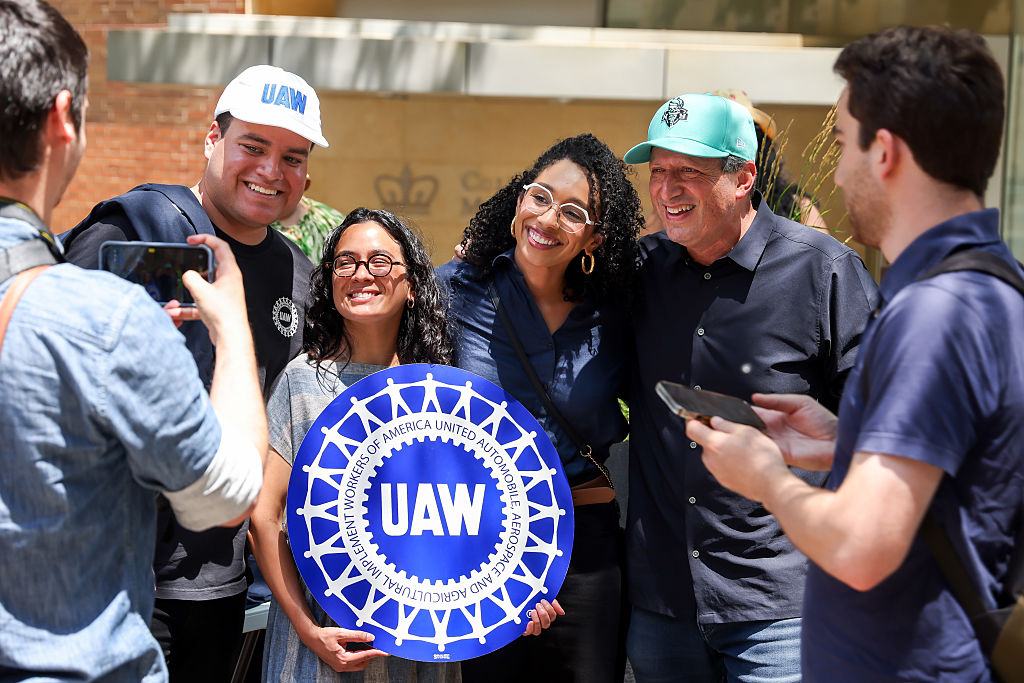
Brandon Mancilla, Claire Valdez, Darializa Avila Chevalier, and Brad Lander particiapte in a rally with Columbia Postdoctoral Workers (CPW-UAW Local 4100) at Haven Plaza at Columbia University Medical Center in New York, on June 30, 2026. (Michael Nagle / Bloomberg via Getty Images)
Brandon Mancilla is very happy.
For the United Auto Workers (UAW) Region 9A Director and a Democratic Socialists of America member, June’s New York primary elections were a massive success. Speaking with Jacobin a week later, hours before a rally supporting Columbia University postdoctoral workers, the victory was still fresh.
“Going into 2026, there were zero UAW 9A members in Congress. At the start of 2027, we will have two,” he says proudly, referring to Claire Valdez and Darializa Avila Chevalier. Both had just won congressional primaries after running insurgent campaigns where their main opponents — Antonio Reynoso and Adriano Espaillat, respectively — had received the vast majority of organized labor’s endorsements and support.
Mancilla and 9A broke with that trend and backed both Valdez and Avila Chevalier, as well as Brad Lander, the progressive former New York City comptroller, mayoral candidate, and Zohran Mamdani ally, and Alex Bores, the NY assemblymember cum AI regulatory crusader.
“In the UAW and in Region 9A, we are building a political program that starts with the question of who has the power. Do we simply try to get a slice of the pie in a society where billionaires continue to amass unchecked influence and obscene levels of wealth?” Mancilla says. “Or do we rebalance power in favor of workers so we can win fair wages, job security and work-life balance, universal health care, retirement security, and so much more?”
By repeatedly supporting challengers, the union has been an outlier among other regional unions who tend to pursue more incumbent-supportive strategies.
This cycle, for example, the New York State AFL-CIO endorsed in seven congressional races, winning only three — all of whom were incumbents. UAW 9A, meanwhile, endorsed five candidates, four of whom won, with only one, Rep. Alexandria Ocasio-Cortez, being an incumbent. In the four congressional races in which the UAW 9A endorsed nonincumbents, it supported candidates without the most labor endorsements in three. And for one candidate, Avila Chevalier, UAW 9A was her only union endorsement.
To Mancilla, the union’s successful strategy can be broken down into a few components.
“Very early on, [we realized] that we needed to have a political program. . . . that was rooted in our fights, held our electeds in the different cities and states accountable, and also brought in the membership into every single one of those decisions,” he says. “That meant, number one, that our endorsements would be earned, and our political program would be just as concerned with issues and a program and building coalitions with social movements and other organizations as it was with endorsements of political politicians and individuals who run for office.”
Secondly, “it also meant that we believed that we needed to recruit from within our own membership to run for office,” Mancilla says. “Union candidates, folks who have cut their teeth in the labor movement, who have been on strike, who have led local unions who have been involved in big organizing fights are also incredibly important to building working-class politics and working-class political culture because people look to those folks as organic leaders.”
It was this rubric that pushed the union to support Zohran Mamdani’s 2025 mayoral run, a series of insurgent state legislative campaigns also backed by the New York City Democratic Socialists of America, and especially Claire Valdez’s 2024 NY State Assembly and 2026 congressional campaigns.
“Claire is one of us. She’s done everything that we ask our members to get involved and do at their workplace, in their local; she promotes and centers the labor movement and organizing specifically, even more importantly than just the labor movement, but the fact that we need to organize density in this country. She centers labor in every single one of her speeches and events and campaigns,” Mancilla says. “And yet, both times, she has not received in the primary the state American Federation of Labor-Congress of Industrial Organizations’ or the city Central Labor Council’s endorsement. That’s what we have to change.”
For Mancilla, for too long, the labor movement has thought in terms of short-term gains and survival. That defensive crouch has convinced many that maintaining existing relationships with incumbents should guide their political involvement, whether or not such relationships go beyond surface-level political support.
“I think individual unions may have their own calculations and decisions for why they back one candidate or the other,” he says. “But taken as a whole, unless something truly egregious has happened, there’s a real [hesitancy] to break with the incumbent.”
Mancilla’s own background hints at an evolution that the UAW has undergone over the past thirty years. He is a third-generation union worker in a family of Guatemalan immigrants whose father works as a unionized building handyman with 32BJ Service Employees International Union, and his grandfather had a union manufacturing job at a labeling plant on Long Island.
“I was able to grow up understanding the importance of unions because of my family’s experience,” he says. “I grew up with better health care. My family was able to earn enough savings to be able to buy a house in the ’90s in New York City — something that’s unthinkable right now for working-class families. We were able to have some retirement savings and just basically enjoy a life of a little bit more dignity and comfort — with many challenges within it, but still a little bit more than a lot of other undocumented Guatemalan families.”
Unlike his father and grandfather however, Mancilla was brought into the labor movement through its outreach to white-collar workers. Shortly before Mancilla arrived at Harvard University to pursue a PhD in history in 2017, the UAW had attempted to set up a graduate student workers local, only to lose the organizing election. A ruling by the National Labor Relations Board (NLRB) would subsequently reorder a rerun due to enough workers being left off the eligible voting list. Mancilla threw himself into the work. The rerun proved successful, and a subsequent strike helped him cut his teeth. By 2020, Mancilla had been elected the local’s first president.
Mancilla’s work at Harvard means that he shares a key experience with Valdez and Avila Chevalier as well as thousands of a new generation of UAW members. Both women joined the UAW as members of locals tied to nonmanufacturing work. Valdez was a rank-and-file organizer at Columbia University with UAW Local 2110, which represents technical, office, and professional workers. Avila Chevalier was a member of UAW Local 2325 (Association of Legal Aid Attorneys), where Mancilla also worked as local staff organizer, though the two did not overlap.
In 2016, the UAW won a landmark case before the NLRB that “graduate assistants, and other student teaching and research assistants, were employees with a right to unionize.” The decision set off a series of unionization drives across the country which brought in thousands of workers at higher education institutions. Just seven years after the ruling, National Public Radio estimated that those workers accounted for almost one in four UAW members.
These changes have been especially important for Mancilla’s Region 9A, which covers eastern New York, Connecticut, New England, and Puerto Rico. The 2016 case itself stemmed from organizing the UAW had been doing at Columbia University in New York City. The increased presence of UAW organizers on campuses has also placed the union within conversations about academic freedom and free speech protections, especially following the sustained crackdowns against pro-Palestine protesters.
In 2024, thousands of UAW-affiliated workers in the University of California system went on strike over how administrators had reacted to pro-Palestine protests. In March 2025, Columbia University expelled, and by extension fired, Grant Miner, president of the UAW local representing the university’s student workers, over his actions during the 2024 student encampment and occupation. And at the national level, there are allegations that the federal monitor, instituted to enforce a 2021 consent decree between the UAW and the government and oversee anti-corruption efforts in the union, has unduly used its powers to retaliate against union President Shawn Fain due to the latter’s stance on Palestine.
The union’s pro-Palestine stance has also been reflected in 9A’s political endorsements. At the congressional level, opposition to Israel’s genocide in Gaza played a major role in the campaigns of Lander, Valdez, and Avila Chevalier. In their state legislative endorsements, UAW 9A also supported Aber Kawas in her successful state senate bid. Kawas helped write the “Not on Our Dime” Act introduced by Mamdani during his time in the New York State Assembly, which aims to prevent New York–based charities from financially supporting groups involved in Israeli war crimes.
“As a union, we’ve got to keep acting in solidarity with not just Palestine, but any group of people that’s been oppressed, no matter how much money and power is trying to tell us to not do that anymore,” Mancilla says.
With the primaries behind them, UAW 9A is looking at what might come next. In the short term, they’re focused on winning a contract for the roughly nine hundred workers at the Metropolitan Museum of Art, Mancilla says. Past that, the union is preparing for May Day 2028 — the day when several of UAW contracts are set to expire, including those with the “Big Three” auto makers. President Fain has urged other unions to set the date for their own contract expirations and hopes to rally enough unions to credibly threaten a general strike.
2028 is also, obviously, a presidential election year — though Mancilla made clear that it’s too early for the union to be considering who to endorse. However, he says, “We have made it clear what our priorities are and what the different candidates have to be serious about in order to earn our endorsement in 2028.”