Claire Valdez on Taking the Mamdani Coalition to Congress
In New York’s “Commie Corridor,” democratic socialists have built the most advanced electoral beachhead in the country. Claire Valdez’s run for Congress tests whether that power can scale nationwide.
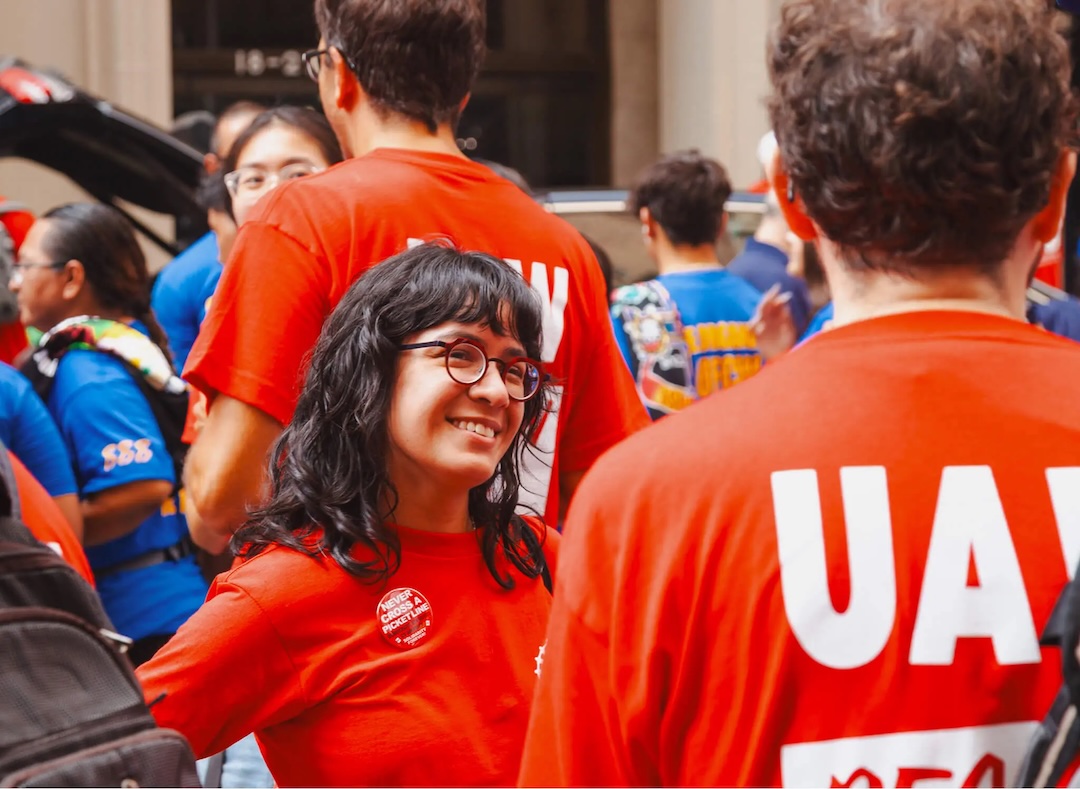
In Claire Valdez’s campaign, the New York City Democratic Socialists of America chapter is testing whether its organizing model can reshape Congress. (Kara McCurdy / Claire Valdez for Congress)
- Interview by
- Daniel Denvir
New York City’s “Commie Corridor” has become the beating heart of the country’s resurgent socialist left — the place where tenant organizers, young workers, and Democratic Socialists of America (DSA) cadre have turned one of the most expensive cities on Earth into a proving ground for class politics.
Fresh off the shock wave of Zohran Mamdani’s mayoral victory, Assemblymember Claire Valdez is now running to take that fight to Congress in New York’s Seventh District. In this interview, Valdez reflects on the organizing traditions that shaped her, the power New York City DSA has built in western Queens and northern Brooklyn, and what it means to carry a democratic socialist mandate into the federal arena.
This conversation between Daniel Denvir and Claire Valdez was recorded for the Jacobin Radio podcast The Dig. You can listen to the episode here.
Daniel Denvir
You’re running for the US House seat in the most famous socialist bastion in the country — New York City’s so-called Commie Corridor. What sort of significance does that carry, both for your campaign and, if you win, for how you operate in office?
Claire Valdez
For those who don’t know, the “Commie Corridor” is western Queens and northern Brooklyn. It was a district that voted overwhelmingly for Mayor Zohran Mamdani in the Democratic primary in 2025 and has elected democratic socialists at the state level as well — so, territory that is very favorable to us.
It’s a very tenant district. It’s a very young district. It’s a very diverse district. It [presents] a real opportunity for the Left and for democratic socialists to lead at the federal level. This is an opportunity for us to be the tip of the spear in fights around international solidarity, housing, tenant protections, climate change, and workers’ rights.
Daniel Denvir
What does your campaign look like on the ground?
Claire Valdez
We’ve got 1,200 volunteers and a hundred field leads. We have everyday people coming out to knock doors, and then we have layers of leadership beyond that, people who organize the canvasses, people who organize those people, and so on.
It’s a ladder of leadership and engagement that I traveled through as a member of New York City DSA. I started knocking doors for Bernie. I was a field lead on a different campaign and then a field coordinator — the same organizing operation that we have in this campaign. Something that’s so essential to me, and so essential to our movement, is that we’re training up organizers who will take this fight beyond this campaign. Because certainly the fight for the working class is not done on June 23.
Daniel Denvir
How has Zohran’s victory, the fact that he’s now Mayor Mamdani, changed the political reality for DSA candidates like you and so many others running across the city right now?
Claire Valdez
We’re being contended with as serious challengers and as serious power players in New York City. I joined DSA in 2019, as a door-knocker. I ended up in DSA leadership, and I spent the last few years of my life doing onboarding for new members, developing DSA 101s, welcoming literally hundreds and hundreds of members into this organization and trying to inspire them and motivate them to take their political power into their own hands.
Winning the mayor’s race is the result of so many people’s work over these many years, demonstrating that real political power can come from everyday working people who are ready to organize together. Obviously, there’s a lot more attention on these races because now we’re contesting establishment power, and this is a real test of the organization’s strength. We’re running many different races this year, including my own. But it’s a really exciting moment, and I think we’re being taken seriously in a way that we should’ve been for many years.
Daniel Denvir
Nothing causes people to take you seriously more than beating them. Let’s talk more about your experience in NYC-DSA, because you come into running for office not as one of these people who’s been planning on running for office since they were six years old, but as someone who’s done a ton of the hard, unglamorous work of organizing.
Claire Valdez
I spent a couple years as New York City DSA’s chapter membership coordinator. I found it to be profoundly joyful and beautiful work and also incredibly challenging, because — as I’m sure you have experienced — it is hard to just take somebody who walked in off the street, who is really excited about the idea of this project, and find a place for them to do meaningful work.
What I learned over the years of doing this in partnership with many other incredible comrades and organizers in New York City DSA, in the membership committee, is that the social component of this work is profoundly important. I think people come to DSA because they want to get involved. But oftentimes, I don’t even know what that means when [people] say “get involved.” They want to feel like they have a meaningful place in this very alienated and strange world we all live in.
So much of that is just about having true and deep and meaningful social bonds with other people. So, we really foregrounded Magic: The Gathering nights, and soccer, and movies, and finding places for people to connect with their neighbors and form those meaningful connections. Because the thing that motivated me to do this for the many years I was in DSA — going out and knocking on doors when it was 100 degrees or snowing or raining — it was obviously that I believed in what we were doing, but it was also that I knew people were counting on me. I knew those people, and we had been organizing together, and I cared about them. And at the end of this grueling shift, we’d go to the bar, or we’d go to Nowadays and hang out.
In doing that, you identify people who continue to show up. You identify people who seem like they want to pitch in more. Those are the folks you ask, “Would you be willing to be a field lead? Would you be able to be a field coordinator? What about running for internal leadership positions?”
Daniel Denvir
It can be brutal and, on some days, make people feel pessimistic.
Claire Valdez
Absolutely. And people come to this work because they found hope in a moment, at least a moment, to click a link and go to the thing, and so we have to sustain that.
Daniel Denvir
One of the key things that I’ve thought about over the last six years of building organization in Rhode Island is that I feel like we’ve had a solid portion of the population in the state that’s agreed with our values and principles and program. But what changed is the rise and fall in people’s belief that there’s efficacy in their taking action. Last year, it got hard — not because people turned away from the values but because they were pessimistic that putting those values into action would do anything.
Claire Valdez
I had a very similar experience in New York City DSA. We won this enormous slate of folks, including with Zohran Mamdani in 2020, and then we picked up a few seats in between then and last year, but there were a lot of losses. Pushing through the demobilization was really challenging, especially at a moment when we had elected Joe Biden, and things were fine; I think we all experienced a pre–October 7 Biden.
Then of course the genocide began. I think the work that we have to do is maintain the organization such that, when there are these moments when political activity is required or organization is deeply required to counter a genocide, to defeat a fascist, that we’re ready — that people are ready to plug back in and go to the streets, go to the doors, run for office, and challenge the political status quo.
Daniel Denvir
I want to talk about the United Auto Workers (UAW). You started off as a clerical worker at Columbia University. And you became a UAW member. Then you became a leader in United Auto Workers for Democracy (UAWD), which played a big role in getting Shawn Fain elected president of the union. I want to get into how you think about left labor politics, but first, how did you get into it in the first place?
Claire Valdez
I moved to New York to work in the arts and because I wanted to be an artist. That is really hard in anywhere in the world, but especially in New York City. So I worked at a small museum for a number of years and then went to work at Columbia in their visual arts program, in large part because I just wanted some work-life balance so I could pursue artistic passions.
The job ended up being unionized. It’s unionized through UAW Local 2110. It was organized in the mid-to-late 1980s, largely by women of color who were fighting for pay parity and childcare. That was my first time experiencing what the life of a union member is — getting out of work at five o’clock, getting overtime, getting lunch breaks, all the absolute bare minimums of what we should expect as workers.
But it was this totally new world for me. It was so liberating to know that I wasn’t alone in the workplace — that I had five hundred coworkers to stand alongside — and it’s so powerful. So I got involved. I’d been paying attention to the one member, one vote referendum, and then I was asked by a coworker to join our bargaining committee in 2022.
So I was on the negotiating team against Columbia, and wow, what a radicalizing experience — to sit across the table from a $14-billion-endowment institution. And then I ran for unit chair, to be the steward of stewards at the university. It was great. It’s incredibly hard work handling grievances, sitting with your members during disciplinary meetings. Management at Columbia is not, as you can imagine, very keen on honoring our contract.
Daniel Denvir
What’s your assessment of the current state of the relationship between the organized socialist left and organized labor?
Claire Valdez
I think the relationship can be very fraught. Sometimes it works very well. In New York City, I’m always very proud when DSA can turn people out to picket lines and help sustain them. During the New York State Nurses Association (NYSNA) strike earlier this year, we were able to get members out and help out there. When we can show up for our union siblings in visible ways and provide them real material support, I think that relationship can be built up, and that’s something that we’re very committed to working on within New York City DSA. So more of that relationship building needs to happen.
I think there’s this sense that we’re new on the scene, and we think we know everything. Being humble and approaching union members — who honestly have been organizing their entire lives, in all kinds of difficult political environments and in all kinds of challenging moments — I think approaching that with real humility is important because there’s a lot to learn our friends in the labor movement.
The UAW went through this transformation a few years ago. We rooted out the corruption; we’ve elected Shawn Fain and others who are democratizing the union and looking to membership for guidance in the way that we’re moving as a union. Some unions need a little bit more democracy. We need some members to do some organizing to challenge the status quo. We can shake off a little bit of the hesitation, I think, to make big swings to advance new organizing and to challenge the Democratic Party. There are a lot of fronts [where we can push] membership to take some leadership in this moment.
In my campaign, we have an affinity group called Labor for Claire. It’s rank-and-file members from unions all over the city who are coming out to canvass. It’s because, I think, they see this as an opportunity to organize with their coworkers, and I hope that we can get more folks out to do exactly that.
Daniel Denvir
What’s your theory on how to be a left-wing socialist member of the US House of Representatives? How do you balance being a clear, outspoken tribune of the Left with organizing a broader progressive caucus of liberals?
Claire Valdez
This is something that we do every day in the New York State Assembly and Senate. I am very proud to be a member of the Socialists in Office Committee here in New York State. We have nine representatives between the assembly and senate, and this is a balancing act we have to do all the time: taking hard votes and figuring out when we’re going to take positions that we will absolutely lose on but that are important signs of where we stand as democratic socialists. And winning as much as we can and understanding where the limits of our power are as an absolute minority within both of our [legislative] bodies.
I think this is why this race is so important. This is one of the most progressive, democratic socialist districts in this country, if not the most. We have the opportunity to win a seat, and I know that we can lead, that we can carve out a future for the democratic socialist left in the United States, that we can be bold, that we can be brave, that we can speak truth to power, and use the bully pulpit of the seat to advance a vision of a world that actually works for working people — that challenges the donor class and the billionaire class, that takes on the military-industrial complex, and much more.