Claire Valdez’s Bold Program for Labor in Congress

New York congressional candidate Claire Valdez just announced an ambitious pro-labor policy agenda, including labor law reform, ending at-will employment, and a federal jobs guarantee. Everyone who is hoping to revive labor’s fortunes should take note.
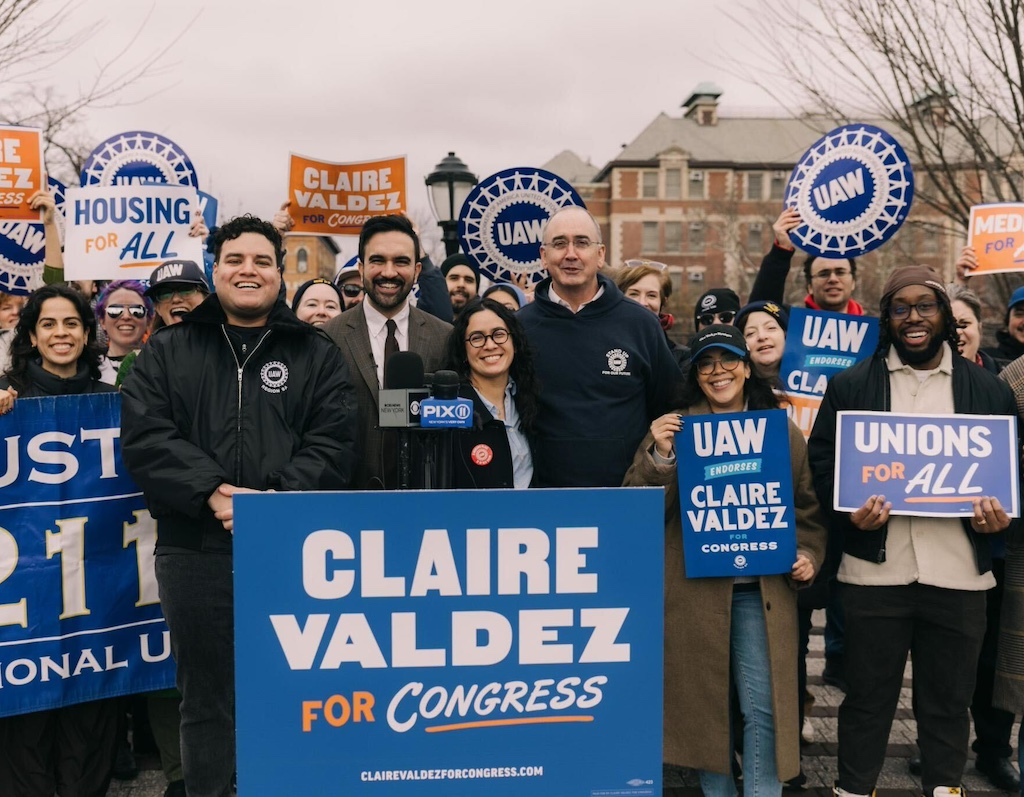
Socialist Claire Valdez, who is running for New York’s Seventh Congressional District, is advocating an ambitious pro-labor policy platform. (Courtesy of Scott Heins)

Labor law reform. Ending at-will employment. A federal jobs guarantee. A four-day workweek. Guaranteed paid family, medical, and sick leave and vacation. Medicare for All.

This list reflects the ambitious, long-standing policy goals of the labor left — goals that many have given up on after decades of demoralizing neoliberalism. It also happens to be a collection of highlights from socialist congressional candidate Claire Valdez’s labor policy platform, just released today.

Valdez, a New York State Assembly member who is now running for the Seventh Congressional District, is also calling for federal government support for new union organizing, legalizing strikes for federal employees, implementing pro-worker trade and industrial policy, raising the federal minimum wage, and expanding unemployment insurance. She is casting the proposals as furthering three goals: to establish “unions for all,” to “empower workers and end corporate dominance,” and to guarantee everyone the “freedom to live a good life.”

It is a bold list of demands. If just a portion of the agenda were passed, it would mean a major shift of power and income away from capital and the ultrarich toward working people.

“I see my role as a legislator right now in the assembly, but hopefully someday in Congress, as making the terrain fertile for new organizing and for workers to be as powerful as possible,” Valdez told Jacobin. “This platform, talking about a federal jobs guarantee and a four-day workweek, wresting power back from billionaires and bosses and corporations that have taken so much of our free time and energy, so much of our wages and basic dignity on the job — it’s essential to building the world that we need.”

It is also significant that Valdez, who has been endorsed by Bernie Sanders, Democratic Socialists of America (DSA), and Mayor Zohran Mamdani, is foregrounding support for unions and framing many of the policies as aimed at empowering workers to organize and stand up to their bosses. And while Sanders’s presidential campaigns captured the imagination of a nascent new left with redistributive demands like single-payer health care, free public college, and student debt cancellation, Valdez’s platform gives equal prominence to “predistributive” measures to, e.g., increase wages, create jobs, and give workers more leverage at the point of production.

Democratic Socialists and the Labor Movement

Valdez comes out of the labor movement. As a Columbia University employee, she was a member of United Auto Workers (UAW) Local 2110, an amalgamated union representing technical, office, and professional workers. She was eventually elected to her unit’s bargaining committee and participated in the reform movement that ousted the undemocratic Administration Caucus and elected Shawn Fain as president in 2023, setting the stage for the union’s historic “stand-up strike” against the Big Three automakers later that year. Fain, too, has endorsed Valdez.

Valdez credits her experiences working low-wage jobs and then organizing in a union with getting her into politics.

“I come out of the labor movement. I found my power in organizing with UAW Local 2110 in bargaining and defending my coworkers in grievances,” she says. “I believe strongly in the potential for a union to transform a worker’s life and the profound necessity of a strong, militant labor movement in transforming our society, in building democracy, and winning an affordability agenda.”

She is also a longtime leader in DSA, which backed her 2024 run for state assembly. Valdez’s emphasis on unions — and her own background in the movement and connection to Fain, one of its most important leaders — could represent a new kind of connection between the socialist group and organized labor.

Yet it is only in recent years that the socialist left has begun to focus on rebuilding and rooting itself in labor unions, and most unions do not see DSA as a natural partner. The Seventh District race is a case in point. Valdez’s Democratic primary opponent, Brooklyn Borough President Antonio Reynoso, has received far more union endorsements. That is likely a function of unions’ natural risk aversion and Reynoso’s being more of a known quantity in New York politics: he was city councilor from 2014 to 2021 before becoming borough president, and he has the endorsement of the district’s long-standing incumbent, Rep. Nydia Velázquez, and other high-profile New York public officials like Attorney General Letitia James and Congressman Jerry Nadler.

Asked about Reynoso’s stronger union backing, Valdez said, “I’m running for this seat because so much of our federal policy has to change around labor law and supporting organizing workers and giving workers a seat at the table,” she said. “That will continue to be my motivation, regardless of where endorsements fall.”

The Left still has a long way to go in convincing labor to get behind it. But socialists in New York have recently made some big strides on this front, most notably through the Mamdani campaign, which saw a surprising number of unions come around to the insurgent (especially after he beat Andrew Cuomo in the Democratic primary). And if left-wing elected officials like Mamdani and Valdez can successfully govern in a way that serves labor’s interests, that will likely get more unions on board.

Capitol Hill and the Shop Floor

It’s heartening to see a congressional candidate championing collective bargaining rights and bold economic reforms that would address staggering inequality and that are widely popular with voters. The big question is whether and how such policies can be enacted. The odds of passing legislation that would seriously threaten major corporations and the ultrarich look very long, even if Democrats manage to regain control of Congress and the White House by 2028.

Take labor law reform, for example. Both Barack Obama and Joe Biden campaigned on reforms to make it easier for workers to organize: the Employee Free Choice Act (EFCA) in Obama’s case, the PRO Act in Biden’s. And both presidents began their terms with Democratic majorities in both houses of Congress (during part of Obama’s first year, the Democrats even held a supermajority in the Senate). Yet labor law reform never happened, at least in part due to Democratic leaders’ neglect of the issue.

Valdez was part of the reform movement at the United Auto Workers that elected Shawn Fain as president in 2023. (Courtesy of Emily Minster)

A lot would need to change in Congress, and in the Democratic Party, before Valdez’s agenda has a real shot at being passed. And some momentum for that change might need to come from outside the electoral arena. The American left and unions today find themselves in the odd position of trying to pass major reforms in the absence of a militant working class or a strong labor movement, reversing how things generally went in advanced capitalist countries in the twentieth century. Back then, social democratic parties used the economic and social leverage granted by mass bases in powerful unions to win generous welfare states and exert some measure of control over the economy as a whole.

The United States never had such a party, nor as powerful a labor movement as most of the rest of the developed world. But the limited social democratic reforms American workers did win, including Social Security and the legal codification of collective bargaining rights, were closely related to a dramatic upsurge in left-wing organizing and workplace militancy during the Great Depression.

Now, after decades of unions being hollowed out and a resulting decline of working-class influence over politics, labor advocates and socialists are attempting to use whatever means they can to reverse labor’s decline, including both electoral action and grassroots organizing like the Emergency Workplace Organizing Committee (EWOC), a joint project of DSA and the United Electrical Workers that offers support to new organizing drives — Valdez’s labor platform calls for federal support for projects like EWOC — as well as the Rank and File Project, an effort by DSA members and fellow travelers (which I myself am involved in) to build a layer of socialist militants in existing unions, and DSA-supported efforts to “salt” nonunion companies like Amazon and Starbucks.

“Part of this is about raising workers’ expectations and resetting the terms of how we talk about where workers and the labor movement fit into our political environment. This will take time,” Valdez says of her campaign. “We can point to four-day workweek pilots that have happened around the world that have been successful; we can point to good data. And we might be able to advance things like updating unemployment insurance benefits or stronger AI regulations [in the near term] as we build toward something like the PRO Act or a federal fund for new organizing.”

Valdez hopes that grassroots organizing efforts and campaigns like hers can be mutually reinforcing. “We need a thriving labor movement to win some of these demands. And winning these demands will help build a thriving labor movement. We have to do both at the same time.”

If she wins, Valdez plans to find ways besides legislation to support labor organizing. “I intend to stand with workers in all of their fights, to go to bat for workers that are trying to unionize or fight for a first contract or fight for a tenth contract,” Valdez tells me:

That can look like using the bully pulpit to advance new legislation, or just popularizing ideas like a four-day workweek or a federal jobs guarantee. Or it can mean standing with workers who are going out on strike and walking the picket lines with them.

The path to badly needed reforms like a jobs guarantee and Medicare for All, and the revival of the labor movement, is still hard to discern. But we do know that the continuing aftershocks of Sanders’s class-struggle presidential campaigns have inspired a new generation of union activists, as well as a left-wing electoral renaissance that made a socialist mayor of the United States’ largest city. We know, at least, that it helps to have more politicians planting the flag for labor.

“For so long, the federal government has claimed to be a neutral arbiter [between workers and bosses], but it hasn’t been,” Valdez says. “And we should be really aggressive about supporting workers wherever they are trying to win a better life for themselves and their coworkers and their families. For me, the primary purpose of being in Congress would be building and supporting a labor movement that’s ready to fight for things like Medicare for All, for pensions for all, for more time off.”