Unions and the Working Families Party Bet Against the Future Again
In New York City, leaders of unions and nonprofit groups like the Working Families Party again picked the losing, old-guard side in last night’s elections. How long before these leaders get on board with the future of working-class politics?
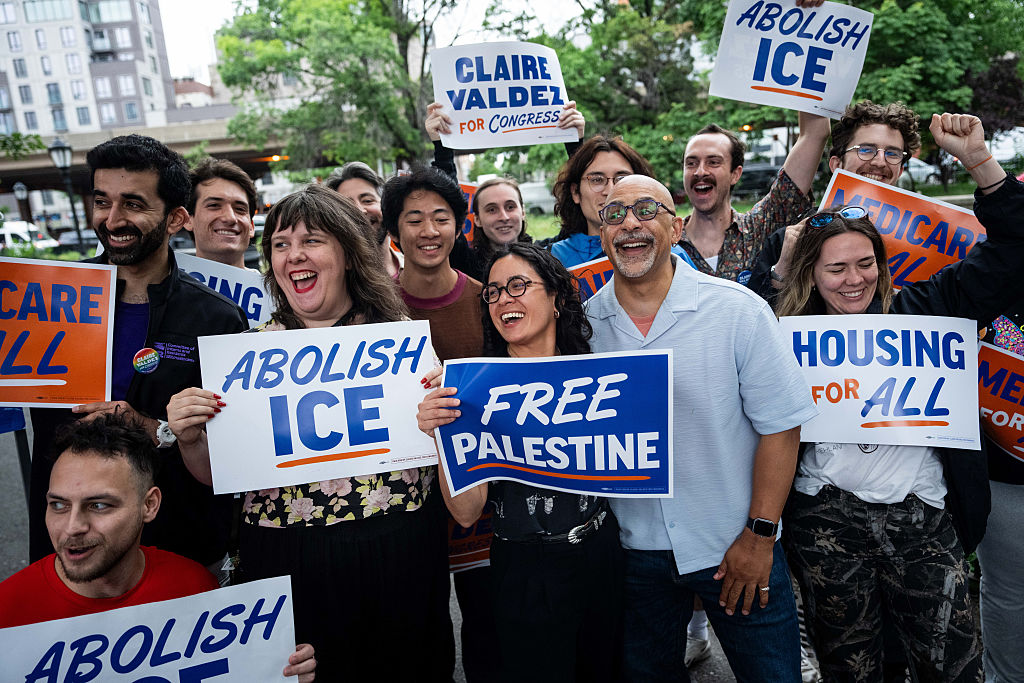
Even on self-interested grounds, savvy union and nonprofit operators should start reading the room. Last night’s New York election results show that backing old-guard politicians over the rising socialist movement is no longer a risk-averse, pragmatic wager. (Adam Gray / Bloomberg via Getty Images)
Last night, New York City’s labor and nonprofit leaders got a brutal reminder that they no longer politically speak for the working class they claim to represent.
In the city’s two marquee congressional primaries, candidates backed by labor’s biggest names — the Service Employees International Union 32BJ and 1199, District Council 37, the Hotel and Gaming Trades Council, the United Federation of Teachers, and others — went down in defeat. In the first of these primaries, Congressional Hispanic Caucus Chair Adriano Espaillat, a corporate Democrat who racked up some fourteen union endorsements, lost his Upper Manhattan and Bronx seat to Darializa Avila Chevalier, a thirty-two-year-old democratic socialist insurgent backed by Mayor Zohran Mamdani, the New York City Democratic Socialists of America (NYC-DSA), and Justice Democrats.
Delivering Avila Chevalier the biggest congressional upset since Alexandria Ocasio-Cortez’s win in 2018, District 13 voters showed that they no longer trust a Democratic establishment unable or unwilling to seriously challenge Donald Trump and an oligarchic status quo. Yet most union and nonprofit leaders haven’t yet followed their lead. And it’s a sign of dramatic internal decay that these organizations, so powerful on paper, can now deliver so little in the way of actual votes.
No less significant was the race in Brooklyn’s District 7. In a battle for the mantle of New York City left politics, the race pitted Brooklyn Borough President Antonio Reynoso — backed by a nearly identical union roster, the Working Families Party (WFP), and the city’s alphabet soup of progressive nonprofits — against union activist and DSA cadre Claire Valdez. By delivering an unexpectedly decisive victory for Valdez, Brooklyn voters put a lie to cynical claims about community representation against white gentrifiers: she swamped Reynoso 56 percent to 36 percent.
Faced with an era of crisis and anger at the status quo, working people of all backgrounds are increasingly tired of old-guard politics, in both its corporate-Democratic and nonprofit-industrial-complex varieties. How long before union and nonprofit leaders get this?
We saw this same movie play out in early 2025, when most of the city’s union leadership lined up behind Andrew Cuomo — a serial harasser they’d demanded resign four years earlier — and watched Mamdani beat him anyway. (WFP, to their credit, endorsed Mamdani in the race.) Similarly, the WFP and nonprofit leaders’ decision in February 2026 to endorse Reynoso over Valdez — thereby overruling the votes of their own on-the-ground members — gave strong echoes of the WFP leadership’s controversial decision to endorse Elizabeth Warren over Bernie Sanders in 2019, as well as its decision to back Joe Crowley against Alexandria Ocasio-Cortez the year prior.
Again, only a tiny handful of unions had the political courage and conviction to stand up for transformational change. It is to the credit of United Auto Workers (UAW) Region 9A, led by Director Brandon Mancilla, that it fought so hard for both Valdez and Avila Chevalier. As UAW President Shawn Fain put it at Valdez’s January 9 campaign launch event: “This is exactly how the labor movement can fight back against corporate greed and inequality: by electing more of our own.” (Claire was also endorsed by the International Federation of Professional and Technical Engineers and the American Federation of Government Employees, as well as by the left-led South Asian nonprofit DRUM Beats.)
There are strong moral and political reasons why unions and progressive nonprofits would start backing viable fighters for the pro-worker, anti-billionaire agenda that socialists are championing: such politics can deliver the type of change working people desperately need and, in so doing, provide a viable alternative to Trumpism.
But even on purely self-interested grounds, savvy union and nonprofit operators should start reading the room. Backing old-guard politicians is no longer a risk-averse, pragmatic wager.
Union and nonprofit leaders blew it in early 2025, and again in this 2026 cycle. It remains to be seen whether they’ll do so again in 2028 when faced with a possible Alexandria Ocasio-Cortez presidential run.
The movement of the future is being built with or without these labor and NGO officials. The open question is whether they’ll finally jump on board — or get run over.