Keir Starmer Has Paved Nigel Farage’s Path to Power

Phil Burton-Cartledge

The right-wing party Reform UK outperformed Labour in elections this month across Britain. Labour has mainly been shedding support on its left flank, but the party’s current leaders have no desire to win those voters back with left-wing policies.
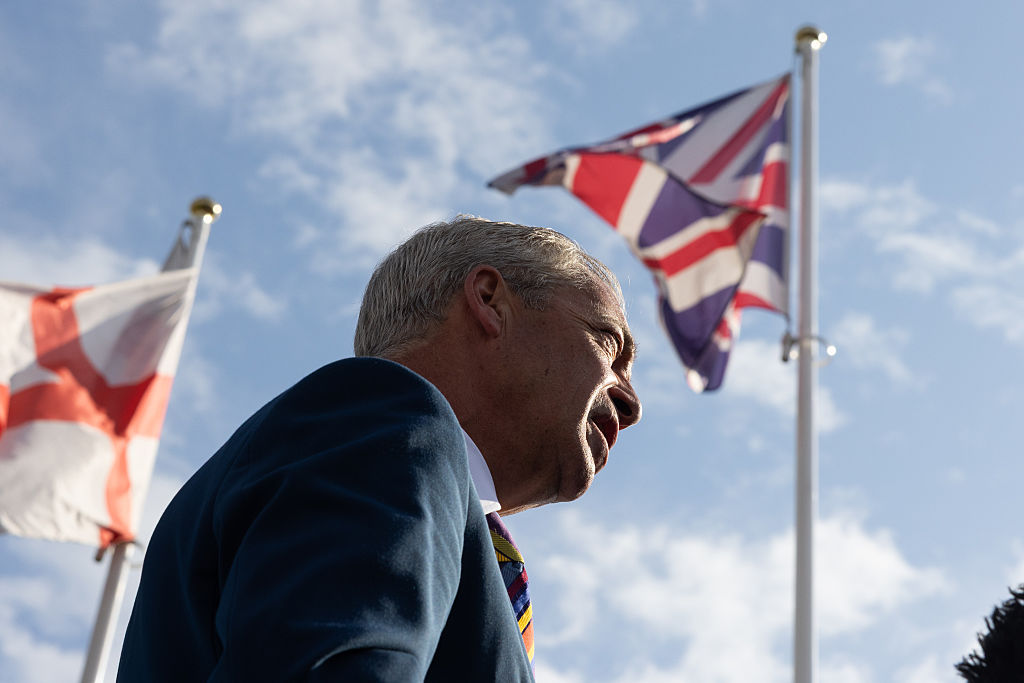
Reform UK leader Nigel Farage outside Havering Town Hall following the local election in Romford, UK, on May 8, 2026.

Nigel Farage’s Reform UK topped the poll in England’s local elections and made big gains in Scotland and Wales. Keir Starmer should have taken responsibility for the fiasco, but he’s still trying to cling on to his job as Labour leader. (Chris Ratcliffe / Bloomberg via Getty Images)


Interview by
Daniel Finn

Britain held local and regional elections earlier this month that proved to be catastrophic for the Labour government of Keir Starmer. Labour fell behind the right-wing party Reform UK that is led by Nigel Farage.

Ten years after the Brexit referendum of 2016, could Farage be on track to become Britain’s next prime minister? Phil Burton-Cartledge spoke to Jacobin about the state of British politics. Phil is a lecturer in sociology at the University of Derby and the author of The Party’s Over: The Rise and Fall of the Conservatives from Thatcher to Sunak.

This is an edited transcript from Jacobin’s Long Reads podcast. You can listen to the interview here.


Daniel Finn

Let’s begin with the Conservative Party. Two years ago, they suffered their worst ever election defeat in the UK general election. Has there been any revival of their fortunes, large or small, under the leadership of Kemi Badenoch?

Phil Burton-Cartledge

The short answer is no. If you look at the local elections that we saw across England, while the focus was on Labour doing catastrophically badly, you can’t say the Conservatives have done well. They lost six councils that they previously controlled and won a projected 17 percent of the popular vote.

In Scotland and Wales, they had their worst ever performances in devolved elections. At Holyrood, the Conservatives previously had thirty-one seats and were the second-largest party and the official opposition. Now they’re the fifth-largest party, having fallen behind the Greens as well as Reform and Labour.

They crashed to 12 percent in both the constituency and regional-vote contests, and lost nineteen seats, falling to twelve, having been replaced as the main force on the right in Scotland by Reform. In Wales, again, they were the official opposition prior to this set of elections, and they’ve now crashed to fourth place, down from thirteen to seven seats on less than 11 percent of the vote.

A number of mainstream commentators have noted that Kemi Badenoch has managed to improve her poll ratings in recent times. For example, the latest figures put out by YouGov put her on a rating of -17, which is the least bad rating she’s ever had. Badenoch is outpolling her own party when it comes to the unpopularity stakes. But that is not translating into any kind of “Brand Badenoch” that is lifting the Conservative Party’s fortunes.

You would not know that from looking at how she acted on the Friday morning following the election results, when she was out celebrating in London as if the Conservatives had made a terrific advance. They did manage to recapture Westminster Council, which was one of their flagship councils back in the glory days of Margaret Thatcher and John Major. She gave the impression that things were advancing, but in reality they’ve gone completely in reverse.

The problem the Conservatives have is that they have been squeezed by Reform. Reform as a right-wing force seem like a much more credible vehicle. First of all, they really mean their right-wing politics. Secondly, they’re more popular electorally than the Conservatives, so they are more likely to be in a position to deliver.

Badenoch has tried contesting the political ground that Reform have moved in on. In fact, when she was voted into the leadership back in the autumn of 2024, she explicitly positioned herself as a candidate of the Right who would be moving the Conservative Party even further to the right.

We were expecting to see tougher positioning on immigration and more of a free-market stress in economic policy, as well as more culture war nonsense, which is in fact exactly what we’ve had from Badenoch. But ultimately, Reform has swooped in and taken all that ground from underneath the Conservatives.

Since the start of this year, Badenoch has tried shifting tack away from race and immigration toward a kind of politics that the Conservatives used to own: welfare and social security. During the Thatcher and Major years, a great deal was made of bashing benefits cheats. There was a succession of folk devils who were supposedly welfare dependent. They were picked on, targeted by the press, and used to justify the increase of conditionality and the reduction of social security benefits.

The focus went from unemployed people in general to single mothers, young people supposedly living the life of Riley on the dole, and so on. In a series of set pieces versus Keir Starmer, Badenoch has tried to position herself as someone who wants to cut welfare and who will then do things for people.

The first trial of this approach was at the beginning of the year, when all of a sudden she revealed a newfound concern for the plight of university students who have to pay back huge loans that they take out in order to fund higher education in this country. She argued that we need to provide debt relief for students, and the way that we can pay for this is by cutting social security.

With the Iran war, Badenoch started off advocating that the UK should back Israel and the United States in their attacks on Iran, and then she walked back that position. But all the way through that conflict, she was criticizing Starmer for being slow on his defense review and not putting the amount of resources into the military that she thinks are needed. Again, the way she identifies to do that is by cutting social security.

That’s her little niche cause at the moment over which she’s been banging the drum. I think we’re going to see more of that over the next year or so. But it does seem that her chosen path of taking the Conservative Party further to the right hasn’t bought them any new voters or any significant victories.

Daniel Finn

That brings us now to the status of Reform as the dominant player on the British right. There are two overlapping questions here about the nature of Reform’s base and the nature of Reform itself as a party. First of all, who is supporting Reform? What are the key issues for them? Would they previously have been supporters of the Tories, or have they also defected from Labour and other parties?

Secondly, when it comes to the party itself, is Reform overreliant on the leadership of Nigel Farage, and how significant are the defections from the Tory Party in recent months of figures like Suella Braverman and Robert Jenrick? Has Reform come any closer to being a structured party now that it actually has a formal membership as opposed to being a private company, as it was before?

Phil Burton-Cartledge

In my estimation, qualitatively speaking, there is very little difference demographically between Reform and Farage’s previous vehicle, the UK Independence Party. UKIP’s constituency was what you would call the classical petty bourgeoisie — the sort of people you would expect to support fascist and extreme right-wing parties in Europe. The one thing that Reform has managed to do that UKIP didn’t do before is to make massive inroads into the Tory pensioner vote.

In my book on the Conservative Party, my argument about what was powering the Tories, particularly in the latter part of the last decade and up until the fall of Boris Johnson, was that they had become a pensioners’ party. This argument was based on two points.

Firstly, older people are generally more likely to own property, even if that property is quite modest. For example, my own parents own a very small, two-bedroom, semi-detached house — the one that me and my brother grew up in when we were kids.

Of course, Thatcher made a conscious effort at the start of the 1980s to transform as many working-class people into property owners and mortgage holders as she could. The idea was that they would be subject to the discipline of debt, plus if they had an appreciating asset, that would cut across collectivist notions of class consciousness or class identity. It has worked for a certain layer of the population.

The second point is about the experience of being an older person and particularly a retired person. When you retire from the workforce, you effectively become your own boss again. You don’t have to get up in the morning and go to work; you’ve got no one bossing you around anymore, and you’ve got your pension (which might be quite a modest pension, with the state pension plus any occupational pension that you might have).

This effectively puts you in a structural position that’s similar to the classical petty bourgeoisie. The Marxist analysis of the petty bourgeois is that you are a small businessperson, totally reliant on yourself to make your own living. You can be wiped out either by a big business moving in on your niche in the market or by the demands of any staff that you might employ, so you’re caught in the vice between capital on the one hand and workers on the other.

My argument was that increasing numbers of pensioners find themselves in that structural location as well. There can be a sudden, sharp shock that can raise prices, or there might be a problem that requires a great deal of expense with their house, or they might be in declining health as well. They cannot make good any kind of sudden economic shock to their own lives.

That means they’ve become predisposed toward a form of politics that promises stability. Of course, authoritarian politics more generally is all about offering a spurious notion of stability. The genius of David Cameron and George Osborne was to understand that this was the character of the pensioners in this country, so their program was geared toward delivering for them as core voters.

Hence we had policies like the triple lock, which ensured that the state pension went up by a particular minimum rate every year, sparing pensioners the brunt of the cuts to social security, particularly around housing benefits and so on. They were able to build up this coalition to a point where the vast majority of over-sixty-five-year-olds, which is the pensionable age in Britain, were voting Conservative in the 2017 and 2019 general elections.

Since then, that coalition has fragmented under the Conservatives. Firstly, it was a case of Boris Johnson antagonizing supporters, particularly through his hypocrisies around pandemic rules and the Downing Street parties that took place, but also crucially around questions of dishonesty. But what really broke the trust of this core constituency for the Conservative Party was the Liz Truss episode.

When Truss was in office for less than fifty days, she effectively crashed the economy, putting pension funds in mortal danger. That undermined any kind of confidence in the Conservative Party. Those people did not have anywhere else to go, so they started to drift over toward Reform.

The way that Boris Johnson was able to mobilize this layer of people around his project wasn’t just on the basis of saying, “We’re going to shield you from social security cuts.” They were able to identify a series of destabilizing figures, or what Stanley Cohen would call folk devils, and go hard on them, particularly racialized others, asylum seekers, immigrants more generally, and trans people.

The Conservatives in government offered a package where they would control these people, give them a good hiding if need be, or force them out, and that powered support for Boris Johnson. Those sentiments have now transferred from the Conservative Party over to Reform. This wasn’t just because of the Liz Truss episode — it was also because of her successor, Rishi Sunak.

Sunak promised that he was going to get tough on immigration and put all the asylum seekers on planes to Rwanda. I obviously disagree strongly with those policies, and things weren’t easy for asylum seekers during his time as prime minister. But Sunak spectacularly failed to ensure that they were put on those planes to Rwanda. In doing so, he demonstrated to the people that might otherwise have considered voting Conservative that the Tories were incapable of delivering on the spitefulness to which they in particular are disposed.

Nigel Farage and Reform were there as an alternative, saying, “We will take this on, we will do it more seriously.” Their rhetoric on asylum and immigration has become even more extreme. For example, in the lead up to the recent elections, Zia Yusuf, who is one of Reform’s deputy chairs, said that if any area voted for a Green council or a Green MP, those would be the places where a Reform government would locate detention centers for asylum seekers.

They were able to prove to a section of the electorate that they are now the ones who own immigration as an issue. This is backed up by the fact that the legacy media in this country is disproportionately right wing and disproportionately read by those layers of the population, so there’s a constant feedback loop between Farage and the right-wing press.

You also have online echo chambers, and the TV channel GB News is very popular among older layers of the population as well. Put together, this has created an entire right-wing ecosystem that large parts of this constituency completely inhabit, which further fuels support for Reform.

On the question of whether Reform can do without Nigel Farage, I’m still very much of the view that Farage has a particular kind of charisma that appeals to older men of a certain demographic. If Farage were to leave the scene, I do think that Reform would have a very difficult time.

Looking back at the experience with UKIP, it always advanced when Farage was front and center. When he was not the front man, none of the other figures associated with UKIP had the personality to draw together the same energies as Farage. With Reform itself, before the 2024 general election, its polling figures only began to rise when Farage announced that he was coming back to stand for the party in Clacton.

So far as the Tory defectors are concerned, it’s no coincidence that Reform have slipped in the polls a little bit since the trickle of defections earlier this year, because people do know who Suella Braverman and Robert Jenrick are. There’s a concern among some Reform supporters that having too many ex-Tories on board makes them look like a kind of retirement home or lifeboat for figures like that.

When you look at people like Braverman and Jenrick, they don’t have any trace of Farage’s charisma — they don’t even come close. They just come across as deeply insincere career politicians who say racist things simply because they think they can get ahead that way. But what people like Jenrick and Braverman do bring, even though I never rated them as ministers, is experience of working at the highest levels of the British state.

For a layer of right-wing Conservative Party supporters who might be flirting with Reform, the fact that those people are there might convince them that Reform isn’t just a ragtag and bobtail outfit full of weird people who want to use local council powers to investigate UFOs. They want serious people, so having the likes of Jenrick and Nadhim Zahawi, who very briefly served as chancellor under Johnson, join up with Reform suggests that they are serious about governing from the right.

In terms of the membership, I don’t think the character of Reform has changed very much. Yes, it’s not simply a wholly owned company anymore, but ultimately Farage can do what he likes because the party is based around him as a personality. There’s no internal democracy as such. Perhaps you could go to a Reform branch meeting and mouth off about the things that are happening in your area, but if you want to challenge the chairman of Reform, there’s no way of doing that.

Even though it’s theoretically a proper political party, Nigel Farage is still at the top and all his lieutenants are effectively employees of the organization. To get on in Reform, you have to be an employee, and even then you have to defer to those who are more senior than you, so it’s still organized more like a company with a bolted-on membership.

When you look at their party conference, it doesn’t debate any motions. It’s just a case of set-piece rally after set-piece rally. Whereas with the Conservative and Labour parties there are at least pretenses around policy making and debates, none of that exists in Reform at all.

Daniel Finn

The response of Keir Starmer to the initial breakthrough for Reform in elections last year was to announce a clampdown on immigration in various forms. Starmer and his home secretary, Shabana Mahmood, made various interventions on that front, both in terms of policy and in terms of rhetoric, with a lot of talk about the Danish model for dealing with asylum seekers. What is the balance sheet of that attempt to fight Reform on its chosen political ground?

Phil Burton-Cartledge

The political consequences are what you see with the results that we’ve had this month. It’s been catastrophic for the Labour Party. If you want to be generous to them, you could say that this is based on a fundamental misreading of the character of Labour’s voter coalition. If you don’t want to be generous to them, I do think a lot of right-wing Labour politicians relish the idea of setting up an authoritarian state and smiting people that they deem unworthy of being in this country.

Let’s take the Morgan McSweeney argument, or what people sometimes refer to as the “Blue Labour” argument. This is the idea that the core Labour working-class coalition is economically progressive but socially conservative. In the name of those imagined socially conservative values, we’ve seen a whole tranche of positioning from Labour, from tough rhetoric about borders and “stopping the boats” all the way to social issues — in particular, outrageous attacks on trans people.

When it comes to immigration, they’ve tried to outflank Reform on the right by changing the time frame for settled status for people who have been accepted as refugees. Mahmood wanted to change it so that people could only receive settled status after ten or even twenty years living here, and they would be subject to periodic checks on their status as well. If a country is deemed safe, they would be expected to return to it straight away.

Let’s say, for example, that you are a Syrian asylum seeker, whose country is deemed to be unsafe now. Five or ten years down the line, the government arbitrarily decides that everything is now fine in Syria. You’ll be expected to go back, regardless of the life that you’ve built here, the family that you may have raised, and so on.

Their thinking was that by being harsh on immigration, they would shut immigration down as an issue. There would be a layer of Reform supporters that might be impressed enough to come back and vote Labour. Under the McSweeney strategy, they believed that if you could neutralize immigration, then you could concentrate on the bread-and-butter issues, and people would be more willing to give Labour a punt.

The results are in, so far as this strategy is concerned. Labour plunged to 17 percent of the popular vote and was outpolled for the first time in a national election by the Green Party. They suffered their worst loss of councilors in any set of local English elections on record. They’ve tested this strategy to destruction now.

But you still see elements of the Labour right who think that they need to hang on to it. Particularly in seats where their second-place opponent is Reform, they seem to think that they can win by winning over Reform votes. There is a distinct unwillingness on the part of the Labour Party to recompose their coalition and try to build from the left.

If you are not persuading Reform voters to support you with your tough stance on immigration, then you’re going to have to try to out-organize them by giving left-wing voters something to vote for. Politically, that puts them in a tricky position, because if you raise people’s aspirations, then they’re going to expect you to deliver on those pledges. Delivering on social democratic pledges, or what you might call traditional Labourist pledges, ultimately means taking on powerful interests in this country.

That is certainly something no Labour MP on the right of the party wants to do, because many of them are thinking about what comes after Westminster. Being part of a social democratic Labour Party that introduces modest reforms around workplace rights, property ownership, or renters’ rights is not going to endear them to the [Financial Times Stock Exchange] FTSE 100 firms where they might want to go and work after their career in politics.

Daniel Finn

Taking stock now of the elections this month from the viewpoint of Farage and Reform, how strong was their performance? Has Reform now become a genuinely national, pan-British party as opposed to an English nationalist one? Does Farage now have a route into government, and what form would that take, especially if they weren’t able to win an overall majority? In the Netherlands, there was a coalition government formed with the party of Geert Wilders as the largest component, but Wilders himself didn’t become prime minister — could you imagine a scenario like that in Britain?

Phil Burton-Cartledge

Yes, Reform are now a pan-British party: they won seventeen seats in Scotland and thirty-four seats in Wales, along with their successes in the English local elections. But when it comes to their projected vote share, particularly in England, they were still down from the 30 percent that they achieved last year.

You might think that British politics is now even more well disposed toward Reform’s agenda than it was then, after a year of anti-immigration bile and a political environment that has done nothing but nurture Reform. Yet they still underperformed in comparison with last year’s figures.

They were more or less where the polls have put them in terms of support. But there’s another problem here that few commentators have picked up on: differential turnout. Older people are more likely to turn out in elections. If older people are also more likely to vote for right-wing parties, then the right have an inbuilt advantage, especially when it comes to second-order elections.

Second-order elections are the ones that don’t lead to the formation of a government. Most people see them as being less important than a general election, so the differential tends to be even wider than usual. Older people are less likely to turn out versus a general election, but working-age people are even less likely to participate. As a result, the advantage that Reform (or any right-wing party) has going into these elections is greater than it would be otherwise.

If Reform were able to get 26 percent of the vote in this set of English local elections, in a general election with larger numbers of working-age people turning out, their vote would be diluted by 2 or 3 points, which could have a real impact in determining who gets to form the next government at Westminster.

Under the first-past-the-post system, we have regular seat projections of how many seats Reform would get on the basis of 25 or 26 percent of the vote. Most of those projections put them in the region of 280 or 290 seats, with the Conservatives getting fifty or sixty seats. That would be their worst result ever, but it would certainly be enough to generate a majority for the right-wing parties in Parliament.

Under those circumstances, would the Conservatives be open to doing a deal with Reform? They absolutely would, because what Conservatives want more than anything is power. For a lot of Conservatives, doing a deal with Reform would mean steering a group of people who are much less experienced than they are. It might also be a way for the Conservatives to mount a comeback.

In Canada, the Conservatives suffered a wipeout in the early 1990s, where they went from being the governing party to only having two seats. The Right was subsequently taken over by the Progressive Conservatives and they were able to reforge themselves through a new alliance with a rising populist challenger. I think some Conservatives will see their route to rejuvenation through effectively merging with and taking over Reform.

Whether the Tories in that potential coalition will be led by Kemi Badenoch is another matter. Badenoch has consistently ruled out any kind of deal with Reform. But when you look at the right-wing positioning of the Conservatives, it’s very hard to see why they would have any principled reason for not allying with Farage. I cannot see them maintaining a cordon sanitaire, as the French call it, against Reform.

On the question of whether they would have Farage as prime minister, the Dutch example may be instructive, but the Netherlands does have a long history of coalition governments, whereas our history in the UK is more patchy. If a party with around 290 seats took office without its leader being prime minister, that would be considered very irregular. A lot of Reform supporters would expect Farage to be prime minister, because Reform is all about him.

On the other hand, if there’s a situation where Reform have 290 MPs or thereabouts in the House of Commons, what would an alternative government that would lock them out look like? It would be incredibly difficult to put together (and hold together) a coalition of the Greens, Labour, the Liberal Democrats, and other parties. It might simply pave the way for another election in the near future and, who knows, perhaps an outright majority for Reform.

Of course, we’ve still got three years for things to play out. In that time, something could happen to Nigel Farage — he could be removed from the political scene. There are plenty of scandals that attach themselves to Reform. You have the question mark over his £5 million pound donation, plus the mysterious means by which he was able to buy a house in Clacton, and all kinds of other issues too.

If there had to be a by-election in Clacton because of those issues and the other parties were able to field an anti-corruption unity candidate, it is quite possible that Farage could be turfed out. There is a lot to play for — I don’t think British politics has been as open or as uncertain as this in my lifetime.

Daniel Finn

The last two questions I want to ask you are about the Labour Party and its prospects of being able to stand as some kind of barrier to the formation of a right-wing government. First of all, how bad were the results for the Labour Party this month, and who was it losing votes to? Secondly, if Starmer is ousted as leader over the coming months, which of the likely candidates do you think is most likely to replace him, and do any of them have a vision that could begin to revive the party’s fortunes?

Phil Burton-Cartledge

This is the problem that Labour have. It’s a question of whether Starmer and the last six years have cut into the brand of the Labour Party, because generally speaking, Labour’s brand in British politics has been quite strong. Yes, they need to dump Starmer, and yes, they need a new face. The nearest thing to that is probably Andy Burnham, the Manchester mayor.

Burnham has allowed himself to be portrayed as a soft-left figure who is more in touch with the working-class base of the Labour Party but who can also reach out to the more middling layers as well. In the elections that we have just seen, for every vote that Labour lost to Reform, they lost four to the Greens. The left-wing part of Labour’s coalition has completely hemorrhaged.

We can see this in Wales as well, where it went from being the dominant political force to becoming an also-ran with 11 percent of the vote and just nine seats. Those Labour votes went to Plaid Cymru, the Welsh nationalist party. According to the polls, Labour voters were defecting to Plaid Cymru to stop Reform.

Labour have lost the argument of being the fire barrier that keeps Reform out of office. The same logic was at play in the Gorton and Denton by-election, where the Greens won their first ever parliamentary by-election.

Labour needs to be able to recompose and rebuild the coalition that we saw under Jeremy Corbyn in 2017 and 2019. Yes, it didn’t get the numbers of seats that were required for victory, but it certainly outpolled Starmer in terms of votes, and some of the demographics at work have changed since then to the benefit of the Left.

For example, the Labour voters who were previously concentrated in the cities are now more dispersed as property values have continued to go through the roof, so there is a wider spread of potential supporters. Plus, some older people have, as we might euphemistically say, exited the electorate, while younger people of a left-wing persuasion have reached voting age.

Labour do need to think about what happened in 2017 and to a lesser extent in 2019. They have to try and recompose that coalition, because that is the only hope they’ve got. They have to be able to outnumber the Right.

The question, of course, is whether Andy Burnham can be the person to do that. If Burnham has an ideology, it is the nebulous notion of “Manchesterism,” which is supposed to mean competence in delivery, while offering the kind of policies that local people want to see. There has been a lot of talk in the press about Burnham being popular because he was able to get the buses running on time. He has a reputation for competence.

Would he be able to transfer that to a national Labour program? He talks a good game about investment, the green transition, addressing fundamental inequalities, and so on. But if you actually look at what he’s done in Manchester, while he talks about how the city is outpacing the UK economy in terms of its economic growth rates, a lot of that growth comes from financial investment. It comes from people building big towers and from gentrifying whole areas.

When you actually tie Burnham down on any of the fuzzy promises he has made around, for example, electoral reform, it turns out that he’s not in favor of proportional representation. He supports alternative forms of voting that would still lead to disproportionality in the electoral system.

If you look at his past record as an MP and as a two-time leadership contender in 2010 and 2015, particularly in 2015, he was renowned for flip-flopping on a variety of things. If Andy Burnham is as good as he sounds, then he might well be Labour’s savior. But a lot of what Burnham is about, I’m afraid, is pure hype and vaporware.