Brexit Gave the EU a Glimpse of Its Own Future
June 23, 2016, has gone down as the day Britain departed from the mainstream by voting to leave the European Union. In reality, British politics was a few steps ahead of the curve, as the EU itself has become a vehicle for the anti-immigrant far right.
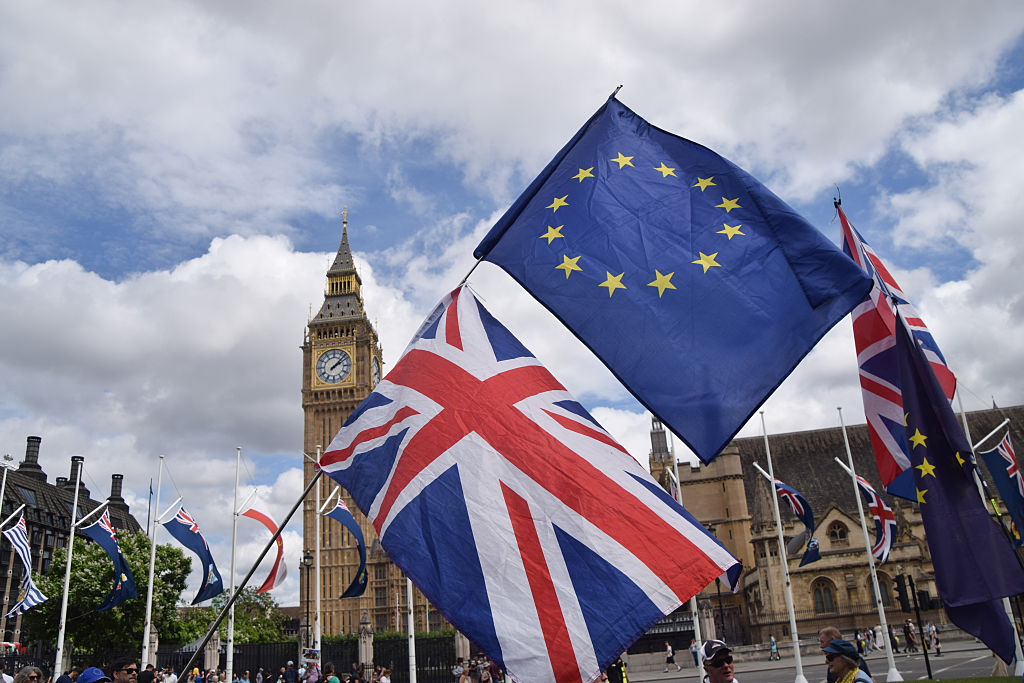
Many of the positions linked to the pro-Brexit right in Britain a decade ago are now deeply entrenched at the heart of the EU itself. (Vuk Valcic / SOPA Images / LightRocket via Getty Images)
Liberal opponents of Brexit are fond of listing all the falsehoods that were propagated by its supporters a decade ago. Prominent champions of the Leave campaign such as Boris Johnson and Nigel Farage certainly deserve all of the scornful criticism that’s been flung in their direction for a record of serial dishonesty. But they’re not the only ones who have presented a false image of the European Union over the last decade.
The 2016 referendum helped enshrine in British political debate a misleading view of how the EU actually works. For their own separate reasons, supporters and opponents of Brexit have both presented the EU as if it were a bastion of liberal, progressive values with a welcoming stance toward immigrants and refugees. They have tacitly colluded in diverting our attention from what has really been happening on the other side of the English Channel over the last decade.
The progressive image of the EU was already deceptive back in 2016 — after all, the referendum came less than a year after the brutal beating administered to the Greek government for daring to challenge the Troika’s austerity regime. But since then, the gap between British rhetoric and European reality has widened into a chasm. Many of the positions linked to the pro-Brexit right in Britain are now deeply entrenched at the heart of the EU itself.
Ways of Life
During the British referendum, the Leave campaign successfully created an association between the EU and a liberal immigration policy, and there was some truth in that claim circa 2016. From the mid-2000s, several million people moved to Britain from EU member states like Poland, Romania, and Portugal to take up employment. The leaders of the pro-Brexit camp were wrong to blame EU immigrants for the lack of well-paying jobs and the crisis in Britain’s public services, but they weren’t lying when they told people that staying in the EU meant accepting free movement of labor for its citizens.
The Leave side also held the EU responsible for immigration from outside its borders, which was more deceptive. Michael Gove claimed that Turkey was on the brink of joining the EU, which he knew to be false, and Nigel Farage unveiled a poster of refugees from the Middle East trekking through the Balkans with the inflammatory slogan “BREAKING POINT.” Free movement obviously didn’t apply in that case: there was never a time when the EU gave refugees open access to its territory. However, there was a short-lived moment in the middle of the last decade when Angela Merkel, Europe’s most influential politician, had a fairly welcoming stance toward Syrians fleeing a catastrophic war.
Ten years later, things look very different. The EU still has a policy of free movement for its own citizens, but the focus of Britain’s nativist scaremongering has shifted away from Poles and Lithuanians and toward immigrants who are seen as non-white and non-Western, especially Muslims. The term “immigrant” in this context could refer to someone who has arrived very recently from Somalia or Sudan, or it could refer to someone who was born and raised in Britain. There is no way of appeasing this sentiment short of mass ethnic cleansing, which sections of the far right have begun referring to euphemistically as “remigration.”
Meanwhile, the idea of immigration as a civilizational threat has gone mainstream in the EU over the past few years. When Ursula von der Leyen took over as president of the European Commission, she created a new position with responsibility for “Protecting Our European Way of Life.” The French far-right leader Marine Le Pen understandably hailed the move as an “ideological victory” for her political camp.
Europe’s Shield
It wasn’t long before von der Leyen demonstrated what “Protecting Our European Way of Life” meant in practice. In 2020, she praised Greece as “our European shield” against refugees crossing the border from Turkey. Von der Leyen brushed aside reports that Greek border guards were brutally assaulting refugees with the complicity of the EU’s own border agency, Frontex.
In 2021, it seemed as if the Commission might be forced to act when Greek police officers kidnapped and tortured an employee of Frontex itself near the Turkish border. The man, who was working as a translator for the agency, originally came from Afghanistan and was a permanent resident of Italy. The police officers assumed he was a refugee because of his skin color, so they snatched him off a bus, beat him up in custody, and illegally deported him to Turkey.
Matina Stevis-Gridneff of the New York Times suggested that the case “may force a reckoning. . . . The European Union, which has mostly looked the other way on abuses of migrants, is now being forced to confront the problem.” In fact, the EU was determined to keep looking the other way, even when its own employee was the victim. The translator’s story disappeared without a trace.
The man who was in charge of Frontex at the time, Fabrice Leggeri, decided to enter politics after stepping down from the job and became an MEP for Marine Le Pen’s party. A French judge is now investigating Leggeri over violent pushbacks of refugee boats in the Mediterranean during his years at Frontex.
Remain and Reform
When Britain voted to leave the EU, supporters of Brexit often expressed the hope that it would set off a chain reaction, with “Frexit,” “Italexit,” or even “Nexit” (for the Netherlands) following in quick succession. In fact, the major parties of the far right in continental Europe have mostly discarded talk of breaking with the EU. But there are two sides to this political coin.
On the one hand, the messy, protracted way Brexit was handled certainly made departure from the Union seem less attractive to the citizens of other countries. On the other hand, Europe’s far-right forces have grown increasingly confident that they can achieve their goals from inside the EU. The slogan “Remain and Reform” was associated with the British left during the 2016 referendum, but it now sums up the thinking of Le Pen and Giorgia Meloni and their allies.
Since the last European elections in 2024, the traditional center-right bloc grouped in the European People’s Party has forged alliances with the far right, ripping down the cordon sanitaire. The forces of the broad right, from Christian Democrats to neofascists, have united to weaken European climate policy and roll back environmental legislation.
Last week, this political bloc rammed through a package of measures to discourage immigration, including plans for the detention of refugees in countries outside the EU and a US-style enforcement regime. Far-right MEPs chanted “Send them back” in celebration of the vote. Britain’s Tory government couldn’t deliver on its scheme to forcibly transfer refugees to Rwanda, which critics panned as an exercise in theatrical sadism. Now some of the EU’s leading actors are hoping to succeed where the British authorities failed.
Britain’s exit from the EU didn’t stop Keir Starmer from teaming up with Danish prime minister Mette Frederiksen on a mission to undermine the European Convention on Human Rights. The ECHR and the body that upholds it, the Council of Europe, predate the Treaty of Rome that launched the process of European integration in the 1950s. They represent the best side of transnational cooperation in Europe; Starmer and Frederiksen represent the worst. Ten years after Brexit, instead of asking whether we need “more Europe” or “less Europe,” we should be posing the question “What kind of Europe?”