A Voice From Northern England, but Which One?

Britain’s new prime minister, Andy Burnham, says he can connect with the northern working-class voters who were once Labour’s base. Yet after decades of deindustrialization, it’s less clear that the party can rebuild its roots outside the main cities.
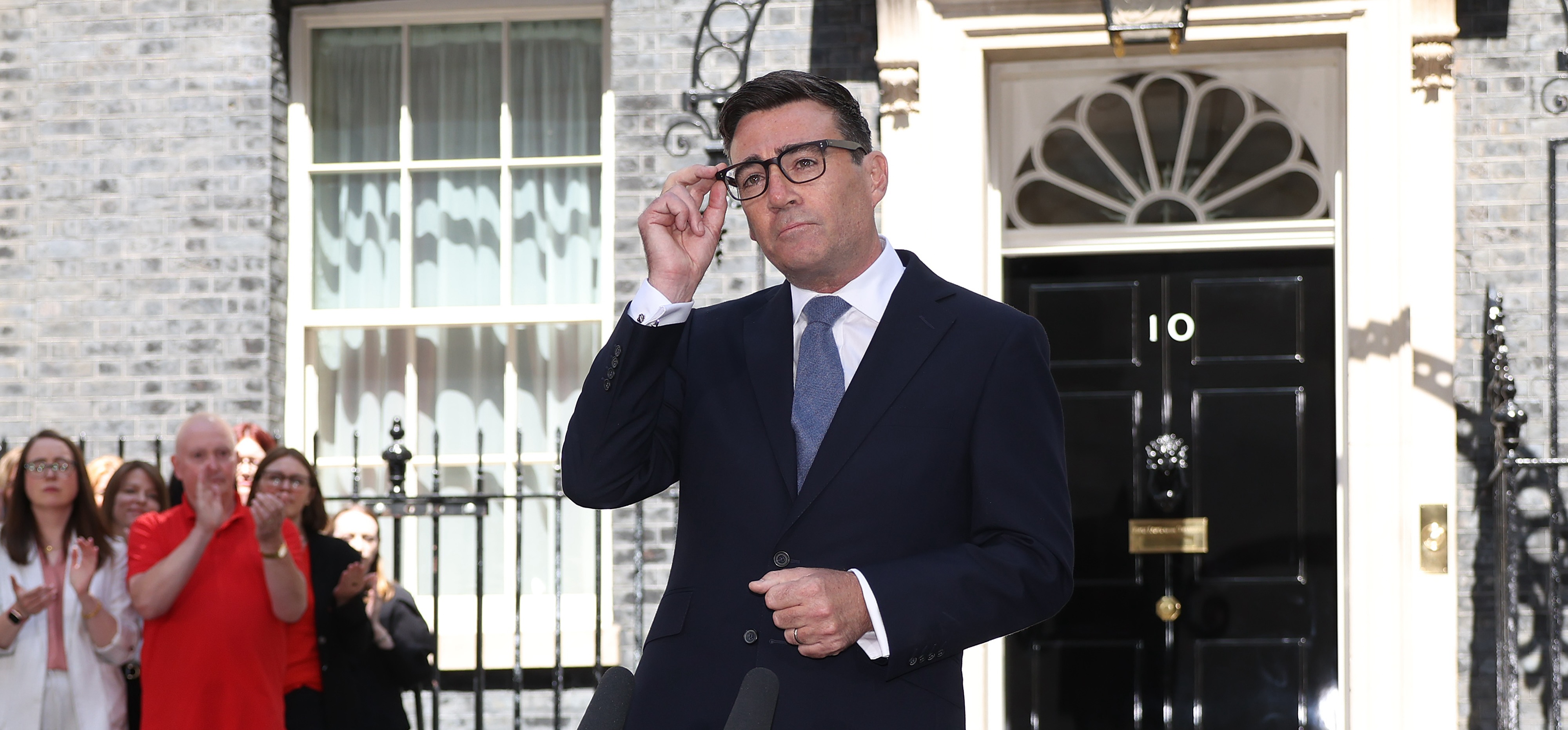
Andy Burnham takes office

Andy Burnham delivers his inaugural speech as the UK’s new prime minister, July 20, 2026. (Dan Kitwood / Getty Images)


I am no expert in US politics, but seeing flags on front lawns through the windows of a coach from Chicago to Urbana-Champaign in fall 2022 prompted my first inkling that Donald Trump winning a second term was a distinct possibility. Closer to home in England, a night out this spring in the impoverished but picturesque former mining town of Barnsley — twenty-five miles from where I work and live in Leeds — was my first direct encounter with a phenomenon I had till then only read about in the press. For I saw rows and rows of houses and businesses adorned with “patriotic” St George and Union flags as part of the Raise the Colours campaign. A couple of months down the line and Labour lost control of Barnsley city council for the first time in fifty years, with Nigel Farage’s far-right Reform UK taking charge. If the former Labour stronghold, which suffered more under austerity than virtually anywhere else in Britain, provided a damning indictment of Keir Starmer’s failure to connect with large swaths of the population, it also showcased how and why the future of the Labour Party and national politics would be fought far from Westminster.

If God loves a trier, the time is nigh for the self-appointed “King of the North.” Andy Burnham twice ran unsuccessfully for the Labour leadership (losing to Ed Miliband in 2010 and Jeremy Corbyn in 2015) when the party was in opposition, before being elected mayor of Greater Manchester in 2017. As a mayor rather than an MP, Burnham was ineligible to make a leadership challenge against Starmer following Labour’s battering in this May’s local elections. This changed when Labour MP Josh Simons agreed to step aside and trigger a by-election in Makerfield this June 18, thus allowing Burnham to run as the Labour candidate and win the election. Once back in Parliament, Burnham was rapidly anointed as Labour’s next leader, and Starmer has now stepped aside to let him become Britain’s new prime minister.

Burnham running in this specific constituency was a calculated risk. On the one hand, he had popular grassroots appeal in Makerfield, located roughly halfway between Manchester and Liverpool, not far from where he was born. It is also exactly the kind of postindustrial working-class area in which Reform has overtaken Labour (it had won in May’s local elections there). By running, Burnham was not only putting himself in a position to become leader but also pitching his candidacy by showing that he — and perhaps only he — could reclaim for Labour a northern demographic that the party had for too long taken for granted.

Burnham has reiterated that four-plus decades of neoliberal rule by both Labour and Conservative governments has been catastrophic for the North. He also served as mayor of Manchester at a time when the city council of Birmingham — the UK’s second-biggest city and Europe’s largest local authority — was declared bankrupt. A sports-mad music junkie, Burnham intuitively grasps the real significance of emotion and tribal identities.

Attending a gig in Barnsley recently reinformed my conviction that culture and politics rarely exist in isolation. More than that, it highlighted the challenges Burnham faces in safeguarding his own political future, the Labour Party, and northern England outside of booming Manchester alone.

Wasted Opportunities

As an academic discipline, cultural studies are forever associated with the University of Birmingham, where Richard Hoggart and Stuart Hall ran a highly influential research center. The discipline’s foundational text — Hoggart’s The Uses of Literacy — drew on his experiences growing up further north, in Hunslet, a working-class area of Leeds.

In an age of nearly full employment, he noted the importance of belonging to a local working men’s club (national membership was over two million in the late 1950s) and popular entertainment: “Some features of songs and singing among the working classes illustrate better than anything else both their contact with older traditions and their capacity for assimilating and modifying new materials to their established industry.”

A snapshot of this continuity appears in the most famous cinematic depiction of Barnsley: Ken Loach’s Kes, from 1969. Up north to adapt Barry Hines’s 1968 novel A Kestrel for a Knave for the big screen, Loach and screenwriter Tony Garnett were in Barnsley’s Club Ba-Ba when they witnessed the stage act of local lass Lynne Perrie — affectionately known as “Little Miss Dynamite” across the northern club scene where she had shared stages with the Beatles in their early years — and cast the entertainer in her debut role as the protagonist’s mother. Perrie’s character does not perform on stage in the film. But she is seen enjoying a night out singing along to an innuendo-laden music hall routine, alongside drunken men from the pit, flush with cash after getting paid.

Born in Barnsley, Hines escaped pit life by passing the infamous eleven-plus, a preteen standardized examination that long determined young Britons’ future by putting a select few on an academic pathway to middle-class professions by attending non-fee-paying grammar schools, whereas their peers were sent to secondary moderns — institutions that provided rudimentary education and fodder for local factories. Hines and Garnett (who, like me, attended a grammar school in Birmingham) both felt a sense of class betrayal on passing the eleven-plus, and sought to present an elegiac depiction of the beauty and wasted opportunities of working-class lives.

In a rare public appearance by Garnett in London shortly before his death in 2020, the grammar-school-boy-done-good was brought close to tears talking about how Britain continued to consign so much human potential to the dustbin, before working-class individuals had a chance to begin life. Kes, now considered a classic of British social-realist cinema, was no easy sell: London-based production and distribution companies showed little interest in a film about the uncouth northern provinces. Only the influx of US dollars secured a local booking in the neighboring town of Doncaster. In her memoirs, Perrie is disparaging about the premiere taking place in a small Yorkshire town as opposed to, say, London or Los Angeles. Still, she remained grateful to the role for getting her cast as Ivy Tilsley (1971–94) in the world’s longest-running soap opera, the Manchester-based Coronation Street.

With the closing of the pits and the liberalization of all aspects of life, including the nighttime economy, the golden age of working men’s clubs came to an end. Audiences and bands who cut their teeth in such environments were nevertheless easy to spot. Saxon may never have made it is as big as Iron Maiden or Def Leppard, but the Barnsley heavy-metal titans maintain a loyal global following to the present day, for both their musical chops and repartee. I spent childhood summers during the 1980s and 1990s in Barnsley as my grandparents had bought a small farm locally; after retiring from the armed forces, my granddad worked as a secondary-school teacher. Truth be told, he had picked what he rightly identified as an easy option. He was expected to do the bare minimum for local children, who it was assumed would not amount to much.

From Macc Lads to Macc Lad

With dwindling career opportunities, the often angry white youth of towns such as Barnsley were prime recruiting grounds for the army and constituted the fanbase for the cult punk rock band the Macc Lads, formed in 1981, whose most iconic album, Beer & Sex & Chips n Gravy appeared in 1985. Their politically incorrect repertoire includes such classics as “Now He’s a Poof” (“He’s got some black bloke sleeping in his bed / AIDS and herpes, he’s got ‘em / The evidence is written all over his bottom”), “Charlotte” (“Said her name was Charlotte and she wanted to suck my dick / Oh, I thought now lad, times are hard, and it’s nearly closing time”), and “Buenos Aires” (“There was a load of bloody fairies in Buenos bloody Aires / You can keep that poof Ardiles, we’re going to have your Malvinas”).

Concerts often descended into mass brawls. The band was, for example, banned from Birmingham’s Hummingbird venue after their fans caused thousands of pounds of damage at a concert in 1989. According to a later retrospective published in the Guardian: “Listen closely and the Macc Lads were always a subversive parody of such macho bigotry.” I’m not so sure. The band may not be as Neanderthal as their song titles, but much of their audience took the songs at face value, and unlike, say, ska punk band Madness, which also attracted far-right fans, they never issued statements to correct or challenge audience prejudices.

After a decade laying waste to Britain and mainland Europe (they had a surprisingly loyal following in Germany), the Macc Lads disbanded after a farewell gig at Nottingham’s Rock City in December 1995. In recent years, the Macc Lads, or to be more precise, the Macc Lad — given only the singer Muttley McLad (real name Tristan O’Neill) remains from the original lineup — have recommenced touring. They rarely play primary markets in big cities now but retain a loyal following in the Reform strongholds of postindustrial Britain.

Following a mediocre meal in a peculiar Indian restaurant adorned with photographs of the owner with 1960s rock’n’roll juvenile Cliff Richard (the septuagenarian had dined here after being released from questioning over child sexual assault allegations), this March I joined five hundred fans to watch the Macc Lads pay a sold-out show at Barnsley’s Birdwell venue. A pogoing audience did the heavy lifting for a band going through the motions. Muttley — whose relatively healthy complexion suggests he hardly lives off beer, gravy, and chips — milked trademark facial gestures and introduced the band’s latest recruit (in real life an Englishman called Shaun) as smelly Pablo González (“He is Mexican. Like gravy, he arrived in a small boat. Pablo has a drum kit and knows only four English words. Fortunately they are: FUCK!, CUNT! WANK! SHIT!”).

Balding leather-wearing middle-aged men predominated, but a surprisingly number of young people and women were in attendance. For a white, heterosexual male such as myself, the Macc Lads concert and surrounding bars were a welcoming environment in which patrons felt relaxed among their own. Old-school thuggery has not altogether disappeared from northern towns (for instance, soccer hooliganism, in much of Britain a relic of the 1980s, is alive and kicking in Doncaster), but the reactionary turn in British politics is all the more insidious because it caters to all the family. A London editorial meeting of Modern Language Review on May 16 coincided with a Unite the Kingdom rally through the city center. My coeditors and I exited onto the streets to encounter not violence but a carnival-like atmosphere, as intergenerational groups enjoyed a family day with some northerners visiting the capital for the first time.

But communities exclude as well as include. Many of my grandparents’ generation dismissed objections to old-school racist comedians such as Bernard Manning and Roy Chubby Brown (whose performances came with the explicit warning, “if easily offended, please stay away”) as the stuff of politically correct killjoys.

The festive atmosphere at a Macc Lads concert may not include all tastes or racial backgrounds. Still, there are far worse investments of time for southern-based politicians and pundits than having a night out in the north. Vestiges of a traditional working-class British culture can still be detected in the architecture of, say, the City Varieties (a former music hall) in central Leeds or the longstanding Duck and Drake pub. Still, such culture is more overt in ungentrified towns such as Barnsley, whose low rents allow country and western theme bars to coexist alongside more traditional community venues such as the Hoyland Common Working Mens Club (now open to nonmembers) and the fish-and-chip shop featured in Kes, a century-old business that just about remains afloat through loyal local customers and a nascent heritage industry.

The people of Barnsley have lost a lot — and have metaphorically raised the barricades to preserve what is left of their community and culture. Matt Goodwin’s recent bestseller, Suicide of a Nation: Immigration, Islam, Identity, has become a hot topic of conversation in working-class homes, pubs and clubs. Reform UK has capitalized on disenchantment with both the Conservative and Labour parties to inspire many people who have either never voted, or not done so for many years. “When was the last time you voted with enthusiasm?” was among the most successful slogans of Spain’s left-wing Podemos party. In Britain, at the opposite end of the political spectrum, the buzz of conversations in some ways reminds me of the atmosphere in Spain’s squares during the 15-M movement. There, truth be told, I heard just as many false premises and non sequiturs (for instance, one peculiar presentation in Madrid’s Puerta del Sol on the need for the masses to incarnate the spirit of Agustina de Aragón, the nineteenth-century heroine, painted by Goya, who defied local political elites to defend the nation against Europe).

The analogy only goes so far; the potential real-life consequences unleashed by the discourse of right-wing commentator Matt Goodwin and his acolytes are dystopian. If the only remedy against the “suicide” of a nation is self-defense against Muslim communities (just 6.5 percent of the British population), it is hard to conceive how this crusade might be waged without recourse to institutional or vigilante violence.

If universities once provided a refuge for failed politicians, recent populist movements have offered a plan B for frustrated academics. Goodwin took voluntary severance from a full professorship at the financially beleaguered University of Kent (whose website still boasts of his 2022 appointment as a Social Mobility Commissioner for the UK government); Pablo Iglesias and many of the leading lights from Podemos only turned to parliamentary politics once attempts to secure tenure at Madrid’s Complutense University turned sour. While an inability to translate their message to nongraduate working-class voters was instrumental to Podemos’s decline, Goodwin and Farage — the opportunistic, privately educated Reform UK leader — have had far more effective communication strategies.

Out of Touch

The populist right’s success has been delivered on a plate by the frequent perception, in many predominantly white working-class communities, that Starmer and Corbyn (who attended a private primary school before passing the eleven-plus) belong to the condescending, out-of-touch metropolitan elite.

Already long before scandals over Starmer’s appointment of Peter Mandelson as Britain’s ambassador to Washington, Mandelson had lost all credibility with his local constituents when he confused mushy peas in a fish-and-chip shop for guacamole. Doncaster North may have retained Ed Miliband as its MP since 2005, but the then opposition leader made a fool of himself in 2012 with his attempt to brand the Conservatives as out of touch for introducing a so-called pastry tax on takeaway food; his plan backfired after viral images circulated of him looking aghast as he bit into a sausage roll.

Burnham’s personal and professional biography has, up to now at least, made him immune to such gaffes. His free run to the Labour leadership is, in no small part, due to the fact that he is Labour’s first major player in recent years able to inspire similar excitement to Reform UK in long-forgotten places like Barnsley. For once, these towns are at the center of political conversations in Britain. If the Labour government under Burnham’s leadership cannot deliver on the promise invested in him, then we will, I fear, be taken another step closer to a Trump-like administration under Farage and his ilk.