Scotland Has No Escape Route From Britain’s Political Crisis

The Scottish National Party won its 5th consecutive term in office last week. But the party’s tepid brand of centrism still looks worn out, and the only big advances came for Reform on the right and the Greens on the left.
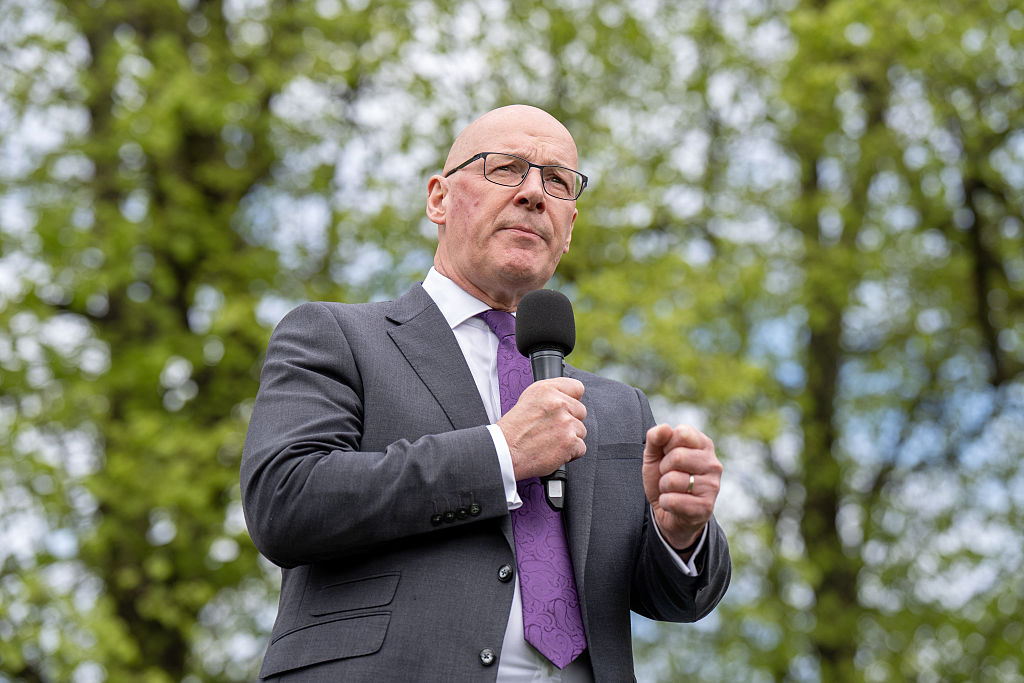
First Minister and Scottish National Party leader John Swinney delivers an election eve speech in Edinburgh.

John Swinney has made ominous noises about the “honest” need to tackle Scotland’s £5 billion budget black hole. Meanwhile, a raft of long-standing social problems remain unresolved nineteen years after the SNP first assumed office in Edinburgh. (Jane Barlow / PA Images via Getty Images)


In the end, Scotland’s election last week played out largely as the polls had said it would. John Swinney’s ruling Scottish National Party (SNP) went into May 7 as the country’s primary political force and emerged in the same position, albeit with slightly fewer seats (fifty-eight) than it held during the last session of the devolved parliament (sixty-four).

Reform on the far right, with seventeen seats, and the Greens on the left, with fifteen, surged. In the center, Labour and the Conservatives slumped, while the Liberal Democrats — Scotland’s forgotten party, a relic of late-Victorian Highland liberalism, for some reason still extant — unexpectedly gained a handful of constituencies.

In the weeks leading up to the vote, the national mood ranged from unenthusiastic to indifferent and back again. The public never engaged with the campaign, and the campaign, devoid of detailed policy debate, never caught fire.

By the time most of the votes had been counted on May 8, it was clear that turnout had gone down. At the last Holyrood election in 2021, 63 percent of Scots cast a ballot. This year, that figure was 52 percent, two points below the average since devolution began.

Red Top Swan Song

The single biggest casualty of the night, other than the old Westminster duopoly, was the credibility of Scotland’s tabloid press. On polling day, both the Sun and the Daily Record, which between them once boasted hundreds of thousands of readers and considerable cultural pull, ran sensational anti-SNP splashes.

“After 19 years of failure and scandal, the SNP are completely CLAPPED OUT,” screamed Rupert Murdoch’s Sun. “SNP Were Warned About Paedo And Did Nothing,” claimed the Record — a reference to the recent conviction, for sex offenses, of Jordan Linden, the former nationalist leader of North Lanarkshire council.

In decades gone by, headlines like these might have ruined a party’s chances of winning reelection. Last week, Scotland just shrugged. The era of newspaper editors policing the parameters of Scottish democracy — the Record, in particular, shilled shamelessly for Scottish Labour’s profoundly unimpressive Blairite leader Anas Sarwar — is clearly over.

And yet, the air of inertia that so visibly shrouded the 2026 election should not detract from the seismic nature of the election results themselves. For the first time since the creation of the Scottish Parliament twenty-seven years ago, Holyrood will play host to a sizable contingent of politicians from the extreme right of the political spectrum.

Farage Goes Forth 

Reform’s leader in Scotland, Malcolm Offord, ran what must rank as one of the worst election campaigns in modern history. In April, during a live television debate, the multimillionaire member of the House of Lords boasted about owning “six houses, five cars, and six boats.” Earlier in the campaign, one of his candidates, Senga Beresford, was revealed to have shared a social media post calling for the mass deportation of Scottish Muslims. This was par for the course for the Reform ticket.

Still, Offord’s party, whose policies include tax cuts for the rich, draconian border controls, and US Immigration and Customs Enforcement–style immigration raids, won almost four hundred thousand Scottish votes. There is a long-standing conceit that liberal Scotland is somehow immune to the politics of race-baiting and ethnic polarization that have afflicted other Western democracies of late. That myth has now been comprehensively shattered, and in the coming years, Reform’s success will test the limits of the “Scottish consensus.”

It’s not clear how Scottish civil society, weakened by decades of privatization, fragmentation, and austerity, will cope with that kind of stress. Swinney, Scotland’s returning first minister, has made ominous noises about the “honest” need to tackle Scotland’s £5 billion budget black hole.

Scottish government cuts, when they come, will probably take the form of mass public-sector redundancies. Meanwhile, a raft of long-standing social problems — record high rates of drug deaths, a chronic shortage of social housing, rural neglect — remain unresolved nineteen years after the SNP first assumed office in Edinburgh.

Green Surge

Popular discontent lifted parties on the left as well as on the right. Under the millennial socialist leadership of Ross Greer and Gillian Mackay, the Scottish Greens nearly doubled their share of the vote and will sit for the next five years as the third-largest party in the Scottish Parliament, ahead of the Conservatives and Liberal Democrats. Indeed, the most striking result of the campaign was the defeat of the veteran nationalist Angus Robertson by the Greens in Edinburgh Central.

For years Robertson has operated as the SNP’s chief centrist strategist. In 2012, he orchestrated the party’s embrace of NATO in the face of grassroots opposition. Since then, he has worked behind the scenes to bind the independence movement ever more closely to the foreign policy coordinates of Washington and Brussels.

In keeping with these maneuvers, while serving as the Scottish government’s secretary for external affairs, Robertson held a private meeting in 2024 with Israel’s deputy ambassador to the UK, Daniela Grudsky Ekstein. During the meeting, which was conducted at the height of Israel’s genocidal assault on Gaza, Robertson assured Grudsky that Scotland remained a “critical friend” of the Israeli state.

This encounter, the details of which the Scottish government fought to keep secret on the grounds that releasing them could “prejudice substantially” relations between Scotland and Israel, probably cost the former minister his seat. Green sources say the issue was raised repeatedly with their candidate Lorna Slater on the doorsteps and there were reports that nationalist students at Edinburgh University refused to campaign for Robertson because of it.

On May 7, Robertson’s slipperiness finally got the better of him. He came in third, behind not just Slater, but a miserably weak and diminished Scottish Labour too.

The Green surge was extraordinary, with support for the party hitting a record high of 14 percent. This was fueled in part by the insurgent popularity of Zack Polanski, the leader of the Green Party in England and Wales, which is a functionally separate organization from its Scottish counterpart. Polanski paid a visit to Scotland during the election campaign, prompting a significant (and politically useful) stream of opprobrium from the aging and dyspeptic anti-woke Scottish commentariat. The Greens beat the SNP in Nicola Sturgeon’s former constituency of Glasgow Southside and became the second-largest party in terms of votes cast across the city as a whole.

In contrast to the Greens in Ireland, who have gone into government twice since 2007 and twice been virtually wiped out at subsequent elections, the Scottish Greens appear to have benefited from their brief stint in power alongside the SNP between 2021 and 2024. The experience in government raised the party’s profile and affirmed its status in the eyes of many voters as the left flank of the independence movement. The challenge now for Greer, thirty-one, and Mackay, thirty-four, will be to navigate the next Holyrood session with a massively expanded and diverse caucus of MSPs.

Hollow Triumph

Robertson’s landmark defeat speaks to the underlying emptiness of the SNP’s victory. In 2021, the party, then led by Nicola Sturgeon, won 1.3 million Scottish constituency votes. Last week, under Swinney, it secured fewer than nine hundred thousand.

In total, support for the nationalists fell by 10 percentage points across the country. Thousands of SNP voters, exhausted by the party’s mediocrity, its conservatism, and its mounting pile of policy failures, simply stayed at home. Absent the rise of Reform, which split the unionist base four ways, it may not have been reelected at all. Turnout dropped particularly in working-class areas.

The next five years could be painful for the SNP. With no overall majority, Swinney will have to rely on the support of other groups in parliament to pass his budgets. Liberal Democrat leader Alex Cole-Hamilton has spoken in oblique terms about “getting Scotland’s finances in shape.” Anas Sarwar and Scottish Conservative leader Russell Findlay, both of whom remain bafflingly in their posts despite being humiliated by the electorate, want to reduce Scotland’s social security bill in order to balance Holyrood’s books.

Swinney is a career bureaucrat with ruthlessly pragmatic instincts. He may prefer to cut deals with parties of the center and center-right than cooperate too extensively with the socialist Greens.

The outlook for Holyrood darkens further given the first minister’s tendency to reward loyalty over talent with respect to his cabinet. In the coming years, the machinery of Scottish government will grow even more densely clogged with lobbyists, timeservers, and overpromoted special advisers.

Moreover, Swinney campaigned on a pledge to secure a second independence referendum that he knows he cannot deliver. As the new parliament settles in, these factors, among others, will deepen Scotland’s paralysis. The SNP has just won a record fifth consecutive term in office, and British unionism is in disarray. But look more closely at the party and the country it leads, and you will find acute signs of decay.