Keir Starmer Has Given Scottish Nationalism a Booster Shot
In 2024, the Scottish National Party suffered its worst election setback for decades at Labour’s hands. But the calamitous record of Keir Starmer’s government has given the party and its leader John Swinney the chance to recover its dominant position.
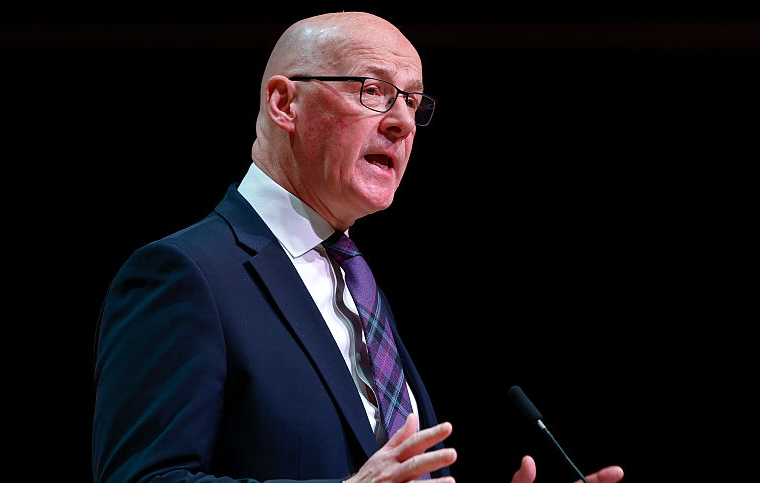
Two years ago, the nationalist movement in Scotland looked doomed. But with Keir Starmer’s Labour government in meltdown, the Scottish National Party is on course for its fifth consecutive victory in next month’s Scottish Parliament election. (Jeff J Mitchell / Getty Images)
Two years ago, the nationalist movement in Scotland looked doomed. Scottish National Party (SNP) leader Humza Yousaf was about to resign as Scotland’s first minister, having endured barely more than twelve torrid months in the post.
His predecessor Nicola Sturgeon and her husband Peter Murrell, the SNP’s former chief executive, faced investigation for financial fraud (Murrell was subsequently charged, Sturgeon was not). Meanwhile, Alex Salmond, Sturgeon’s mentor and the most influential nationalist politician of the past forty years, had dedicated his life to destroying the party he once led.
Scottish voters took note of the discord in nationalist ranks and responded accordingly. At the UK general election in May 2024, the SNP lost thirty-nine of its forty-eight Westminster seats, mostly to Labour, and saw its share of the vote slump by 15 points.
The result reflected a growing anti-nationalist impulse in Scottish public life. There was a sense that the SNP, seventeen years after securing power at Holyrood, Scotland’s devolved national parliament, was spent, worn down by a steady stream — sometimes bordering on a torrent — of scandals, crises, and policy failures.
Fifth Time Around
But memories run short in modern British politics, and electorates are fickle. Today, the SNP is on course for its fifth consecutive victory at the Holyrood elections, which take place on May 7. Meanwhile, Scottish independence, the SNP’s lodestar since its founding in the early 1930s, is now the constitutional preference of at least 50 percent of Scots.
The significance of this shift cannot be overstated. Historically, unionism — the belief that Scotland should remain part of the UK, with its economic and defense postures decided by policymakers in London — has been the default setting in Scottish political culture. Now, increasingly, separatism is the dominant ideological strain.
The SNP’s renewed success stems to a large extent from the weakness of its unionist opposition. The profound unpopularity of Keir Starmer, who has become a byword for sleaze and incompetence following his own recent slew of scandals and U-turns, has spread into Scotland, sinking the prospects of Scottish Labour and its oleaginous Blairite leader Anas Sarwar.
The rise of Nigel Farage’s right-wing populist Reform UK has also worked to the SNP’s advantage. Scottish unionist votes now split four ways, between Labour, Reform, the Conservatives, and the Liberal Democrats, while independence-supporting Scots have coalesced behind the only two parties capable of credibly advancing their cause — the SNP and the smaller, more radical Scottish Greens.
Add into this dismal mix a Labour government too feeble to keep Britain meaningfully detached from Donald Trump’s deranged foreign entanglements, plus the looming threat of a far-right takeover at Westminster, and the sources of Scottish discontent become clear.
Swinney’s Return
However, the SNP’s renaissance, such as it is, has not been purely accidental: some credit is due, too, to the party’s new leader, John Swinney. Scarcely known outside Scotland, Swinney has been a central figure in the country’s politics for the past three decades. He led the SNP unsuccessfully, from the center, between 2000 and 2004, before resigning to make way for Salmond, who moved the party to the left of New Labour and guided it into power at Holyrood for the first time in 2007.
Swinney was born in Edinburgh in 1964. His mother, Agnes, was a Sunday school teacher, and his father, Kenneth, worked as a garage manager. Agnes and Kenneth were not political people. The young Swinney nonetheless joined the SNP in his mid-teens, radicalized by the onset of Thatcherism and by Westminster’s cynical obstruction, in 1979, of the demand for Scottish home rule.
Over the years that followed, Swinney progressed through the ranks of Scottish civil society. In the early 1980s, he was a member of the socialist 79 Group, a de facto training ground for future SNP leaders, Salmond included. In 1986, he graduated from Edinburgh University with a degree in politics. During the late 1980s and early ’90s, he held a series of boring bureaucratic positions across the Scottish public and private sectors: research officer at the Scottish Coal Project; strategic planner at Scottish Amicable Insurance.
But Swinney was ambitious — he was SNP National Secretary by the time he was twenty-two — and his eyes were always fixed firmly on a career in politics. He was elected to Westminster in 1997 before entering the new Scottish Parliament two years later. When Salmond resigned as SNP leader in 2000, exhausted after a decade at the top, Swinney stepped forward to replace him.
During his first spell in charge, Swinney, who has never been a novel thinker, parroted the Blairite orthodoxies of the day: low taxes, free trade, and deregulated finance. His headline strategy of sanitizing nationalist politics, stripping it of its subversive content in a bid to bolster the SNP’s bourgeois bona fides, didn’t work. At the 2003 Holyrood elections, the SNP lost eight seats as support for the left-wing Scottish Socialists and Greens surged. After a miserable showing at the 2004 European elections, Swinney resigned and a reenergized Salmond returned.
Last Man Back
After the SNP’s narrow victory in the 2007 Scottish election, Swinney served as a diligent, loyal, and decidedly unflashy lieutenant in successive nationalist administrations. He was Salmond’s finance secretary before the 2014 independence referendum and Sturgeon’s deputy first minister and education secretary after it.
His decisions were often controversial. In the 2010s, Swinney balanced the Scottish government’s books at the expense of local authority budgets. In 2020, he presided over a marking scandal that systematically lowered the grades of kids at working-class schools in favor of those at middle-class ones, surviving a vote of no-confidence in parliament by a narrow margin.
Salmond quit the SNP in 2018, trailed by a flurry of sexual misconduct claims and ranting wildly about a political “conspiracy” supposedly orchestrated by Sturgeon. Swinney was one of a small number of senior nationalists graciously admitted into the Sturgeon–Murrell inner circle. When Sturgeon stepped down as first minister in February 2023, he resigned along with her, and Humza Yousaf won the ensuing leadership contest.
Yousaf’s stint in Bute House proved to be short, painful, and pointless. He stood down in the spring of 2024, having jettisoned Sturgeon’s coalition agreement with the Greens. Swinney was inundated with messages from party activists and insiders asking him to stand.
In May 2024, Swinney once again took over as leader of the SNP, but this time, he also became Scotland’s first minister. His decision to return to frontline politics was motivated, he said, not by “personal ambition” but by “a profound sense of duty to my party and my country.”
Salmond, who had been Swinney’s friend and colleague for three decades prior to the 2018 split, died of a heart attack in October 2024 at the age of sixty-nine. A few weeks later, Swinney arrived at Salmond’s memorial service at St Giles Cathedral in central Edinburgh. As he entered the Cathedral, he was heckled by Salmond’s supporters in front of the national press.
Unlikely Savior
Sixty-one years old, bald and bespectacled, with the inoffensive bearing of a mid-level German administrator, Swinney is an unlikely nationalist savior. He is a ranking member of Scotland’s devolutionary elites; a career politician who has raised income taxes, junked landmark election pledges, and cut college funding. He has none of Salmond’s strategic brilliance and even less of Sturgeon’s celebrity appeal.
Logically, he should be despised by the Scottish electorate. But he isn’t. Instead, the SNP leader enjoys a modest approval rating of plus 1 percent and remains more popular than any of his potential rivals for the position of first minister. Why?
Explanations vary. One theory is that, following the chaotic departures of Sturgeon and Yousaf, the rancid fallout from Salmond’s resignation, and the Covid-era splintering of the independence movement through social media, Swinney has reimposed discipline on the SNP, ruthlessly ditching the party’s most controversial policy proposals and streamlining its pitch to the Scottish public.
Another is that Swinney radiates stability at a time of rampant populist angst. According to Ipsos MORI, Scottish voters view Swinney as the Holyrood leader who “most understands the problems facing Scotland,” who is “most in touch with ordinary people.” and who is “most honest” — remarkable feedback for a politician with nearly twenty years of incumbency under his belt.
Latter-day Blairism remains central to Swinney’s politics. In recent months, he has worked with global fossil fuel firms to attack Labour’s Energy Profits Levy, a windfall tax on the returns of oil and gas companies operating in the North Sea. As part of a broader drive to slash Scotland’s budget deficit, he has also proposed cutting up to twenty thousand public sector jobs over the next five years if reelected.
Such policies are typical of Swinney’s enduring neoliberal instincts. However, Swinney 2.0 has shrewdly sought to deepen, rather than dilute, the SNP’s center-left identity. Like Sturgeon, he cites the “eradication” of child poverty as his defining mission. Like Salmond, he casts the SNP as an anti-imperial party, opposed on principle to nuclear weapons and critical of Western support for the “genocidal” Israeli state.
As the election nears, Swinney, ever the pragmatist, has sought to amplify the SNP’s redistributive credentials. At the party’s manifesto launch in Glasgow on April 16, he announced plans to cap the cost of essential food items ahead of the anticipated inflationary impact of the Iran war. He also promised to expand state-funded childcare support and to pilot an Irish-style minimum income for artists.
These ideas echo the populist achievements of his predecessors: the scrapping of drug prescription charges and university tuition fees under Salmond, and the creation of an incipient Scottish social security system under Sturgeon.
Social Democratic Nationalism
Research published in March showed that the SNP’s interventionist initiatives, implemented during the early years of the party’s hegemony at Holyrood, remain massively popular with the Scottish public. Sixty percent of Scots believe expanded free school meals “reflect positively” on the Scottish government; 65 percent have a positive view of publicly subsidized personal care for the elderly; more than 40 percent support rent caps and the banning of so-called no fault evictions.
Despite the endless gnashing of libertarian teeth in Scotland’s right-wing media, the bulk of Scottish voters still cherish the welfare state. Like Salmond and Sturgeon before him, Swinney has grasped this simple political fact. Coupled with the party’s dogged defense of “Scottish interests,” the SNP’s universalism, qualified though it may be, constitutes the centerpiece of its ongoing electoral success, and the social democratic pillar upon which the wider case for Scottish self-government rests.
The underlying irony here is that Swinney, a true believer of the SNP for more than forty years, has no concrete plan to achieve the one thing he came into politics to achieve: Scottish independence itself. On the campaign trail, the first minister argues that an emphatic SNP victory on May 7 will force the UK government into negotiations with Edinburgh over Scotland’s withdrawal from the Union. Sturgeon and Yousaf both argued the same thing and were proved wrong.
Since the failed independence plebiscite of September 2014, successive British prime ministers, Tory and Labour alike, have repeatedly refused to permit a second referendum. This position was legally gold-plated in November 2022 by a ruling of the UK Supreme Court.
Swinney understands all of this perfectly well. An arch gradualist, he won’t declare independence unilaterally, as the Catalan independentistas did in 2017, or in a style that would damage Scotland’s international standing: the SNP has spent years quietly cultivating support for its cause among officials in Brussels and remains keen to secure European approval.
Even so, for electoral reasons, Swinney persists in the fiction that another referendum is just around the corner. How much longer rank-and-file nationalists, impatient for a rerun of the 2014 vote, will tolerate this strategic sleight of hand is one question going into this election. How Swinney responds when London once again rejects Edinburgh’s independence overtures is another.
Breaking Points
But it may not matter, as the British state appears to be faltering. Elections are also taking place on May 7 for the Welsh parliament in Cardiff and local authorities across England. In Wales, Reform and the center-left nationalists of Plaid Cymru are competing against an exhausted incumbent Labour Party for control of the Senedd. In England, Reform on the right and the Greens on the left are both set to make massive gains.
The collapse of Welsh Labour means there may soon be nationalists who want to break up the United Kingdom holding office in Edinburgh, Cardiff, and Belfast, where Sinn Féin became the largest party at Stormont in 2022. Plaid’s likely ascendancy reflects a steady souring of Welsh attitudes toward Westminster. Once a fringe idea, support for Welsh independence now polls at around 35 percent, roughly parallel with levels of support for Scottish independence prior to the 2014 referendum.
The UK is now in its hyperpolitical era. Starmer, the least popular British prime minister in history, is on the brink; Farage and Reform are advancing on Downing Street; a trio of separatist governments could soon be collectively chipping away at the Union from the country’s Celtic capitals.
Salmond and Sturgeon are gone, and Scotland’s ties to London are visibly loosening. Swinney, a veteran Holyrood apparatchik and softly spoken nationalist foot soldier, didn’t choose this moment. But the moment may yet choose him. If so, does he have the creativity to meet it?