Labor Can’t Remain Shackled to the Democrats
In much of the US, Democrats’ reputation is utterly toxic to working-class voters. Running independent candidates may be the way forward for labor and the Left in many regions — potentially planting the seeds of a new party.
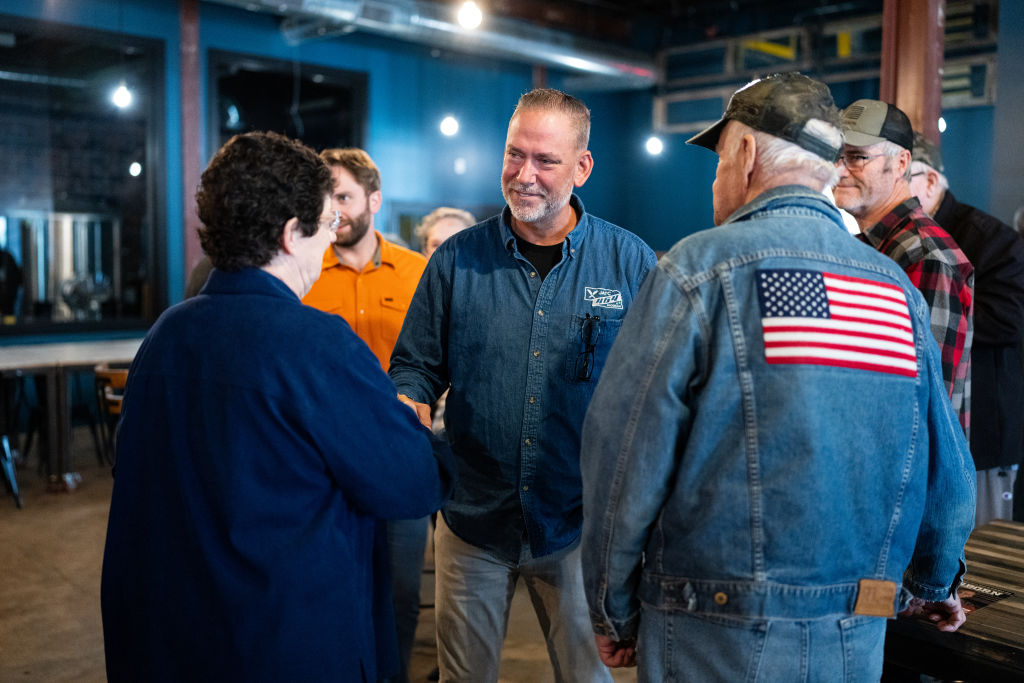
There is plenty of room for two pro-labor electoral strategies to run parallel to one another: running left-wing candidates inside the Democratic Party in blue states and congressional districts, and independent labor populists in red states and districts. (Bill Clark / CQ-Roll Call, Inc via Getty Images)
In 1992, West Virginia was one of the country’s “bluest” states, while Democratic victory in Connecticut — today very much one of the bluest — was hardly assured. This was not a product of the unusual three-way contest that year between Bill Clinton, George H. W. Bush, and Ross Perot. Nor was it due to Clinton’s personal charisma and Southern roots. Four years prior, when Bush faced off against the stiff and technocratic Massachusetts Governor Michael Dukakis, West Virginia was one of a handful of states that went blue, while Connecticut went red by a comfortable margin.
West Virginia and Connecticut are object lessons for what has since become of American politics in Les Leopold’s latest book, The Billionaires Have Two Parties, We Need a Party of Our Own: How Working People Can Build Independent Political Power. In the last few decades, Democrats have lost considerable ground with working-class voters and in struggling regions across the country, but they have built new strongholds in communities and states that have come out ahead in a new “postindustrial” economy.
Leopold is well positioned to wade into the debate about what this means for unions’ political strategy. He is the executive director of the Labor Institute and the author of the The Man Who Hated Work and Loved Labor (2007), a rich biography of one of the late twentieth century’s great but mostly unsung union leaders, Tony Mazzocchi. But Leopold’s newest work is not an account of how we got to this point (for that, check out his Wall Street’s War on Workers [2024], as well as my work in Catalyst). Instead, Leopold dedicates the bulk of We Need a Party of Our Own to what labor activists, unions, and other progressives should do to escape from the Democrats’ toxic brand. He makes a serious and convincing case for why labor should join the electoral battle by running candidates in general elections as independents, and how this could pave the way to building a new third party — a relatively rare argument these days.
A Toxic Brand
The anchor for We Need a Party of Our Own is a unique poll conducted by the Labor Institute and the Center for Working-Class Politics. Surveying three thousand voters in Wisconsin, Michigan, Ohio, and Pennsylvania, Leopold and his collaborators show that there is real support for a pro-labor reform agenda in the Midwest. These voters strongly support taxing the rich, government controls to stop price gouging by big business and the pharmaceutical industry, a public sector jobs program, and aggressive steps to stop companies that take federal money from doing mass layoffs.
This pro-labor agenda is popular, especially among working-class voters, but people justifiably don’t trust Democrats to advance it. The party’s brand is in the gutter: Voters sympathetic to Democrats view them as weak and ineffective. Independents think the party is out of touch. Republicans think Democrats are corrupt liars.
Leopold doesn’t make this point explicitly, but all three perspectives are products of the same basic problem. The liberal former governor of New York, Mario Cuomo — father of the recently defeated Andrew — was famous for saying that politicians have to “campaign in poetry but govern in prose.” Another way of saying this is that politicians say one thing and do another.
Voters correctly clock that this has been routine practice for the last few generations of Democratic politicians. When the party is in the minority, Democrats usually talk a big game about universal health care, creating good-paying jobs, and rebuilding the labor movement. But there’s always a reason, once back in power, why they can’t deliver on campaign-time poetry. No wonder that those most sympathetic to the party think it falls short because it is weak, those most hostile to it think it has been corrupted, and those in between think it’s out to lunch. All three groups are looking for reasons to explain the disconnect between campaign promises and policy results. Each explanation is damning to the Democratic brand in its own way.
Politics of, by, and for Workers
Leopold’s analysis of what has gone wrong shares much in common with the current progressive take on the party’s problems. But Leopold makes a more novel argument as he moves to prescribing solutions. For Leopold, the party’s brand is so tarnished among working-class voters that well-meaning candidates who run under its banner will be hobbled by a “Democratic penalty” that makes their odds of election slim. The solution is to make a clean break with the party.
Leopold proposes that labor-backed candidates run instead in general elections as members of an “independent workers’ political association.” Though he’s well aware that the name needs work, his polling data shows that such an organization would have much greater popular support than the Democratic Party among working-class voters.
To those who would raise immediate concerns about spoiled elections leading to more Republican victories, Leopold has an effective response. Thanks to the disappearance of a competitive Democratic Party in much of the country and the gerrymandering war of the last decade, there are more than one hundred congressional districts where Democrats put up guaranteed losers or run no candidate at all. The same holds true in elections for the Senate in more than a dozen red states.
These districts are ripe for a new electoral strategy. Leopold proposes that unions focus on recruiting working-class independents to run instead. If elections are spoiled in favor of the GOP in these places, it’ll be because Democrats insist on running candidates whose chances of winning are next to nil.
It’s a promising approach that a number of candidates in 2026 are testing out. Union mechanic Dan Osborn is repeating his bid two years ago to be elected senator from Nebraska; Osborn is doing surprisingly well in polling this year, even taking the lead in the first poll conducted since February. Osborn is joined by a number of other independents running for Congress in the labor-populist lane, including Mike Thurow (Wisconsin), Nate Powell (Washington), and Bill Hill (Alaska). The key, actionable takeaway from We Need a Party of Our Own is that labor and its allies should build substantially on these early experiments in the run-up to the 2028 election.
Leopold’s argument here is a welcome take on party politics in the United States, and one more grounded in reality than what you’ll get from some on the progressive left. It has become conventional wisdom that party labels and ballot lines are meaningless, and that running left-wing candidates as Democrats has no downside. But as Leopold shows, for the vast majority of Americans party labels are exceptionally important devices for understanding their choices come election time. They are so meaningful that candidates championing an otherwise popular policy platform, like Sherrod Brown in Ohio, get dragged down and lose because of their party’s toxic brand.
This may not be a problem, for now at least, in deep-blue parts of the country. But outside the big cities, the labor movement and the Left don’t have the luxury of denying that the party’s brand is a major problem.
On to a Political Revolution
There’s a difference, however, between running independent candidates and building a political party. It’s the latter project that Leopold’s book is really dedicated to promoting, and for him the success or failure of that project will hinge on what the labor movement decides to do.
He has no illusions on this score. The vast majority of union leaders are still hostile to the idea of making a clean break with the Democratic Party. Leopold also reports that labor officials he interacts with are so frightened by the prospect of internal fights breaking out with union MAGA voters that they block opening up political debates. This is a misguided strategy, since it reinforces the idea that union leaders are making shady pacts with Democrats, and that the only alternative to the Democrats is Republicans. It also stymies much-needed conversations in unions about what’s actually going wrong in this country and how to fix it. When progressives and union leaders refuse to include members in debates about their unions’ strategies, they cede the argument to the Right.
Leopold proposes a national educational campaign to promote the idea of running independent labor populists and the need for a new political party to bring them together. Building off of the Labor Institute’s “Reversing Runaway Inequality” trainings, this educational campaign could build momentum among rank-and-file unionists for a new political strategy, ratcheting up pressure on union leaders to strike out away from the Democratic Party.
Coupled with some successful experiments by independent labor populists who don’t wait for permission from tactically conservative union officials to run, it’s possible to imagine such a strategy making some headway. And if at least some labor leaders can be convinced to redirect even a portion of the considerable biannual tribute they give to corporate Democrats toward independent labor populists, the strategy could gain real traction.
But on the question of how to go from running independent candidates to building an independent party, there are two notable omissions in this otherwise compelling book.
First, Leopold’s platform for an independent working-class political organization leans heavily on economic issues. But any hope for a future working-class political party surely depends at least in part on upending the rules of the political game in the United States. In 2016, Bernie Sanders championed the call for a “political revolution.” That seems more urgent than ever. Without proportional representation and ranked-choice voting in presidential and Senate elections, public financing of campaigns and a ban on political spending by corporations and the rich, and breaking the power of the reactionary-dominated Supreme Court, it’s hard to imagine that a third party will ever make much headway.
Of course, making the case for democratic reforms seems, at least on the surface, to be a harder task than making the case for economic redistribution. But if an oligarchy really controls American politics today, the case has to be made somehow. A thorough democratization of the political system will be a necessary first step to winning economic reforms.
Ours wouldn’t be the first labor-based political movement to face this kind of problem. The labor and social democratic parties of the late nineteenth century also had to first break the political stranglehold of oligarchies before moving a social democratic economic agenda forward. The Chartists in Britain — one of the world’s first truly working-class political movements — foregrounded the need for political reforms and won the support of millions of workers. Every working-class party after them followed a similar track: break the political power of oligarchs first, then redistribute income and wealth. At one point in his book, Leopold calls for the drafting of a new “People’s Charter” to serve as a program for a new working-class political movement. Such a charter should make room for democratic reforms, especially if an independent workers’ political association aspires to transform itself into a new Labor Party.
Second, while he spends a considerable amount of time assessing the limits in the strategy of the Working Families Party (WFP), Leopold mentions the Democratic Socialists of America (DSA) only once in a quote taken from Steve Bannon. DSA today is the largest membership-based democratic organization on the Left — a far different beast than the WFP, which remains a staff-driven effort weighed down by its own tactical conservatism. DSA has a serious electoral strategy that is making headway across the country, not just in much-publicized races in New York City. In just the last few weeks, its candidates won big in Kentucky, Oregon, Georgia, and Pennsylvania. A recent estimate from members of the organization’s National Labor Commission put the number of DSA union members at fifteen thousand. Setting aside unions themselves, that means that DSA is one of the largest organized groups of politicized union members in the country, if not the largest.
It’s hard to imagine how any progressive, pro-labor electoral strategy can sidestep what its relationship to DSA will look like. This is an especially important and thorny issue for imagining a route to forming a new third party. The new democratic socialist movement and especially its standard bearers — Bernie Sanders, Alexandria Ocasio-Cortez, and Zohran Mamdani — are, for now at least, mostly committed to a strategy of working inside the Democratic Party. (To Sanders’s credit, he has been very supportive of independent labor populists too but not, as far as I know, of any talk of launching a new party.)
For now however, there is plenty of room for two pro-labor electoral strategies to run parallel to one another: running left-wing candidates inside the Democratic Party in blue states and congressional districts, and independent labor populists in red states and districts. In mounting a challenge of this kind, the labor left would be turning the hyperpolarized political geography of the United States against both parties: eating away at the support for centrist Democrats in the big cities and on the two coasts and at the support for MAGA Republicans in the Rust Belt, the South, and the prairie states. As Bernie would say, “maybe, just maybe” that’s a road map for building a new political party.