Tony Mazzocchi Embodied the Best of the Labor Movement
In the latter half of the 20th century, labor leader Tony Mazzocchi fought for a progressive political vision that put working-class concerns front and center. His example continues to be invaluable for labor and the Left today.
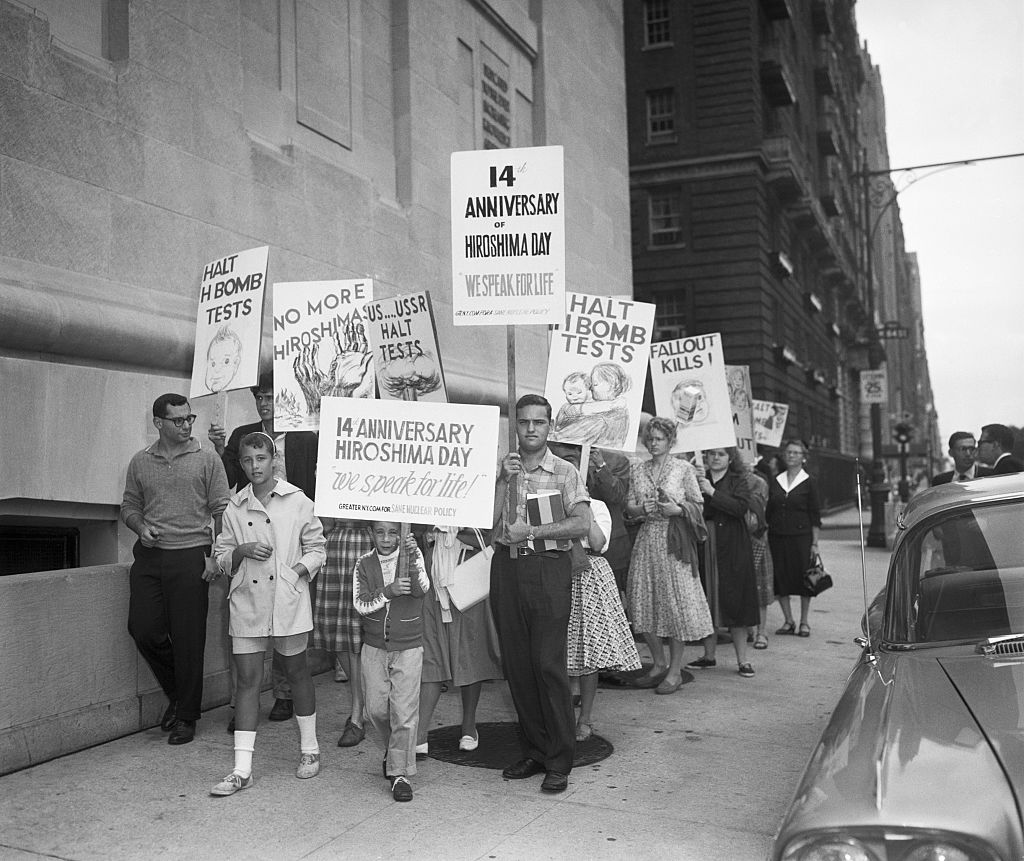
The Committee for a Sane Nuclear Policy (SANE), an organization Tony Mazzocchi helped launch, demonstrates on the West Side of Manhattan around the fourteenth anniversary of the bombings of Hiroshima and Nagasaki on August 9, 1959. (Bettman Archive via Getty Images)
In 1948, the radical sociologist C. Wright Mills published a book called The New Men of Power, which examined the careers of postwar labor leaders who emerged from industrial union struggles in the 1930s. At the time, the author was hopeful that labor’s progressive wing — led by this new generation of trade unionists — would be a bulwark against war, militarism, and resurgent corporate power.
A decade later, Mills became a cheerleader for the emerging student movement, because the “main drift” of organized labor and most of its officialdom in the 1950s was trending in a conservative direction. That trend was symbolized by the Congress of Industrial Organizations’ (CIO) purge of left-wing unions representing a million workers. This paved the way for its mid-1950s merger with the American Federation of Labor (AFL), an alliance in which craft union influence was predominant.
One exception to this generational trajectory was the career of a World War II veteran from Brooklyn named Tony Mazzocchi. In the 1950s and ’60s, Mazzocchi rose through the ranks of the Oil, Chemical, and Atomic Workers (OCAW), a union with then-strong CIO traditions of rank-and-file activism and internal democracy.
While Mills welcomed the revival of campus radicalism in his famous 1960 “Letter to the New Left,” mainstream unions were very hostile, then and later, to any migration of New Leftists from college campuses to unionized workplaces. The stodgy cold warriors at AFL-CIO headquarters viewed the growing militancy of the civil rights, antiwar, Black Power, environmental, and feminist movements as a big political threat.
Only a few longtime working-class leaders welcomed 1960s activists into the ranks of labor, and Tony Mazzocchi was one of the most influential among them. His personal mentoring enabled many former students to become more effective organizers, contract negotiators, strike leaders, and advocates for independent political action.
Mazzocchi developed a wide following outside his own union. As recounted well in labor educator Les Leopold’s 2007 biography, The Man Who Hated Work and Loved Labor, Mazzocchi was both a role model and catalyst for progressive activism around multiple issues.
As an OCAW local president and regional leader in New York, legislative director in Washington, and later the union’s national secretary-treasurer, Mazzocchi managed to juggle day-to-day union responsibilities with a tireless commitment to civil rights, labor-based environmentalism, job safety reform, single-payer health care, nuclear disarmament, and union democracy. He was a leading architect of the fight for a federal Occupational Safety and Health Act (OSHA) in 1972, warranting Leopold’s description of him as “the Rachel Carson of the American workplace.”
Working-Class Roots
Unlike many of his later fans, who were middle-class baby boomers, Mazzocchi was shaped by his childhood experience during the Depression, followed by Army service in the Battle of the Bulge. He came from a boisterous, pro-labor Italian American family in Bensonhurst, a Brooklyn neighborhood later known for its white working-class conservatism and residents with mob ties.
Mazzocchi’s two sisters and a closeted gay uncle were Communist Party (CP) members. Despite growing up in that milieu, Tony never joined the CP. As Leopold reports, Mazzocchi regarded “formal Marxism and its terminology to be too doctrinaire.”
He was more influenced by left-wingers with a popular touch. He actively supported socialist Congressman Vito Marcantonio’s unsuccessful 1949 campaign for New York City mayor as an American Labor Party candidate. According to Leopold, the young World War II veteran “watched and learned how Marc carefully serviced his base, while also staking out radical positions. Not only did he care for ‘workers’ as a political category — he cared for his constituents personally.”
Mazzocchi took the same approach when he got a job at a Queens cosmetics factory in 1950 and became a union activist. Local 149 at Helena Rubinstein was then affiliated with the United Gas, Coke and Chemical Workers (which merged with the Oil Workers to become OCAW five years later). As a union shop steward, organizer, and eventually president, Mazzocchi tripled his local’s size. He built a strong cadre of shop-floor leaders, started a book club and credit union, and sponsored a “vast array of social activities” that “combined to create a remarkable new spirit at work.” As Leopold recounts, “In stark contrast with much of the labor movement in the mid-1950s, Local 149 championed the rising civil rights movement — even though its membership was 95 percent white.”
War and Peace
In 1957, Mazzocchi helped launch the Committee for a Sane Nuclear Policy (SANE) to oppose atomic bomb testing. His longtime involvement with SANE put him in touch with the “leading scientists, environmentalists, and activists who would later join him building an occupational safety and health movement.”
When the Rubinstein plant relocated outside the city, Mazzocchi’s membership became a force in local politics and a reliable source of strike solidarity in the suburbs. By the mid-1960s, Mazzocchi was mobilizing against job cuts at military contractors on Long Island with a union-drafted plan “to use defense workers’ vast skills to build public buses and subway cars.”
Aided by economist and fellow SANE activist Seymour Melman, this pioneering promotion of “economic conversion” won Mazzocchi a White House audience with Lyndon Johnson in 1964. That same year, he almost ran for Congress — a move thwarted by Democratic Party officials who looked askance at his peace activities and feared they would be red-baited along with him.
Mazzocchi’s aspirations for higher office were partially fulfilled, instead, within the 200,000-member OCAW. In 1965, he helped elect a new national union president, after a bitter struggle with top OCAW officials linked to the CIA’s meddling in foreign labor movements. This victory made him the union’s legislative and political director.
Job Safety and Health
In that capacity, Mazzocchi linked emerging public concern about environmental pollution to the source of the problem — workplaces where OCAW members and other workers were exposed to toxic chemicals at much higher levels than anyone in surrounding communities. In the era before OSHA and the Environmental Protection Act (EPA), as Leopold points out, “There were no effective standards. There was no enforcement. The corporations ruled as absolute monarchs over chemical production, exposure, and regulation.”
At Mazzocchi’s initiative, organized labor began to shift its own focus, from a traditional emphasis on job safety (i.e., protection against injuries) to dealing with the long-term health effects of occupational hazards. His method involved rank-and-file consciousness-raising and grassroots coalition building outside the Beltway.
A high school dropout himself, Mazzocchi recruited a high-powered network of medical researchers to provide documentation for lawsuits, reports, press releases, hearing testimony, and investigative reporting. He regularly dispatched these allies to probe for the causes of job illnesses reported by his membership.
At the same time, he organized nonstop “road shows” that brought workers together with friendly experts and forced lawmakers to listen to both of them. Mazzocchi’s drive for passage of the Occupational Health and Safety Act in 1972 is a case study in building effective labor clout, albeit in an era when legislative gains were still possible even under a Republican president.
The Silkwood Case
In that same decade, OCAW tried to help rank-and-file whistleblowers like Karen Silkwood in Oklahoma. She worked at a dangerous nuclear facility operated by Kerr-McGee and died under suspicious circumstances in a 1974 car crash, on her way to meet a New York Times reporter. (The case was dramatized in the 1983 film Silkwood, starring Meryl Streep.)
As an integral part of what Leopold calls “the atomic-industrial complex,” OCAW dues payers in the nuclear industry proved to be Mazzocchi’s own Achilles’ heel. When he decided to run for national union president in 1979 and 1981, conservative opponents — critical of his “anti-nuke” politics and “incessant boat-rocking” — mobilized against him. In both hotly contested convention elections, he suffered heartbreakingly narrow defeats.
Mazzocchi confounded his foes, per usual, by making an unexpected political comeback. In the late 1980s he reconciled with Bob Wages, the last president of OCAW before it merged with the Paper Workers and then the United Steel Workers. Mazzocchi returned to the OCAW leadership as national secretary-treasurer again. This time, he used that post to promote worker education initiatives like Leopold’s Labor Institute and, with far more obstacles, a new labor-based third party.
A Party for Labor?
After four years of preparatory work, the Labor Party (LP) got off to a promising start in 1996 due to growing rank-and-file disillusionment with the Clinton administration. Its founding convention in Cleveland drew 1,400 delegates, including rank-and-file activists, local officers, some national union officials, and labor-oriented academics like author and historian Adolph Reed.
During the LP’s early years, Mazzocchi helped generate much of its labor funding and support through relentless personal barnstorming around the country. Unfortunately, dreary and divisive left sectarian squabbles soon paralyzed some chapters. A substantive disagreement about when to start running viable independent candidates — and at what level of government — was never satisfactorily resolved.
After Ralph Nader, Tony’s longtime friend and ally, made his Green Party run for the presidency in 2000, the mainstream union backlash against alleged third-party “spoilers” further complicated LP recruitment efforts. “Labor for Nader” supporters (including the authors of this article) did grassroots turnout for Ralph’s famous “super-rallies” in Boston and other cities. But only two LP affiliates — the United Electrical Workers (UE) and California Nurses Association — officially endorsed his campaign, not the LP itself.
The Electoral College and Supreme Court–assisted victory of George W. Bush in 2000 and subsequent Republican attacks on labor tended to drive unions back into the Democratic Party fold. Other LP sponsors, including OCAW’s new parent organization, withdrew their support. In 2007, the LP folded its tent.
As two key LP organizers, Mark Dudzic and Katherine Isaac, summed up the experience five years later: “The prospect of breaking completely with the Democratic Party without an established alternative was too risky for even the most militant unions and remains the biggest challenge to any effort to build an independent labor politics.”
It should be noted that, even within the Democratic Party, only seven national unions, representing just a million workers, dared to embrace the pro-labor presidential primary campaign of Bernie Sanders in 2016, when Hillary Clinton was the leadership choice of the AFL-CIO, SEIU, and big independent unions like the National Education Association.
Mazzocchi’s Legacy
Tony didn’t live to see it but, two years ago, former local union president and strike leader Dan Osborn proved, without a doubt, that Nebraska is one state ready for a labor-backed independent candidate. After an unexpectedly strong showing in his 2024 US Senate race against a MAGA Republican incumbent, Osborn is making a second run against another one this year.
From MassCOSH in Boston to Work Safe in the Bay Area, local occupational safety and health coalitions which Tony helped foster, continue to support job safety and health fights. Antiwar agitation by US Labor Against the War and Veterans and Labor for Sensible Priorities still reprise the role played by the Vietnam-era Labor for Peace, which Mazzocchi supported.
Under Tony’s influence in the 1980s, OCAW sponsored a Boston Organizing Project, which placed “salts” in nonunion workplaces. The much bigger twenty-first-century successors to that effort include the SEIU-backed Starbucks Workers United, Amazon warehouse worker organizing efforts by the Teamsters, and efforts like the Emergency Workplace Organizing Committee, a joint project of the Democratic Socialists of America and UE. Meanwhile, the Rank and File Project, supported by helpers from DSA and Labor Notes, is carrying on Mazzocchi’s legacy with a multi-industry effort to create links between left-wing activists and existing unions, seeking to increase democracy and rank-and-file militancy in organized labor.
The Labor Institute, an independent labor education and research project that Mazzocchi helped start in the mid-1970s, continues to issue studies on economic inequality and provide health and safety training for unions, immigrant workers, and disaster cleanup crews.
Two key Labor Party demands — single payer health coverage and “Higher Ed for All” — the latter inspired by Mazzocchi’s own experience with the original GI Bill — didn’t gain enough traction in the 1990s. But both became programmatic centerpieces of Bernie Sanders’s presidential campaigns in 2016 and 2020.
As Les Leopold points out, Mazzocchi always raised hopes and expectations by “conjuring up a labor movement that didn’t really exist, but just might.” And that “movement would be militant and green. It would bring about radical changes that would stop global warming. It would give workers real control over the quality and pace of work and over corporate investment decisions. It would champion the fight against militarism and for peace and equality. It would win free health care. It would dare to create a new political party to counter the corporate domination of the two major parties.”
In a period of declining union density and Trump-related defensive crouches, few union leaders today project anything like this expansive vision. Unionists and their allies would do well to look back to the visionary leadership and pragmatic radicalism of Tony Mazzocchi for inspiration.