Can Class Politics Win Again?
Krystal Ball, Vivek Chibber, and Matt Karp discuss how class politics stalled after the Bernie Sanders campaigns — and why a new political opening is finally emerging.
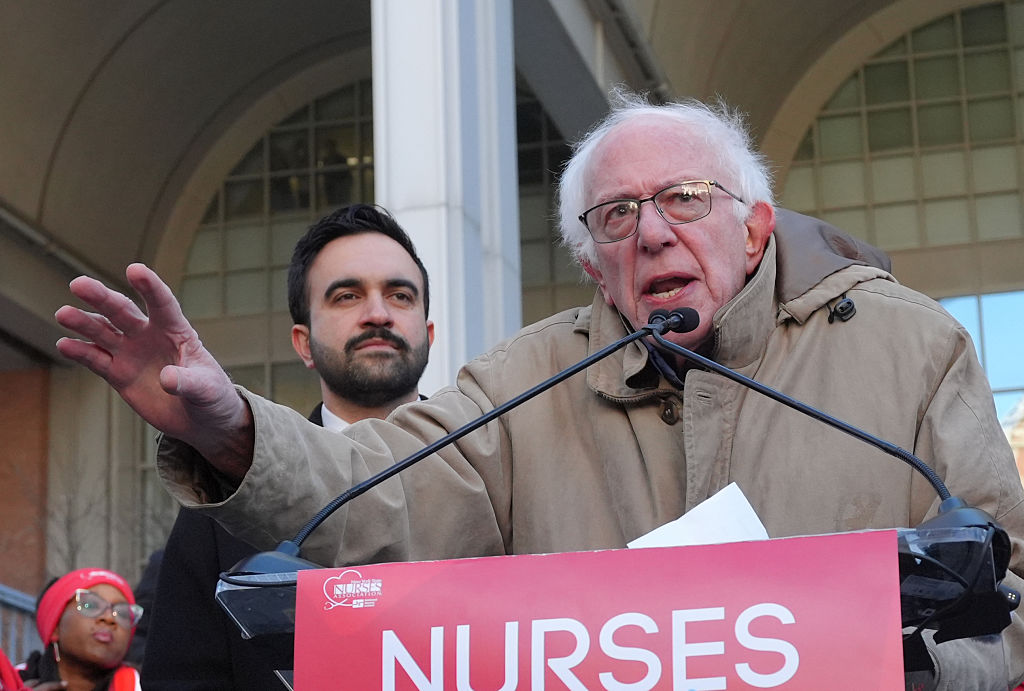
New York City Mayor Zohran Mamdani and Vermont Sen. Bernie Sanders join nurses on the picket line on January 20, 2026, in New York City. (Selcuk Acar / Anadolu via Getty Images)
How effective has the Left’s political strategy been since the first Bernie Sanders campaign? And how has our relationship to the Democratic Party changed?
On this special episode of the Jacobin Radio podcast Confronting Capitalism, recorded live at Littlefield in Brooklyn on April 6, Vivek Chibber and Melissa Naschek are joined by Krystal Ball and Matt Karp to discuss how class politics can convert popular anger into durable power — and why rebuilding labor is the precondition for any serious democratic renewal.
Confronting Capitalism with Vivek Chibber is produced by Catalyst: A Journal of Theory and Strategy and published by Jacobin. You can listen to the full episode here. This transcript has been edited for length and clarity.
- Krystal Ball
Well, first of all, thank you for not asking me specifically for a definition because I got very nervous there. And, second of all, thank you so much for having me. Thank you to Jacobin. When I was back at MSNBC as an embarrassing sort of progressive lib, I was reading Jacobin and becoming increasingly radicalized. So, it’s been an important part of my political development and it’s really an honor to be able to participate in things like this. And thank you also for giving me an excuse to come here to the “Commie Corridor” of Zohran Mamdani’s New York.
I’m going to speak mostly to the national level because that’s most of what I cover. There are probably people here in this room who would know more about the specifics of local engagement and the work the Democratic Socialists of America (DSA) have been doing here in New York and around the country.
To sum up, I would say that the most successful strategy that has been employed since Bernie’s 2016 win and has shown the most results, with New York City being the primary example, is DSA-backed candidates running in Democratic primaries. Now, I think that has had mixed results both in terms of whether people actually won and also whether they delivered what we were hoping they would deliver when they got into office. But I still think that that is the strategy that has been the most successful and that has the most promise.
So, to think back to where we were after Bernie lost in 2016, even though obviously it was very disappointing that he would not be president in that particular instance, there was still a lot of hope on the Left because the sense was like, oh my God, okay, this guy came out of nowhere. You’ve got all this growth in the Left. Young people are super excited about it. This is where the country is going.
We were right in our critique of liberal politics and its failures, and we saw the realignment of the working class toward the right wing. All of these things happening were what we predicted. We saw the Justice Democrats, the Squad, and candidates like AOC come in and, oh my God, she knocks off Joe Crowley out of nowhere. She’s going into Congress. Everything felt like it was building. The ranks of DSA were expanding.
There was all this great organizing and excitement, and you get into 2020. Okay, we’ve got our guy. Bernie’s running again. We’re all behind him. Let’s go. We’re going to learn our lessons from the last time and then, boom! He loses. And that sets off a lot of recriminations that I’ll get to in a moment, a lot of left infighting, etc.
But I want to go back a little bit to that time period between 2016 and 2020 because, even though I don’t think Bernie’s defeat was inevitable, I do think that the seeds of that defeat were sown during that time period.
First of all, and this is something that Vivek can speak to better than I can, there was an adoption on the Left of the very same neoliberal identity politics that had been weaponized by Hillary Clinton and the neoliberals to defeat Bernie. So this is taken up wholesale by the Left and makes it a less appealing and less broad-based coalition. So you have that.
You also had at that time within the Democratic base itself — and this is something that I think has changed now, which gives me hope — a lot of excitement around Democratic leadership. There was a lot of faith in Nancy Pelosi and Adam Schiff and a sense that these people were fighting the good fight and knew how to defeat Trump and knew how to defeat the fascists at the doorstep. You also still had a lot of confidence in mainstream liberal news sources.
And so, when it came down to it in 2020, and you’ve got this, in my opinion, genuinely existential threat of Trump at the doorstep, and all of the media apparatus and all of the establishment figures led by Barack Obama chimed in and said, “Sorry guys, you may like Bernie’s policy better, but Joe Biden’s the guy that can win.” The way they all fell into line was astonishing. So that was the period where there was a lot of hype and excitement, but underneath the surface, there were a lot of problems.
Post-2020, Bernie, AOC, and the Squad were in some ways disappointing. And I honestly don’t want to personalize it. I think this was because there’s a lot of weakness on the Left and they didn’t necessarily have the organizational backing to be this force standing up to the Democratic establishment. They calculated that the best direction to go in was to collaborate with Biden, try to push from the inside, try to work from the inside.
And they did have some results in the Biden administration: They were very pro-union. They were good on antitrust. There were some genuine breaks with the neoliberal consensus that you could see in the Biden administration and that you can trace back to Bernie in particular, as well as AOC, and even Elizabeth Warren to a certain extent. But obviously, that also has its limits.
And then you had October 7, and you had the specter of a Democratic president, vice president, and ultimately the Democratic nominee wholesale backing a genocide occurring in real time in front of all of our eyes. Obviously a lot of left organizing, understandably, went into opposing that moral abomination, and that was expressed electorally through the uncommitted movement, which was unsuccessful in being able to force either Biden or Kamala Harris to change their position.
But I think those efforts were successful in terms of exposing the hypocrisy,the deceit, and the moral cowardice of the Democratic Party establishment. And that, along with horror at the Immigration and Customs Enforcement (ICE) raids, horror at the Iran war, a sense of increasing precarity among white working-class people who also see AI coming for their jobs, I think has created an electoral opening the likes of which we have never seen before in our lifetime for the Left.
Zohran Mamdani is proof of that. And of course, that is owed to all sorts of factors that created a ripe environment, incredible DSA organizing. He’s also a very talented and charismatic person. But I do think he’s a test case for the type of politics that are possible now.
So, that’s my broad summary from there to here, and of some of the strategies that have been employed.
The Case for Optimism
- Vivek Chibber
There’s not a single sentence in that that I would disagree with. That’s amazing. Let me follow up on one point and deepen it.
I think, first of all, it is not surprising that people in the first wave of the Bernie moment were feeling their way through what might be the right strategy, what might be at that moment the right tactics, how to win, because we came out of forty years of utter desolation and absolute defeat, dejection, and confusion.
And out of nowhere, Sanders comes. And he comes at a moment when there’s no organizational base. There’s no political culture. The media is corrupt as hell. And what passes as left wing of the Democratic Party is a kind of neoliberal identity politics, right?
So it’s not surprising that we’re having to fight our way out of this morass. But something Krystal brought up is absolutely key to this, which is the confusion that you can fight for what you want to see — which is the kind of populist wave fighting for people’s basic economic needs and their security — or you can try to win. And supposedly Biden was the guy who can win, even though we love Bernie.
But what Mamdani has shown, and part of our maturation now is seeing that actually, if you want to beat the Republicans, Bernie is the way to win. It’s not that Bernie is aspirational and moral but impractical. It’s that if you want to actually bring 50 percent of the electorate that doesn’t vote back out, if you want to win over the working class that’s been dealigned from the Democratic Party and going over the Republicans, if you want to win over the Latino vote and the working-class black vote, Sanders’s program is the way to go.
I think Mamdani’s win has huge implications, since he came out of nowhere, he was exactly the person who “could not win,” he stuck to his guns, and he continued to pound the streets and go door-to-door delivering his message. I think at this moment, Krystal is 100 percent right, this opportunity is the best we’ve ever had.
Now that we’ve come out of the other end of the Bernie moment, one lesson is that, in fact, the Sanders campaign, this kind of social democratic program, this kind of electoral strategy, is not only something that lines up with our moral inclinations and our political program, but it’s also practically the one that can actually get you where you need to be.
And my feeling is that this, and the fact that we are finally coming out of the woke brain virus on the Left, gives the Left an actual chance to win, and to extricate the notion of progressive politics from the grip of the black, brown, and white elites who have captured it.
- Krystal Ball
And I would just throw Graham Platner into the mix as another very important example of this shift. In the state of Maine, where you’ve got all these older liberals looking at Graham and have the choice between him and Janet Mills, the sitting governor, and he’s winning by like 30 points. And not only that, but the polls also have him beating Susan Collins by a much larger margin than. Mills. In many of the polls, Mills doesn’t even defeat Collins.
So in some ways, Graham is an even better test case, because people can always resort to, “Oh, New York City is so liberal, it’s different, it’s not representative, blah, blah, blah.” Maine is harder to explain away, I would say.
- Matt Karp
Yeah. We were talking backstage about who’s going to be good cop and who’s going to be bad cop. And Vivek’s like, “I’m always the bad cop.” And he comes out here tripping over daisies and throwing rainbows out of the palms of his hands.
- Vivek Chibber
The fact is, for the last eighteen months, I have totally been Mr Pollyanna. The eighteen months before that, I was like, “Let’s dig a hole, jump in it and not come back out again.”
- Matt Karp
So, I’ll offer some more critical thoughts. But first, I need to one-up you, Vivek. I agreed with every syllable of Krystal. It was magisterial. I love those little capsule histories of the present. So I really did value that. And I do agree.
There’s a lot to be optimistic about right now if you compare this moment to a lot of the other moments that were brought up, whether it was the woke world of the late 2010s or early 2020s or the ultimately bogus enthusiasm for Joe Biden that I think captured a lot of people. Right now, we do have opportunities. We have openings. We have reasons for hope. And I’m going to cop to my own blind spots before I go negative.
In January of 2025, when Zohran was jumping in the ocean at Coney Island and polling at less than 4 percent, I was at a meeting and some younger guy was like, “What do you think of the Zohran Mamdani campaign?’ And I was trying to channel Don Draper in the elevator in Mad Men. I was like, “I don’t. Who cares about some liberal socialist running for New York mayor?” And look, I was totally wrong.
I was never a hater of Zohran. Who could be a hater? But I was a skeptic. I didn’t think it was going to go anywhere.
- Vivek Chibber
But everyone was, including him, probably.
But Class Dealignment Isn’t Going Away
- Matt Karp
Yeah, but I want to just own that. But here’s the limit to the Left and all of the examples you guys have cited. The elephant in the room that we always come back to is this class dealignment problem, and this issue that, in the same period that we talk about the alternately inspiring and confronting Bernie Sanders era, underneath that, and all of the action or waves at the top of the ocean, there’s an undertow.
And that undertow has been workers and people making less income and with less education generally — if you amalgamate that in a crude way, it approximates real life chances and real access to power and the good things of life — are moving Republican while people at the top end of the spectrum have been moving Democrat. And nothing that we’ve said or done, or Bernie even, who no one loves more than me, has changed that.
And that’s a reality that I still think we need to reckon with. And I think the Left in some ways needs to reckon with it harder even than the Democrats, because the Democrats can get by winning with their remade coalition, with the college educated and with various smaller minority groups or whatever. That’s the Kamala coalition that didn’t win, but the Biden coalition did win. And the margins are pretty small.
Also, the Democrats don’t have an ambitious program to do anything. They want to win power every other election, more or less, and stave off the fascists at the gates half the time. So, not bad. But we want to change the country. We want to empower the working class. We want to create economic democracy. The bar is a lot higher for us than it is for them.
And that means we need to win in places that are utterly unlike New York City. I know you guys agree with this. But still, we need to win in places that look nothing like this room, and places that have politics that are nothing like this room.
And to me, when I take a hard look at the last eight years, I’m not sure we’ve advanced that ball that much. And so that’s a provocation for the panel. But I think that is our challenge.
- Krystal Ball
So, you’re obviously correct. You can’t have a working class–centered politics with an attitude of, “Well, we’ll worry about these working-class people being in the coalition later.” But I think you need to expand your definition of “working class,” because for a lot of decades in this country, you’ve had a separate economic track for blue-collar and service sector workers. So basically, non-college versus college-educated workers. That is still the case, but the gap is narrowing.
The same squeeze that came for blue-collar and service sector workers is now coming from white-collar workers as well. And while it’s not the whole story, I think that is part of why you see an increasing radicalization, or I’d call it a deprogramming of the college educated, who were formerly liberals and now basically share an ideology with the DSA, much more than they share one with democratic elites.
You have AI overlords every day coming out and announcing that they’re going to destroy every white-collar worker’s job. You have — as someone who’s about to send a daughter off to college — you have parents and young people who are looking at the landscape who are like, “I literally don’t know what work will be left for me.”
Now, maybe this is all hype and this is all overblown, but if you don’t think people are worried about that and, by the way, not already feeling that in their own workplace, where instead of having mass layoffs — there are some layoffs going on — but they’re just not hiring and people are fearful to move. And you can see there’s no wage growth. They’re seeing the same precarity come for them that already came for blue-collar and service sector workers.
And so I think we, as the Left, need to expand our view of what the working class is, not look down our nose at like, “Oh, we can’t have those college-educated people dominating the coalition,” because increasingly their problems are the very same material concerns of blue-collar and service sector workers.
The other thing that I’ll say is that I do think the ground is more fertile to win over some of that more traditional working class than it has been before. Right now, if you look at most polls, Trump is underwater with non–college educated voters. A lot of the groups that were steadily moving right, the young people, Latinos, etc., those are the groups that have fled the fastest.
Now that doesn’t mean the Democratic Party is winning them over, but it means there’s an opening. And I think there’s a real sense of betrayal, of economic betrayal, of betrayal because Trump has brought us into this horrific conflict. I mean, I think it is already World War III. He is potentially causing a global depression. Gas prices are up. Inflation is almost definitely going to spike.
And then you also have a real betrayal that won’t show up in the polls, as a top issue for people in the cover-up of the [Jeffrey] Epstein files which just totally blew this guy’s cover as some paragon of the antiestablishment: “I’m going to come and run this place for you all.” Trump has been proven to be a tool of oligarchic elites who want to eliminate every single white-collar job and as many other jobs as they possibly can, and make human beings irrelevant.
So, I’d respond with those two things. Number one, broaden the definition of the working class. Number two, the opening is there, but, you’re absolutely right that we have to seize it. And it may take actually winning an election like Zohran in New York City to prove that we’re actually delivering for people before we actually win back some of that trust.
- Melissa Naschek
I agree with a lot of your comments, Krystal. For many in this huge group of people that have a college education, it increasingly seems like they’re being locked out of what was promised to them, which is a high-paying career. So part of what the Left faces is a political challenge to get them to also agree that what they need to do is be in a working-class coalition.
But another part of the problem for the Left has been its adoption of these very unpopular positions on identity politics. And I think among that white-collar, college-educated group, there’s still a lot of adherence to these kinds of politics.
I think one of the things that Zohran’s campaign can potentially prove is that actually there’s another way to form this coalition, but the Left has to actually choose to integrate it into its strategy. And I think that it is still a bit of an unknown if they’re actually going to go down that road.
- Krystal Ball
Yeah. Matt, you and I have talked a lot about the Virginia versus the Nevada model of the Democratic coalition. Virginia, especially northern Virginia is suburban, upscale, college educated, more white, although there are also significant black populations that go into that. Nevada, on the other hand, is more based in a multiracial working class. In Nevada, they tended to focus more on material concerns. Virginia tended to focus more on, like, “let’s pass a resolution about the Equal Rights Amendment” or whatever.
It’s been very interesting to see things change in Virginia, where I live. Abigail Spanberger was recently elected governor. She is terrible in a lot of ways. She’s former CIA. She came out after Trump won the second time and her analysis was like, “The Left is the reason why Trump’s back in office.” She ran as a centrist. I was watching all these ads saying, “She’s a national security Democrat, blah, blah, blah.”
- Matt Karp
She was the poster child of this in Virginia. Like, you couldn’t find it more on the nose.
- Krystal Ball
But since she’s gotten in office, she hasn’t been half bad. There has not been all this virtue signaling. Her first act was to roll back an executive order that demanded that local law enforcement work with ICE. That was her first order of business, and it passed.
I’m not saying it’s revolutionary stuff, but she’s focused on going after pharmacy benefit managers and cutting health care costs in whatever way she can. She’s saying she’s trying to lift the minimum wage and expand labor rights in the state. And this is a lady who is diametrically opposed to that type of politics.
And it’s not because she’s changed. It’s because this is an upper-class professional white lady who is living in an ecosystem of similar types of people who have really shifted in terms of the way they view their political priorities. And that is who she’s fundamentally living for.
So I have found that really very interesting. The way that she has chosen to govern since she’s gotten into office was very different from how Virginia Democrats have governed in the past.
- Matt Karp
Yeah. I mean, look, I actually take all your points. They’re helpful because I don’t want to tie myself to the mast of some kind of twentieth-century class politics where every worker has to have a hard hat, yada, yada, yada — all the stuff that people always say to sort of caricature anyone who says, “Hey, we should care about the 60 percent of the electorate that is not college educated still.” I understand that even that group is much more diverse than the stereotyped images one would have. And I agree that there are openings in the white-collar workforce.
And it’s not 1995 or 1983, where every centrist white-collar worker is then also going to support Democratic Leadership Ccouncil–style austerity and Clintonian triangulation. I think a lot of them are on board for some measure of progressive policy. And I think Spanberger is in some ways the most vivid example.
You’ve seen it with other Democratic figures who I’m even more sympathetic to. People like Chris Murphy in Connecticut or Jon Ossoff in Georgia, who are prototypical suburbanite, white-collar, elite-educated, well-dressed white guys. But they’re making hardcore populist cases, at least in YouTube clips, about the Epstein class and about how this is the wealthiest cabinet in history.
And they know that their base is this white-collar professional electorate, and they’re still making populist-sounding arguments. And I think that’s positive. But I think there are limits to it too.
I think there are still huge limits to how this populism expresses itself. Rather than an independent attack on the bipartisan millionaire class, it becomes shoehorned into a really specific partisan attack on Trump and the Republican billionaires. To the average voter who’s not deeply partisan, to the independent working-class voter, a lot of whom are still very gettable, I think that kind of rhetoric has limits when it ends up just coming back to, “those are the bad guys,” when that worker knows that there are a lot of Democratic millionaires and billionaires out there. And even if a lot of them suddenly became right wing on inauguration day, they’re going to go back and become Democrats again in the next election.
- Krystal Ball
I don’t actually agree that’s the rhetoric though. I mean, you mentioned the “Epstein class” rhetoric, and the Epstein class, we all know, is cross-partisan. And what I hear from people is like, “Listen, if Bill Clinton’s in there, let Bill Clinton be in there.” You know, “If Bill Gates is in there, all right, we need to deal with that.” And I do think that this is another kind of opening.
While I, as a leftist, have a certain view of the way power works in the world and the way elites dominate, I was not prepared for just how direct and brazen that exercise of power really was, as was exposed in the Epstein files. And what you see there is some incredible billionaire elite-class solidarity. So I think anyone who’s looking at that, and this is part of the opening, not just for the college educated but for the entire country and anyone who would be open to joining this type of coalition, it’s very hard to read those files and be like, “That’s why the problem is trans people,” or, “That’s why the problem is immigrants.”
It’s like, no, we can see the billionaire class right in front of our eyes. We can see the Epstein class and the way that they operate. And so I don’t agree, Matt. I mean, of course there is some partisan, “Oh, it’s just Trump and the Trump billionaires.” But I truly believe that there’s been more of an awareness of class consciousness and that it is an area that needs to be further developed.
But another important development here that I think has been really noteworthy is the growth of the I’ve Had It podcast with Jennifer Welch and how much of a star she’s been, because her audience is these white, college-educated liberal ladies, and here she is on there like, “Cory Booker, why will you not say that Benjamin Netanyahu is a war criminal? Why will you not pledge to not take any AIPAC [American Israel Public Affairs Committee] funds?,” holding their feet to the fire.
I was at a No Kings protest the other day in my little conservative town, and there were anti-AIPAC signs there. My town votes 65 percent for Donald Trump, and it’s small. Never in my life would I have thought that I would even be able to have a conversation in this town with someone about AIPAC, let alone go to a protest.
So, what I worry about is less the radicalization of the base, which I think is already there, and more the manipulation of the politicians. Could a Gavin Newsom or Chris Murphy, one of these people who gets how to talk the talk and say the right words and put up a lot of theatrical resistance to Trump, could that be enough for a broad swath of the Democratic base in 2028 to look at and go, “Oh, that’s our guy. That’s the fighter. That’s the guy who’s going to. . .”?
- Matt Karp
Absolutely!
- Krystal Ball
I actually wouldn’t say that. And I actually don’t think that Gavin Newsom is as slick as he thinks he is. He’s already face-planted like five different times. It becomes very difficult when you’re being asked direct questions about AIPAC, about genocide, about his opposition to this wealth tax in California. It becomes very difficult to weasel your way out of it. And he hasn’t been able to successfully do it.
To me, the danger is that you have some figure who can check enough boxes that they can sneak a status quo agenda through while using some leftist language.
- Melissa Naschek
Yeah, Krystal, I think a lot of times the Left’s wins don’t necessarily come in the exact form we think they’re going to, right? Sometimes we’re influencing the overall landscape and the direction of things.
Vivek, how do you think that the Left’s strategy, in particular its electoral strategy, has helped advance left politics in this roughly ten-year time frame we’re talking about?
The Left and the Democrats
- Vivek Chibber
It kind of depends on what we call “the Left.” Right now, at this moment, the Left is basically the Democratic Party and a few organizations that orbit around it. And then there’s something like the DSA, which, where the DSA is doing important work, it’s mostly still orbiting around the Democratic Party. So I’ll link this up to what Matt and Krystal were talking about.
The point of seeing this political opening right now, that all three of us agree is here, is, as Matt said, not to win the next election or even the election after that. Those are tactical issues. What’s always distinguished the Left is they have a strategic perspective on how to build over the long term.
So the essential thing for us is to not just win these elections, but through the elections, to sink an anchor into what we think our main constituency is, which is working people. And Krystal is right that that’s increasingly going to include a lot of people who are middle income or higher income, who are being proletarianized or who are being thrown out. That doesn’t so much require changing our definition of the working class, but changing our expectation of what kinds of people are being sucked into the working class. And that is no doubt expanding.
Now, I will say this: even if we’re having this white-collar job AI apocalypse, just from what we know about the history of electoral politics on the Left, there is no universe in which you were going to advance a social democratic or socialist agenda just based on blue-collar workers. It was never going to happen. Or even on the working class defined in an expansive fashion.
You’re always going to have to draw in sections of the middle class, of the managerial class, of professionals. Nowhere have social democratic parties ever won purely based on the working-class vote, much less the blue-collar vote. You can’t lose it all either.
And this is where maybe I disagree a bit with Krystal on this.
It comes down to a question of who sets the agenda. And it is in fact true that if college-educated people are being drawn into the ranks of the working class, they have much more varied agendas than what we would call ordinary working people. They don’t have to be blue collar, but working people in the service sector, working people who are maybe in the slightly more elevated positions within the labor force.
It is in fact the case that if the college-educated working class hegemonizes and sets the agenda, it’s not going to draw in the people who you see as your long-term target for being the anchor and being the constituency of what you’re trying to do. This does not mean that you exclude the college-educated people, but it does mean that you have to set a priority as to who sets the core of your agenda, which is the economic issues, the issues around bread and butter, around basic services, around health care, etc. And then which people you try to draw into that agenda.
Now, here’s another lesson of the Sanders experience.
If you draw up that bread-and-butter agenda, and that’s what Sanders did, it did bring in the college-educated left, especially the younger ones. Why? Because the older sections of the college-educated population already have health care, retirement, and pensions. The younger ones face precarity for their entire lives, even if they can get jobs.
And so, something like a de-commodified services-based agenda like Sanders has appeals to them because they need health care, they need transportation, they need housing, which they will never be able to afford even if they have jobs.
But Bernie thought if he just puts out the agenda, all those workers who have given up on the system, who have dropped out — not just dealigned from the Democratic Party in terms of going to the Republicans, but who’ve just given up — that they’ll be inspired and they’ll come back in. And that didn’t happen. Only in patches or small eddies here and there.
How can you make that happen? That’s the flip side now, the other side of this opening. You have to use the elections as a tool to do the actual organizing and to build organizations where the working class lives, where it works and where it lives.
You cannot be an organization that shows up every four years and knocks on the door and says, “Hey, will you vote for this guy, look at the agenda,” because most people think it’s not going to do anything. They’re so dejected.
So in my mind, part of this opening should be a tactical discussion: Gavin Newsom or Ro Khanna? What do we do?
But what distinguishes us and sets us apart from the liberal left or from the Democratic Party is, as these guys said, the Democrats are happy just to win the election. They don’t care about class, they don’t care about constituencies, they’re in the numbers game. And whoever gives them the votes, they’re happy with that.
But one of the things that you do as a socialist, as a social democrat, is you have an analysis of who is the long-term constituency and the long-term agent for what your political program is. And that is still going to be the working class, traditionally defined, which has then in its outer orbit members of what we call the professional class, the managerial class.
They’re all going to have to be in there, you can’t win without them. But A) you can’t let them set the agenda, and B) you have to step out of the electoral arena.
Until we start doing actual organizing, and not just canvassing, we’re going to be limited. We have to actually do what the Communist Party was doing in the 1930s, what the labor parties were doing in Europe, what the social democratic parties were doing globally, which is that you don’t just go out to them and ask for their vote, you bring them in and you make them the lifeblood of your party, and you live with them and work with them and fight with them. At that point, you can start setting the agenda in a long-term perspective as well.
Right now, we’re just in the very, very beginning stages of this. We’re the first left in the history of the Left that has to be convinced to fight on economic issues. That’s how screwed we are.
- Matt Karp
See, I brought out the bad cop.
- Krystal Ball
I think I might have brought him out actually.
Here’s something I want to add to the conversation, which I think adds on to what you’re saying there, Vivek. There’s a new book that just came out by Noam Scheiber called Mutiny: The Rise and Revolt of the College-Educated Working Class. He talks about how a lot of the organizers or people who were activated by Bernie’s 2016 campaign were college-educated people who bought the promise of, okay, you do the thing and you get good grades and you go to college and take on the debt. But then at the end of that rainbow, there’s going to be this stable, at least middle-class life for you where you have health care and you’re able to buy a house, blah, blah, blah.
Obviously for many millions of people, that was a lie. They graduated college and they ended up with a lot of debt and a job as a barista at Starbucks. Some of those very people are the ones that went on to lead successful union organizing campaigns in places like Starbucks, in places like Amazon, places that we previously thought it was impossible to organize. That’s part of what’s in my mind when I’m talking about the expanded working-class definition.
We shorthanded the working class as non–college educated. I just don’t think that is the reality of the working class when you look at the number of college-educated people who are never able to get into that professional-managerial class at all.
- Vivek Chibber
That’s absolutely right. Let me just deepen your point. It’s always been the case that organizers and some of the leaders of labor struggles have come from the middle class. They’ve come from people who are more educated, who have literacy, who have a lot of confidence and who have been proletarianized, highly skilled workers, who are craft workers. That’s always been the case.
The question is, what’s your anchor?
And you have to ask that question if you’re on the Left, you have to. And if your anchor is still the 60 percent or so of the labor force, what we would call working class, people who work for a wage, whether it’s blue collar or not. If that’s your anchor, then you have to forge your platform, your program, your strategy based on them.
You do not close your doors to or look down your nose at the others, absolutely. But you also can’t live in the fantasy that if these people are being pushed down into the ranks of the workers, we don’t make a distinction between them and the workers. Because it’s not just in the United States, it’s also everywhere else. The more professionalized sections of the working class have tended to play a more conservative role or a more, let’s just say, hesitant role.
Just remember: the Bernie Sanders program can’t be our horizon. That’s just the start of trying to humanize this world. And while many sections of that part of the labor force will be drawn to the Sanders program, if you want to go further, you have to look for the people who have an interest in going further than that.
AI Doomerism
- Krystal Ball
I think that’s a very important point and one I wanted to raise, which is that, number one, I think part of how you view this question we’re grappling with is what you think is going to happen with AI.
I’m a bit of an AI doomer. I think when they say they’re coming for everybody’s jobs, I think they mean it. I think they would desperately like to make human labor as irrelevant as possible. And that opens up, obviously, dystopian futures that we cannot even contemplate at this point.
However, again, you also have an opening here. Because we see Sam Altman and Mark Zuckerberg and all of these cartoonish villain characters running around saying, “We’re going to rip up the social contract. We are going to destroy the social contract, and we’re going to write a new one.” And as the Left, we should say, “OK, bet. Let’s do that.”
Because, does anyone really think — to your point, Vivek — that at this point, given where we are, given the existential threats, of AI, of climate crisis, of World War III, potential nuclear conflict, given where we are with these existential challenges, does anyone think that Medicare for All is going to cut it? I mean, it’s great that we’ve moved a lot of the population. I think even a majority of Republicans now support Medicare for All. That’s awesome.
But we have to continue to push that horizon, to your point, Vivek, and continue to be at the vanguard of making politicians uncomfortable, because the world is coming at us really quickly. And I think there’s a true existential question on the table. There is a true sort of decimation in our future.
The only reason they keep workers around at all is because we have to do the labor. And so that, to me, is the piece that really needs to be dug into and dealt with more seriously on the Left.
- Melissa Naschek
One thing I wonder, looking at people like Chris Murphy who are nominally adopting populist positions, is: Are they actually moving toward the Left, or is something else going on?
- Matt Karp
In some ways, yeah, I don’t want to make it about Chris. I actually like Chris Murphy. He’s like a top five senator for me. So I don’t even want to dunk on him. But it’s a low bar for Senate rankings.
I want to focus on Vivek’s invocation to take the strategic aspects of left electoral politics seriously. Because the burden of your point is outside the bounds of what I know about, such as what Ben Fong was talking about on the podcast. We’ve got to organize Amazon. That’s nonnegotiable as part of any kind of meaningful left project, etc.
But in the electoral realm, what would a strategically successful left electoral project look like over the next like ten, twenty years?
Within the American constitutional system, with its checks and balances and with its federalized power, it requires enormous majorities. There’s just no way around it.
And the only small example we have is the New Deal, which was inadequate and yet still better than anything we’ve seen in our lifetime. And it depended on massive majorities. It depended on exactly what you said.
- Vivek Chibber
It depended on two things, Matt. What allowed the New Deal to persist over fifty years? Massive majorities. But secondly, you’ve got to keep in mind, the Democratic Party was actually two parties in those decades. There was the South and there was the North. And the northern Democrats could not have sustained the New Deal without the help of northern Republicans. Republicans from the Eastern Seaboard.
And the question is, why did Republicans from the Eastern Seaboard and from the Midwest cooperate? These are the two key regions. Why did they cooperate with the left wing of the Democratic Party? And there’s a simple answer. These were the parts of the country that were unionized.
The United States had 35 percent union density at its peak nationally. But if you look at the Midwest and the Eastern Seaboard, it was Sweden. You had 70 to 78 percent union density in those parts of the country. So if you were a politician coming out of those parts of the country, you could not ignore the needs of labor. So now you ask the question: What would a successful strategy over a decade or decade and a half look like?
Now, I’m not as much of a doomer about AI as Krystal. I think the jury is out on that. But I’m a doomer about this. No electoral strategy that relies on elections can succeed on the Left if it doesn’t have real organizing within the working class.
- Matt Karp
Well, yeah. I think we would all agree on that. And we have to believe that. It’s almost like a predicate that we have to assume that and then have our conversation about what a left political strategy should look like.
- Vivek Chibber
And we should say, that’s a big assumption. We are still hemorrhaging union workers.
- Matt Karp
Now private union density is 6 percent. And dropping.
- Vivek Chibber
You know, Ben mentioned this on the podcast. There were 120,000 workers who voted in NLRB [National Labor Relations Board] elections last year. In order to maintain the current level of union density, we need a million workers to be doing it.
- Matt Karp
But Vivek, I don’t want to talk about unions and organizing because I don’t know anything about that. So I want to talk about what I know. I want to talk about elections. But I completely agree. I think probably we would all agree.
- Vivek Chibber
But we have to make that part of the discussion here because we’re talking about our political challenges. And if we simply reduce it to electoral challenges, we’re missing 80 percent of the game, because if you don’t have that weight, I can tell you right now what’s going to happen electorally.
I don’t care how many elections you win. If there’s nothing else on the ground happening, you’re going to move to where the power is in your country and the power resides with capital. There’s no way around it.
- Krystal Ball
I think it’s the sort of thing where you’re going to have to build the plane while it’s going down the runway or whatever people say. Because the reality is, given the present approach to labor organizing and given what an incredible uphill battle it is, you are just not going to have a high level of union density without getting someone in power who is going to fundamentally change the way it even works to join a union. That’s what it will require. And so that is not going to be there.
- Matt Karp
We need chickens and we need eggs at the same time.
- Krystal Ball
That’s exactly right.
- Matt Karp
I want to take up the electoral side of that strategic challenge in simplistic terms. I do think a lot of Mamdani-pilled leftists might not fully appreciate the scale of our challenge, meaning the scale of what it would look like to actually win that 60 percent in America, that 60 percent majority.
And actually, as much as I agree with all the particulars that Krystal said, I’m not sure if in toto what she’s saying about this sort of proletarianized college worker–led party is capable of remaking the Democrats, but a little bit better, a little bit more anti-AI populist, a little bit of pushing Spanberger in that direction.
I’m not saying we can’t work with the Democrats, because it’s like what Frederick Douglass said about the Republican Party during Reconstruction: It’s the ship and everything else is the sea. There’s no other practical way to go. We have to work in this scheme. But I don’t think we should deceive ourselves about the bearing of that ship right now.
At the Center for Working Class Politics, we just did a survey of the Rust Belt. And a big challenge for our politics is why did Sherrod Brown lose, right? He is the most pro-union, even gravelly-voiced working-class populist. Okay, yes, he went to Yale, but he’s the labor Democrat, right? And for years and years, even in the last election, he ran ahead of Kamala. He’s great, but he still lost.
And what we found is there’s this thing called the “Democratic penalty.” If you run in the Democratic Party in the Rust Belt, in Ohio, in Wisconsin, in Michigan, you’re looking at a 10 to 15 percent deficit just by having the “D” next to your name. And why is that?
I’m mostly convinced that it’s about class dealignment. It’s because the Democratic Party no longer stands for the number one thing that the Democratic Party stood for from Franklin Delano Roosevelt to John Kerry, which is the party of the little guy, the party of the working class, the party that punches up.
And as long as it’s a party whose agenda is set by, and whose most visible characters are in, this elite professional class, however radical they might be getting on policy, that party is going to pay a penalty with the larger group of the electorate, the much larger group of the working class that right now is very allergic to outright hostile — even the group that are like 20 percent of Trump voters who support Medicare for All or whatever, who support a jobs guarantee, that group is completely allergic.
That’s the group we need. More than anything, we need that group. We need the independent voters, the working-class independent voters. Right now, I can’t see those voters getting behind a party of Spanberger, or even a party of Spanberger plus Medicare for All. I just can’t see it.
- Krystal Ball
I’m not arguing for the party of Abigail Spanberger, to be totally clear.
- Matt Karp
You have credibility on that.
- Krystal Ball
First of all, I think Sherrod Brown is probably going to win this time. There’s something to be said about that and the way that the politics have shifted. I think you also have to grapple with the fact it’s not like the Republicans are led by a bunch of non–college educated blue-collar workers. You’ve got a literal billionaire and a cabal of oligarchs, including the richest man on the planet, who won this election. I don’t think that’s necessarily the problem, whether they’re college educated and what college they went to.
The problem is the Democrats suck. The problem is they don’t stand for anything. They won’t fight for anything. To use the Gavin Newsom example again, he gets up there because he realizes, “Okay, the donors want me to say this on Israel, but the base wants me to say that. I guess I’ll say this thing about apartheid.” Five seconds later, he’s like, “I didn’t mean that. I didn’t mean that. Sorry.” There’s no principle they won’t abandon. There’s nothing they’re willing to stand and fight for.
Understandably, people look at that and are like, “This sucks. No to all of this.” You’ve also had, of course, this level of condescension toward a lot of the public that has come across where people feel like, “Yeah, if you’re going to condescend toward me, screw you.”
The reality of what we need is pretty simple. We see this with Bernie. We see this with Zohran. We see this with other examples. You need a charismatic class-first figure who is going to set the agenda and bring people along and put that at the center and directly rebuke the Democratic Party as it is and as it has been.
To me, maybe the most hopeful development that I’ve seen is the fact that there is a negative approval rating for the Democratic Party among Democrats. They’re disgusted. They hate Chuck Schumer with a burning passion. They want that man to retire. They want Hakeem Jeffries to go. And in that way, they are very much in line with the rest of the country.
So, you know, I think there’s an opportunity for someone who runs hostiley against the previous Democratic Party. And these things are not going to happen overnight. The Left will have to prove itself when it gets in there and actually governs and improve people’s lives. And there’s an actual benefit in governing for them. That might be a narrow path. I’m very well aware of what the perils and the dangers are, but that has to be what the path is if there’s going to be any chance of success.
- Vivek Chibber
I completely agree. We are now going from prognosis and analysis to some kind of program and action.
Historically, is there is any universe in which the Democratic Party, as we know it, will consistently become a party that fights for the working class or for ordinary people, has principles, and stands by those principles? As it’s currently constituted, it’s just not on the agenda.
So you can ask, well, it did it before. When did it do it before and why? I think there are two reasons. One is it was pushed to do it because trade unions organized and entered the party in very large numbers. Until the 1930s, when had it ever done that? It had never done it. And suddenly, it became a party that for seventy years, as Matt was saying, was identified with punching up and fighting for the little guy. Why? Because the little guy organized himself to the point where he civilized the party.
The second thing is Matt is 100 percent right. The Democratic Party is the only game in town. And I think we’ll all agree on that for the foreseeable future. But it has to have some force pushing it away from the grips of the billionaires and the wealthy and what’s called “the groups” and all these elites of various kinds.
And I can only think of two ways to do that. One is organizing. And you’re absolutely right, Krystal. It’s not yet on the agenda. But that’s part of what hopefully we’ll do on the Left, to make that part of what it means to be a socialist or social democrat. For a hundred years, the first thing you do is you organize workers. You organize them. You don’t just bring them in to vote.
The second thing is that I think something like a party is needed. Something like an organization that doesn’t run candidates as a third party but that gives the working-class organizations and political forces a center of gravity and an identity of their own so they’re not just sucked into the Democrats individually bit by bit, little by little, a Mamdani here, somebody else over there, a Platner over there.
They can’t survive. They will not survive on their own. Because once they get into office, they have to do things. And in order to get anything done, they have to curry favor with everybody else who’s on the city council or in the Senate or in Congress, who are agents of capital and of money.
So you need to have some kind of ballast, some kind of anchor, which has a class identity, which has a class agenda, and which doesn’t just go from election to election, and which gives these candidates a sense that, “Hey, I got somebody here who will fight for me, who stands for me,” and who gives them a vision, an identity to fight for.
I just don’t think that’s going to happen unless we change our focus from electoralism to prioritizing who we stand for, who our constituency is, getting them organized, and then giving them social weight inside these parties. I don’t want us to be so dissuaded from how forbidding and how difficult it is right now. I don’t want us to be so dissuaded and dejected by that that we set it aside and say, “Well, we’re having success in elections. Let’s just make that work.” Because it’s 100 percent guaranteed that having electoral victories without this stuff means you’re just going to get sucked into nothingness.
- Melissa Naschek
What do you think is working about the Left’s electoral strategy? And then where would you like to see some changes?
- Matt Karp
Okay, yeah, the solutions part of the program. At the Center for Working Class Politics, we’ve been putting out these survey experiments since 2022. And they all find the same thing. We keep saying it in different ways. But there are these kind of power chords, I think of it as like a classic. It’s like a song from Bad Company when the chorus comes in. And you’ve heard it a hundred times before, but you still want to hear it again.
- Vivek Chibber
Literally no one in this room knows who Bad Company was. You just dated yourself.
- Matt Karp
“Feel Like Makin’ Love?” Come on.
Okay, there are three big ones. The first is aggressive populist rhetoric. That is not Kamala 2024 rhetoric about this bad corporation, but serious rhetoric that identifies an enemy, à la what Bernie did, that identifies an enemy in the economic elite and uplifts workers in contention with that enemy. This rhetoric must make that the chief focus of real political combat. That’s essential.
This is time and time again in all of our studies. And you’ve seen a hundred thousand real world examples, including Zohran’s campaign, where that kind of rhetoric is by far the most effective in reaching independent working-class voters or working-class swing voters, the same sort of dealigning voters that the Left needs to reach. So populist rhetoric, number one.
Number two, laser-like focus on bread-and-butter economic issues. Again, polarizing on those issues where a lot of these people would agree with us. And that means also not polarizing on the other issues where they don’t agree with us. Now, does that mean — everyone always wants to bring up “Well, who are you going to throw under the bus?” Everyone gets thrown under the bus. This is history. Read Walter Benjamin. The angel of history is strapped to that railcar, and it’s just crushing right through all of us. So we’re all under the bus right now. That’s what it looks like to be powerless in a capitalist society.
If we’re going to try to redirect that engine of history, we need to be hardheaded and strategic about what happens. So it doesn’t mean abandoning core commitments to justice and morality, whether it’s on foreign policy or whether it’s on Israel or whether it’s on civil rights. Not at all. But it does mean taking the air out of the bag on a lot of those issues that are not winning issues for the Left. And look, it doesn’t mean you have to be like some Nate Silver dweeb. It’s about, do you want to win working class voters or not? And if you do, you’re going to try to win.
You know, you don’t have to be a popularist. You just have to be a “winning-ist.” And every successful left-wing electoral coalition from the antebellum Republican Party of Frederick Douglass and Abraham Lincoln to the New Deal coalition or the social democrats in Europe, they all made grubby alliances. They all made pacts with groups that were unsavory that the activist core was uncomfortable with. That was necessary. And that will be necessary today.
So populist rhetoric, economic focus, yes, to the exclusion of, not to the retreat on anything else, but to the focused diffusion of everything else. And then the third thing is more working-class candidates and candidates who are of different backgrounds, who are not just all of that sort of Yale- Williams College matrix of Ossoff and whatever.
- Krystal Ball
Okay, Mr Princeton.
- Matt Karp
Exactly — I shouldn’t be the face of anything. But that’s essential. And I think there’s a tiny addendum I would say about running only in the Democratic Party.
I think while we’re shouting out Platner we’ve also got to shout out Dan Osborn too, whose politics are more problematic on some level. He did say he supported the border wall and all this stuff. He’s running in Nebraska. And he almost won. And I think there’s a good chance he’ll win this year. He’s running as an independent. And I think there’s room actually for tactical independence because they don’t have to pay the Democratic penalty or they might not have to pay it quite as highly as the rest of the Democrats do.
But why is that? Is it because Dan Osborn is a political genius? No, he’s a union mechanic who’s just a plainspoken, ordinary guy. But he’s not identified with the powers that be that exist under that light-blue soft D. And I think that is essential, too. Those are my prescriptions, love them or hate them.
- Krystal Ball
I’m glad you brought up Dan Osborn because I kept meaning to bring him up. I think that’s very important in states that are red like Nebraska is. I think that’s a very smart strategy to be deployed in certain places.
I have a couple of things on the electoral front. As I said before, I am relatively confident in where the Left stands electorally in terms of the previous love of the liberal media establishment [being] dead because they’re seen as basically Trump collaborators. The previous love for Democratic leadership is dead.
It will be much harder to screw over a left candidate this time around than it was in the past. That’s huge. That doesn’t mean it’s not possible they could do it again.
- Melissa Naschek
We don’t talk about Iowa enough, what happened there with Bernie.
- Krystal Ball
Oh, my God. I can’t go there right now. I had such high hopes.
Anyway, so, I’m actually quite hopeful on the electoral front. I actually think what the Left really needs is more deep thinking about what the program and the agenda is, and I’ve mentioned AI a bunch of times because I’m thinking a lot about it. I do think that that is incredible peril and also incredible opportunity. I think Saikat Chakrabarti and others have been doing important work thinking through what that could look like. I’d take a look at automated luxury communism for some ideas of a direction to go in. It ultimately all has to come down to who owns this technology. That seems pretty clear.But anyway, there needs to be a lot of thinking about that, about how that program is sold to the public.
There needs to be a lot more organizing in opposition to these data centers, which is a new, burgeoning, cross-partisan opportunity for organizing across the country. The opposition to these things is skyrocketing in my little rural community. They’re trying to build two of these things and it’s brought all sorts of people together.
So on that front, you know, I think Trump is low-key destroying the American empire right now. And so there needs to be a lot of thought about, “Okay, well, what does a left foreign policy look like? How do we want the United States to operate in the world, engage with China, engage with other countries that are framed as adversarial? How do we want to create this new world order that is like basically being born as we speak?” And I think that’s an important part of this.
Obviously, along with the AI conversation, you have to talk about universal basic services, universal basic income potentially. All of that needs to be really thought through and fleshed out. And then it needs to be branded and pitched. Because like I said, with Medicare for All, yes, please. Great. I would love for everybody to have health care. That is not going to cut it. And then, of course, you also have an existential threat from climate crisis, which is going to cause more war, more refugee crises. There are big questions about borders and who belongs where and how that’s all sorted out.
So that’s actually my biggest concern right now, is that there needs to be more thinking and more understanding of where the world is going, how we’re going to respond to it, and how we’re going to sell that agenda and put together a coalition that will achieve that agenda for the public. Because there’s a lot on the table right now.
- Vivek Chibber
For the last six years, the Democratic Party has basically been fighting a war primarily against Bernie Sanders and secondarily against Trump. And the most important thing that’s happened in the last couple of years is that you’re seeing even though the Sanders wing technically lost, it is increasingly setting the agenda for the party, because the party realizes that the kind of policy prescriptions and discourse and positions they took up in order to fend off Sanders absolutely decimated the party.
So the most important thing that’s happened is the kinds of things we are advocating for, that you need to have economic issues at the forefront, you need to set the bar of entry around those issues, and then figure out how you can live with the disagreements on the other issues.
And, you know, every left historically always had disagreements on some of the social issues, but the idea was not that you’re going to make them permanent, it’s that once you’re in and you fight together, you will learn to overcome those disagreements because you’ve agreed on the single most important thing, which is that you’re all fighting together against capital. We’ve taken the first steps toward that, just the first steps, but without those first steps, nothing can happen. That’s where I’m really, really positive on this.
I also think that this is a unique moment in the last hundred years that we’re in because simultaneously you have a quasi-collapse of the two parties, a complete delegitimation of the reigning economic model, which is neoliberalism. Capital has lost control over both of these parties, which means the parties have a lot of room to actually set an agenda that capital may or may not be able to negotiate and navigate.
And thirdly, Trump has taken an empire that was in slow decline and he’s absolutely set it on fire. I believe the American empire is going to die in the next four to six years, which is not to say that American violence and aggression is going to die. You might see it get a lot worse. But the parameters and institutions by which the United States ruled the world are on fire right now. And I cannot see them coming back. I cannot see the instruments of diplomacy and statecraft and global hegemony that it had before. And it’s not just Trump. Biden’s proxy war also did a lot to bleed the resources through which America ruled the world.
- Krystal Ball
And the genocide in Gaza.
- Vivek Chibber
Absolutely. These three things together — there’s never been a time in American imperial history when we were witnessing this happening. And that’s happening at a time when there’s a domestic crisis and when the Left is actually shaking off its torpor and rediscovering itself.
So these are huge openings. What I am encouraged by is that we are seeing the glimmers of the emergence of a left that is worthy of calling itself that, as against the last six years.
And the Democrats are not going to be the party that gets us there. But they are the main game in town now. And inside that game, they are finally realizing that they can’t prioritize the destruction of Bernie Sanders over the destruction of the world.
And since the Spanbergers are coming around — she fought against Sanders. She said Sanders is the biggest danger there is to the party. But lo and behold, she’s rhetorically moving over to a milquetoast version of those same policies.
And you see that happening everywhere. This is a big deal. And I think we can build on it. The question is how we’ll build on it.
We’re here in Brooklyn right now, and I don’t think I need to explain to this audience how consequential electoral politics can be for the Left — whether the results of electoral campaigns are positive like Alexandria Ocasio-Cortez’s or Zohran Mamdani’s, or if they’re negative like both of Donald Trump’s presidential elections. And at this point, I think it’s undeniable, whether you’re an electoralist through and through or somebody who’s highly critical of the Left’s engagement with electoral politics, that this is an area that has been critical for shaping and defining the modern left. And that makes it critical for us to analyze and talk about what we’re actually doing, what’s going right, and maybe what needs to be adjusted.
If the Left really wants to build a mass movement, and not just a mass movement that’s numerically large but is actually centered around the working class, we have to make sure that we’re actually strategically gearing our politics not just toward winning but toward winning over workers.
Normally we start our shows by defining our terms. And, Krystal, I am going to ask you to kick us off. How would you describe what the Left’s electoral strategy has been since Bernie Sanders’s defeat in 2016, the election and reelection of Donald Trump, and the ongoing crisis of legitimacy within mainstream politics?