Don’t Write Off a Third-Party Challenge to the Democrats

Voters quite simply do not like the Democrats. The Democratic Party brand is complete trash. Although the structural barriers to a break from the Dems are real, that doesn’t mean we shouldn’t try.
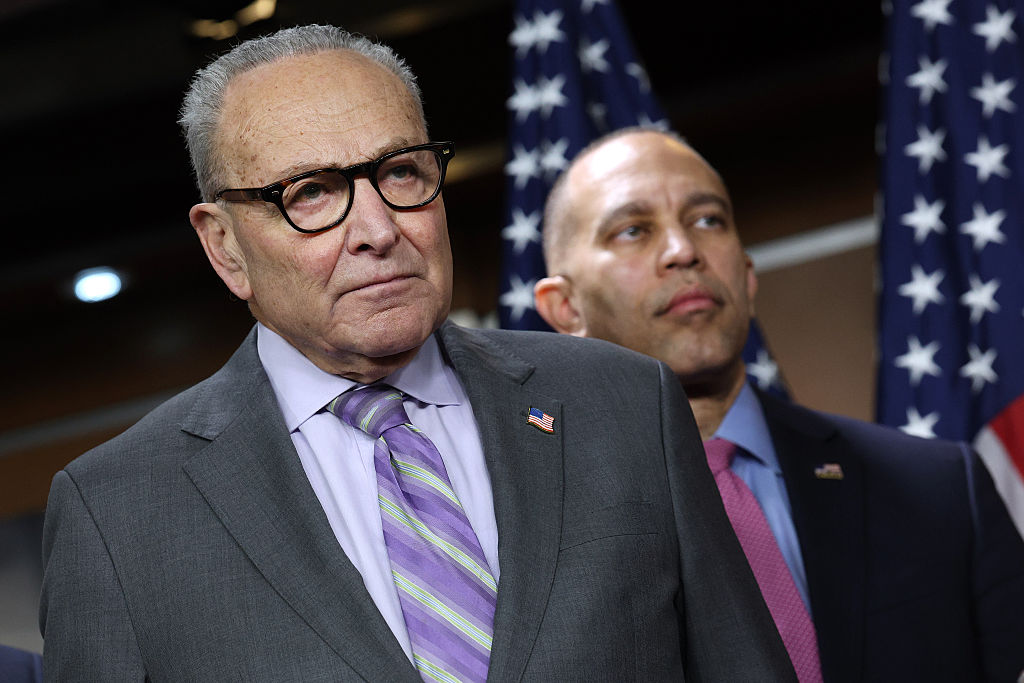
Senate Minority Leader Chuck Schumer (left) and House Minority Leader Hakeem Jeffries (right) attend a press conference on Department of Homeland Security (DHS) funding at the US Capitol on February 4, 2026, in Washington, DC.

A third party representing working-class Americans could be useful in working past Democratic Party dysfunction. Not to mention, there’s clearly an untapped appetite among voters for such a movement. (Kevin Dietsch / Getty Images)


Should we euthanize the Democratic Party?

It’s a question Les Leopold is pondering as he looks out upon the American political landscape. He doesn’t quite advocate a swift and complete death for party of the ass. But he is convinced that the party is no longer capable of advancing a working-class agenda.

A self-described third-party activist, Leopold refuses to fall in with the conventional — and convention-preserving — wisdom that, as he says in the book, “American history and the structure of our political system ensure that third parties will fail, always,” and that we need to “face up to these facts, and realize that reforming the Democrats is the only game in town. It’s not always pretty, and it’s not always pure, but fusion and putting up progressive challengers in Democratic primaries . . . are as good as it gets.”

The “fusion” he references is the practice — still allowed in a handful of states — by which two or more parties cross-nominate the same candidate. The Working Families Party (WFP) has built its model around it: by giving voters the option to back, say, Kamala Harris on the WFP line rather than the Democratic one, the party banks ballot access while signaling that part of the Democratic coalition wants something to the left of the Democratic brand.

Leopold applauds the WFP for its many achievements over the years, from successfully pushing for minimum wage hikes to mobilizing voters and helping progressive candidates, including Zohran Mamdani (who says he actually voted for himself on the WFP line). But he concludes that the party’s fusion model is absurdly limiting and forces an intramural game plan that, as one of its deputy directors admits, has basically “just required winning Democratic primaries.”

Which, when the dominant party is controlled by a centrist, donor-friendly coterie that looks after its own, will always be an uphill battle. That is, it’s possible for a fusion party to advance candidates sympathetic to their priorities but is intrinsically challenging, because it requires stellar candidates (witness Mamdani, who rode the WFP line to the New York City mayoralty) and/or unusual circumstances (witness Analilia Mejia, who benefited in New Jersey’s Eleventh Congressional District from an American Israel Public Affairs Committee–aligned super PAC spending heavily against her chief moderate rival, while machine Democrats split over whom to back).

The question that quickly emerges in Leopold’s The Billionaires Have Two PartiesWe Need a Party of Our Own is:

Should we struggle to reform the Democrats by finding progressive, charismatic leaders to bring the party back to the working class — or at least bring working people back to the party? Or do we go big and build a new party, because realistically reforming the Democratic Party is beyond hope?

The answer he delivers hinges on the fact that, after fifty years of stagnant wages, with half of us living paycheck to paycheck, with 42 million receiving food assistance, with a majority (55 percent) worried about getting laid off, and a wealth disparity that is even now exceeding what the nation knew in the last gilded age, “the Democratic brand is so tarnished that Democrats face a severe electoral penalty even before starting their campaigns.”

It turns out the party whose president was in office when the North American Free Trade Agreement (NAFTA) passed (even if it was, as he reminds us, the majority-Republican congress that was driving the bus), the party that has become “loaded with nonprofit leaders who are uniformly members of the professional class,” is suffering a perception penalty so severe that it is entirely persona non grata across vast swaths of the country.

In one study by the Center for Working-Class Politics (where I work as a researcher) and Leopold’s Labor Institute, in which populist messages were tested on Midwestern respondents, they identified an 11 to 16 percent penalty for candidates who run as Democrats versus as independents.

Voters hear the same message from a candidate facing off against a corporate-aligned Republican and the person does more than 10 points better if there’s an “I” rather than a “D” after their name.

Have we heard of any recent elections being decided by fewer than 11 percentage points?

A Long, Steady Decline

This situation didn’t arrive overnight. Leopold tracks the steady decline of the Democrats’ popularity over the decades, particularly with the working class, and delves into the reasons citizens are still falling away from the party.

Much of the book references this same innovative study he and his organization designed with the Center for Working-Class Politics and Rutgers University’s Labor Education Action Research Network (LEARN) and conducted with YouGov. The survey was conducted with three thousand demographically representative voters in the key battleground states of Ohio, Pennsylvania, Wisconsin, and Michigan. One of the key questions asked participants was, “In one sentence, what first comes to mind when you think of the Democratic Party?”

The sentences they delivered, in line with an October 2025 Pew poll, were about 70 percent negative. And the most common theme was that the party is “Ineffective/Weak/Spineless.”

However this situation came to be, Leopold argues that it is clearly not one that can be remedied by procedure-abiding internal party adjustments. Not, at least, if meaningful change is desired within a lifetime.

Leopold is convinced that a whole new model is required. And that we need to push back on those who continue to squelch all talk of third parties by shouting “Ralph Nader” at us like it’s still 2000, and that our silly pie-in-the-sky principles — more than other factors like Clinton’s legacy — were responsible for Al Gore’s loss to George W. Bush. Not when they have steered the party into a popularity ditch that’s more than three times deeper than the 2.74 percentage points they contend Nader stole from them.

As Leopold puts it, “There is no Democratic Party to spoil.”

Leopold, executive director and cofounder of the Labor Institute and author of the seminal biography of Tony MazzocchiThe Man Who Hated Work and Loved Labor, does not get to this stance without abundant empirical evidence.

He contends not only that a third party representing working-class Americans would be useful in working past Democratic Party dysfunction but also that there’s an untapped appetite for such a movement.

In Ohio, Pennsylvania, Wisconsin, and Michigan — again tapping his study with the Center for Working-Class Politics and Rutgers — he cites support for a hypothetical working-class party with a progressive platform coming in at 57 percent, with only 19 percent opposed and the rest not sure (which seems a reasonable response for respondents to offer given that they had not heard of this fantastical political entity until they took this survey). Clearly even the idea of such a party has appeal.

And not surprisingly, being a party with a working-class identity, it especially appeals to those Democrats who, if only because Republicans haven’t won their allegiance, are still registered with the party.

A New Party Platform

As to the platform’s details, twenty-five distinct policy ideas were tested across the political spectrum, from tariffs on foreign imports to cutting government regulation to wage and price limits to control inflation. They found that the following issues are almost universally winners:

● Capping prescription drug prices

● Eliminating taxes on Social Security (he points out that “this would favor high wage earners over low wage earners [though] respondents probably weren’t thinking about it that way”)

● Banning all members of Congress and their families from owning stock, with criminal penalties

● A federal jobs guarantee where, if the private sector can’t provide enough jobs, the government will guarantee stable work with a decent wage.

The last one, the federal jobs guarantee, was a bit of a surprise to Leopold given that trust in the federal government has plummeted from 77 percent in 1965 to only 22 percent today. But hopefully he, and we, can put that in the hopeful-signs category — an indication that people at least can envision a new and useful function for the federal government.

Leopold and his colleagues additionally found that 50 percent of rural Republicans and 77 percent (!) of beyond-the-’burbs Democrats would favor a viable new party option focused on working-class economic issues. Their point in focusing upon rural populations is presumably to get after the bleak reality that the current two-party system has created a GOP permafrost across vast portions of the country. For the past several cycles, much of rural America has become a frozen tundra that the Democrats — minding their budgets and their “Philadelphia suburbs” game plan — no longer even consider cultivating.

From a congressional perspective, Leopold points out that “132 [almost a third] of districts were won by Republicans in 2024, with a margin of at least 25 percentage points.”

Here Leopold dives in on the Dan Osborn situation in Nebraska. If you’re not familiar, Deb Fischer, the two-term Republican senator who had won both her prior elections with 57 percent or more of the vote, was viewed as such a lock in 2024 that the Dems didn’t even field a candidate against her.

But then Osborn — a Navy veteran, working pipefitter, and former local union president who had led a successful strike in 2021 — jumped into the race as an independent, explaining his lack of party affiliation by saying he was taking a stand against the “the two-party doom loop.”

Osborn didn’t win, but he did pull off the inconceivable: giving Fischer a run for her money and doing 14 points better against the Republican candidate than Kamala Harris managed against Donald Trump with the same Nebraskans.

And now, Osborn is back running against the state’s other incumbent GOP senator and is in an early dead heat in the polls (with half a year until the election), and with a significant edge in favorability ratings.

How is it that an independent candidate with economic populist, pro-labor politics can be competitive in ruby-red Nebraska without major party backing? By not being a Democrat, Leopold contends.

Leopold breaks down what worked for Osborn and generally gets into the issues and sentiments that a third party could learn from Osborn.

Leopold is younger than our two most recent presidents but betrays no interest in leading such a party himself. But for anybody (and it sounds like all of us should be) interested in doing the unthinkable — like trying something besides a donkey or an elephant to pull our cart down this nation’s wreckage-strewn two-lane highway — Leopold’s short, hopeful book is the place to start. He doesn’t pretend a working-class party will be easy to build. He just makes it harder to keep pretending the alternative — another cycle of progressive primary challenges inside a brand that voters tell us, again and again, they have already written off — is anything but a slower way of losing.