Why the Left Misreads Gen Z — and What the Right Sees Clearly
Leftists have celebrated the growing favorability of socialism among young people, but youth politics are more heterodox than they appear.
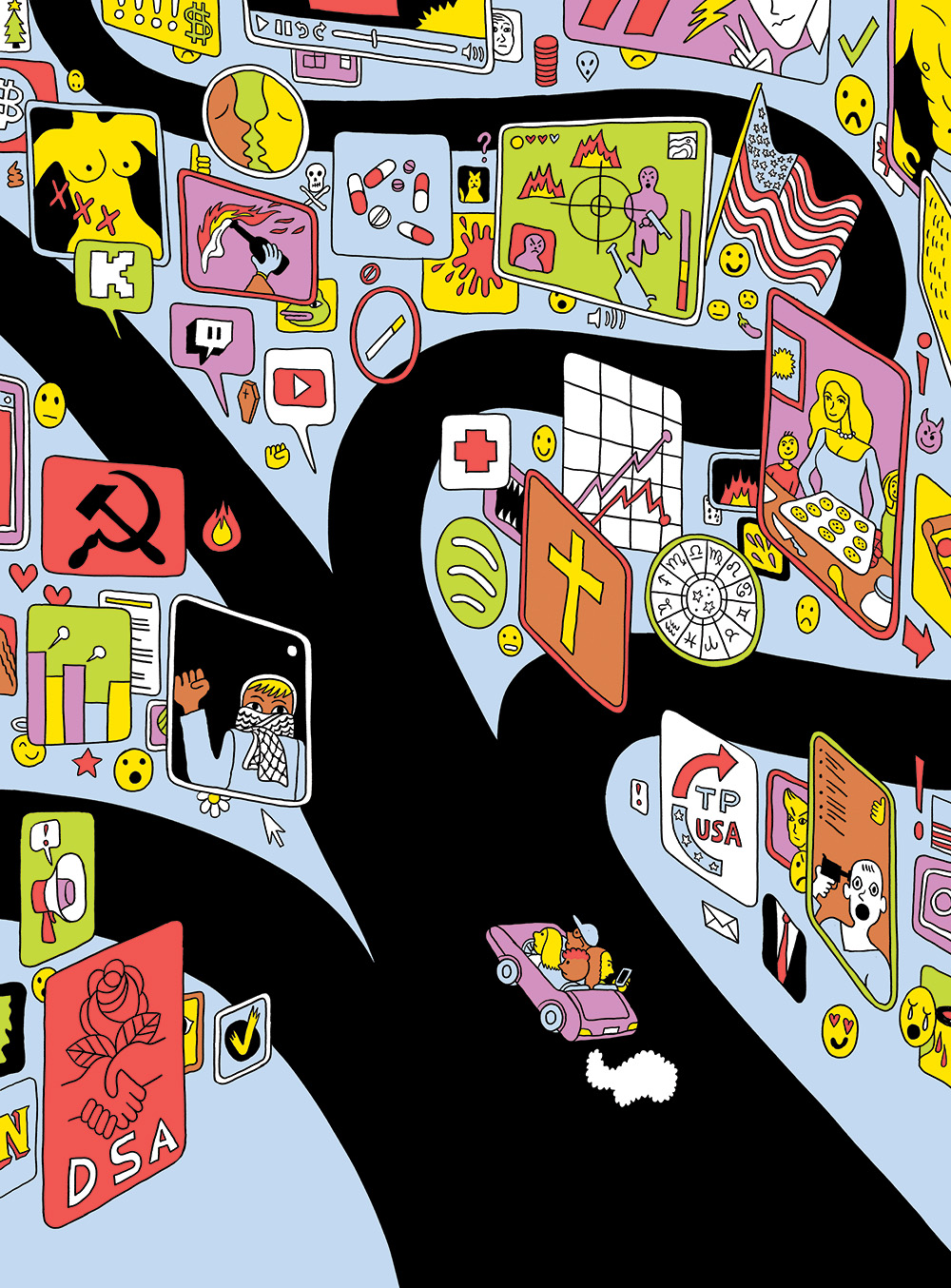
Illustration by Michael DeForge
Last July, as tens of thousands of volunteers for Zohran Mamdani’s campaign fanned out across New York’s five boroughs, long lines began forming outside one of Manhattan’s trendiest and most expensive grocery stores. A swirl of social media buzz quickly followed. What drew them there, despite the sweltering summer heat? A limited-time protein-powder soft serve created by Hannah Neeleman, the immensely popular tradwife influencer known online as Ballerina Farm, who has graced the cover of Evie, described as a “conservative Cosmo.”
The scene was striking: young women in one of America’s most liberal cities lining up to buy products from a figure whose brand centers on traditional gender roles and rural domesticity. The meeting of these two worlds might reinforce a narrative of opposing cultural and political divides: on the one hand, thousands of young organizers giving up their evenings and weekends to, door by door, build a movement for democratic socialism; and on the other, young women lining up for a $10 cup of soft serve branded by a right-leaning influencer.
But there’s more overlap between the two groups than you might expect, and it speaks volumes about the heterodox politics of Gen Z. Here politics and culture bleed into each other in ways not reflected by traditional partisan affiliation, with aesthetics sometimes carrying as much weight as policy. Ironic engagement with political figures can slide into genuine affection. The same generation that turned out in droves for Mamdani also propels tradwives, anti-vax wellness influencers, and Make America Healthy Again (MAHA) content creators to virality. Today a Democratic Socialists of America member freely shares Mormon influencer Nara Smith’s elaborate recipes without contradiction. A college-educated young woman follows a MAHA influencer’s endometriosis supplement routine while simultaneously maintaining a monthly donation to Planned Parenthood. Mapping this terrain requires abandoning the assumption that political identity must be internally consistent and that cultural consumption reliably predicts voting patterns. It also requires taking the material realities and grievances of this generation seriously.